
| 영문 | open heart surgery | 한글 | 개심술, 심장절개술 |
|---|---|---|---|
| 설명 | 심장의 한 개 또는 그 이상의 방실 절개하는 수술. 심방사이막결손증, 심실사이막결손증, 순수형 허파동맥판막협착증, 팔로(Fallot) 사징후 등이 적용이 된다. 이 수술을 위해서는 인공심폐장치가 필요하다. |
||
| 영문 | hypertensive heart disease | 한글 | 고혈압심장병 |
|---|---|---|---|
| 설명 | 고혈압에 의해서 생기는 심장병. 고혈압심장병이라는 진단을 붙이기 위해서는 최소한 다음과 같은 조건이 부합되어야 하는데, 첫째 심장혈관계에 심장병을 유발할 수 있을 만한 다른 병변이 없이 좌심실 비대가 있어야 하며, 둘째 고혈압을 앓았다는 병력이 있어야 한다. 주로 고혈압에 의한 심장병은 초기에는 좌심실이 비후라는 것으로 특징되어진다. 즉 혈압이 높으므로 혈액을 순환시키기 위해서는 그만큼 심장의 혈액을 보내는 힘이 좋아야 한다. 그 힘을 얻기위해서는 심근의 비후가 필요로 하여 좌심실 근육의 비후가 생긴다. 그리고 고혈압이 지속이 될 경우에는 결국 심장이 제 구실을 하지 못하고 펌프로서의 기능을 잃어버리게 되어 심장기능상실에 빠지게 된다. |
||
| 영문 | rheumatic heart disease | 한글 | 류마티스심장병 |
|---|---|---|---|
| 설명 | 사슬알균감염 후 생기는 심장판막병이다. 원인은 A군 -용혈사슬알에 의한 인두염후 일종의 면역반응으로 발병한다. 진단은 존의 기준에 의한다. (1) 주요기준은 관절염 심장염(심장비대, 심장잡음, 심장기능상실 등) 무도증: 무당이 춤을 추는 것 같은 행동의 발작증세. 연변홍반: 빨간 테두리를 가진 피부병변은 피하결절(subcutaneous nodule): 피부 밑에 생긴 결절, (2)참고 기준은 열, 관절통, EKG상 PR연장: 심전도 소견 급성기 반응물질(예: ESR, CRP)의 상승, 류마티스열 치료는 페니실린으로 치료하고 심장의 후유증 또한 페니실린으로 예방한다. |
||
| 영문 | congenital heart disease | 한글 | 선천심장병 |
|---|---|---|---|
| 설명 | 선천적으로 심장의 구조에 이상이 있는 병. |
||
| 영문 | heart | 한글 | 심장 |
|---|---|---|---|
| 설명 | 심장은 가슴의 중앙에 위치하며 오른쪽과 왼쪽반으로 나눌 수 있다. 각각은 정맥에서 피가 들어오는 방과 동맥으로 피를 내보내는 실이 있다. 심장은 정중앙선에서 왼쪽에 놓여 있다. 심장의 2개의 심방과 2개의 심실, 그리고 심방사이의 심방중격, 심실사이의 심실중격이 존재한다. 심실은 혈액을 주로 순환시키는 힘을 내는 곳으로 강한 근육층이 존재를 한다. 반면에 심방은 심실에 들어가기전에 일시적으로 피가 모이는 곳으로 근육층의 발달이 미약하다. 심방과 심실사이에 삼첨판과 승모판, 심실의 유출로에 대동맥판과 폐동맥판이 있다. 이것들은 혈액이 흐르는 방향에 거슬러 진행하는 것을 막는 기능을 한다. 그리고 심장에는 심장의 근육에 혈액을 공급하는 관상동맥이 있다. 이 심장동맥은 심장을 쌓듯이 존재한다. 심장박동의 신호는 특수한 장치에 의해서 발생이 되고 특수한 전도계를 통해서 전체의 심장으로 전도된다. 심장박동의 신호는 우선 우심방에 위치하는 동방결절(SA node)라는 곳에서 우선 생긴다. 여기에서 보내는 전기적 신호가 바로 심장을 뛰게하는 신호인 것이다. 이 신호로 말미암아 심방이 우선 수축을 한다. 그리고는 심방과 심실사이에 위치하는 방실결절(AV node)라는 곳에 일정하게 정해진 통로없이 전체의 심방을 통해서 전달이 되고 이 신호를 받은 방실결절(AV node)는 히스 다발(His bundle)과 심장전도근육섬유를 통해서 심실의 심장근육에게 이 신호를 보내주어 심실근육을 수축하게 한다. 히스다발과 심장전도근육섬유는 전체의 심실의 심근섬유에 동시에 전기적 신호를 보내어 줄 수 있게 하는 일종의 전기줄과 같은 역할을 한다. 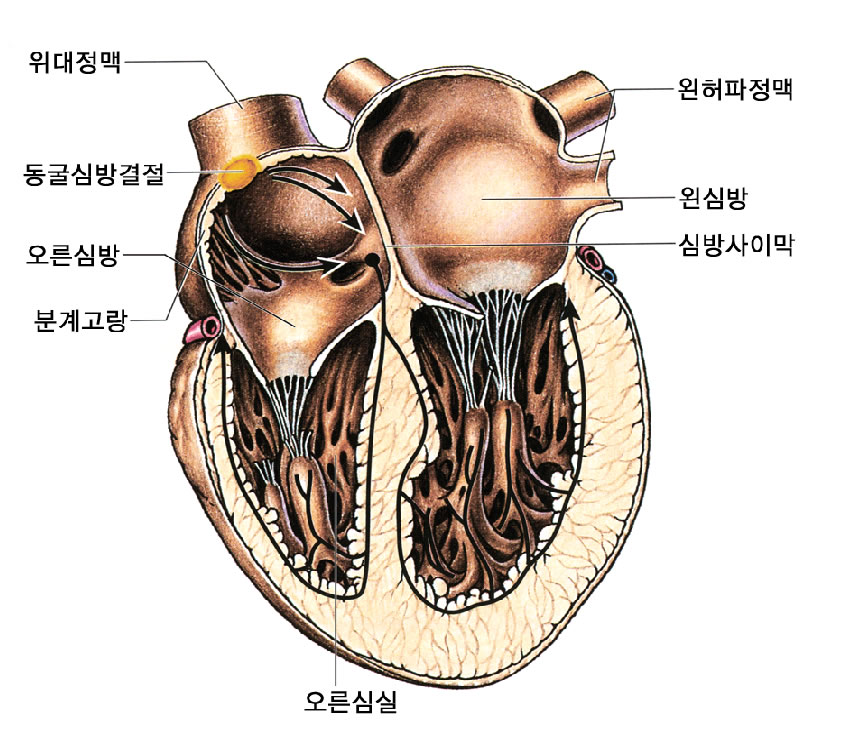 |
||
| CW | cardiac work; case work; cell wall; chemical warfare; chemical weapon; chest wall; children's ward; ... |
|---|---|
| PWC | peak work capacity; physical work capacity |
| IABP | Intra-Aortic Balloon Pump(Plasty) - Ix 1. Low Output Synd... |
| BAO | basal acid output; brachial artery output |
| BAO-MAO | basal acid output to maximal acid output [ratio] |
| EHW | External heart work |
|---|---|
| HW | heart work |
| BAO | Basal Acid Output |
| VCO(2) | CO(2) output |
| DSO | Daily sperm output |
| cardiac output | A measurement of the blood flow through the heart to the systemic (and pulmonary) circulation. Cardiac output is expressed as volume of blood per unit time or litres/minute. Cardiac output can be calculated using the Fick method (oxygen consumption divided by arteriovenous oxygen difference) or by the thermodilution technique, using a Swan-Ganz catheter. (27 Sep 1997) |
|---|---|
| cardiac output, high | A state of elevated cardiac output. Conditions that lower peripheral vascular resistance, such as anaemia, arteriovenous fistulas, thyrotoxicosis, and pregnancy, are among the most important factors augmenting the venous return and therefore elevating cardiac output. Increased cardiac output also occurs in muscular exercise, fever, and severe anoxia. (12 Dec 1998) |
| cardiac output, low | A state of subnormal or depressed cardiac output, usually seen in patients with heart failure secondary to coronary artery, hypertensive, primary myocardial, valvular, or pericardial disease. (12 Dec 1998) |
| pacemaker output | Electrical energy delivered into a standard load (500 ohms resistance). (05 Mar 2000) |
| minute output | A measurement of the blood flow through the heart to the systemic (and pulmonary) circulation. Cardiac output is expressed as volume of blood per unit time or litres/minute. Cardiac output can be calculated using the Fick method (oxygen consumption divided by arteriovenous oxygen difference) or by the thermodilution technique, using a Swan-Ganz catheter. (27 Sep 1997) |
| high output failure | Heart failure in which, despite relative myocardial insufficiency and consequent congestive heart failure, the cardiac output is maintained at normal or supernormal levels, as is sometimes seen in emphysema, thyrotoxicosis, etc. (05 Mar 2000) |
| stroke output | <physiology> The amount of blood pumped out of one ventricle of the heart as the result of a single contraction. A measure of the effectiveness of ventricular contraction. (16 Dec 1997) |
| output | 1. The amount of coal or ore put out from one or more mines, or the quantity of material produced by, or turned out from, one or more furnaces or mills, in a given time. 2. <physiology> That which is thrown out as products of the metabolic activity of the body; the egesta other than the faeces. See Income. The output consists of: (a) The respiratory products of the lungs, skin, and alimentary canal, consisting chiefly of carbonic acid and water with small quantities of hydrogen and carbureted hydrogen. (b) Perspiration, consisting chiefly of water and salts. (c) The urine, which is assumed to contain all the nitrogen truly excreted by the body, besides a large quantity of saline matters and water. Source: Websters Dictionary (01 Mar 1998) |
| environmental output | Environmental outputs are the desired or anticipated measurable products or results of restoration measures and plans. (09 Oct 1997) |
| low output failure | Heart failure in which the cardiac output is subnormal, as is usually seen in failure due to coronary, hypertensive, or valvular heart disease. (05 Mar 2000) |
| relief work | Assistance, such as money, food, or shelter, given to the needy, aged, or victims of disaster. It is usually granted on a temporary basis. (12 Dec 1998) |
| rescue work | Activities devoted to freeing persons or animals from danger to life or well-being in accidents, fires, bombings, floods, earthquakes, other disasters and life-threatening conditions. While usually performed by team efforts, rescue work is not restricted to organised services. (12 Dec 1998) |
| work | <chemistry> Energy transferred by mechanical means, force acting over a distance. For chemical systems the sign for work is positive, if work is done on the system and negative, if work is done by the system. An example is the expansion of a gas against the external, atmospheric pressure. In this case work is negative, because it is done by the gas which represents the system. (09 Jan 1998) |
| work capacity evaluation | Assessment of physiological capacities in relation to job requirements. It is usually done by measuring certain physiological (e.g., circulatory and respiratory) variables during a gradually increasing workload until specific limitations occur with respect to those variables. (12 Dec 1998) |
| work of breathing | Respiratory muscle contraction during inspiration. The work is accomplished in three phases: that required to expand the lungs against its elastic forces (lung compliance work), that required to overcome the viscosity of the lung and chest wall structures (tissue resistance work), and that required to overcome airway resistance during the movement of air into the lungs (airway resistance work). Work of breaking does not refer to expiration, which is entirely a passive process caused by elastic recoil of the lung and chest cage. (guyton, textbook of medical physiology, 8th ed, p406) (12 Dec 1998) |
제품명 |
판매사 |
보험코드 | 성분/함량 | 구분/보험급여 |
|---|
제품명 |
판매사 |
보험코드 | 성분/함량 | 구분/보험급여 |
|---|