
| 영문 | adenoma | 한글 | 샘종 |
|---|---|---|---|
| 설명 | 분비샘의 세포에서 기원하는 전이(다른 조직으로 직접 또는 혈액이나 림프를 따라 펴져나가는 것)되지 않는 종양, 또는 상피세포의 종양 중에서 분비샘의 모양을 이루는 양성(전이되지 않는) 종양. |
||
| 영문 | muscle cell(=muscle fiber) | 한글 | 근육세포 |
|---|---|---|---|
| 설명 | 근육은 수의근(의식에 의해서 조절이 가능한 근육: 예를 들어 다리, 팔, 얼굴근육 등)과 불수의근(의식과 무관하게 조절하지 않아도 움직이는 근육: 예를 들어 심장근, 소화기관에 분포하는 근육 등)으로 나누어지며, 근육세포의 모양은 다음과 같다(수의근, 불수의근 외에 심장에 있는 심장근은 불수의근에 해당하지만 그 모양은 수의근과 같아 따로 분류한다).  |
||
| 영문 | white blood cell(WBC), leukocyte | 한글 | 백혈구 |
|---|---|---|---|
| 설명 | 혈액내에 골수구계세포와 림프계세포, 단핵구계세포를 모두 통틀어 말한다. 백혈구의 증가가 있으면 대개 감염이 있거나, 혹은 탈수현상이 있음을 의미한다. 또한 지나친 백혈구수의 감소는 인체내 면역기능이 떨어져 있음을 의미하며, 다른 질병에 의해 나타나는 이차적인 현상이 아닌지 꼭 진단을 받아보아야 한다. |
||
| 영문 | mast cell | 한글 | 비만 세포 |
|---|---|---|---|
| 설명 | 동물의 결합 조직 가운데 널리 분포하는 세포. 결합조직과 점막조직 내에 있는 호염기성 색소로 이염색성(metachromasia)을 나타내는 과립을 가진 방추형의 세포에 작은 둥근 핵을 가진다. 비만세포의 표면에는 IgE에 대한 수용체가 존재하며, 수용체에 결합한 IgE 분자들끼리 다가의 항원에 의해 서로 연결되면 비만세포 과립탈출 반응이 일어나, 히스타민, 세로토닌, 헤파린 등의 화학전달 물질이 방출되어, 즉시형 알레르기 반응 등의 증상을 일으킨다. 피부, 장막, 혈관 주위, 점막 주변에 있다. |
||
| 영문 | cell | 한글 | 세포 |
|---|---|---|---|
| 설명 | 생명체를 이루는 구조적, 기능적 단위. 핵의 유무에 따라서 유핵세포와 무핵세포로 나눌 수가 있다. 무핵세포란 핵이 없는 세포를 말한다. 핵이란 유전정보를 가지고 있는 염색체를 보관하는 곳인데 무핵세포에서는 염색체가 세포속에 그냥 노출되어 있다. 대개 세포 하나하나가 독립된 생명체의 역할을 하는 단세포생물로서 외부환경으로부터 자신을 보호할 수 있는 견고한 세포벽을 가지고 있다. 유핵세포란 핵을 가지고 있어서 유전정보가 있는 염색체가 세포의 다른 부분과 구분되어 핵속에 들어있다. 세포속에서 핵외의 부분(이를 세포질이라 한다)에는 여러 가지 세포의 소기관이 있어서 세포의 다양한 기능을 분담한다. ◈유핵세포의 기본 구조 1.세포막-세포를 둘러싸서 주위환경과 분리하여 세포의 내환경을 유지한다. 2.형질내세망(endoplasmic reticulum)-단위막으로 둘러쌓여 있는 불규칙한 망상구조이다. 이 망상구조의 내부를 소강, 소조라고 부른다. 여기에는 표면이 매끈한 무과립형질내세망과 표면이 불규칙한 과립형질내세망의 두 가지가 있다. 과립형질내세망의 경우는 표면에 단백질을 합성하는 리보솜이라는 것이 부착되어 있다. 이곳은 주로 세포밖으로 분비할 단백질을 합성하는 장소이다. 무과립형질내세망은 표면에 리보솜이 부착되어 있지 않은 것을 말하며, 이곳에서는 주로 해독작용, 글리코겐의 합성, 스테로이드호르몬의 합성 등이 일어난다. 3.리보솜-단백질을 합성하는 역할을 하는 곳이다.이것은 세포질에 존재하는 자유리보솜과 과립형질내세망에 부착이 되어 존재하는 부착리보솜의 두 가지로 나눈다. 자유리보솜은 주로 세포내에서 필요한 단백질을 만드는 역할을 하고 부착리보솜은 세포밖으로 분비할 단백질을 만드는 역할을 한다. 4.골지장치(Golgi apparatus)-핵주위에 분포하는 납작해진 주머니모양의 것이 중첩되어 형성된 층판 모양의 구조물로 과립형질내세망에서 생성되어 외부로 분비될 단백질을 모아서 농축, 포장하여 과립을 만드는 역할을 한다. 5.사립체(mitochondria)-구형, 난형의 긴 막대기 모양으로 크기가 다양한 구조물. 생물체의 에너지 저장물질인 ATP를 생산하는 역할을 한다. 또 세포와 다른 자신만의 유전정보를 가진 DNA, RNA를 가지고 있다. 모양, 크기가 세균과 비슷하며 자체증식성 등 독립된 생명체로서 필요한 요건을 갖추고 있어서 세포와 공생관계를 가진 독립된 세포로 생각하고 있다. 6.용해소체(lysosome)-작은 구형의 소체로 여러 가지 분해효소를 가진다. 세포외계에서 들어온 물질과 결합하여 그 물질들을 용해하는 역할을 하고, 오래된 세포소기관들을 제거하는 역할도 한다. 7.세포핵(nucleus)-구형, 난형으로 세포의 중심에 위치한다. 핵내에는 유전정보가 있는 물질인 염색체가 존재한다. 8.중심소체(centrosome)-핵주위에 존재하면서 핵의 분열시에 양쪽의 염색체를 당기는 작은 섬유를 만드는 역할을 하는 곳. 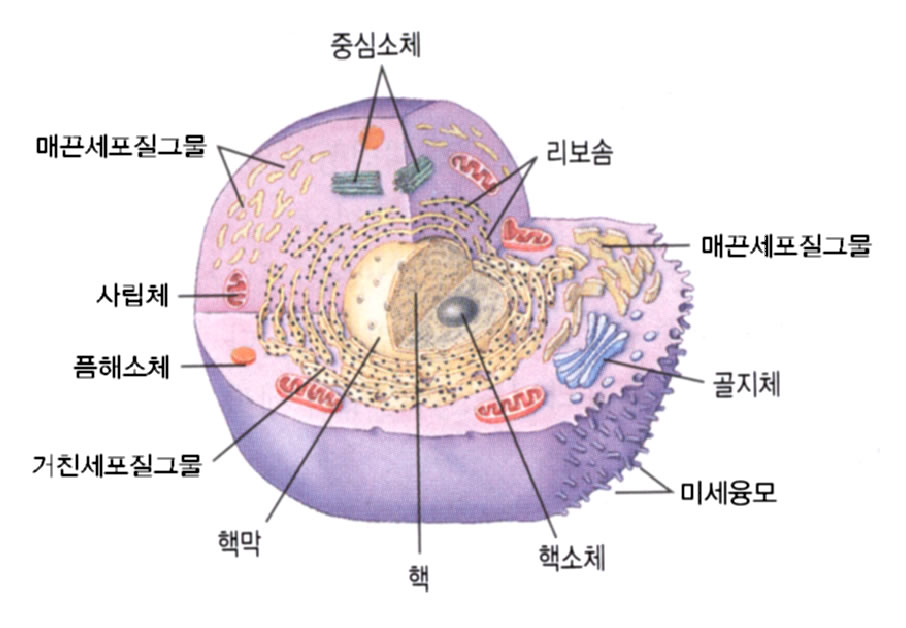 |
||
| MEN | Multiple Endocrine Neoplasia ; AD Trait 1. MEN Type I(= Wermer Syndro... |
|---|---|
| AML | Acute Myelogenous Leukemia Morphologic Classification(FAB분류) &n... |
| MC | mass casualties; mast cell; Master of Surgery [Lat. Magister Chirurgiae]; maximum concentration; Med... |
| HCA | heart cell aggregate; hepatocellular adenoma; home care aide; Hospital Corporation of America; hydro... |
| UBL | undifferentiated B-cell lymphoma |
| SCUC | small cell undifferentiated carcinoma |
|---|---|
| AUL | Acute undifferentiated leukemia |
| UCTD | Undifferentiated Connective Tissue Disease |
| UCNT | Undifferentiated carcinoma of nasopharyngeal type |
| UC | undifferentiated carcinoma |
| undifferentiated cell adenoma | <tumour> An adenoma of the hypophysis composed of cells for which there is no overt evidence or hormone production, but which usually produces hypopituitarism and visual disturbances by compression of adjacent structures; approximately one third of these tumours have cells with abundant mitochondria (oncocytes) that are somewhat larger than the monocytic null cells. Synonym: undifferentiated cell adenoma. (05 Mar 2000) |
|---|
| undifferentiated cell | A primitive cell that has not assumed the morphologic and functional characteristics it will later acquire. (05 Mar 2000) |
|---|---|
| undifferentiated | <embryology, pathology> An immature, embryonic or primitive cell. It has a non-specific appearance with multiple non-specific activities and functions poorly. See: differentiate, dedifferentiate. (16 Dec 1997) |
| undifferentiated abdominal malignancy | <radiology> Large soft-tissue masses, multiple linear or nodular calcific densities, can coalesce to form conglomerate masses (12 Dec 1998) |
| undifferentiated sarcoma of liver | <radiology> Kiddies, age 4 - 15 yrs, M = F, complex hepatic mass, often hypovascular, most in right lobe, large ( more than 10 cm), ** Differential diagnosis: embryonal rhabdomyosarcoma (12 Dec 1998) |
| undifferentiated type fever | A term applied to illnesses resulting from infection by any one of the arboviruses pathogenic for man, in which the only constant manifestation is fever; rash, lymphadenopathy, or arthralgia (alone or in combination) may occur in some individuals but not in others; some arboviruses may induce infections in which undifferentiated type fever is the only manifestation, whereas other arboviruses may induce in some persons only undifferentiated fever, and in other persons similar fever followed by secondary manifestations, e.g., a haemorrhagic fever or encephalitis. (05 Mar 2000) |
| lymphoma, undifferentiated | A form of lymphoma in which relatively large stem cells with large nuclei, pale, scanty cytoplasm, and indistinct borders are predominant. The cells are undifferentiated, i.e., show no morphologic evidence of maturation toward lymphocytes or histiocytes. (12 Dec 1998) |
| adenoma, islet cell | A benign tumour of the islets of langerhans that may occur anywhere throughout the pancreas. Such tumours may result in hyperinsulinism or zollinger-ellison syndrome. (12 Dec 1998) |
| adenoma, liver cell | A benign epithelial tumour of the liver. (12 Dec 1998) |
| basal cell adenoma | <tumour> A benign tumour of major or minor salivary glands or other organs composed of small cells showing peripheral palisading. (05 Mar 2000) |
| Hurthle cell adenoma | <tumour> An uncommon type of thyroid tumour characterised by abundant eosinophilic cytoplasm containing numerous mitochondria. Often malignant with widespread metastases; rarely takes up radioiodine. See: Hurthle cell tumour. (05 Mar 2000) |
| null-cell adenoma | <tumour> An adenoma of the hypophysis composed of cells for which there is no overt evidence or hormone production, but which usually produces hypopituitarism and visual disturbances by compression of adjacent structures; approximately one third of these tumours have cells with abundant mitochondria (oncocytes) that are somewhat larger than the monocytic null cells. Synonym: undifferentiated cell adenoma. (05 Mar 2000) |
| islet cell adenoma | <tumour> A benign neoplasm of the pancreas composed of tissue similar in structure to that of the islets of Langerhans; it may contain functioning beta cells, and may cause hypoglycaemia. See: insulinoma. Synonym: nesidioblastoma. (05 Mar 2000) |
| Leydig cell adenoma | <tumour> A small benign tumours of the testis that often produce testosterone, causing endocrine symptoms. Synonym: interstitial cell tumour of testis. (05 Mar 2000) |
| acidophil adenoma | <endocrinology, oncology, tumour> A benign tumour, usually found in the anterior lobe of the pituitary gland, whose cells stain with acid dyes. Such pituitary tumours may give rise to excessive secretion of growth hormone, resulting in gigantism or acromegaly. A specific type of acidophil adenoma may give rise to nonpuerperal galactorrhoea. (25 Jun 1999) |
| ACTH-producing adenoma | <tumour> A pituitary tumour composed of corticotrophs that produce ACTH, often a basophilic adenoma; may give rise to Cushing's disease or Nelson's syndrome. (05 Mar 2000) |
제품명 |
판매사 |
보험코드 | 성분/함량 | 구분/보험급여 |
|---|
제품명 |
판매사 |
보험코드 | 성분/함량 | 구분/보험급여 |
|---|