
| 영문 | muscle cell(=muscle fiber) | 한글 | 근육세포 |
|---|---|---|---|
| 설명 | 근육은 수의근(의식에 의해서 조절이 가능한 근육: 예를 들어 다리, 팔, 얼굴근육 등)과 불수의근(의식과 무관하게 조절하지 않아도 움직이는 근육: 예를 들어 심장근, 소화기관에 분포하는 근육 등)으로 나누어지며, 근육세포의 모양은 다음과 같다(수의근, 불수의근 외에 심장에 있는 심장근은 불수의근에 해당하지만 그 모양은 수의근과 같아 따로 분류한다).  |
||
| 영문 | white blood cell(WBC), leukocyte | 한글 | 백혈구 |
|---|---|---|---|
| 설명 | 혈액내에 골수구계세포와 림프계세포, 단핵구계세포를 모두 통틀어 말한다. 백혈구의 증가가 있으면 대개 감염이 있거나, 혹은 탈수현상이 있음을 의미한다. 또한 지나친 백혈구수의 감소는 인체내 면역기능이 떨어져 있음을 의미하며, 다른 질병에 의해 나타나는 이차적인 현상이 아닌지 꼭 진단을 받아보아야 한다. |
||
| 영문 | mast cell | 한글 | 비만 세포 |
|---|---|---|---|
| 설명 | 동물의 결합 조직 가운데 널리 분포하는 세포. 결합조직과 점막조직 내에 있는 호염기성 색소로 이염색성(metachromasia)을 나타내는 과립을 가진 방추형의 세포에 작은 둥근 핵을 가진다. 비만세포의 표면에는 IgE에 대한 수용체가 존재하며, 수용체에 결합한 IgE 분자들끼리 다가의 항원에 의해 서로 연결되면 비만세포 과립탈출 반응이 일어나, 히스타민, 세로토닌, 헤파린 등의 화학전달 물질이 방출되어, 즉시형 알레르기 반응 등의 증상을 일으킨다. 피부, 장막, 혈관 주위, 점막 주변에 있다. |
||
| 영문 | cell | 한글 | 세포 |
|---|---|---|---|
| 설명 | 생명체를 이루는 구조적, 기능적 단위. 핵의 유무에 따라서 유핵세포와 무핵세포로 나눌 수가 있다. 무핵세포란 핵이 없는 세포를 말한다. 핵이란 유전정보를 가지고 있는 염색체를 보관하는 곳인데 무핵세포에서는 염색체가 세포속에 그냥 노출되어 있다. 대개 세포 하나하나가 독립된 생명체의 역할을 하는 단세포생물로서 외부환경으로부터 자신을 보호할 수 있는 견고한 세포벽을 가지고 있다. 유핵세포란 핵을 가지고 있어서 유전정보가 있는 염색체가 세포의 다른 부분과 구분되어 핵속에 들어있다. 세포속에서 핵외의 부분(이를 세포질이라 한다)에는 여러 가지 세포의 소기관이 있어서 세포의 다양한 기능을 분담한다. ◈유핵세포의 기본 구조 1.세포막-세포를 둘러싸서 주위환경과 분리하여 세포의 내환경을 유지한다. 2.형질내세망(endoplasmic reticulum)-단위막으로 둘러쌓여 있는 불규칙한 망상구조이다. 이 망상구조의 내부를 소강, 소조라고 부른다. 여기에는 표면이 매끈한 무과립형질내세망과 표면이 불규칙한 과립형질내세망의 두 가지가 있다. 과립형질내세망의 경우는 표면에 단백질을 합성하는 리보솜이라는 것이 부착되어 있다. 이곳은 주로 세포밖으로 분비할 단백질을 합성하는 장소이다. 무과립형질내세망은 표면에 리보솜이 부착되어 있지 않은 것을 말하며, 이곳에서는 주로 해독작용, 글리코겐의 합성, 스테로이드호르몬의 합성 등이 일어난다. 3.리보솜-단백질을 합성하는 역할을 하는 곳이다.이것은 세포질에 존재하는 자유리보솜과 과립형질내세망에 부착이 되어 존재하는 부착리보솜의 두 가지로 나눈다. 자유리보솜은 주로 세포내에서 필요한 단백질을 만드는 역할을 하고 부착리보솜은 세포밖으로 분비할 단백질을 만드는 역할을 한다. 4.골지장치(Golgi apparatus)-핵주위에 분포하는 납작해진 주머니모양의 것이 중첩되어 형성된 층판 모양의 구조물로 과립형질내세망에서 생성되어 외부로 분비될 단백질을 모아서 농축, 포장하여 과립을 만드는 역할을 한다. 5.사립체(mitochondria)-구형, 난형의 긴 막대기 모양으로 크기가 다양한 구조물. 생물체의 에너지 저장물질인 ATP를 생산하는 역할을 한다. 또 세포와 다른 자신만의 유전정보를 가진 DNA, RNA를 가지고 있다. 모양, 크기가 세균과 비슷하며 자체증식성 등 독립된 생명체로서 필요한 요건을 갖추고 있어서 세포와 공생관계를 가진 독립된 세포로 생각하고 있다. 6.용해소체(lysosome)-작은 구형의 소체로 여러 가지 분해효소를 가진다. 세포외계에서 들어온 물질과 결합하여 그 물질들을 용해하는 역할을 하고, 오래된 세포소기관들을 제거하는 역할도 한다. 7.세포핵(nucleus)-구형, 난형으로 세포의 중심에 위치한다. 핵내에는 유전정보가 있는 물질인 염색체가 존재한다. 8.중심소체(centrosome)-핵주위에 존재하면서 핵의 분열시에 양쪽의 염색체를 당기는 작은 섬유를 만드는 역할을 하는 곳. 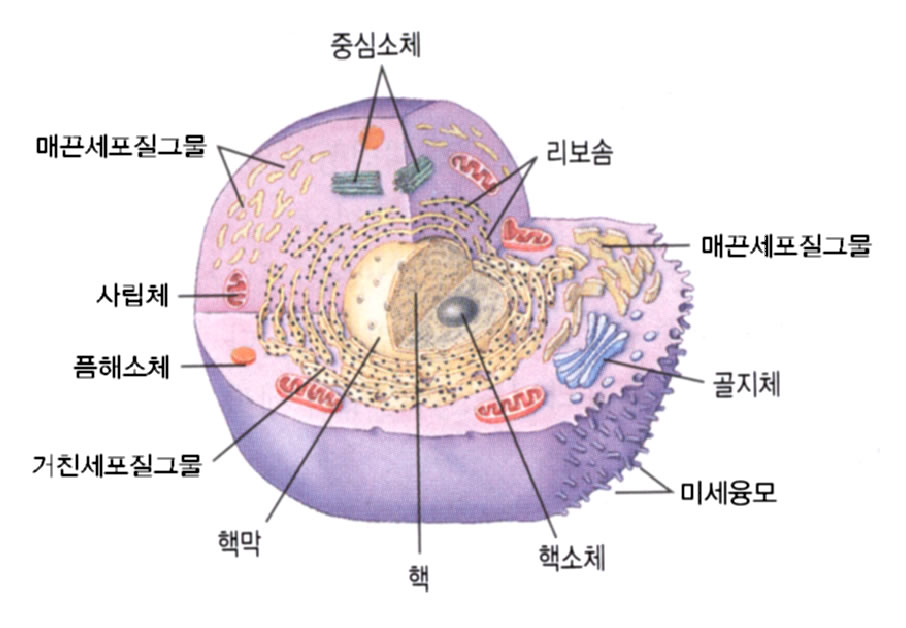 |
||
| 영문 | cell-mediated immunity | 한글 | 세포매개면역 |
|---|---|---|---|
| 설명 | 면역이란 신체를 외부의 물질로부터 보호하는 행위를 말한다. 여기에는 특이적 면역과 비특이적 면역의 두 가지가 있다. 비특이적 면역이라함은 특정한 물질에 관계하는 면역이 아니라 특정 대상이 없이 모든 외부 물체에 작용할 수 있는 면역을 말한다. 여기에는 소변의 흐름, 눈물의 흐름, 피부의 비투과성 등의 기계적인 것도 포함되고 피속에 돌아다니는 세포 중에서 비특이적으로 외부의 물질을 포식하는 세포들(예를 들면 큰포식세포(macrophage)의 활동도 포함이 된다. 세포매개면역이란 특이한 물질을 감지할 수 있는 세포를 생성하게 하여 그것으로 하여금 그 물질을 포식하게 하는 것을 말한다. |
||
| MC | mass casualties; mast cell; Master of Surgery [Lat. Magister Chirurgiae]; maximum concentration; Med... |
|---|---|
| ACC | accommodation; acetyl coenzyme A carboxylase; acinic cell carcinoma; acute care center; adenoid cyst... |
| GC | ganglion cell; gas chromatography; general circulation; general closure; general condition; generali... |
| ADCC cell | Antibody Dependent Cellular(= Cell-Mediated) Cytotoxicity cell |
| HCG, hCG | Human Chorionic Gonadotropin; 사람융모성성선자극호르몬 1. Placental Glycoprotein Hormone &nbs... |
| GCT | Granular Cell Tumour |
|---|---|
| TNF alpha | Anti-tumour necrosis factor alpha |
| BTB | Blood-Tumour-Barrier |
| BMRTC | Bone metastasising renal tumour of childhood |
| EATC | Ehrlich Ascites tumour cells |
| tumour cell | <oncology> Cell derived from a tumour in an animal. Refers to a tumour causing malignant cell and not an adventitious normal cell. Loosely, a transformed cell able to give rise to tumours. (18 Nov 1997) |
|---|---|
| tumour cells, cultured | Cells grown in vitro from neoplastic tissue for use in studying the proliferative and metabolic capacities of tumour cells, in predicting clinical responses to chemotherapy, in screening new antitumour agents, and in basic biological research. They include carcinoma cell lines. (12 Dec 1998) |
| acinar cell tumour | A solid and cystic tumour of the pancreas, occurring in young women; tumour cells contain zymogen granules. (05 Mar 2000) |
|---|---|
| malignant giant cell tumour | A type of bone tumour. (12 Dec 1998) |
| germ cell tumour | A type of brain tumour. (12 Dec 1998) |
| giant cell tumour | <radiology> Osteoclastoma, GCT, any age, typically 20-35, site: metaphysis into epiphysis, 50% at knee (distal femur, proximal tibia), long bones, patella, spine, eccentric, expansile, with or without soap bubble appearance, treatment: curette, fill with methacrylate, 10% recur, a few are premalignant or malignant, cannot determine malignancy by XR (12 Dec 1998) |
| giant cell tumour of bone | A bone tumour composed of cellular spindle-cell stroma containing scattered multinucleated giant cells resembling osteoclasts. The tumours range from benign to frankly malignant lesions. The tumour occurs most frequently in an end of a long tubular bone in young adults. (12 Dec 1998) |
| giant cell tumour of tendon sheath | A nodule, possibly inflammatory in nature, arising commonly from the flexor sheath of the fingers and thumb; composed of fibrous tissue, lipid-and haemosiderin-containing macrophages, and multinucleated giant cells. Synonym: localised nodular tenosynovitis. (05 Mar 2000) |
| Merkel cell tumour | A rare malignant cutaneous tumour seen in sun-exposed skin of elderly patients composed of dermal nodules of small round cells with scanty cytoplasm in a trabecular pattern; the tumour cells contain cytoplasmic dense core granules resembling neurosecretory granules seen in Merkel cells. Synonym: primary neuroendocrine carcinoma of the skin, trabecular carcinoma. (05 Mar 2000) |
| granular cell tumour | Unusual tumour affecting any site of the body, but most often encountered in the head and neck. Considerable debate has surrounded the histogenesis of this neoplasm; however, it is considered to be a myoblastoma of, usually, a benign nature. It affects women more often than men. When it develops beneath the epidermis or mucous membrane, it can lead to proliferation of the squamous cells and mimic squamous cell carcinoma. (12 Dec 1998) |
| granulosa cell tumour | An ovarian tumour originating in the cells of the primordial membrana granulosa of the graafian follicle. It may be associated with excessive production of estrin, inducing endometrial hyperplasia with menorrhagia. It can be benign or malignant. It is soft, solid, white or yellow, and consists of small round cells sometimes enclosing call-exner bodies. Larger lipid-containing cells may be present. Granulosa cell tumours are seen in women of all ages. Treatment depends on the age of the patient and the extent of the disease. (12 Dec 1998) |
| hilar cell tumour of ovary | A small benign masculinizing ovarian tumour derived from hilar cells, which resemble Leydig cells of the testis. (05 Mar 2000) |
| Hurthle cell tumour | A neoplasm of the thyroid gland composed of polyhedral acidophilic cells, thought by some to be oncocytes; it may be benign or malignant, the behaviour of the latter depending on the general microscopic pattern, whether follicular, papillary, or undifferentiated. See: Hurthle cell adenoma. Synonym: Hurthle cell carcinoma. (05 Mar 2000) |
| sertoli cell tumour | A rare benign tumour of the testis that histologically resembles the foetal testis. There are three varieties: diffuse stromal, mixed (stromal and epithelial), and tubular (epithelial). Sertoli cells in the epithelial elements may produce oestrogen and cause feminization. (12 Dec 1998) |
| sertoli-leydig cell tumour | An ovarian tumour usually of low-grade malignancy occurring most frequently in the third and fourth decades, with 75% seen in women under 40. It is rare, representing less than .02% of ovarian cancers. The tumour typically produces androgens with virilization being noted in 70-85% of the patients. (holland et al., cancer medicine, 3d ed, p1684) (12 Dec 1998) |
| interstitial cell tumour of testis | <tumour> A small benign tumours of the testis that often produce testosterone, causing endocrine symptoms. Synonym: interstitial cell tumour of testis. (05 Mar 2000) |
| ovarian granulosa-theca cell tumour | <radiology> Any age, most benign, oestrogens may lead to isosexual precocious puberty (pathognomonic), large tumour with areas of cystic degeneration (12 Dec 1998) |
제품명 |
판매사 |
보험코드 | 성분/함량 | 구분/보험급여 |
|---|
제품명 |
판매사 |
보험코드 | 성분/함량 | 구분/보험급여 |
|---|