
| 영문 | open heart surgery | 한글 | 개심술, 심장절개술 |
|---|---|---|---|
| 설명 | 심장의 한 개 또는 그 이상의 방실 절개하는 수술. 심방사이막결손증, 심실사이막결손증, 순수형 허파동맥판막협착증, 팔로(Fallot) 사징후 등이 적용이 된다. 이 수술을 위해서는 인공심폐장치가 필요하다. |
||
| 영문 | hypertensive heart disease | 한글 | 고혈압심장병 |
|---|---|---|---|
| 설명 | 고혈압에 의해서 생기는 심장병. 고혈압심장병이라는 진단을 붙이기 위해서는 최소한 다음과 같은 조건이 부합되어야 하는데, 첫째 심장혈관계에 심장병을 유발할 수 있을 만한 다른 병변이 없이 좌심실 비대가 있어야 하며, 둘째 고혈압을 앓았다는 병력이 있어야 한다. 주로 고혈압에 의한 심장병은 초기에는 좌심실이 비후라는 것으로 특징되어진다. 즉 혈압이 높으므로 혈액을 순환시키기 위해서는 그만큼 심장의 혈액을 보내는 힘이 좋아야 한다. 그 힘을 얻기위해서는 심근의 비후가 필요로 하여 좌심실 근육의 비후가 생긴다. 그리고 고혈압이 지속이 될 경우에는 결국 심장이 제 구실을 하지 못하고 펌프로서의 기능을 잃어버리게 되어 심장기능상실에 빠지게 된다. |
||
| 영문 | rheumatic heart disease | 한글 | 류마티스심장병 |
|---|---|---|---|
| 설명 | 사슬알균감염 후 생기는 심장판막병이다. 원인은 A군 -용혈사슬알에 의한 인두염후 일종의 면역반응으로 발병한다. 진단은 존의 기준에 의한다. (1) 주요기준은 관절염 심장염(심장비대, 심장잡음, 심장기능상실 등) 무도증: 무당이 춤을 추는 것 같은 행동의 발작증세. 연변홍반: 빨간 테두리를 가진 피부병변은 피하결절(subcutaneous nodule): 피부 밑에 생긴 결절, (2)참고 기준은 열, 관절통, EKG상 PR연장: 심전도 소견 급성기 반응물질(예: ESR, CRP)의 상승, 류마티스열 치료는 페니실린으로 치료하고 심장의 후유증 또한 페니실린으로 예방한다. |
||
| 영문 | congenital heart disease | 한글 | 선천심장병 |
|---|---|---|---|
| 설명 | 선천적으로 심장의 구조에 이상이 있는 병. |
||
| 영문 | heart | 한글 | 심장 |
|---|---|---|---|
| 설명 | 심장은 가슴의 중앙에 위치하며 오른쪽과 왼쪽반으로 나눌 수 있다. 각각은 정맥에서 피가 들어오는 방과 동맥으로 피를 내보내는 실이 있다. 심장은 정중앙선에서 왼쪽에 놓여 있다. 심장의 2개의 심방과 2개의 심실, 그리고 심방사이의 심방중격, 심실사이의 심실중격이 존재한다. 심실은 혈액을 주로 순환시키는 힘을 내는 곳으로 강한 근육층이 존재를 한다. 반면에 심방은 심실에 들어가기전에 일시적으로 피가 모이는 곳으로 근육층의 발달이 미약하다. 심방과 심실사이에 삼첨판과 승모판, 심실의 유출로에 대동맥판과 폐동맥판이 있다. 이것들은 혈액이 흐르는 방향에 거슬러 진행하는 것을 막는 기능을 한다. 그리고 심장에는 심장의 근육에 혈액을 공급하는 관상동맥이 있다. 이 심장동맥은 심장을 쌓듯이 존재한다. 심장박동의 신호는 특수한 장치에 의해서 발생이 되고 특수한 전도계를 통해서 전체의 심장으로 전도된다. 심장박동의 신호는 우선 우심방에 위치하는 동방결절(SA node)라는 곳에서 우선 생긴다. 여기에서 보내는 전기적 신호가 바로 심장을 뛰게하는 신호인 것이다. 이 신호로 말미암아 심방이 우선 수축을 한다. 그리고는 심방과 심실사이에 위치하는 방실결절(AV node)라는 곳에 일정하게 정해진 통로없이 전체의 심방을 통해서 전달이 되고 이 신호를 받은 방실결절(AV node)는 히스 다발(His bundle)과 심장전도근육섬유를 통해서 심실의 심장근육에게 이 신호를 보내주어 심실근육을 수축하게 한다. 히스다발과 심장전도근육섬유는 전체의 심실의 심근섬유에 동시에 전기적 신호를 보내어 줄 수 있게 하는 일종의 전기줄과 같은 역할을 한다. 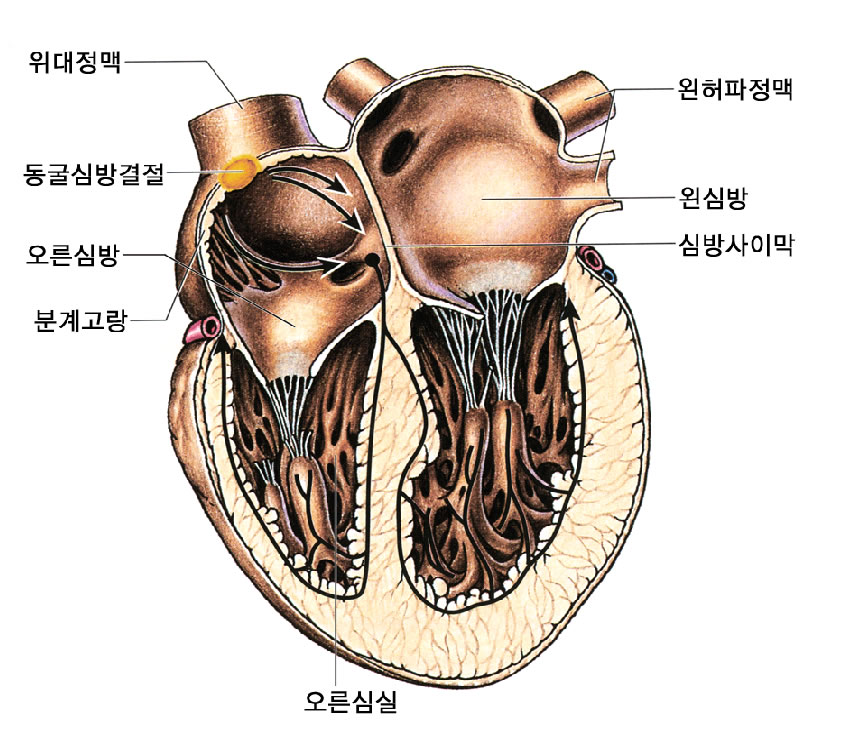 |
||
| CAT | 1) Computerized(= Computed) Axial Tomography = CAT scan &n... |
|---|---|
| IHD | Ischemic Heart Disease = Coronary Heart(Artery) Disease = Atheroscler... |
| JVP | [POMD P 49 - 52] 1) Jugular Vein Pressure 2) Jugular Venous Pulse ... |
| AHD | acquired hepatocerebral degeneration; acute heart disease; antihyaluronidase; antihypertensive drug;... |
| CHD | Chediak-Higashi disease; childhood disease; chronic hemodialysis; congenital or congestive heart dis... |
| Ta | Tabby |
|---|---|
| CAT | chloramphenacol acyl transferase |
| CAT | Carboxyatractylate |
| CAT | Carboxyatractyloside |
| CAT | Carnitine acetyltransferase |
| tabby cat striation | Linear whitish or yellowish markings on the fatty degenerated heart muscle. Synonym: tabby cat striation. (05 Mar 2000) |
|---|---|
| tabby | Origin: F. Tabis (cf. It. Tabi, Sp. & Pg. Tabi, LL. Attabi), fr. Ar. 'attabi, properly the name of a quarter of Bagdad where it was made, the quarter being named from the prince Attab, great grandson of Omeyya. Cf. Tobine. 1. A kind of waved silk, usually called watered silk, manufactured like taffeta, but thicker and stronger. The watering is given to it by calendering. 2. A mixture of lime with shells, gravel, or stones, in equal proportions, with an equal proportion of water. When dry, this becomes as hard as rock. 3. A brindled cat; hence, popularly, any cat. 4. An old maid or gossip. 1. Having a wavy or watered appearance; as a tabby waistcoar. 2. Brindled; diversified in colour; as, a tabby cat. <zoology> Tabby moth, the grease moth. See Grease. Source: Websters Dictionary (01 Mar 1998) |
| amaurotic cat's eye | A yellow reflex from the pupil in cases of retinoblastoma or pseudoglioma. (05 Mar 2000) |
| gib-cat | A male cat, especially. An old one. See lst Gib. Source: Websters Dictionary (01 Mar 1998) |
| CAT | <abbreviation> Computerised axial tomography; chloramphenicol acetyltransferase. (05 Mar 2000) |
| cat-bite disease | Rat-bite fever, presumably spread from rats to cats and thus to humans. Synonym: cat-bite fever. (05 Mar 2000) |
| cat-bite fever | Rat-bite fever, presumably spread from rats to cats and thus to humans. Synonym: cat-bite fever. (05 Mar 2000) |
| cat diseases | Diseases of the domestic cat (felis catus or f. Domesticus). This term does not include diseases of the so-called big cats such as cheetahs, lions, tigers, cougars, panthers, leopards, and other felidae for which the heading carnivora is used. (12 Dec 1998) |
| cat distemper virus | A virus of the genus Parvovirus that causes panleukopenia; the virus infects all Felidae, raccoons and mink, but not dogs or other Canidae. Synonym: cat distemper virus, panleukopenia virus of cats. (05 Mar 2000) |
| cat scan | <investigation, procedure, radiology> A special radiographic technique that uses a computer to assimilate multiple X-ray images into a 2 dimentional cross-sectional image. This can reveal many soft tissue structures not shown by conventional radiography. Scans may also be dynamic in which a movement of a dye is tracked. Cuts may be 5 or 10 mm apart or, in some instances even further apart. A special dye material may be injected into the patients vein prior to the scan to help differentiate abnormal tissue and vasculature. The machine rotates 180 |
| cat-scratch disease | <disease> A self-limiting bacterial infection of the regional lymph nodes (lymphadenitis) caused by afipia felis, a gram-negative bacterium recently identified as bartonella henselae. It usually arises one or more weeks following a feline scratch, with raised inflammatory nodules at the site of the scratch being the primary symptom. It results in tender and enlarged lymph glands above the site of injury. A chronic benign adenopathy, especially in children and young adults, commonly associated with a recent cat scratch or bite and caused by bacteria including Bartonella henselae and Alipia felis; the lymphadenopathy usually resolves spontaneously within a period of several months, but complications involving central nervous system, liver, spleen, lung, and skin have been seen. Synonym: benign inoculation lymphoreticulosis, benign inoculation reticulosis, cat-scratch fever, regional granulomatous lymphadenitis. (05 Mar 2000) |
| cat-scratch fever | <disease> A self-limiting bacterial infection of the regional lymph nodes (lymphadenitis) caused by afipia felis, a gram-negative bacterium recently identified as bartonella henselae. It usually arises one or more weeks following a feline scratch, with raised inflammatory nodules at the site of the scratch being the primary symptom. It results in tender and enlarged lymph glands above the site of injury. A chronic benign adenopathy, especially in children and young adults, commonly associated with a recent cat scratch or bite and caused by bacteria including Bartonella henselae and Alipia felis; the lymphadenopathy usually resolves spontaneously within a period of several months, but complications involving central nervous system, liver, spleen, lung, and skin have been seen. Synonym: benign inoculation lymphoreticulosis, benign inoculation reticulosis, cat-scratch fever, regional granulomatous lymphadenitis. (05 Mar 2000) |
| cat's cry syndrome | <paediatrics, syndrome> A congenital human syndrome caused by the loss of part of the short arm of Chromosome 5. The syndrome gets its name from the peculiar cry of afflicted infants, which sounds like the meowing of a cat. The syndrome causes severe retardation and various congenital malformations. (09 Oct 1997) |
| cat's-eye pupil | A distorted, elongated pupil; usually due to anterior segment anomaly. (05 Mar 2000) |
| cat's-eye syndrome | <syndrome> Iris colobomas (resembling the vertical pupils of a cat) and anal atresia, associated with an additional acrocentric chromosome; other malformations and mental retardation may be present. Synonym: Schmid-Fraccaro syndrome. (05 Mar 2000) |
제품명 |
판매사 |
보험코드 | 성분/함량 | 구분/보험급여 |
|---|
제품명 |
판매사 |
보험코드 | 성분/함량 | 구분/보험급여 |
|---|