
| 영문 | sympathetic nervous system | 한글 | 교감신경계 |
|---|---|---|---|
| 설명 | 자율신경계의 일종으로 내장기능을 주로 항진시켜 활동을 증가시키는 기능을 가진다. 자율신경계의 다른 계열인 부교감신경계는 반대로 내장기능을 억제시켜 에너지를 비축하는 기능을 가진다. 자율신경계의 해부학적 특성은 신경이 중추신경계에서 나와 목표장기에 도달하기 전에 한번의 시냅스(synapse)를 이룬다는 점이며, 따라서 자율신경계는 두 개의 신경(시냅스를 이루기 전의 절전신경과 이룬 후의 절후신경)으로 구성된다. 자율신경계중 교감신경계는 중추신경계 즉 척수 부근의 교감신경절(sympathetic ganglion)에서 시냅스가 일어나고, 부교감 신경계는 중추신경계에서 멀리 떨어진 목표 장기부근의 신경절(ganglion)에서 시냅스가 일어나는 점이 다르다. |
||
| 영문 | muscle cell(=muscle fiber) | 한글 | 근육세포 |
|---|---|---|---|
| 설명 | 근육은 수의근(의식에 의해서 조절이 가능한 근육: 예를 들어 다리, 팔, 얼굴근육 등)과 불수의근(의식과 무관하게 조절하지 않아도 움직이는 근육: 예를 들어 심장근, 소화기관에 분포하는 근육 등)으로 나누어지며, 근육세포의 모양은 다음과 같다(수의근, 불수의근 외에 심장에 있는 심장근은 불수의근에 해당하지만 그 모양은 수의근과 같아 따로 분류한다).  |
||
| 영문 | white blood cell(WBC), leukocyte | 한글 | 백혈구 |
|---|---|---|---|
| 설명 | 혈액내에 골수구계세포와 림프계세포, 단핵구계세포를 모두 통틀어 말한다. 백혈구의 증가가 있으면 대개 감염이 있거나, 혹은 탈수현상이 있음을 의미한다. 또한 지나친 백혈구수의 감소는 인체내 면역기능이 떨어져 있음을 의미하며, 다른 질병에 의해 나타나는 이차적인 현상이 아닌지 꼭 진단을 받아보아야 한다. |
||
| 영문 | mast cell | 한글 | 비만 세포 |
|---|---|---|---|
| 설명 | 동물의 결합 조직 가운데 널리 분포하는 세포. 결합조직과 점막조직 내에 있는 호염기성 색소로 이염색성(metachromasia)을 나타내는 과립을 가진 방추형의 세포에 작은 둥근 핵을 가진다. 비만세포의 표면에는 IgE에 대한 수용체가 존재하며, 수용체에 결합한 IgE 분자들끼리 다가의 항원에 의해 서로 연결되면 비만세포 과립탈출 반응이 일어나, 히스타민, 세로토닌, 헤파린 등의 화학전달 물질이 방출되어, 즉시형 알레르기 반응 등의 증상을 일으킨다. 피부, 장막, 혈관 주위, 점막 주변에 있다. |
||
| 영문 | cell | 한글 | 세포 |
|---|---|---|---|
| 설명 | 생명체를 이루는 구조적, 기능적 단위. 핵의 유무에 따라서 유핵세포와 무핵세포로 나눌 수가 있다. 무핵세포란 핵이 없는 세포를 말한다. 핵이란 유전정보를 가지고 있는 염색체를 보관하는 곳인데 무핵세포에서는 염색체가 세포속에 그냥 노출되어 있다. 대개 세포 하나하나가 독립된 생명체의 역할을 하는 단세포생물로서 외부환경으로부터 자신을 보호할 수 있는 견고한 세포벽을 가지고 있다. 유핵세포란 핵을 가지고 있어서 유전정보가 있는 염색체가 세포의 다른 부분과 구분되어 핵속에 들어있다. 세포속에서 핵외의 부분(이를 세포질이라 한다)에는 여러 가지 세포의 소기관이 있어서 세포의 다양한 기능을 분담한다. ◈유핵세포의 기본 구조 1.세포막-세포를 둘러싸서 주위환경과 분리하여 세포의 내환경을 유지한다. 2.형질내세망(endoplasmic reticulum)-단위막으로 둘러쌓여 있는 불규칙한 망상구조이다. 이 망상구조의 내부를 소강, 소조라고 부른다. 여기에는 표면이 매끈한 무과립형질내세망과 표면이 불규칙한 과립형질내세망의 두 가지가 있다. 과립형질내세망의 경우는 표면에 단백질을 합성하는 리보솜이라는 것이 부착되어 있다. 이곳은 주로 세포밖으로 분비할 단백질을 합성하는 장소이다. 무과립형질내세망은 표면에 리보솜이 부착되어 있지 않은 것을 말하며, 이곳에서는 주로 해독작용, 글리코겐의 합성, 스테로이드호르몬의 합성 등이 일어난다. 3.리보솜-단백질을 합성하는 역할을 하는 곳이다.이것은 세포질에 존재하는 자유리보솜과 과립형질내세망에 부착이 되어 존재하는 부착리보솜의 두 가지로 나눈다. 자유리보솜은 주로 세포내에서 필요한 단백질을 만드는 역할을 하고 부착리보솜은 세포밖으로 분비할 단백질을 만드는 역할을 한다. 4.골지장치(Golgi apparatus)-핵주위에 분포하는 납작해진 주머니모양의 것이 중첩되어 형성된 층판 모양의 구조물로 과립형질내세망에서 생성되어 외부로 분비될 단백질을 모아서 농축, 포장하여 과립을 만드는 역할을 한다. 5.사립체(mitochondria)-구형, 난형의 긴 막대기 모양으로 크기가 다양한 구조물. 생물체의 에너지 저장물질인 ATP를 생산하는 역할을 한다. 또 세포와 다른 자신만의 유전정보를 가진 DNA, RNA를 가지고 있다. 모양, 크기가 세균과 비슷하며 자체증식성 등 독립된 생명체로서 필요한 요건을 갖추고 있어서 세포와 공생관계를 가진 독립된 세포로 생각하고 있다. 6.용해소체(lysosome)-작은 구형의 소체로 여러 가지 분해효소를 가진다. 세포외계에서 들어온 물질과 결합하여 그 물질들을 용해하는 역할을 하고, 오래된 세포소기관들을 제거하는 역할도 한다. 7.세포핵(nucleus)-구형, 난형으로 세포의 중심에 위치한다. 핵내에는 유전정보가 있는 물질인 염색체가 존재한다. 8.중심소체(centrosome)-핵주위에 존재하면서 핵의 분열시에 양쪽의 염색체를 당기는 작은 섬유를 만드는 역할을 하는 곳. 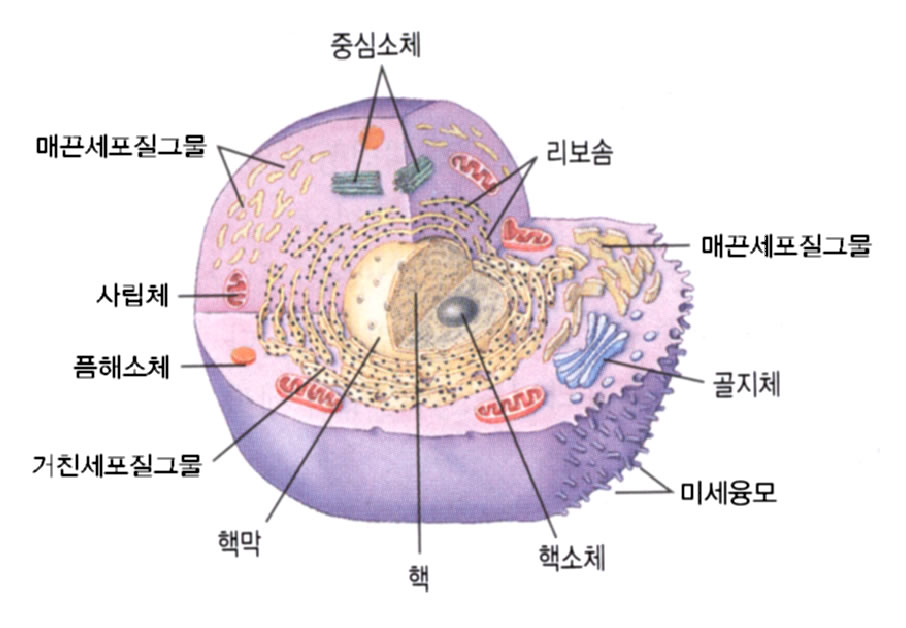 |
||
| MC | mass casualties; mast cell; Master of Surgery [Lat. Magister Chirurgiae]; maximum concentration; Med... |
|---|---|
| ACC | accommodation; acetyl coenzyme A carboxylase; acinic cell carcinoma; acute care center; adenoid cyst... |
| RSDS | Reflex Sympathetic Dystrophy Syndrome |
| CMSD | congenital myocardial sympathetic dysinnervation |
| CSN | cardiac sympathetic nerve; carotid sinus nerve |
| CSNA | Cardiac sympathetic nerve activity |
|---|---|
| CST | cervical sympathetic trunk |
| HSI | Hippocampal sympathetic ingrowth |
| LSNA | Lumbar sympathetic nerve activity |
| MSA | Muscle nerve sympathetic activity |
| sympathetic formative cell | A neuroblast of the embryonic autonomic nervous system. (05 Mar 2000) |
|---|
| formative cell | <embryology> The cell's of the blastocyst; collectively, these cells give rise to the embryo. (05 Mar 2000) |
|---|---|
| formative | 1. Giving form; having the power of giving form; plastic; as, the formative arts. "The meanest plant can not be raised without seed, by any formative residing in the soil." (Bentley) 2. Serving to form; derivative; not radical; as, a termination merely formative. 3. <biology> Capable of growth and development; germinal; as, living or formative matter. Origin: Cf. F. Formatif. Source: Websters Dictionary (01 Mar 1998) |
| ganglia of sympathetic trunk | The clusters of postganglionic neurons located at intervals along the sympathetic trunks, including the superior cervical, middle cervical, and cervicothoracic (stellate) ganglion, the thoracic, lumbar, and sacral ganglia, and the ganglion impar. Synonym: ganglia trunci sympathici, paravertebral ganglia. (05 Mar 2000) |
| ganglia, sympathetic | Ganglia of the sympathetic nervous system including the paravertebral and the prevertebral ganglia. Among these are the sympathetic chain ganglia, the superior, middle, and inferior cervical ganglia, and the aorticorenal, coeliac, and stellate ganglia. (12 Dec 1998) |
| reflex sympathetic dystrophy | A syndrome of pain and tenderness, usually to a hand or foot, associated with vasomotor instability, skin changes and rapid development of bony demineralisation (osteoporosis). Frequently will follow a localised trauma, stroke or peripheral nerve injury. (27 Sep 1997) |
| reflex sympathetic dystrophy syndrome | <syndrome> A condition that features a group of typical symptoms, including pain (often burning type), tenderness, and swelling of an extremity associated with varying degrees of sweating, warmth and/or coolness, flushing, discoloration, and shiny skin. (12 Dec 1998) |
| communicating branches of sympathetic trunk | Short nerves arising from the lateral aspect of the sympathetic trunk conducting nonmyelinated postsynaptic sympathetic nerve fibres from the sympathetic trunk to the initial portions of all 31 pairs of ventral primary rami of spinal nerves for distribution by all parts (including the dorsal primary ramus) of the spinal nerve. The gray rami are the parietal branches of the sympathetic trunks since all postsynaptic fibres to be distributed to the body wall (including limbs) must pass through them. Synonym: communicating branches of sympathetic trunk, communicating rami of sympathetic trunk. (05 Mar 2000) |
| communicating rami of sympathetic trunk | Short nerves arising from the lateral aspect of the sympathetic trunk conducting nonmyelinated postsynaptic sympathetic nerve fibres from the sympathetic trunk to the initial portions of all 31 pairs of ventral primary rami of spinal nerves for distribution by all parts (including the dorsal primary ramus) of the spinal nerve. The gray rami are the parietal branches of the sympathetic trunks since all postsynaptic fibres to be distributed to the body wall (including limbs) must pass through them. Synonym: communicating branches of sympathetic trunk, communicating rami of sympathetic trunk. (05 Mar 2000) |
| nervous system, sympathetic | A part of the nervous system that accelerates the heart rate, constricts blood vessels, and raises blood pressure. The sympathetic nervous system together with the parasympathetic nervous system (that slows the heart rate, increases intestinal and gland activity, and relaxes sphincter muscles) constitute the autonomic nervous system. (12 Dec 1998) |
| sympathetic | 1. <psychology> Pertaining to, caused by or exhibiting sympathy. 2. <physiology> A sympathetic nerve or the sympathetic nervous system. Origin: Gr. Sympathetikos (19 Jan 1998) |
| sympathetic agent | An agent that evokes responses similar to those produced by adrenergic nerve activity (e.g., epinephrine, ephedrine, isoproterenol). Synonym: adrenergic amine, adrenomimetic amine, sympathetic amine. (05 Mar 2000) |
| sympathetic amine | An agent that evokes responses similar to those produced by adrenergic nerve activity (e.g., epinephrine, ephedrine, isoproterenol). Synonym: adrenergic amine, adrenomimetic amine, sympathetic amine. (05 Mar 2000) |
| sympathetic blockade | Interruption of transmission in sympathetic ganglia or conduction of impulses in pre-or postganglionic sympathetic nerve fibres. (05 Mar 2000) |
| sympathetic branch to submandibular ganglion | Branch to the submandibular ganglion composed of postsynaptic sympathetic fibres from the internal carotid plexus conveyed largely by a periarterial plexus of the facial artery. Synonym: ramus sympathicus [sympatheticus] ad ganglion submandibulare. (05 Mar 2000) |
| sympathetic denervation | <procedure, surgery> Removal of the sympathetic nervous systems influence in one area of the body. This may be accomplished with drugs or surgery. A treatment for reflex sympathetic dystrophy. (27 Sep 1997) |
제품명 |
판매사 |
보험코드 | 성분/함량 | 구분/보험급여 |
|---|
제품명 |
판매사 |
보험코드 | 성분/함량 | 구분/보험급여 |
|---|