
| 영문 | alimentary tract | 한글 | 소화관, 영양관 |
|---|---|---|---|
| 설명 | 입에서 시작하여 항문으로 끝나는 소화를 담당하는 이르는 말. 위창자관이라고도 불린다. |
||
| 영문 | biliary tract | 한글 | 쓸개길, 담도, 담관 |
|---|---|---|---|
| 설명 | 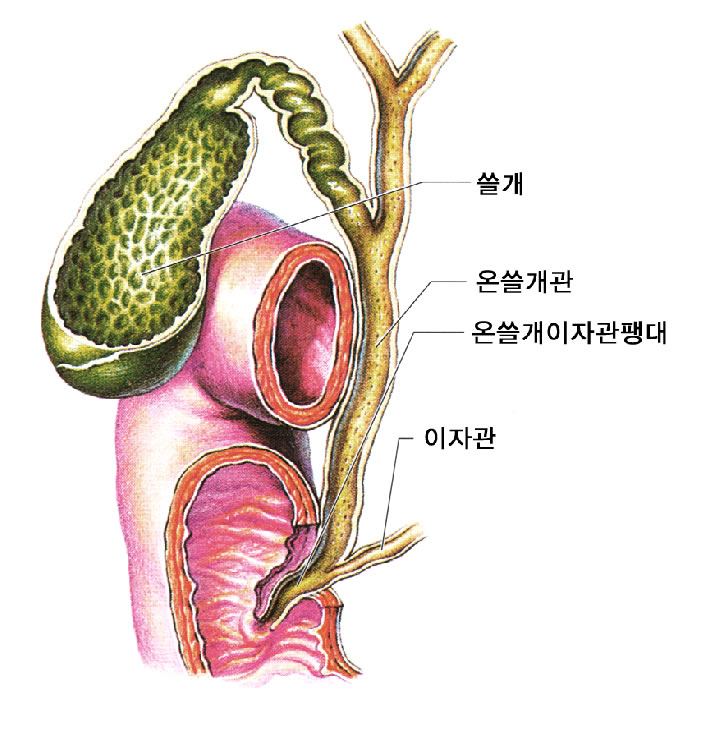 간에서 만들어진 쓸개즙을 수송하는 관조직의 일부. 간에서 만들어진 담즙은 간관, 쓸개관을 거쳐서 쓸개에 보관되었다가 온쓸개관을 통해서 샘창자로 보내진다. 이처럼 간에서 만들어진 담즙이 샘창자까지 배설되는 길로서 길이는 6~7cm 이며 간관, 쓸개관, 온쓸개관 따위로 이루어져 있다. |
||
| 영문 | urinary tract | 한글 | 요로 |
|---|---|---|---|
| 설명 | 오줌을 몸 밖으로 배출하기 위한 길. 콩팥, 요관, 방광, 요도로 이루어져 있다. |
||
| ECG | Electro-Cardio-Graphy(-Gram); 심전도 = EKG 1. Conducting System Structu... |
|---|---|
| DSCT | dorsal spinocerebellar tract |
| SpnCbT | spinocerebellar tract |
| LRI | lamina rara interna; lower respiratory [tract] illness; lower respiratory [tract] infection; lymphoc... |
| LRTI | lower respiratory tract illness; lower respiratory tract infection |
| DSCT | Dorsal Spinocerebellar Tract |
|---|---|
| SCA1 | Spinocerebellar Ataxia 1 |
| SCA2 | Spinocerebellar Ataxia Type 2 |
| SCA | Spinocerebellar ataxia |
| SCA-2 | Spinocerebellar ataxia 2 |
| spinocerebellar tracts | See: anterior spinocerebellar tract, posterior spinocerebellar tract. (05 Mar 2000) |
|---|
| anterior spinocerebellar tract | A bundle of fibres originating in the base of the posterior horn and zona intermedia throughout lumbosacral segments of the spinal cord, crossing to the opposite side and ascending in a peripheral position in the ventral half of the lateral funiculus. In its ascent through the rhombencephalon, the tract curves sharply dorsalward along the rostral border of the trigeminal motor nucleus, entering the cerebellum in a caudal direction over the dorsal surface of the superior cerebellar peduncle, and terminating as mossy fibres in the granular layer of the cortex of the cerebellar vermis. The bundle conveys proprioceptive and exteroceptive information largely from the opposite lower extremity. Synonym: tractus spinocerebellaris anterior, Gowers' column, Gowers' tract, ventral spinocerebellar tract. (05 Mar 2000) |
|---|---|
| ventral spinocerebellar tract | A bundle of fibres originating in the base of the posterior horn and zona intermedia throughout lumbosacral segments of the spinal cord, crossing to the opposite side and ascending in a peripheral position in the ventral half of the lateral funiculus. In its ascent through the rhombencephalon, the tract curves sharply dorsalward along the rostral border of the trigeminal motor nucleus, entering the cerebellum in a caudal direction over the dorsal surface of the superior cerebellar peduncle, and terminating as mossy fibres in the granular layer of the cortex of the cerebellar vermis. The bundle conveys proprioceptive and exteroceptive information largely from the opposite lower extremity. Synonym: tractus spinocerebellaris anterior, Gowers' column, Gowers' tract, ventral spinocerebellar tract. (05 Mar 2000) |
| posterior spinocerebellar tract | A compact bundle of heavily myelinated, thick fibres at the periphery of the dorsal half of the lateral funiculus of the spinal cord, originating in the ipsilateral thoracic nucleus (column of Clarke) and ascending by way of the inferior cerebellar peduncle. Terminals end as mossy fibres in the granular layer of the cortex of the cerebellar vermis. The bundle conveys largely proprioceptive information originating from the annulospiral nerve endings surrounding muscle spindles and from Golgi tendon organs. Synonym: tractus spinocerebellaris posterior, Flechsig's tract. (05 Mar 2000) |
| spinocerebellar ataxia | The most common hereditary ataxia, with onset in middle to late childhood, manifested as limb ataxia, nystagmus, kyphoscoliosis, and pes cavus; the major pathological changes are found in the posterior columns of the spinal cord; most often autosomal recessive inheritance. (05 Mar 2000) |
| spinocerebellar degeneration | An autosomal recessive inherited disorder that leads to the progressive dysfunction of the cerebellum, spinal cord and peripheral nerves. Symptoms usually begin in childhood before puberty and consist of an unsteady gait (ataxia), slurred speech (dysarthria) and jerky eye movements (nystagmus). Other findings include kyphoscoliosis, hammer toe, heart disease and high arches. Congestive heart failure is a common complication. There is no known treatment and prognosis is poor. Inheritance: autosomal recessive. (27 Sep 1997) |
| alimentary tract | The passage leading from the mouth to the anus through the pharynx, oesophagus, stomach, and intestine. Synonym: alimentary canal, alimentary tract, digestive tube, tubus digestorius. (05 Mar 2000) |
| alimentary tract smear | A group of cytologic specimens containing material from the mouth (oral smear), oesophagus and stomach (gastric smear), duodenum (paraduodenal smear), and colon, obtained by specialised lavage techniques; used principally for the diagnosis of cancer of those areas. (05 Mar 2000) |
| anterior corticospinal tract | Uncrossed fibres forming a small bundle in the pyramidal tract. See: pyramidal tract. Synonym: tractus corticospinalis anterior, tractus pyramidalis anterior, anterior corticospinal tract, anterior pyramidal fasciculus, direct pyramidal tract, fasciculus corticospinalis anterior, fasciculus pyramidalis anterior, Turck's bundle, Turck's column, Turck's tract. (05 Mar 2000) |
| anterior pyramidal tract | Uncrossed fibres forming a small bundle in the pyramidal tract. See: pyramidal tract. Synonym: tractus corticospinalis anterior, tractus pyramidalis anterior, anterior corticospinal tract, anterior pyramidal fasciculus, direct pyramidal tract, fasciculus corticospinalis anterior, fasciculus pyramidalis anterior, Turck's bundle, Turck's column, Turck's tract. (05 Mar 2000) |
| anterior spinothalamic tract | The more anterior or ventral part of the spinothalamic tract that is involved in tactile sensation. See: spinothalamic tract. Synonym: tractus spinothalamicus anterior, ventral spinothalamic tract. (05 Mar 2000) |
| Arnold's tract | A fibre group originating in the cerebral cortex of the temporal lobe, particularly the superior and middle temporal gyri, following the sublenticular limb of the internal capsule into the lateral margin of the crus cerebri in which it descends to its termination in the pontine nuclei or the ventral part of the pons. Synonym: tractus temporopontinus, Arnold's bundle, Arnold's tract. (05 Mar 2000) |
| association tract | See: association system. (05 Mar 2000) |
| auditory tract | A bundle of ascending fibres that originate from the cochlear and auditory relay nuclei of the rhombencephalon, enter the trapezoid body, a transverse fibre stratum in which about half their number decussate, and from here turn rostrally along the lateral side of the spinothalamic tract; in the midbrain, it arches dorsally and enters the inferior colliculus in which all of its fibres terminate; the auditory pathway is transsynaptically extended from here by the brachium of the inferior colliculus to the medial geniculate body of the thalamus, from which in turn the auditory radiation leads to the auditory cortex; intercalated in the trapezoid body and along the ascending trajectory of the lemniscus are several cell groups in which part of the fibres synapse. Synonym: lemniscus lateralis, acoustic lemniscus, auditory lemniscus, auditory tract, lateral fillet. (05 Mar 2000) |
| benign mesothelioma of genital tract | A small, circumscribed, benign tumour of the genital tract, composed of small glandlike spaces lined by flattened or cuboidal mesothelium-like cells. (12 Dec 1998) |
| biliary tract | <anatomy> The biliary tract refers to the bile ducts within the liver, the common bile duct (connecting the liver and gallbladder to the small intestine) and the cystic duct (short duct that connects the common bile duct to the gallbladder). Blockage in any location in the biliary tract can result in obstructive jaundice. (27 Sep 1997) |
Synonyms : Spinocerebellar Tract, Tract, Spinocerebellar, Tracts, Spinocerebellar
제품명 |
판매사 |
보험코드 | 성분/함량 | 구분/보험급여 |
|---|
제품명 |
판매사 |
보험코드 | 성분/함량 | 구분/보험급여 |
|---|