
| 영문 | spinal tap, spinal puncture | 한글 | 허리천자, 요추천자, 요추뚫기 |
|---|---|---|---|
| 설명 | 질병의 진단이나 치료 또는 마취를 하기 위해 피부에서 거미막밑공간으로 바늘을 찌를 때가 있다. 이것은 셋째 허리뼈 아래쪽에서 시행한다. 척수가 첫째 허리뼈 아랫모서리에서 끝나고, 거미막밑공간은 둘째 엉치뼈 분절까지 뻗어 있기 때문에 이 부위는 바늘로 척수를 찌를 위험이 없다. 또 척추뼈고리판이 짧아 서로 겹쳐있지 않기 때문에 허리뼈 사이로 바늘을 찌를 수 있다. 이 부위의 거미막밑공간에는 척수신경 뿌리가 있으나, 이들은 뇌척수액속에 있기 때문에 바늘을 넣을 때 한쪽으로 밀려 손상받는 경우는 거의 없다. 배를 넓적다리에 붙일정도로 허리를 구부리면 고리판 사이가 더 벌어져 틈이 커진다. 바늘이 뚫고 지나가는 구조는 바깥에서 속으로 ① 피부, ② 피부밑조직, ③ 근육막, ④ 가시끝인대, ⑤ 가시사이인대, ⑥ 황색인대, ⑦ 경질막, ⑧ 거미막, ⑨ 뇌척수액이 된다.  |
||
| 영문 | spinal cord | 한글 | 척수 |
|---|---|---|---|
| 설명 | 척추내에 위치하는 중추신경계의 일부분. 위에서부터 목척수, 등척수, 허리척수, 엉치척수로 구분됨. 내부는 바깥쪽의 백색질과 안쪽의 회색질로 구분된다. 척수의 아래끝은 척수 원뿔이라 하며 첫번째 허리뼈 높이까지 내려온다. 뇌와 말초신경사이의 신경 통로 역할을 하며 척수반사(예: 무릎반사)에서는 뇌를 통하지 않고 반사의 중추 작용을 한다. 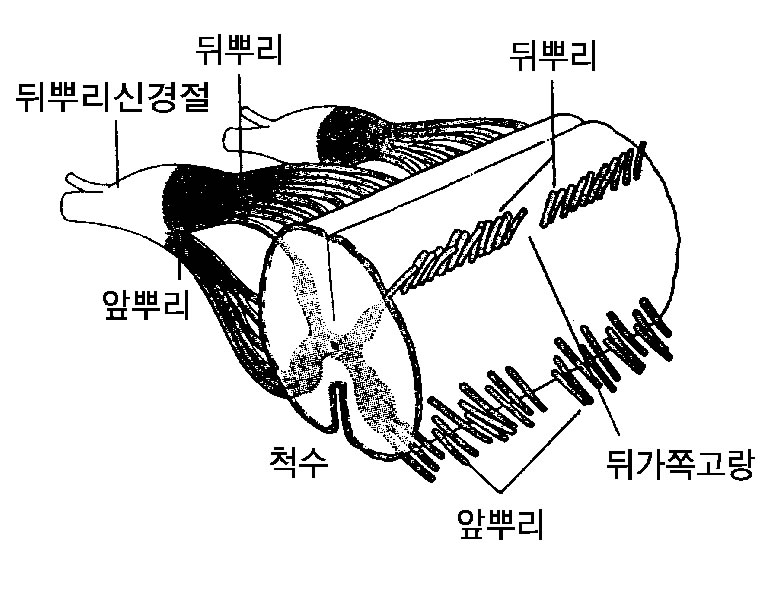 |
||
| 영문 | spinal nerve | 한글 | 척수신경 |
|---|---|---|---|
| 설명 | 척수의 앞뿔에서 출발하는 운동신경과 뒷뿔으로 들어오는 감각신경이 합쳐서 형성되는 신경으로서 총 31쌍이 존재함. 목뼈신경이 8쌍, 자등뼈신경이 12쌍, 허리뼈의 신경이 5쌍, 엉치뼈의 6쌍을 이룸. |
||
| PSA | parasternal short axis; pleomorphic salivary gland adenoma; polyethylene sulfonic acid; polysacchari... |
|---|---|
| SC | conditioned stimulus; sacrococcygeal; Sanitary Corps; scalenus [muscle]; scapula; Schwann cell; scia... |
| CID | 1) Carpal Instability Dissociative; 해리성 주근관절 불안정성 2) Cytomegalic Inclusio... |
| CIND | Carpal Instability Nondissociative; 불해리성 주근관절 불안정성 |
| ALRI | anterolateral rotatory instability |
| DI | Detrusor instability |
|---|---|
| DFIC | Dominant frequency instability coefficient |
| MSI | MICROSATELLITE INSTABILITY |
| MI | Microsatellite Instability |
| MIN | Microsatellite instability |
| Alfven ion cyclotron instability | <radiobiology> An electromagnetic microinstability near the ion cyclotron frequency, driven by the ion loss cone in a mirror device. Acronym: AIC (13 Nov 1997) |
|---|---|
| velocity space instability | <radiobiology> A class of instabilities driven by particle distributions (in velocity space) which are not in thermal equilibrium. (09 Oct 1997) |
| parametric instability | <physics> Instability which occurs in a system whose equilibrium is weakly modulated in time or space. The modulation produces a coupling of the linear eigenmodes of the system and can lead to destabilisation. (09 Oct 1997) |
| vertical instability | <radiobiology> A type of magnetohydrodynamic (n=0) instability where the plasma drifts vertically upward. Nearly all tokamaks are vertically unstable (all highly shaped ones are). Controlling this instability is possible in many cases, and is an important facet of machine design. Vertical instabilities give rise to halo effects. (09 Oct 1997) |
| chromosomal instability syndromes | A group of mendelian conditions associated with chromosomal instability and breakage in vitro, they often manifest an increased tendency to certain types of malignancies. See: Bloom's syndrome, fragile X syndrome, xeroderma pigmentosum. (05 Mar 2000) |
| heat instability test | A test for the presence of unstable haemoglobins; fresh red blood cells lysed in distilled water develop a precipitate within one hour at 50캜 if unstable haemoglobin is present. (05 Mar 2000) |
| disruptive instability | <radiobiology> Instability which causes a disruption. See: disruption. (09 Oct 1997) |
| instability | The quality or state of being unstable. (18 Nov 1997) |
| interchange instability | <radiobiology> In the simplest form, if you place a high-density fluid on top of a low density fluid, gravity will pull the high density fluid downwards so that the low-density fluid ends up on top. The two fluids therefore interchange places. More generally, an interchange instability occurs when two types of fluid are situated with an external force such that the potential energy is not a minimum, the two fluids will then interchange locations to bring the potential energy to a minimum. In plasmas with magnetic fields, the plasma may interchange position with the magnetic field. A prime example is the flute instability in mirror machines. (See magnetohydrodynamic, instability, flute, mirror.) (09 Oct 1997) |
| trapped-particle instability | <radiobiology> Slowly-growing class of instabilities driven by particles which cannot circulate freely in a toroidal system. See: banana orbit. (09 Oct 1997) |
| two-stream instability | <radiobiology> Instability which can develop when a stream of particles of one type has a velocity distribution with its peak well separated from that of another type of particle through which it is flowing. A stream of energetic electrons passing through a cold plasma can, for example: excite ion waves which will grow rapidly in magnitude at the expense of the kinetic energy of the electrons. (09 Oct 1997) |
| joint instability | Lack of stability of a joint or joint prosthesis. Factors involved are intra-articular disease and integrity of extra-articular structures such as joint capsule, ligaments, and muscles. (12 Dec 1998) |
| universal instability | <radiobiology> Low-frequency instability resulting from the presence of density gradients perpendicular to the magnetic field lines. An instability of this type is generally localised and usually has a small rate of growth. (09 Oct 1997) |
| flute instability | <radiobiology> Term used to describe an interchange instability in which the perturbation is uniform parallel to the magnetic field. In cylindrical geometry, the structure resembles a fluted column (as in classical architecture). Occurs in some mirror machines. (09 Oct 1997) |
| accessory portion of spinal accessory nerve | <anatomy, nerve> The roots of the accessory nerve which arise from the medulla; the nerve fibres of the cranial root join the intracranial portion of the vagus nerve and are distributed to the pharyngeal plexus, providing the motor innervation of the soft palate (except the tensor veli palati) and the pharynx. Synonym: pars vagalis nervi accessorii, radices craniales, accessory portion of spinal accessory nerve, cranial roots, vagal part of accessory nerve, vagal part. (05 Mar 2000) |
제품명 |
판매사 |
보험코드 | 성분/함량 | 구분/보험급여 |
|---|
제품명 |
판매사 |
보험코드 | 성분/함량 | 구분/보험급여 |
|---|