
| 영문 | muscle cell(=muscle fiber) | 한글 | 근육세포 |
|---|---|---|---|
| 설명 | 근육은 수의근(의식에 의해서 조절이 가능한 근육: 예를 들어 다리, 팔, 얼굴근육 등)과 불수의근(의식과 무관하게 조절하지 않아도 움직이는 근육: 예를 들어 심장근, 소화기관에 분포하는 근육 등)으로 나누어지며, 근육세포의 모양은 다음과 같다(수의근, 불수의근 외에 심장에 있는 심장근은 불수의근에 해당하지만 그 모양은 수의근과 같아 따로 분류한다).  |
||
| 영문 | white blood cell(WBC), leukocyte | 한글 | 백혈구 |
|---|---|---|---|
| 설명 | 혈액내에 골수구계세포와 림프계세포, 단핵구계세포를 모두 통틀어 말한다. 백혈구의 증가가 있으면 대개 감염이 있거나, 혹은 탈수현상이 있음을 의미한다. 또한 지나친 백혈구수의 감소는 인체내 면역기능이 떨어져 있음을 의미하며, 다른 질병에 의해 나타나는 이차적인 현상이 아닌지 꼭 진단을 받아보아야 한다. |
||
| 영문 | mast cell | 한글 | 비만 세포 |
|---|---|---|---|
| 설명 | 동물의 결합 조직 가운데 널리 분포하는 세포. 결합조직과 점막조직 내에 있는 호염기성 색소로 이염색성(metachromasia)을 나타내는 과립을 가진 방추형의 세포에 작은 둥근 핵을 가진다. 비만세포의 표면에는 IgE에 대한 수용체가 존재하며, 수용체에 결합한 IgE 분자들끼리 다가의 항원에 의해 서로 연결되면 비만세포 과립탈출 반응이 일어나, 히스타민, 세로토닌, 헤파린 등의 화학전달 물질이 방출되어, 즉시형 알레르기 반응 등의 증상을 일으킨다. 피부, 장막, 혈관 주위, 점막 주변에 있다. |
||
| 영문 | cell | 한글 | 세포 |
|---|---|---|---|
| 설명 | 생명체를 이루는 구조적, 기능적 단위. 핵의 유무에 따라서 유핵세포와 무핵세포로 나눌 수가 있다. 무핵세포란 핵이 없는 세포를 말한다. 핵이란 유전정보를 가지고 있는 염색체를 보관하는 곳인데 무핵세포에서는 염색체가 세포속에 그냥 노출되어 있다. 대개 세포 하나하나가 독립된 생명체의 역할을 하는 단세포생물로서 외부환경으로부터 자신을 보호할 수 있는 견고한 세포벽을 가지고 있다. 유핵세포란 핵을 가지고 있어서 유전정보가 있는 염색체가 세포의 다른 부분과 구분되어 핵속에 들어있다. 세포속에서 핵외의 부분(이를 세포질이라 한다)에는 여러 가지 세포의 소기관이 있어서 세포의 다양한 기능을 분담한다. ◈유핵세포의 기본 구조 1.세포막-세포를 둘러싸서 주위환경과 분리하여 세포의 내환경을 유지한다. 2.형질내세망(endoplasmic reticulum)-단위막으로 둘러쌓여 있는 불규칙한 망상구조이다. 이 망상구조의 내부를 소강, 소조라고 부른다. 여기에는 표면이 매끈한 무과립형질내세망과 표면이 불규칙한 과립형질내세망의 두 가지가 있다. 과립형질내세망의 경우는 표면에 단백질을 합성하는 리보솜이라는 것이 부착되어 있다. 이곳은 주로 세포밖으로 분비할 단백질을 합성하는 장소이다. 무과립형질내세망은 표면에 리보솜이 부착되어 있지 않은 것을 말하며, 이곳에서는 주로 해독작용, 글리코겐의 합성, 스테로이드호르몬의 합성 등이 일어난다. 3.리보솜-단백질을 합성하는 역할을 하는 곳이다.이것은 세포질에 존재하는 자유리보솜과 과립형질내세망에 부착이 되어 존재하는 부착리보솜의 두 가지로 나눈다. 자유리보솜은 주로 세포내에서 필요한 단백질을 만드는 역할을 하고 부착리보솜은 세포밖으로 분비할 단백질을 만드는 역할을 한다. 4.골지장치(Golgi apparatus)-핵주위에 분포하는 납작해진 주머니모양의 것이 중첩되어 형성된 층판 모양의 구조물로 과립형질내세망에서 생성되어 외부로 분비될 단백질을 모아서 농축, 포장하여 과립을 만드는 역할을 한다. 5.사립체(mitochondria)-구형, 난형의 긴 막대기 모양으로 크기가 다양한 구조물. 생물체의 에너지 저장물질인 ATP를 생산하는 역할을 한다. 또 세포와 다른 자신만의 유전정보를 가진 DNA, RNA를 가지고 있다. 모양, 크기가 세균과 비슷하며 자체증식성 등 독립된 생명체로서 필요한 요건을 갖추고 있어서 세포와 공생관계를 가진 독립된 세포로 생각하고 있다. 6.용해소체(lysosome)-작은 구형의 소체로 여러 가지 분해효소를 가진다. 세포외계에서 들어온 물질과 결합하여 그 물질들을 용해하는 역할을 하고, 오래된 세포소기관들을 제거하는 역할도 한다. 7.세포핵(nucleus)-구형, 난형으로 세포의 중심에 위치한다. 핵내에는 유전정보가 있는 물질인 염색체가 존재한다. 8.중심소체(centrosome)-핵주위에 존재하면서 핵의 분열시에 양쪽의 염색체를 당기는 작은 섬유를 만드는 역할을 하는 곳. 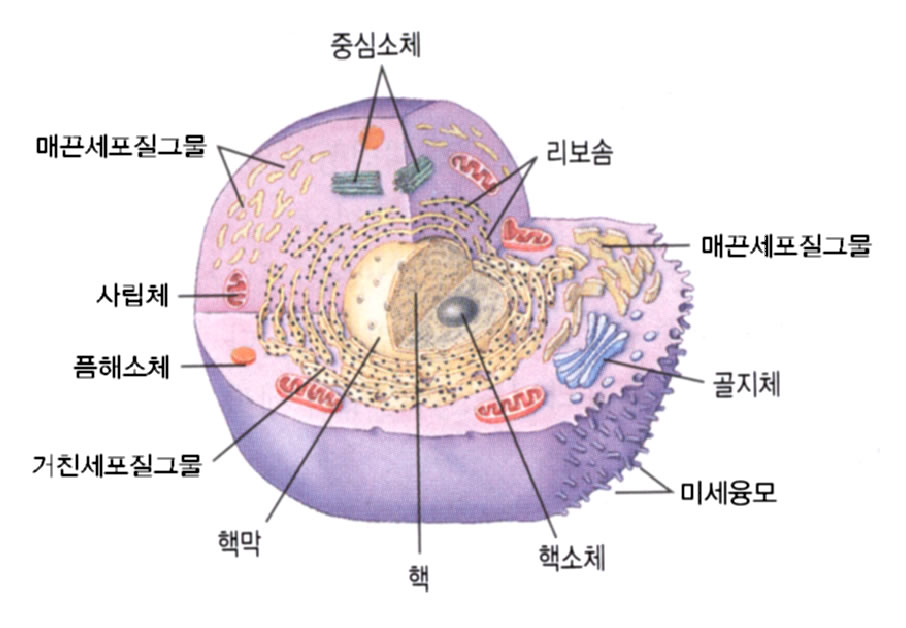 |
||
| 영문 | cell-mediated immunity | 한글 | 세포매개면역 |
|---|---|---|---|
| 설명 | 면역이란 신체를 외부의 물질로부터 보호하는 행위를 말한다. 여기에는 특이적 면역과 비특이적 면역의 두 가지가 있다. 비특이적 면역이라함은 특정한 물질에 관계하는 면역이 아니라 특정 대상이 없이 모든 외부 물체에 작용할 수 있는 면역을 말한다. 여기에는 소변의 흐름, 눈물의 흐름, 피부의 비투과성 등의 기계적인 것도 포함되고 피속에 돌아다니는 세포 중에서 비특이적으로 외부의 물질을 포식하는 세포들(예를 들면 큰포식세포(macrophage)의 활동도 포함이 된다. 세포매개면역이란 특이한 물질을 감지할 수 있는 세포를 생성하게 하여 그것으로 하여금 그 물질을 포식하게 하는 것을 말한다. |
||
| MC | mass casualties; mast cell; Master of Surgery [Lat. Magister Chirurgiae]; maximum concentration; Med... |
|---|---|
| SCe | somatic cell |
| ACC | accommodation; acetyl coenzyme A carboxylase; acinic cell carcinoma; acute care center; adenoid cyst... |
| FISH | Fluorescence In Situ Hybridization |
| CISH | competitive in situ hybridization |
| SCC | Somatic Cell Count |
|---|---|
| SMART | Somatic Mutation And Recombination Test |
| CGH | Comparative genome hybridization |
| FISH | Filter In Situ Hybridization |
| FISH | Fluorescence In Situ Hybridization |
| somatic cell hybridization | Production of a heterokaryon. (05 Mar 2000) |
|---|
| cell hybridization | Fusion of two or more dissimilar cells, leading to formation of a synkaryon. (05 Mar 2000) |
|---|---|
| somatic cell | Usually any cell of a multicellular organism that will not contribute to the production of gametes, i.e. most cells of which an organism is made: not a germ cell. Notice, however, the alternative use in somatic mesoderm. (18 Nov 1997) |
| somatic cell gene therapy | The repair or replacement of a defective gene within somatic tissue. (09 Oct 1997) |
| somatic cell genetics | Method for identifying the chromosomal location of a particular gene without sexual crossing. Unstable heterokaryons are made between the cell of interest and another cell with identifiably different characteristics (or without the gene in question) and a series of clones isolated. By correlating retention of gene expression with the remaining chromosomes, it is possible to deduce which chromosome must carry the gene. Human mouse heterokaryons have been extensively used in this sort of work. (18 Nov 1997) |
| cross hybridization | Annealing of a DNA probe to an imperfectly matching DNA molecule. (05 Mar 2000) |
| protein hybridization | The formation of a protein consisting of two or more polypeptide chains from separate and different polypeptide chains. (12 Dec 1998) |
| hybridization | <molecular biology> The process of joining two complementary strands of DNA or one each of DNA and RNA to form a double-stranded molecule. Technique in which single stranded nucleic acids are allowed to interact so that complexes or hybrids, are formed by molecules with sufficiently similar, complementary sequences. By this means the degree of sequence identity can be assessed and specific sequences detected. The hybridisation can be carried out in solution or with one component immobilised on a gel or, most commonly, nitrocellulose paper. Hybrids are detected by various means: visualisation in the electron microscope, by radioactively labelling one component and removing noncomplexed DNA or by washing or digestion with an enzyme that attacks single stranded nucleic acids and finally estimating the radioactivity bound. Hybridisations are done in all combinations: DNA DNA (DNA can be rendered single stranded by heat denaturation), DNA RNA or RNA RNA. In situ hybridisations involve hybridising a labelled nucleic acid (often labelled with a fluorescent dye) to suitably prepared cells or histological sections. This is used particularly to look for specific transcription or localisation of genes to specific chromosomes (FISH analysis). <zoology> The mating of individuals from different species or sub-species. (13 Oct 1997) |
| nucleic acid hybridization | Widely used technique which exploits the ability of complementary sequences in single-stranded dnas or rnas to pair with each other to form a double helix. Hybridization can take place between two complimentary DNA sequences, between a single-stranded DNA and a complementary RNA, or between two RNA sequences. The technique is used to detect and isolate specific sequences, measure homology, or define other characteristics of one or both strands. (kendrew, encyclopedia of molecular biology, 1994, p503; dorlands, 28th ed, p781) (12 Dec 1998) |
| DNA hybridization | A technique used to determine the relatedness of microorganisms by the speed and efficiency of the reassociation of single-stranded DNA to form double-stranded DNA when one of the strands originates from one organism and the other strand from another organism; occurs when the base sequences are complementary or nearly so. (05 Mar 2000) |
| in situ hybridization | <molecular biology> The use of a DNA or RNA probe to detect the complementary DNA sequence. (12 Dec 1998) |
| in situ nucleic acid hybridization | <molecular biology> The use of a DNA or RNA probe to detect the complementary DNA sequence. (12 Dec 1998) |
| overlap hybridization | A procedure to find and sequence a gene whose approximate position in a chromosome is known by classical genetic linkage studies. Starting with the known sequence of a gene shown by classical genetics to be near to the novel gene, new clones are picked from a genomic library by hybridisation with a short probe generated from the appropriate end of the known sequence. The new clones are then sequenced, new probes generated and the process repeated until the gene of interest is reached. (18 Nov 1997) |
| fluorescence in situ hybridization | <molecular biology, technique> A type of in situ hybridization in which target sequences are stained with fluorescent dye so their location and size can be determined using fluorescence microscopy. This staining is sufficiently distinct that the hybridization signal can be seen both in metaphase spreads and in interphase nuclei. Acronym: FISH (25 Jun 1999) |
| fluorescent in situ hybridization | See FISH. (12 Dec 1998) |
| general somatic afferent column | In the embryo, a column of gray matter in the hindbrain and spinal cord, represented in the adult by the sensory nuclei of the trigeminal nerve and relay cells in the dorsal horn. (05 Mar 2000) |
| somatic cell hybridization |
Production of hybrid cells by fusion of two protoplasts with different genetic makeup. (2)
출처: ppathw3.cals.cornell.edu/glossary/Defs_S.htm
|
|---|---|
| somatic cell hybridization |
The in vitro fusion of animal cells or plant protoplasts derived from somatic cells which differ genetically.
출처: www.sivb.org/edu_terminology.asp
|
제품명 |
판매사 |
보험코드 | 성분/함량 | 구분/보험급여 |
|---|
제품명 |
판매사 |
보험코드 | 성분/함량 | 구분/보험급여 |
|---|