
| 영문 | inguinal hernia | 한글 | 샅굴탈장, 서혜부탈장 |
|---|---|---|---|
| 설명 | 탈장이란 선천적 또는 후천적으로 생긴 구멍이나 틈을 통해 본래 위치하고 있던 장소로부터 장기나 조직이 탈출된 상태를 말한다. 샅굴탈장은 탈장의 가장 흔한 형태로서 전체의 약 75%를 차지한다. 샅굴과 넙적다리를 관찰하여 튀어나온 부위가 있거나 검사를 하는 동안 밑으로 힘을 주어 보았을 때 튀어 나오는 부위가 있다면 탈장을 의심할 수 있다. 감금(혈류 순환 장애), 창자폐색 등의 합병증이 오면 위험하므로 가능한 조기에 수술을 시행해야 하나 생후 3개월 이후가 안전하다. 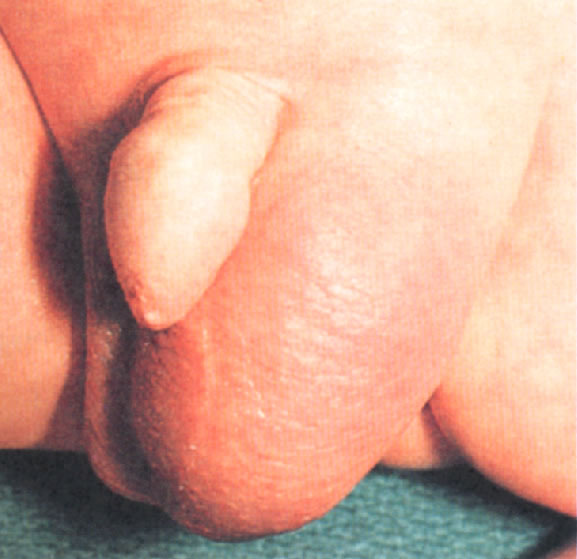 |
||
| 영문 | hiatal hernia | 한글 | 열공헤르니아 |
|---|---|---|---|
| 설명 | 위의 일부가 식도가 가로막을 통과하는 구멍을 통해서 흉강으로 빠져나가는 것이다. 탈장이 되는 방식에 따라서 미끄럼 헤르니아와 식도주위 헤르니아가 있다. 미끄럼헤르니아는 가장 흔한 형이며, 식도위접합부가 식도가 가로막을 빠져나오는 구멍 위에 위치하는 것으로, 이렇게 되면 식도와 위사이에 존재하는 조임근의 힘이 적어져서 위의 내용물이 쉽게 식도로 역류되고 이로 인해서 식도염을 일으키고 이 식도염이 지속될 경우에는 식도 협착을 일으키기도 한다. 식도주위헤르니아는 식도가 가로막을 통과하는 구멍까지 정상적으로 위치하지만 위가 흉 강으로 탈장된다. 이때는 위내용물의 식도로의 역류는 드물다. 대신에 식도가 탈장된 위에 눌려서 식도폐쇄의 증상이 나타난다. 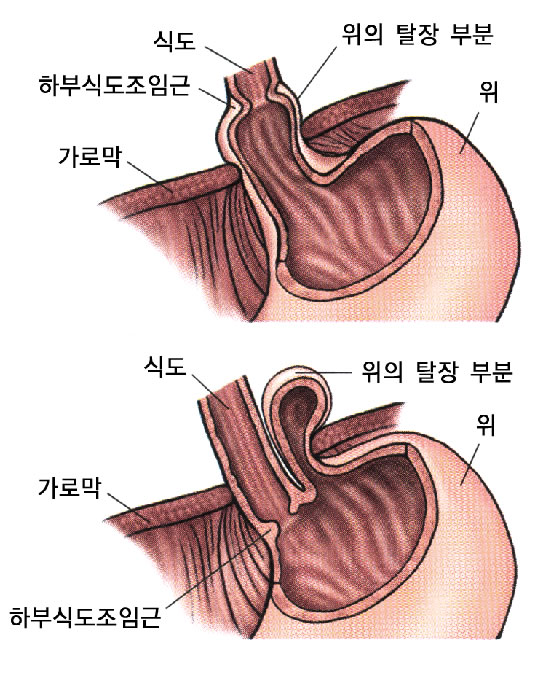 |
||
| 영문 | hernia | 한글 | 헤르니아, 탈장 |
|---|---|---|---|
| 설명 | 장기의 일부가 원래 있어야 할 장소에서 벗어난 상태. 복부에서는 사타구니, 허벅지, 배꼽, 가로막 등에 생기는 경우가 있고, 복부 이외에서는 척추원반이나 뇌에서 발생할 수 있다. 샅고랑헤르니아란 창자의 일부가 복벽의 약한 부위나 비정상적으로 존재하는 고환부위의 공간을 통해서 빠져나오는 것을 말하며, 열공헤르니아란 위의 일부가 식도가 통과하는 구멍을 통해서 흉강으로 빠져나가는 것을 말한다. |
||
| SLIP | serial line interface protocol |
|---|---|
| CDH | 1) Chronic Daily Headache = CTH = ... |
| CDH | ceramide dihexoside; congenital diaphragmatic hernia; congenital dislocation of hip; congenital dysp... |
| DH | daily habits; day hospital; dehydrocholate; dehydrogenase; delayed hypersensitivity; dermatitis herp... |
| EHH | esophageal hiatal hernia |
| CDH | Congenital Diaphragmatic Hernia |
|---|---|
| DH | Diaphragmatic hernia |
| H.H | hiatal hernia |
| slip | 1. To cause to move smoothly and quickly; to slide; to convey gently or secretly. "He tried to slip a powder into her drink." (Arbuthnot) 2. To omit; to loose by negligence. "And slip no advantage That my secure you." (B. Jonson) 3. To cut slips from; to cut; to take off; to make a slip or slips of; as, to slip a piece of cloth or paper. "The branches also may be slipped and planted." (Mortimer) 4. To let loose in pursuit of game, as a greyhound. "Lucento slipped me like his greyhound." (Shak) 5. To cause to slip or slide off, or out of place; as, a horse slips his bridle; a dog slips his collar. 6. To bring forth (young) prematurely; to slink. To slip a cable. See Cable. To slip off, to take off quickly; as, to slip off a coat. To slip on, to put on in haste or loosely; as, to slip on a gown or coat. 1. To move along the surface of a thing without bounding, rolling, or stepping; to slide; to glide. 2. To slide; to lose one's footing or one's hold; not to tread firmly; as, it is necessary to walk carefully lest the foot should slip. 3. To move or fly (out of place); to shoot; often with out, off, etc.; as, a bone may slip out of its place. 4. To depart, withdraw, enter, appear, intrude, or escape as if by sliding; to go or come in a quiet, furtive manner; as, some errors slipped into the work. "Thus one tradesman slips away, To give his partner fairer play." (Prior) "Thrice the flitting shadow slipped away." (Dryden) 5. To err; to fall into error or fault. "There is one that slippeth in his speech, but not from his heart." (Ecclus. Xix. 16) To let slip, to loose from the slip or noose, as a hound; to allow to escape. "Cry, "Havoc," and let slip the dogs of war." (Shak) Origin: OE. Slippen; akin to LG. & D. Slippen, MHG. Slipfen (cf. Dan. Slippe, Sw. Slippa, Icel. Sleppa), and fr. OE. Slipen, AS. Slipan (in comp), akin to G. Schleifen to slide, glide, drag, whet, OHG. Slifan to slide, glide, make smooth, Icel. Slipa to whet; cf. Also AS. Slpan, Goth. Sliupan, OS. Slopian, OHG. Sliofan, G. Schliefen, schlpfen, which seem to come from a somewhat different root form. Cf. Slope. 1. The act of slipping; as, a slip on the ice. 2. An unintentional error or fault; a false step. "This good man's slip mended his pace to martyrdom." (Fuller) 3. A twig separated from the main stock; a cutting; a scion; hence, a descendant; as, a slip from a vine. "A native slip to us from foreign seeds." (Shak) "The girlish slip of a Sicilian bride." (R. Browning) 4. A slender piece; a strip; as, a slip of paper. "Moonlit slips of silver cloud." (Tennyson) "A thin slip of a girl, like a new moon Sure to be rounded into beauty soon." (Longfellow) 5. A leash or string by which a dog is held; so called from its being made in such a manner as to slip, or become loose, by relaxation of the hand. "We stalked over the extensive plains with Killbuck and Lena in the slips, in search of deer." (Sir S. Baker) 6. An escape; a secret or unexpected desertion; as, to give one the slip. 7. A portion of the columns of a newspaper or other work struck off by itself; a proof from a column of type when set up and in the galley. 8. Any covering easily slipped on. Specifically: A loose garment worn by a woman. A child's pinafore. An outside covering or case; as, a pillow slip. The slip or sheath of a sword, and the like. 9. A counterfeit piece of money, being brass covered with silver. 10. Matter found in troughs of grindstones after the grinding of edge tools. 11. Potter's clay in a very liquid state, used for the decoration of ceramic ware, and also as a cement for handless and other applied parts. 12. A particular quantity of yarn. 13. An inclined plane on which a vessel is built, or upon which it is hauled for repair. 14. An opening or space for vessels to lie in, between wharves or in a dock; as, Peck slip. 15. A narrow passage between buildings. 16. A long seat or narrow pew in churches, often without a door. 17. <chemical> A dislocation of a lead, destroying continuity. 18. <engineering> The motion of the center of resistance of the float of a paddle wheel, or the blade of an oar, through the water horozontally, or the difference between a vessel's actual speed and the speed which she would have if the propelling instrument acted upon a solid; also, the velocity, relatively to still water, of the backward current of water produced by the propeller. 19. <zoology> A fish, the sole. 20. A fielder stationed on the off side and to the rear of the batsman. There are usually two of them, called respectively short slip, and long slip. To give one the slip, to slip away from one; to elude one. Slip dock. See Dock. Slip link, an arrangement for letting go the anchor suddenly. Origin: AS. Slipe, slip. Source: Websters Dictionary (01 Mar 1998) |
|---|---|
| abdominal hernia | <surgery> A hernia protruding through a defect or weakened portion of the abdominal wall. An umbilical hernia is an example of a type of abdominal hernia. (27 Sep 1997) |
| Barth's hernia | A loop of intestine between a persistent vitelline duct and the abdominal wall. (05 Mar 2000) |
| Beclard's hernia | A hernia through the opening for the saphenous vein. (05 Mar 2000) |
| bilocular femoral hernia | A femoral hernia with two sacs, the first being in the femoral canal, and the second passing through a defect in the superficial fascia and appearing immediately beneath the skin. Synonym: bilocular femoral hernia, Hey's hernia. (05 Mar 2000) |
| Bochdalek's hernia | Absence of the pleuroperitoneal membrane (usually on the left) or an enlarged Morgagni's foramen which allows protrusion of abdominal viscera into the chest. Synonym: Bochdalek's hernia. (05 Mar 2000) |
| caecal hernia | A hernia containing caecum. (05 Mar 2000) |
| radical operation for hernia | An operation by which the hernia is not only reduced, but the hernial defect is also repaired. (05 Mar 2000) |
| Malgaigne's hernia | Infantile inguinal hernia prior to the descent of the testis. (05 Mar 2000) |
| pannicular hernia | The escape of subcutaneous fat through a gap in a fascia or an aponeurosis. Synonym: fatty hernia. (05 Mar 2000) |
| gastroesophageal hernia | A hiatal hernia into the thorax. (05 Mar 2000) |
| pantaloon hernia | An inguinal hernia that involves both an indirect and a direct component. (05 Mar 2000) |
| Velpeau's hernia | Femoral hernia in which the intestine is in front of the blood vessels. (05 Mar 2000) |
| paraduodenal hernia | A type of internal hernia, resulting from abnormal or incomplete midgut rotation, which involves one of several paraduodenal spaces. (05 Mar 2000) |
| paraesophageal hernia | A non-sliding hernia through or adjacent to the oesophageal hiatus of the diaphragm; most commonly contains stomach and other abdominal viscera. (05 Mar 2000) |
제품명 |
판매사 |
보험코드 | 성분/함량 | 구분/보험급여 |
|---|
제품명 |
판매사 |
보험코드 | 성분/함량 | 구분/보험급여 |
|---|