
| 영문 | open heart surgery | 한글 | 개심술, 심장절개술 |
|---|---|---|---|
| 설명 | 심장의 한 개 또는 그 이상의 방실 절개하는 수술. 심방사이막결손증, 심실사이막결손증, 순수형 허파동맥판막협착증, 팔로(Fallot) 사징후 등이 적용이 된다. 이 수술을 위해서는 인공심폐장치가 필요하다. |
||
| 영문 | hypertensive heart disease | 한글 | 고혈압심장병 |
|---|---|---|---|
| 설명 | 고혈압에 의해서 생기는 심장병. 고혈압심장병이라는 진단을 붙이기 위해서는 최소한 다음과 같은 조건이 부합되어야 하는데, 첫째 심장혈관계에 심장병을 유발할 수 있을 만한 다른 병변이 없이 좌심실 비대가 있어야 하며, 둘째 고혈압을 앓았다는 병력이 있어야 한다. 주로 고혈압에 의한 심장병은 초기에는 좌심실이 비후라는 것으로 특징되어진다. 즉 혈압이 높으므로 혈액을 순환시키기 위해서는 그만큼 심장의 혈액을 보내는 힘이 좋아야 한다. 그 힘을 얻기위해서는 심근의 비후가 필요로 하여 좌심실 근육의 비후가 생긴다. 그리고 고혈압이 지속이 될 경우에는 결국 심장이 제 구실을 하지 못하고 펌프로서의 기능을 잃어버리게 되어 심장기능상실에 빠지게 된다. |
||
| 영문 | rheumatic heart disease | 한글 | 류마티스심장병 |
|---|---|---|---|
| 설명 | 사슬알균감염 후 생기는 심장판막병이다. 원인은 A군 -용혈사슬알에 의한 인두염후 일종의 면역반응으로 발병한다. 진단은 존의 기준에 의한다. (1) 주요기준은 관절염 심장염(심장비대, 심장잡음, 심장기능상실 등) 무도증: 무당이 춤을 추는 것 같은 행동의 발작증세. 연변홍반: 빨간 테두리를 가진 피부병변은 피하결절(subcutaneous nodule): 피부 밑에 생긴 결절, (2)참고 기준은 열, 관절통, EKG상 PR연장: 심전도 소견 급성기 반응물질(예: ESR, CRP)의 상승, 류마티스열 치료는 페니실린으로 치료하고 심장의 후유증 또한 페니실린으로 예방한다. |
||
| 영문 | congenital heart disease | 한글 | 선천심장병 |
|---|---|---|---|
| 설명 | 선천적으로 심장의 구조에 이상이 있는 병. |
||
| 영문 | heart | 한글 | 심장 |
|---|---|---|---|
| 설명 | 심장은 가슴의 중앙에 위치하며 오른쪽과 왼쪽반으로 나눌 수 있다. 각각은 정맥에서 피가 들어오는 방과 동맥으로 피를 내보내는 실이 있다. 심장은 정중앙선에서 왼쪽에 놓여 있다. 심장의 2개의 심방과 2개의 심실, 그리고 심방사이의 심방중격, 심실사이의 심실중격이 존재한다. 심실은 혈액을 주로 순환시키는 힘을 내는 곳으로 강한 근육층이 존재를 한다. 반면에 심방은 심실에 들어가기전에 일시적으로 피가 모이는 곳으로 근육층의 발달이 미약하다. 심방과 심실사이에 삼첨판과 승모판, 심실의 유출로에 대동맥판과 폐동맥판이 있다. 이것들은 혈액이 흐르는 방향에 거슬러 진행하는 것을 막는 기능을 한다. 그리고 심장에는 심장의 근육에 혈액을 공급하는 관상동맥이 있다. 이 심장동맥은 심장을 쌓듯이 존재한다. 심장박동의 신호는 특수한 장치에 의해서 발생이 되고 특수한 전도계를 통해서 전체의 심장으로 전도된다. 심장박동의 신호는 우선 우심방에 위치하는 동방결절(SA node)라는 곳에서 우선 생긴다. 여기에서 보내는 전기적 신호가 바로 심장을 뛰게하는 신호인 것이다. 이 신호로 말미암아 심방이 우선 수축을 한다. 그리고는 심방과 심실사이에 위치하는 방실결절(AV node)라는 곳에 일정하게 정해진 통로없이 전체의 심방을 통해서 전달이 되고 이 신호를 받은 방실결절(AV node)는 히스 다발(His bundle)과 심장전도근육섬유를 통해서 심실의 심장근육에게 이 신호를 보내주어 심실근육을 수축하게 한다. 히스다발과 심장전도근육섬유는 전체의 심실의 심근섬유에 동시에 전기적 신호를 보내어 줄 수 있게 하는 일종의 전기줄과 같은 역할을 한다. 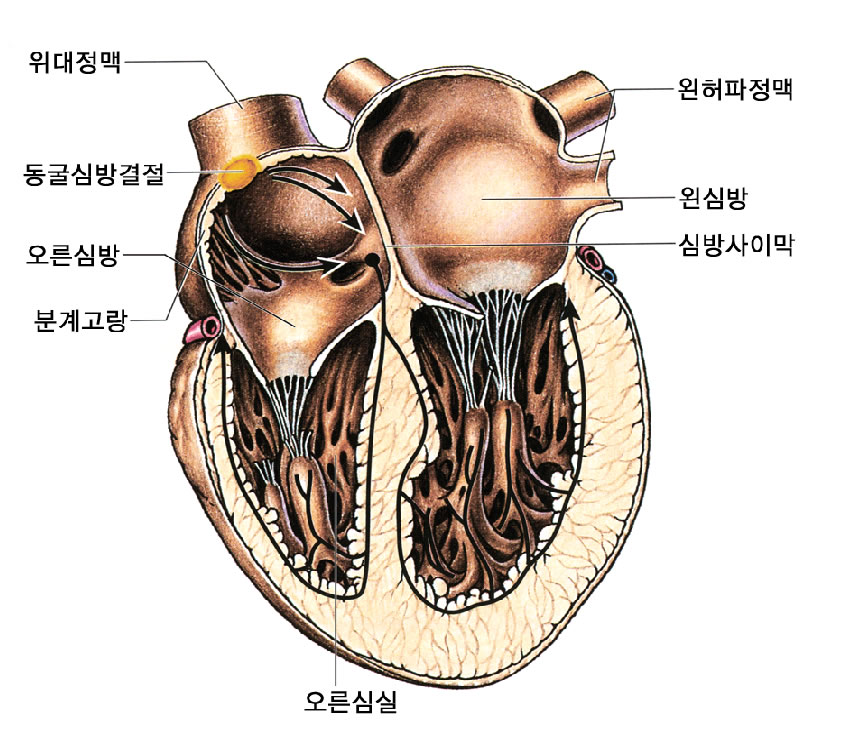 |
||
| IHD | Ischemic Heart Disease = Coronary Heart(Artery) Disease = Atheroscler... |
|---|---|
| JVP | [POMD P 49 - 52] 1) Jugular Vein Pressure 2) Jugular Venous Pulse ... |
| AHD | acquired hepatocerebral degeneration; acute heart disease; antihyaluronidase; antihypertensive drug;... |
| CHD | Chediak-Higashi disease; childhood disease; chronic hemodialysis; congenital or congestive heart dis... |
| HT | Hashimoto thyroiditis; hearing test; hearing threshold; heart; heart transplantation, heart transpla... |
| SRT | Simple Reaction Time |
|---|---|
| SSLP | Simple Sequence Length Polymorphism |
| SSR | Simple Sequence Repeats |
| SS | simple spike |
| STR | Simple tandem repeats |
| acute tubular necrosis | <nephrology> A kidney disorder that results in damage to the renal tubule cells leading to acute renal failure. Acute tubular necrosis can result from any condition which deprives the kidney of oxygen (ischaemia). Acute tubular necrosis may occur as a complication of shock, trauma or sepsis. Conditions such as diabetes or liver disease can predispose people to the development of acute tubular necrosis. Certain medications (for example aminoglycosides, amphotericin B, cyclosporine) are known to cause acute tubular necrosis as a toxic side effect. Radiopaque contrast dyes, used in some radiologic procedures, may also result in acute tubular necrosis as a rare complication from contrast dye use. Acronym: ATN (13 Nov 1997) |
|---|---|
| renal tubular acidosis | <nephrology> A rare sometimes familial disorder of the renal tubule characterised by the inability to excrete urine of normal acidity. This leads to a hyperchloraemic acidosis which is often associated with one or more secondary complications such as hypercalcinuria with nephrolithiasis and nephrocalcinosis, rickets, or osteomalacia and severe potassium depletion. (25 Jun 1999) |
| renal tubular transport, inborn errors | Genetically determined disorders of the reabsorptive functions of the kidney with regard to specific nephron segments responsible for specific transport functions, classifiable by proximal nephron function, loop of henle function, and distal nephron function. The transport defects can be selective or nonselective. (12 Dec 1998) |
| Pick's tubular adenoma | A neoplasm of the ovary, arising from the ovarian stroma, mimicking to a greater or lesser extent derivatives of the sex cord mesenchyme of the testis, and sometimes causing defeminization and virilization. (12 Dec 1998) |
| primary renal tubular acidosis | A metabolic defect in the mechanism of urinary acidification that may be either the transient type, with onset in infancy, or the persistent type, with onset in childhood or adult years; both types are familial. (05 Mar 2000) |
| secondary renal tubular acidosis | Renal tubular acidosis that may occur as a complication of hypercalcaemic states, hyperglobulinaemic disorders, and in some other chronic renal conditions; a regular component of De Toni-Fanconi syndrome. (05 Mar 2000) |
| osteopetrosis with renal tubular acidosis | <syndrome> An inherited deficiency of carbonic anhydrase II that results in osteopetrosis and metabolic acidosis. Synonym: osteopetrosis with renal tubular acidosis. (05 Mar 2000) |
| ovarian tubular adenoma | <oncology, tumour> A type of ovarian tumour whose sells secrete a male sex hormone (testosterone) causing virilisation in women. (27 Sep 1997) |
| testicular tubular adenoma | A neoplasm of the ovary, arising from the ovarian stroma, mimicking to a greater or lesser extent derivatives of the sex cord mesenchyme of the testis, and sometimes causing defeminization and virilization. (12 Dec 1998) |
| tubular | <anatomy> Shaped like a tube, of or pertaining to a tubule. Origin: L. Tubularis (18 Nov 1997) |
| tubular adenoma | <tumour> A benign neoplasm composed of epithelial tissue resembling a tubular gland. (05 Mar 2000) |
| tubular aneurysm | The uniform dilation of an artery along a considerable distance. Synonym: cylindroid aneurysm. (05 Mar 2000) |
| tubular carcinoma | <tumour> A well-differentiated form of ductal breast carcinoma with invasion of the stroma by small epithelial tubules. (05 Mar 2000) |
| tubular cyst | A cyst formed by the dilation of any occluded canal or tube. Synonym: tubular cyst. (05 Mar 2000) |
| tubular excretory mass | The mass of functioning excretory tubules of the kidney determined from the excretion of iodopyracet, or other compounds processed in the kidney primarily by tubular secretion, when large doses are used. (05 Mar 2000) |
제품명 |
판매사 |
보험코드 | 성분/함량 | 구분/보험급여 |
|---|
제품명 |
판매사 |
보험코드 | 성분/함량 | 구분/보험급여 |
|---|