
| 영문 | salivary gland | 한글 | 침샘, 타액선 |
|---|---|---|---|
| 설명 | 입 속으로 침을 분비하는 외분비샘으로 인체에는 세 쌍의 침샘이 있는데 귀밑샘, 턱밑샘 및 혀밑샘이 그들이다. 침샘은 분류상으로 소화기계통의 한 장기이며, 소화관의 한 부속샘으로 구분된다. 혀밑샘은 그 외 구강 점막 내에 산재하고 있는 수많은 작은 침샘과 같이 묽은 용액을 끊임없이 분비하고 있지만, 귀밑샘과 턱밑샘은 자극을 받을 때만 침을 분비한다. |
||
| 영문 | hepatic duct | 한글 | 간관 |
|---|---|---|---|
| 설명 | 간에서 생성된 담즙이 지나는 통로로 간에서 직접 담즙을 운반하는 관을 말한다. 간에서 만들어진 담즙은 간관, 쓸개주머니관를 거쳐서 쓸개에 보관되었다가 온쓸개관을 통해서 샘창자로 보내진다.  |
||
| 영문 | lacrimal duct | 한글 | 눈물관 |
|---|---|---|---|
| 설명 | 눈물이 흘러내리는 통로에 해당한다. 눈물은 대개 눈물샘에서 만들어져 눈을 적신 뒤에, 여기를 거쳐서 눈물주머니에 모인 뒤, 코눈물관으로 흘러 코 안쪽으로 내려가게 된다. 만약 여기가 막히면, 눈물이 계속 고이게 되어 계속 눈물을 흘리게 되며, 또한 병균의 서식처가 되어 감염의 위험성이 높아진다. 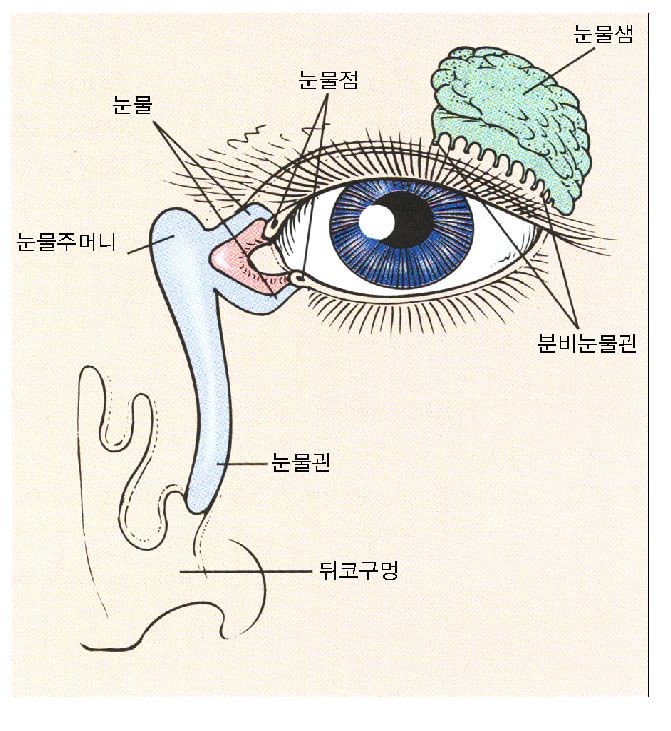 |
||
| 영문 | pancreatic duct | 한글 | 이자관, 췌장관 |
|---|---|---|---|
| 설명 | 이자에서 이자액을 분비하도록 샘창자로 이어진 관. 이자관은 샘창자의 중간부에서 온쓸개관과 같이 개구한다. |
||
| 영문 | nasolacrimal duct | 한글 | 코눈물관 |
|---|---|---|---|
| 설명 | 눈물은 대개 눈물샘에서 만들어져 눈을 적신 뒤에 누관을 거쳐서 눈물주머니에 모인 뒤에 이 코눈물관으로 흘러 코 안쪽으로 내려가게 된다. 만일 여기가 막히면, 눈물이 계속 고이게 되어 계속 눈물을 흘리게 되며, 또한 병균의 서식처가 되어 감염의 위험성이 높아진다. |
||
| CD | cadaver donor; canine distemper; canine dose; carbohydrate dehydratase; carbon dioxide; cardiac dise... |
|---|---|
| TDF | testis-determining factor; thoracic duct fistula; thoracic duct flow; time-dose fractionation; tissu... |
| LSG | labial salivary gland |
| MSGV | mouse salivary gland virus |
| PSA | parasternal short axis; pleomorphic salivary gland adenoma; polyethylene sulfonic acid; polysacchari... |
| SDC | Salivary duct carcinoma |
|---|---|
| LSG | Labial salivary gland |
| MSG | Minor salivary glands |
| S | Salivary |
| SFR | Salivary flow rates |
| salivary duct calculi | Small calculi found in the terminal salivary ducts may be referred to as salivary sand. Larger calculi (stones) are found in the larger ducts, such as stensen's duct and wharton's duct. (12 Dec 1998) |
|---|
| salivary gland calculi | Calculi occurring in a salivary gland. most salivary gland calculi occur in the submandibular gland, but can also occur in the parotid gland and in the sublingual and minor salivary glands. (12 Dec 1998) |
|---|---|
| common bile duct calculi | The presence of gallstones in the common bile duct. It is usually the result of passage of gallstones formed in the gallbladder into the common duct. Less commonly, stones form in a duct behind an obstruction caused by a stricture or ampullary stenosis. Stone type helps to determine site of origin: cholesterol or black pigment stones more likely form in the gallbladder, while almost all brown pigment stones in patients from western countries form in the bile ducts. (12 Dec 1998) |
| salivary duct | A type of intralobular duct found in some salivary glands that modifies the secretory product; it derives its name from extensive infolding of the basal membrane. Synonym: salivary duct, secretory duct. (05 Mar 2000) |
| bladder calculi | Calculi of the urinary bladder; also known as vesical calculi, bladder stones or gravel, and cystoliths. Vesicoprostatic calculi are prostatic calculi extending into the bladder. (12 Dec 1998) |
| calculi | An abnormal concretion occurring within the animal body and usually composed of mineral salts. (12 Dec 1998) |
| matrix calculi | <radiology> Radiolucent, associated with Proteus infection, composition: 2/3 mucoprotein, 1/3 mucopolysaccharide see also: renal calculi (12 Dec 1998) |
| renal calculi | <radiology> Common: calcium phosphate (8%), calcium oxalate (most common: 73%, most opaque), magnesium ammonium phosphate (struvite), uncommon: diammonium calcium phosphate, magnesium phosphate, rare: cystine (faintly opaque; 1%), urate (lucent; 7%), xanthine see: matrix calculi (12 Dec 1998) |
| kidney calculi | Calculi occurring in the kidney. Calculi too large to pass spontaneously range in size from 1 cm to the staghorn stones that occupy the renal pelvis and calyces. Bilateral renal calculi cause additional problems, with infection a common occurrence. (12 Dec 1998) |
| ureteral calculi | Calculi of the ureter. The calculus in the ureter is usually the result of the passage of one originating in the kidney. It occurs usually in mid-life, rarely in children; it occurs more frequently in males than females. (12 Dec 1998) |
| urinary calculi | Calculi in any part of the urinary tract. Vesical calculi (bladder calculi) are those found in the urinary bladder; renal calculi (kidney calculi) are those found in the pelvis of the kidney. Types of urinary calculi are often classified by chemical composition or pattern of chemical composition distribution. Urinary calculi types include alternating or combination, cystine, decubitus, encysted, fibrin, hemp seed, matrix, mulberry, oxalate, struvite, urostealith, and xanthic calculi. (12 Dec 1998) |
| biopsy, salivary gland | <investigation, procedure, surgery> A procedure which involves the removal of a small specimen of salivary gland tissue for microscopic analysis. Used in the diagnosis of Sjogren's syndrome. Risks include localised bleeding, infection and injury to the facial nerve. (21 Mar 1998) |
| major salivary glands | A category of salivary gland's that includes the three largest gland's of the oral cavity that also secrete most of the saliva: the parotid, submandibular, and sublingual gland's. (05 Mar 2000) |
| minor salivary gland | A small gland which produces saliva. There are numerous minor salivary glands distributed within the mouth and palate. (12 Dec 1998) |
| minor salivary glands | The smaller, largely mucous-secreting, exocrine gland's of the oral cavity, consisting of the labial, buccal, molar, lingual, and palatine gland's. (05 Mar 2000) |
| mixed tumour of salivary gland | A tumour composed of salivary gland epithelium and fibrous tissue with mucoid or cartilaginous areas. Synonym: pleomorphic adenoma. (05 Mar 2000) |
Synonyms : Calculi, Salivary Duct, Calculus, Salivary Duct, Duct Calculi, Salivary, Duct Calculus, Salivary, Duct Stone, Salivary, Duct Stones, Salivary, Salivary Duct Calculus, Salivary Duct Stone, Sialolithiases, Ductal, Stone, Salivary Duct, Stones, Salivary Duct
제품명 |
판매사 |
보험코드 | 성분/함량 | 구분/보험급여 |
|---|
제품명 |
판매사 |
보험코드 | 성분/함량 | 구분/보험급여 |
|---|