
| 영문 | red bone marrow | 한글 | 적색골수 |
|---|---|---|---|
| 설명 | 분화중의 갈비뼈, 척추뼈나 그 외의 많은 작은 뼈에 있는 활동성 골수이다. 적혈구나 과립백혈구의 생산 장소이다. |
||
| 영문 | muscle cell(=muscle fiber) | 한글 | 근육세포 |
|---|---|---|---|
| 설명 | 근육은 수의근(의식에 의해서 조절이 가능한 근육: 예를 들어 다리, 팔, 얼굴근육 등)과 불수의근(의식과 무관하게 조절하지 않아도 움직이는 근육: 예를 들어 심장근, 소화기관에 분포하는 근육 등)으로 나누어지며, 근육세포의 모양은 다음과 같다(수의근, 불수의근 외에 심장에 있는 심장근은 불수의근에 해당하지만 그 모양은 수의근과 같아 따로 분류한다).  |
||
| 영문 | white blood cell(WBC), leukocyte | 한글 | 백혈구 |
|---|---|---|---|
| 설명 | 혈액내에 골수구계세포와 림프계세포, 단핵구계세포를 모두 통틀어 말한다. 백혈구의 증가가 있으면 대개 감염이 있거나, 혹은 탈수현상이 있음을 의미한다. 또한 지나친 백혈구수의 감소는 인체내 면역기능이 떨어져 있음을 의미하며, 다른 질병에 의해 나타나는 이차적인 현상이 아닌지 꼭 진단을 받아보아야 한다. |
||
| 영문 | mast cell | 한글 | 비만 세포 |
|---|---|---|---|
| 설명 | 동물의 결합 조직 가운데 널리 분포하는 세포. 결합조직과 점막조직 내에 있는 호염기성 색소로 이염색성(metachromasia)을 나타내는 과립을 가진 방추형의 세포에 작은 둥근 핵을 가진다. 비만세포의 표면에는 IgE에 대한 수용체가 존재하며, 수용체에 결합한 IgE 분자들끼리 다가의 항원에 의해 서로 연결되면 비만세포 과립탈출 반응이 일어나, 히스타민, 세로토닌, 헤파린 등의 화학전달 물질이 방출되어, 즉시형 알레르기 반응 등의 증상을 일으킨다. 피부, 장막, 혈관 주위, 점막 주변에 있다. |
||
| 영문 | cell | 한글 | 세포 |
|---|---|---|---|
| 설명 | 생명체를 이루는 구조적, 기능적 단위. 핵의 유무에 따라서 유핵세포와 무핵세포로 나눌 수가 있다. 무핵세포란 핵이 없는 세포를 말한다. 핵이란 유전정보를 가지고 있는 염색체를 보관하는 곳인데 무핵세포에서는 염색체가 세포속에 그냥 노출되어 있다. 대개 세포 하나하나가 독립된 생명체의 역할을 하는 단세포생물로서 외부환경으로부터 자신을 보호할 수 있는 견고한 세포벽을 가지고 있다. 유핵세포란 핵을 가지고 있어서 유전정보가 있는 염색체가 세포의 다른 부분과 구분되어 핵속에 들어있다. 세포속에서 핵외의 부분(이를 세포질이라 한다)에는 여러 가지 세포의 소기관이 있어서 세포의 다양한 기능을 분담한다. ◈유핵세포의 기본 구조 1.세포막-세포를 둘러싸서 주위환경과 분리하여 세포의 내환경을 유지한다. 2.형질내세망(endoplasmic reticulum)-단위막으로 둘러쌓여 있는 불규칙한 망상구조이다. 이 망상구조의 내부를 소강, 소조라고 부른다. 여기에는 표면이 매끈한 무과립형질내세망과 표면이 불규칙한 과립형질내세망의 두 가지가 있다. 과립형질내세망의 경우는 표면에 단백질을 합성하는 리보솜이라는 것이 부착되어 있다. 이곳은 주로 세포밖으로 분비할 단백질을 합성하는 장소이다. 무과립형질내세망은 표면에 리보솜이 부착되어 있지 않은 것을 말하며, 이곳에서는 주로 해독작용, 글리코겐의 합성, 스테로이드호르몬의 합성 등이 일어난다. 3.리보솜-단백질을 합성하는 역할을 하는 곳이다.이것은 세포질에 존재하는 자유리보솜과 과립형질내세망에 부착이 되어 존재하는 부착리보솜의 두 가지로 나눈다. 자유리보솜은 주로 세포내에서 필요한 단백질을 만드는 역할을 하고 부착리보솜은 세포밖으로 분비할 단백질을 만드는 역할을 한다. 4.골지장치(Golgi apparatus)-핵주위에 분포하는 납작해진 주머니모양의 것이 중첩되어 형성된 층판 모양의 구조물로 과립형질내세망에서 생성되어 외부로 분비될 단백질을 모아서 농축, 포장하여 과립을 만드는 역할을 한다. 5.사립체(mitochondria)-구형, 난형의 긴 막대기 모양으로 크기가 다양한 구조물. 생물체의 에너지 저장물질인 ATP를 생산하는 역할을 한다. 또 세포와 다른 자신만의 유전정보를 가진 DNA, RNA를 가지고 있다. 모양, 크기가 세균과 비슷하며 자체증식성 등 독립된 생명체로서 필요한 요건을 갖추고 있어서 세포와 공생관계를 가진 독립된 세포로 생각하고 있다. 6.용해소체(lysosome)-작은 구형의 소체로 여러 가지 분해효소를 가진다. 세포외계에서 들어온 물질과 결합하여 그 물질들을 용해하는 역할을 하고, 오래된 세포소기관들을 제거하는 역할도 한다. 7.세포핵(nucleus)-구형, 난형으로 세포의 중심에 위치한다. 핵내에는 유전정보가 있는 물질인 염색체가 존재한다. 8.중심소체(centrosome)-핵주위에 존재하면서 핵의 분열시에 양쪽의 염색체를 당기는 작은 섬유를 만드는 역할을 하는 곳. 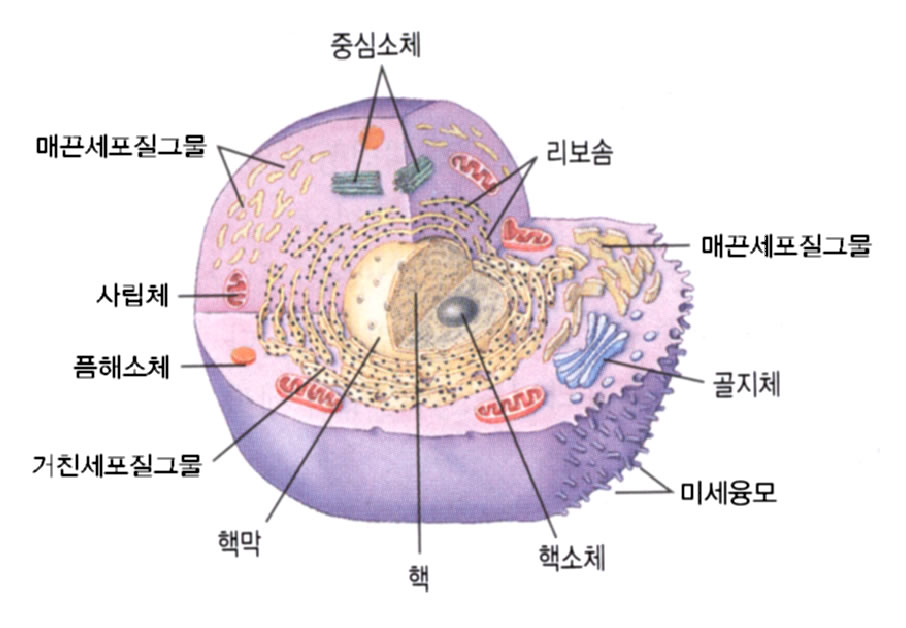 |
||
| RC | an electronic circuit containing a resistor and capacitor in series; radiocarpal; reaction center; r... |
|---|---|
| DRBC | denaturated red blood cell; dog red blood cell; donkey red blood cell |
| RBC | red blood cell; red blood corpuscle; red blood count |
| RCC | radiological control center; rape crisis center; ratio of cost to charges; receptor-chemoeffector co... |
| MRBC | monkey red blood cell; mouse red blood cell |
| RBC | Anti-red blood cell |
|---|---|
| SRBC | Anti-sheep red blood cell |
| HRBC | human red blood cell |
| IRBC | Infected red blood cell |
| MCV | Mean red cell volume |
| ghost cell | <haematology> A red blood cell which has had all of its cytoplasmic contents removed by cell lysis so that only its outer cytoplasmic membrane remains. (17 Dec 1997) |
|---|---|
| ghost cell glaucoma | Glaucoma occurring after vitrectomy, arising from erythrocyte membranes blocking outflow channels of aqueous humor. (05 Mar 2000) |
| ghost | 1. The spirit; the soul of man. "Then gives her grieved ghost thus to lament." (Spenser) 2. The disembodied soul; the soul or spirit of a deceased person; a spirit appearing after death; an apparition; a specter. "The mighty ghosts of our great Harrys rose." (Shak) "I thought that I had died in sleep, And was a blessed ghost." (Coleridge) 3. Any faint shadowy semblance; an unsubstantial image; a phantom; a glimmering; as, not a ghost of a chance; the ghost of an idea. "Each separate dying ember wrought its ghost upon the floor." (Poe) 4. A false image formed in a telescope by reflection from the surfaces of one or more lenses. <zoology> Ghost moth the third person in the Trinity. To give up or yield up the ghost, to die; to expire. "And he gave up the ghost full softly." (Chaucer) "Jacob . . . Yielded up the ghost, and was gathered unto his people". (Gen. Xlix. 33) Origin: OE. Gast, gost, soul, spirit, AS. Gast breath, spirit, soul; akin to OS. Gst spirit, soul, D. Geest, G. Geist, and prob. To E. Gaze, ghastly. Source: Websters Dictionary (01 Mar 1998) |
| ghost corpuscle | A hypochromic, crescent-shaped erythrocyte, probably resulting from artifactual rupture of a red cell with loss of haemoglobin. Synonym: achromacyte, achromatocyte, ghost corpuscle, phantom corpuscle, Ponfick's shadow, shadow corpuscle, shadow, Traube's corpuscle. Origin: G. A-priv. + chroma, colour, + kytos, hollow (cell) (05 Mar 2000) |
| ghost tooth | A tooth with reduced radiodensity seen in regional odontodysplasia. (05 Mar 2000) |
| resealed ghost | <haematology> Membrane shells formed by lysis of erythrocytes resealed by adjusting the cation composition of the medium. Relatively impermeable, although more permeable than the original membrane. (18 Nov 1997) |
| erythrocyte ghost | <cell biology> The membrane and cytoskeletal elements of the erythrocyte devoid of cytoplasmic contents, but preserving the original morphology. (18 Nov 1997) |
| packed red blood cell | <haematology> Red blood cells collected from one individual that are packed into a small volume for transfusion into a patient. (16 Dec 1997) |
| red blood cell | <haematology> Cell specialised for oxygen transport, having a high concentration of haemoglobin in the cytoplasm (and little else). Biconcave, anucleate discs, 7nm diameter in mammals, nucleus contracted and chromatin condensed in other vertebrates. Acronym: RBC (18 Nov 1997) |
| red blood cell cast | A urinary cast composed of a matrix containing red cells in various stages of degeneration and visibility, characteristic of glomerular disease or renal parenchymal bleeding. Synonym: red cell cast. (05 Mar 2000) |
| red blood cell count | A normal value is 4.6-6.2 million RBC's per cubic millimetre of blood. This number can increase in cases of dehydration (fluid loss) or severe lung disease. Interestingly, red blood cell counts are much higher in those who live at high altitude, because of the increased demand for oxygen carrying capacity. (27 Sep 1997) |
| red blood cell indices | Laboratory measurements of red blood cell volume, size and haemoglobin concentration. These values are used to point to the specific cause for anaemia (iron deficiency, B12 deficiency, etc.) (27 Sep 1997) |
| red cell adherence phenomenon | A phenomenon manifested by the adherence of antigen-antibody-complement complex to "indicator cells" (microorganisms, platelets, leukocytes, or erythrocytes), the reaction being sensitive and specific for the antigen and antibody in the complex. Synonym: erythrocyte adherence phenomenon, immune adherence phenomenon, red cell adherence phenomenon. (05 Mar 2000) |
| red cell adherence test | The diagnostic application of the immune adhesion phenomenon. Synonym: erythrocyte adherence test, immune adhesion test, red cell adherence test. (05 Mar 2000) |
| red-cell aplasia, pure | Suppression of erythropoiesis with little or no abnormality of leukocyte or platelet production. (12 Dec 1998) |
제품명 |
판매사 |
보험코드 | 성분/함량 | 구분/보험급여 |
|---|
제품명 |
판매사 |
보험코드 | 성분/함량 | 구분/보험급여 |
|---|