
| 영문 | white matter | 한글 | 백색질 |
|---|---|---|---|
| 설명 | 1. 뇌는 두 부분으로 나뉘어져 있다. 대뇌겉질이나 뇌의 중앙부에 위치하는 핵(예를 들면 시상, 시상하부, 바닥핵 등)이 회색질이고 그 외는 백색질이다. 척수의 경우에는 바깥쪽의 하얀부분을 백색질이라 하고, 안쪽의 색깔이 어두운 부분을 회색질이라 한다. 이중 실제적으로 대부분의 신경세포의 돌기 특히 축삭과 말이집으로 구성된 것이 백색질이며, 회색질은 신경세포와 보조하는 세포들이 많은 곳이다. 또한 척수도 백색질과 회색질로 나뉘어 있다. 2. 치아에 점착된 백색 물질로서 세균 및 사상 미생물을 함유한 점액 및 상피세포로 구성된다. 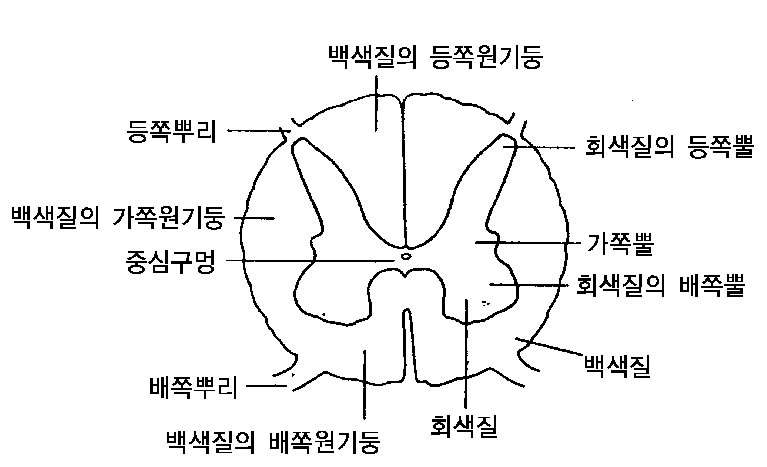 |
||
| CGM | central gray matter |
|---|---|
| GM | gastric mucosa; Geiger-Muller [counter]; general medicine; genetic manipulation; geometric mean; gia... |
| PAG | periaqueductal gray [matter]; polyacrylamide gel; pregnancy-associated globulin; proliferation-assoc... |
| PAG | Peri-Aqueductal Gray |
| GPS | Goodpasture syndrome; gray platelet syndrome; guinea pig serum; guinea pig spleen |
| GM | Gray matter |
|---|---|
| PAG | Periaquaeductal gray matter |
| DPAG | dorsal periaqueductal gray matter |
| CPM | Central Pontine Myelinolysis |
| EPM | Extra Pontine Myelinolysis |
| pontine gray matter | The massive gray matter filling the basilar pons. The nuclei are of fairly homogeneous architecture and project to the cortex of the contralateral cerebellar hemisphere by way of the middle cerebellar peduncle. Their main afferents come from the entire extent of the cerebral neocortex by way of the longitudinal pontine bundles (corticopontine fibres); thus, the pontine nuclei form a major way-station in the impulse conduction from the cerebral cortex of one hemisphere to the posterior lobe of the opposite cerebellum. Synonym: nuclei pontis, pontine gray matter. (05 Mar 2000) |
|---|
| matter, gray | The cortex of the brain which contains nerve cell bodies. The gray matter is as opposed to the white matter, the part of the brain that contains myelinated nerve fibres. The gray matter is so named because it in fact appears gray. In the mysterious affair at styles (1920), agatha christie first quoted the fictional belgian detective hercule poirot in regard to his gray matter: 'this affair must be unravelled from within.' he tapped his forehead. 'these little grey cells. It is up to them as you say over here.' (12 Dec 1998) |
|---|---|
| gray matter | The cortex of the brain which contains nerve cell bodies. The gray matter is in contrast to the white matter, the part of the brain that contains myelinated nerve fibres. The gray matter is so named because it in fact appears gray. The white matter is white because that is the colour of myelin, the insulation covering the nerve fibres. In the mysterious affair at styles (1920), agatha christie first quoted the fictional belgian detective hercule poirot in regard to his gray matter: 'this affair must be unravelled from within.' he tapped his forehead. 'these little grey cells. It is up to them as you say over here.' (12 Dec 1998) |
| heterotopic gray matter | <radiology> Presence of cortical neurons in an abnormal location secondary to arrest of migrating neuroblasts from ventricular walls to brain surface between 7-24 weeks of gestational age, frequency: 3% of healthy population associated with: agenesis of corpus callosum, aqueductal stenosis, microcephaly, schisencephaly, encephalocele X-ray: single/multiple bilateral subependymal nodules along lateral ventricles Differential diagnosis: subependymal spread of neoplasm, subependymal haemorrhage, vascular malformation, tuberous sclerosis, intraventricular meningioma, neurofibromatosis (12 Dec 1998) |
| gray level also gray value | <microscopy> The brightness of pixels in a digitised video image, commonly expressed in integers ranging from 0 (black) to 255 (white) for an 8-bit digital signal. (05 Aug 1998) |
| matter | <chemistry> The material of the universe. (09 Jan 1998) |
| matter, white | The part of the brain that contains myelinated nerve fibres. The white matter is white because it is the colour of myelin, the insulation covering the nerve fibres. The white matter is as opposed to the gray matter (the cortex of the brain which contains nerve cell bodies). (12 Dec 1998) |
| grey matter | <anatomy> Gray matter, the thinking brain, appears gray because it is composed of numerous nerve cells and blood vessels. The outer layer of the cerebrum - the cerebral cortex and areas deep within the brain - the basal ganglia, are made up of grey matter. See: white matter. (16 Dec 1997) |
| white matter | <anatomy> Brain tissue composed of myelin-coated nerve cell fibres. White matter carries information between the nerve cells in the brain and spinal cord. The inner portion of the cerebrum is composed of white matter. See: grey matter. (13 Nov 1997) |
| white-matter disease | <radiology> Demyelinating (myelinoclastic), destruction of existing myelin, acquired diseases with inflammatory characteristics, includes: MS, PML, encephalomyelitis, also may be due to anoxia, infarct, tumour, radiation dysmyelinating, abnormal myelin formation or maintenance, two groups: primary white-matter diseases: leukodystrophies, involve gray matter: Niemann-Pick, Gaucher, Tay-Sachs (12 Dec 1998) |
| sclerosis of white matter | <radiology> Type of dysmyelinating disease, hereditary, peripheral nervous system unaffected in some disorders Specific diseases: adrenoleukodystrophy, metachromatic leukodystrophy, spongy degeneration (Canavan), globoid cell (Krabbe) leukodystrophy, Alexander disease, Pelizaeus-Merzbacher disease, Cockayne syndrome (12 Dec 1998) |
| basilar pontine sulcus | A median groove on the ventral surface of the pons varolii in which lies the basilar artery. Synonym: sulcus basilaris pontis, basilar sulcus. (05 Mar 2000) |
| central pontine myelinolysis | <neurology> A condition characterised by damage to the myelin (sheath) layer of nerve cells in the pons (brainstem). The destruction of myelin inhibits the conduction of a nerve impulse along a nerve cell. The most common cause for exacerbating this condition is a rapid correction of hyponatraemia (low blood sodium level). Some conditions such as Wernicke-Korsakoff syndrome and alcoholism can predispose to loss of myelin. Symptoms can include weakness, double vision, muscle spasms, speech difficulty, delirium, sleepiness, hallucinations, tremors and uncontrolled eye movements. An MRI scan of the brain can demonstrate the abnormality. A more slow controlled correction of serum sodium levels is necessary in these patients. There is no definitive treatment for the underlying disorder. (12 Jan 1998) |
| myelinolysis, central pontine | A form of massive demyelination of the pons occurring in malnutrition and alcoholism. The remarkable unsystematic dissolution of the sheaths of medullated fibres is its most certain feature. The lesion varies from only a few millimeters in diameter to almost the entire pons. The basic pathology is the destruction of the medullated sheaths throughout the lesions with relative sparing of the axis cylinders and intactness of the nerve cells of the pontine nuclei. Pathologically it is easily differentiated from infarction and the inflammatory demyelinations of multiple sclerosis and postinfectious encephalomyelitis. There does not appear to be a genetic, sex, or age factor. It is often, however, associated with some other serious disease, particularly chronic alcoholism. (adams & victor, principles of neurology, 2d ed, p720) (12 Dec 1998) |
| pontine angle | <anatomy, oncology> The angle between the cerebellum and the pons, a common site for the growth of acoustic neuromas. (16 Dec 1997) |
| pontine angle tumour | A tumour in the angle formed by the cerebellum and the lateral pons, often refers to an acoustic schwannoma. (05 Mar 2000) |
제품명 |
판매사 |
보험코드 | 성분/함량 | 구분/보험급여 |
|---|
제품명 |
판매사 |
보험코드 | 성분/함량 | 구분/보험급여 |
|---|