
| 영문 | peritoneal dialysis | 한글 | 복막투석 |
|---|---|---|---|
| 설명 | 투석이란, 혈액내에 존재하는 노폐물을 콩팥외의 다른 방법으로 제거하는 것을 말한다. 정상적으로 신장은 몸속에 싸인 노폐물을 소변으로 배설하는 역할을 하지만, 만성콩팥기능상실 때 노폐물은 몸 밖으로 나갈 수 없게 되고 체내에 쌓여서 이상을 가져온다. 복막투석에는 간간히 혈액투석과 같이 시행하는 간헐적복막투석이 있고, 항상 환자가 착용하는 Continuous Ambulatory Peritoneal Dialysis(CAPD)가 있다.(그림 P-8) |
||
| 영문 | muscle cell(=muscle fiber) | 한글 | 근육세포 |
|---|---|---|---|
| 설명 | 근육은 수의근(의식에 의해서 조절이 가능한 근육: 예를 들어 다리, 팔, 얼굴근육 등)과 불수의근(의식과 무관하게 조절하지 않아도 움직이는 근육: 예를 들어 심장근, 소화기관에 분포하는 근육 등)으로 나누어지며, 근육세포의 모양은 다음과 같다(수의근, 불수의근 외에 심장에 있는 심장근은 불수의근에 해당하지만 그 모양은 수의근과 같아 따로 분류한다).  |
||
| 영문 | white blood cell(WBC), leukocyte | 한글 | 백혈구 |
|---|---|---|---|
| 설명 | 혈액내에 골수구계세포와 림프계세포, 단핵구계세포를 모두 통틀어 말한다. 백혈구의 증가가 있으면 대개 감염이 있거나, 혹은 탈수현상이 있음을 의미한다. 또한 지나친 백혈구수의 감소는 인체내 면역기능이 떨어져 있음을 의미하며, 다른 질병에 의해 나타나는 이차적인 현상이 아닌지 꼭 진단을 받아보아야 한다. |
||
| 영문 | mast cell | 한글 | 비만 세포 |
|---|---|---|---|
| 설명 | 동물의 결합 조직 가운데 널리 분포하는 세포. 결합조직과 점막조직 내에 있는 호염기성 색소로 이염색성(metachromasia)을 나타내는 과립을 가진 방추형의 세포에 작은 둥근 핵을 가진다. 비만세포의 표면에는 IgE에 대한 수용체가 존재하며, 수용체에 결합한 IgE 분자들끼리 다가의 항원에 의해 서로 연결되면 비만세포 과립탈출 반응이 일어나, 히스타민, 세로토닌, 헤파린 등의 화학전달 물질이 방출되어, 즉시형 알레르기 반응 등의 증상을 일으킨다. 피부, 장막, 혈관 주위, 점막 주변에 있다. |
||
| 영문 | cell | 한글 | 세포 |
|---|---|---|---|
| 설명 | 생명체를 이루는 구조적, 기능적 단위. 핵의 유무에 따라서 유핵세포와 무핵세포로 나눌 수가 있다. 무핵세포란 핵이 없는 세포를 말한다. 핵이란 유전정보를 가지고 있는 염색체를 보관하는 곳인데 무핵세포에서는 염색체가 세포속에 그냥 노출되어 있다. 대개 세포 하나하나가 독립된 생명체의 역할을 하는 단세포생물로서 외부환경으로부터 자신을 보호할 수 있는 견고한 세포벽을 가지고 있다. 유핵세포란 핵을 가지고 있어서 유전정보가 있는 염색체가 세포의 다른 부분과 구분되어 핵속에 들어있다. 세포속에서 핵외의 부분(이를 세포질이라 한다)에는 여러 가지 세포의 소기관이 있어서 세포의 다양한 기능을 분담한다. ◈유핵세포의 기본 구조 1.세포막-세포를 둘러싸서 주위환경과 분리하여 세포의 내환경을 유지한다. 2.형질내세망(endoplasmic reticulum)-단위막으로 둘러쌓여 있는 불규칙한 망상구조이다. 이 망상구조의 내부를 소강, 소조라고 부른다. 여기에는 표면이 매끈한 무과립형질내세망과 표면이 불규칙한 과립형질내세망의 두 가지가 있다. 과립형질내세망의 경우는 표면에 단백질을 합성하는 리보솜이라는 것이 부착되어 있다. 이곳은 주로 세포밖으로 분비할 단백질을 합성하는 장소이다. 무과립형질내세망은 표면에 리보솜이 부착되어 있지 않은 것을 말하며, 이곳에서는 주로 해독작용, 글리코겐의 합성, 스테로이드호르몬의 합성 등이 일어난다. 3.리보솜-단백질을 합성하는 역할을 하는 곳이다.이것은 세포질에 존재하는 자유리보솜과 과립형질내세망에 부착이 되어 존재하는 부착리보솜의 두 가지로 나눈다. 자유리보솜은 주로 세포내에서 필요한 단백질을 만드는 역할을 하고 부착리보솜은 세포밖으로 분비할 단백질을 만드는 역할을 한다. 4.골지장치(Golgi apparatus)-핵주위에 분포하는 납작해진 주머니모양의 것이 중첩되어 형성된 층판 모양의 구조물로 과립형질내세망에서 생성되어 외부로 분비될 단백질을 모아서 농축, 포장하여 과립을 만드는 역할을 한다. 5.사립체(mitochondria)-구형, 난형의 긴 막대기 모양으로 크기가 다양한 구조물. 생물체의 에너지 저장물질인 ATP를 생산하는 역할을 한다. 또 세포와 다른 자신만의 유전정보를 가진 DNA, RNA를 가지고 있다. 모양, 크기가 세균과 비슷하며 자체증식성 등 독립된 생명체로서 필요한 요건을 갖추고 있어서 세포와 공생관계를 가진 독립된 세포로 생각하고 있다. 6.용해소체(lysosome)-작은 구형의 소체로 여러 가지 분해효소를 가진다. 세포외계에서 들어온 물질과 결합하여 그 물질들을 용해하는 역할을 하고, 오래된 세포소기관들을 제거하는 역할도 한다. 7.세포핵(nucleus)-구형, 난형으로 세포의 중심에 위치한다. 핵내에는 유전정보가 있는 물질인 염색체가 존재한다. 8.중심소체(centrosome)-핵주위에 존재하면서 핵의 분열시에 양쪽의 염색체를 당기는 작은 섬유를 만드는 역할을 하는 곳. 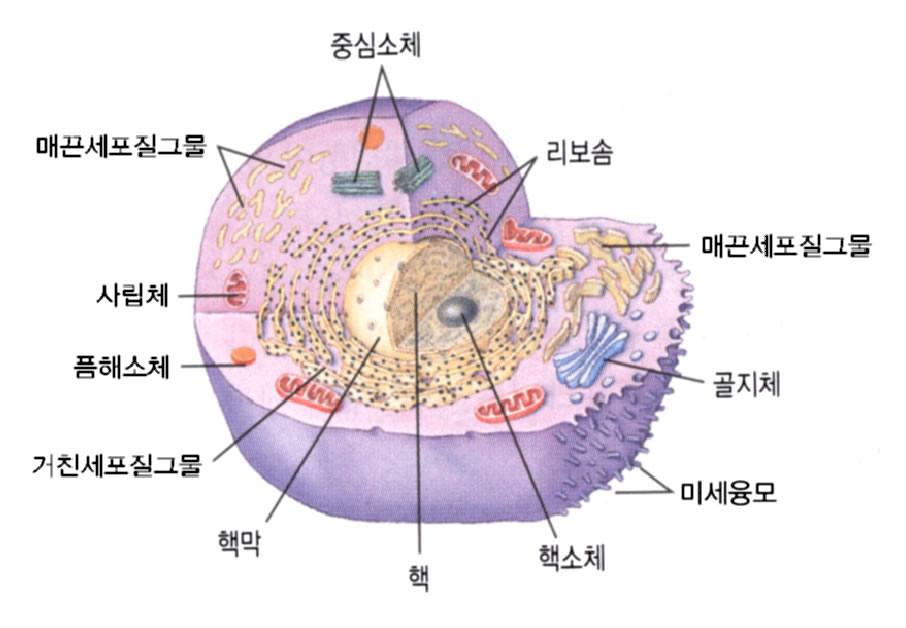 |
||
| PEC | pelvic cramps; peritoneal exudate cell; pyrogenic exotoxin C |
|---|---|
| PE | Edinburgh Pharmacopoeia; pancreatic extract; paper electrophoresis; partial epilepsy; pelvic examina... |
| PEL | peritoneal exudate lymphocyte; permissible exposure limit |
| PEM | pediatric emergency medicine; peritoneal exudate macrophage; polymorphic epithelial mucin; prescript... |
| PC | avoirdupois weight [Lat. pondus civile]; packed cells; paper chromatography; paracortex; parent cell... |
| PEL | Peritoneal exudate lymphocytes |
|---|---|
| PE | Peritoneal exudate |
| PEM | Peritoneal exudate macrophages |
| APD | Automated Peritoneal Dialysis |
| CAPD | Chronic Ambulatory Peritoneal Dialysis |
| peritoneal exudate | A term most commonly used to describe the fluid drained from the peritoneal cavity some time after the injection of an irritant solution. For example: a standard method for obtaining neutrophil leucocytes is to inject intraperitoneally saline with glycogen (to activate complement) and drain off the leucocyte rich peritoneal exudate some hours later. (18 Nov 1997) |
|---|---|
| exudate cell | Leucocytes that enter tissues (exude from the blood vessels) during an inflammatory response. See: peritoneal exudate. (18 Nov 1997) |
| exudate | <physiology> Material, such as fluid, cells or cellular debris, which has escaped from blood vessels and has been deposited in tissues or on tissue surfaces, usually as a result of inflammation. An exudate, in contrast to a transudate, is characterised by a high content of protein, cells or solid materials derived from cells. Compare: transudate. Origin: L. Exsudare = to sweat out (27 Jun 1999) |
| macrophages, peritoneal | Mononuclear phagocytes derived from bone marrow precursors but resident in the peritoneum. (12 Dec 1998) |
| panniculitis, peritoneal | Condition of the peritoneum, most commonly of the mesentery, but also of the omentum, characterised by tissue thickening, alteration of fat cells, infiltration of lipid-laden macrophages, and fibrosis. (12 Dec 1998) |
| greater peritoneal cavity | The space enclosed by the peritoneum. It is divided into two portions, the greater sac and the lesser sac or omental bursa, which lies behind the stomach. The two sacs are connected by the foramen of winslow, or epiploic foramen. (12 Dec 1998) |
| peritoneal | <anatomy> Of or pertaining to the peritoneum. Origin: Cf. F. Peritoneal. Source: Websters Dictionary (01 Mar 1998) |
| peritoneal button | A device used to drain ascitic fluid to subcutaneous space. (05 Mar 2000) |
| peritoneal cavity | The space enclosed by the peritoneum. It is divided into two portions, the greater sac and the lesser sac or omental bursa, which lies behind the stomach. The two sacs are connected by the foramen of winslow, or epiploic foramen. (12 Dec 1998) |
| peritoneal dialysis | <nephrology, procedure> In this type of dialysis, a special solution is run through a tube into the peritoneum, a thin tissue that lines the cavity of the abdomen. The bodys waste products are removed through the tube. There are three types of peritoneal dialysis. Continuous ambulatory peritoneal dialysis (CAPD), the most common type, needs no machine and can be done at home. Continuous cyclic peritoneal dialysis (CCPD) uses a machine and is usually performed at night when the person is sleeping. Intermittent peritoneal dialysis (IPD) uses the same type of machine as CCPD, but is usually done in the hospital because treatment takes longer. Haemodialysis and peritoneal dialysis may be used to treat people with diabetes who have kidney failure. (09 Oct 1997) |
| peritoneal dialysis, continuous ambulatory | Portable peritoneal dialysis using the continuous (24 hours a day, 7 days a week) presence of peritoneal dialysis solution in the peritoneal cavity except for periods of drainage and instillation of fresh solution. (12 Dec 1998) |
| peritoneal diseases | Conditions or disorders affecting the peritoneum. (12 Dec 1998) |
| peritoneal fossae | Depressions or pouches formed between various peritoneal folds; they may be the sites of internal hernias. (05 Mar 2000) |
| peritoneal lavage | Washing out of the peritoneal cavity. The procedure is a diagnostic as well as a therapeutic technique following abdominal trauma or inflammation. (12 Dec 1998) |
| peritoneal transfusion | The injection of saline solution or other fluid into the peritoneal cavity. (05 Mar 2000) |
제품명 |
판매사 |
보험코드 | 성분/함량 | 구분/보험급여 |
|---|
제품명 |
판매사 |
보험코드 | 성분/함량 | 구분/보험급여 |
|---|