
| 영문 | muscle cell(=muscle fiber) | 한글 | 근육세포 |
|---|---|---|---|
| 설명 | 근육은 수의근(의식에 의해서 조절이 가능한 근육: 예를 들어 다리, 팔, 얼굴근육 등)과 불수의근(의식과 무관하게 조절하지 않아도 움직이는 근육: 예를 들어 심장근, 소화기관에 분포하는 근육 등)으로 나누어지며, 근육세포의 모양은 다음과 같다(수의근, 불수의근 외에 심장에 있는 심장근은 불수의근에 해당하지만 그 모양은 수의근과 같아 따로 분류한다).  |
||
| 영문 | white blood cell(WBC), leukocyte | 한글 | 백혈구 |
|---|---|---|---|
| 설명 | 혈액내에 골수구계세포와 림프계세포, 단핵구계세포를 모두 통틀어 말한다. 백혈구의 증가가 있으면 대개 감염이 있거나, 혹은 탈수현상이 있음을 의미한다. 또한 지나친 백혈구수의 감소는 인체내 면역기능이 떨어져 있음을 의미하며, 다른 질병에 의해 나타나는 이차적인 현상이 아닌지 꼭 진단을 받아보아야 한다. |
||
| 영문 | mast cell | 한글 | 비만 세포 |
|---|---|---|---|
| 설명 | 동물의 결합 조직 가운데 널리 분포하는 세포. 결합조직과 점막조직 내에 있는 호염기성 색소로 이염색성(metachromasia)을 나타내는 과립을 가진 방추형의 세포에 작은 둥근 핵을 가진다. 비만세포의 표면에는 IgE에 대한 수용체가 존재하며, 수용체에 결합한 IgE 분자들끼리 다가의 항원에 의해 서로 연결되면 비만세포 과립탈출 반응이 일어나, 히스타민, 세로토닌, 헤파린 등의 화학전달 물질이 방출되어, 즉시형 알레르기 반응 등의 증상을 일으킨다. 피부, 장막, 혈관 주위, 점막 주변에 있다. |
||
| 영문 | cell | 한글 | 세포 |
|---|---|---|---|
| 설명 | 생명체를 이루는 구조적, 기능적 단위. 핵의 유무에 따라서 유핵세포와 무핵세포로 나눌 수가 있다. 무핵세포란 핵이 없는 세포를 말한다. 핵이란 유전정보를 가지고 있는 염색체를 보관하는 곳인데 무핵세포에서는 염색체가 세포속에 그냥 노출되어 있다. 대개 세포 하나하나가 독립된 생명체의 역할을 하는 단세포생물로서 외부환경으로부터 자신을 보호할 수 있는 견고한 세포벽을 가지고 있다. 유핵세포란 핵을 가지고 있어서 유전정보가 있는 염색체가 세포의 다른 부분과 구분되어 핵속에 들어있다. 세포속에서 핵외의 부분(이를 세포질이라 한다)에는 여러 가지 세포의 소기관이 있어서 세포의 다양한 기능을 분담한다. ◈유핵세포의 기본 구조 1.세포막-세포를 둘러싸서 주위환경과 분리하여 세포의 내환경을 유지한다. 2.형질내세망(endoplasmic reticulum)-단위막으로 둘러쌓여 있는 불규칙한 망상구조이다. 이 망상구조의 내부를 소강, 소조라고 부른다. 여기에는 표면이 매끈한 무과립형질내세망과 표면이 불규칙한 과립형질내세망의 두 가지가 있다. 과립형질내세망의 경우는 표면에 단백질을 합성하는 리보솜이라는 것이 부착되어 있다. 이곳은 주로 세포밖으로 분비할 단백질을 합성하는 장소이다. 무과립형질내세망은 표면에 리보솜이 부착되어 있지 않은 것을 말하며, 이곳에서는 주로 해독작용, 글리코겐의 합성, 스테로이드호르몬의 합성 등이 일어난다. 3.리보솜-단백질을 합성하는 역할을 하는 곳이다.이것은 세포질에 존재하는 자유리보솜과 과립형질내세망에 부착이 되어 존재하는 부착리보솜의 두 가지로 나눈다. 자유리보솜은 주로 세포내에서 필요한 단백질을 만드는 역할을 하고 부착리보솜은 세포밖으로 분비할 단백질을 만드는 역할을 한다. 4.골지장치(Golgi apparatus)-핵주위에 분포하는 납작해진 주머니모양의 것이 중첩되어 형성된 층판 모양의 구조물로 과립형질내세망에서 생성되어 외부로 분비될 단백질을 모아서 농축, 포장하여 과립을 만드는 역할을 한다. 5.사립체(mitochondria)-구형, 난형의 긴 막대기 모양으로 크기가 다양한 구조물. 생물체의 에너지 저장물질인 ATP를 생산하는 역할을 한다. 또 세포와 다른 자신만의 유전정보를 가진 DNA, RNA를 가지고 있다. 모양, 크기가 세균과 비슷하며 자체증식성 등 독립된 생명체로서 필요한 요건을 갖추고 있어서 세포와 공생관계를 가진 독립된 세포로 생각하고 있다. 6.용해소체(lysosome)-작은 구형의 소체로 여러 가지 분해효소를 가진다. 세포외계에서 들어온 물질과 결합하여 그 물질들을 용해하는 역할을 하고, 오래된 세포소기관들을 제거하는 역할도 한다. 7.세포핵(nucleus)-구형, 난형으로 세포의 중심에 위치한다. 핵내에는 유전정보가 있는 물질인 염색체가 존재한다. 8.중심소체(centrosome)-핵주위에 존재하면서 핵의 분열시에 양쪽의 염색체를 당기는 작은 섬유를 만드는 역할을 하는 곳. 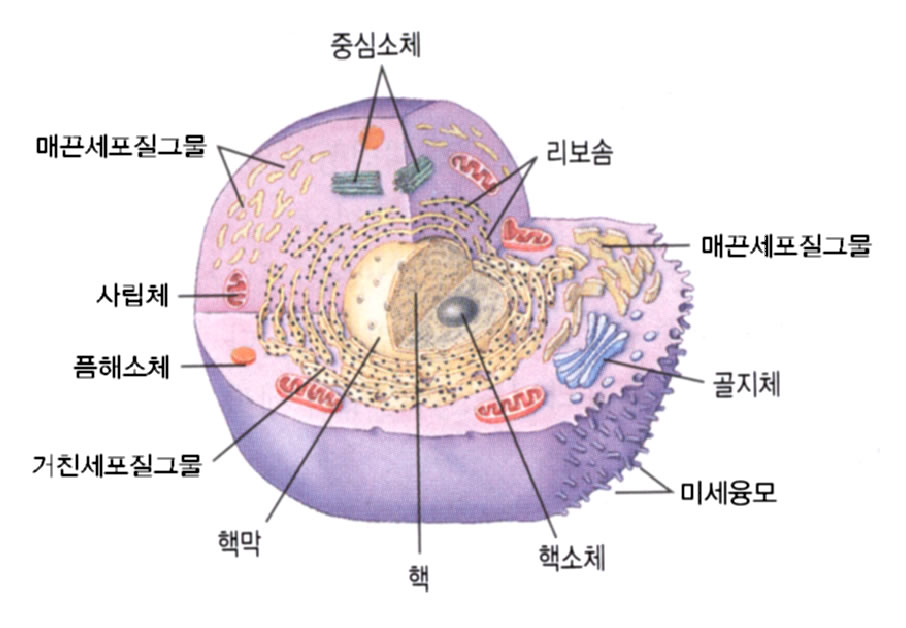 |
||
| 영문 | cell-mediated immunity | 한글 | 세포매개면역 |
|---|---|---|---|
| 설명 | 면역이란 신체를 외부의 물질로부터 보호하는 행위를 말한다. 여기에는 특이적 면역과 비특이적 면역의 두 가지가 있다. 비특이적 면역이라함은 특정한 물질에 관계하는 면역이 아니라 특정 대상이 없이 모든 외부 물체에 작용할 수 있는 면역을 말한다. 여기에는 소변의 흐름, 눈물의 흐름, 피부의 비투과성 등의 기계적인 것도 포함되고 피속에 돌아다니는 세포 중에서 비특이적으로 외부의 물질을 포식하는 세포들(예를 들면 큰포식세포(macrophage)의 활동도 포함이 된다. 세포매개면역이란 특이한 물질을 감지할 수 있는 세포를 생성하게 하여 그것으로 하여금 그 물질을 포식하게 하는 것을 말한다. |
||
| NK cell | Natural Killer cell |
|---|---|
| NK | Commission on [Anatomical] Nomenclature [Ger. Nomenklatur Kommission]; natural killer [cell]; neurok... |
| NKCA | natural killer cell activity |
| NKSF | natural killer cell stimulatory factor |
| LGL-NK | large granular lymphocyte-natural killer |
| NK cell | natural killer cell |
|---|---|
| NKCA | Natural Killer Cell Activity |
| NKCC | Natural Killer Cell Cytotoxicity |
| NKSF | Natural Killer cell Stimulatory Factor |
| NKC | Natural killer cell |
| natural killer cell | <haematology, immunology> A certain type of white blood cell that attacks tumour cells and infected body cells by binding to a tumour cell and releasing lethal chemicals. Natural killer cells are thought to play a key role in cancer prevention by killing abnormal cells before they multiply and grow. (16 Dec 1997) |
|---|---|
| natural killer cell stimulating factor | <cytokine> A 75 kD heterodimeric cytokine composed of disulfide-bonded 40 kD and 35 kD subunits that was originally identified by its ability to induce cytotoxic effector cells in synergy with less than optimal concentrations of interleukin-2. It is released by macrophages in response to infection and promotes the activation of cell-mediated immunity. Specifically, IL-12 triggers the maturation of Thl CD4 cells, specific cytotoxic T-lymphocyte responses and an increase in the activity of NK cells and consequently, it is the initiator of cell-mediated immunity. It enhances the lytic activity of NK cells, induces interferon production, stimulates the proliferation of activated T-cells and NK cells. Is secreted by human B lymphoblastoid cells (NC 37). May play a role in controlling immunoglobulin isotype selection as it also inhibits IgE synthesis (even in the presence of anti-IFN monoclonal antibody) and as a growth factor for activated CD4+ and CD8+ T-cells independently of interleukin-2, and for CD56+ NK cells but not resting peripheral blood mononuclear cells or resting or activated tonsillar B-cells. It is likely that interleukin 12 has a major role in protective immunity against viruses and is under study as an immunotherapy in HIV infection. Formerly referred to as cytotoxic lymphocyte maturation factor. Acronym: IL-12 (12 Dec 1998) |
| natural killer cells | Large granular lymphocytes which do not express markers of either T or B-cell lineage. These cells do possess Fc receptors for IgG and can kill target cells using antibody-dependent cell-mediated cytotoxicity. NK cells can also use perforin to kill cells in the absence of antibody. Killing may occur without previous sensitization. Synonym: NK cells. (05 Mar 2000) |
| killer cells, natural | Cells responsible for spontaneous cytotoxicity of a variety of tumour cells without prior immunization. These natural killer cells are found in non-immune humans and experimental animals and are thought by some to be the same as killer cells (killing by antibody-dependent cell cytotoxicity), but they can also kill in the absence of antibody. (12 Dec 1998) |
|---|---|
| killer cell | 1. <immunology> Mammalian cells which can lyse antibody coated target cells. They have a receptor for the Fc portion of IgG and are probably of the mononuclear phagocyte lineage, though some may be lymphocytes. Not to be confused with cytotoxic T-cells which recognise targets by other means and are clearly a sub set of T lymphocytes. This confusion exists in the early literature. 2. Natural killer cell are CD3 negative large granular lymphocytes, mediating cytolytic reactions that do not require expression of Class I or II major histocompatibility antigens on the target cell. 3. Lymphokine activated killer cells are NK cells activated by interleukin-2 (LAK cells). (13 Nov 1997) |
| killer T-cell | 1. <immunology> Mammalian cells which can lyse antibody coated target cells. They have a receptor for the Fc portion of IgG and are probably of the mononuclear phagocyte lineage, though some may be lymphocytes. Not to be confused with cytotoxic T-cells which recognise targets by other means and are clearly a sub set of T lymphocytes. This confusion exists in the early literature. 2. Natural killer cell are CD3 negative large granular lymphocytes, mediating cytolytic reactions that do not require expression of Class I or II major histocompatibility antigens on the target cell. 3. Lymphokine activated killer cells are NK cells activated by interleukin-2 (LAK cells). (13 Nov 1997) |
| monocytes, activated killer | Monocytes made cytotoxic by ex vivo incubation with cytokines, especially interferon-gamma. Akm cells are used for adoptive immunotherapy in cancer patients. (12 Dec 1998) |
| nine-killer | <zoology> The northern butcher bird. Origin: So called because it is believed to kill and impale on thorns nine birds, etc, in succession. Source: Websters Dictionary (01 Mar 1998) |
| killer | 1. One who deprives of life; one who, or that which, kills. 2. <zoology> A voracious, toothed whale of the genus Orca, of which several species are known. The killers have a high dorsal fin, and powerful jaws armed with large, sharp teeth. They capture, and swallow entire, large numbers of seals, porpoises, and dolphins, and are celebrated for their savage, combined attacks upon the right whales, which they are said to mutilate and kill. The common Atlantic species (Orca gladiator), is found both on the European and the American coast. Two species (Orca ater and O. Rectipinna) occur on the Pacific coast. Source: Websters Dictionary (01 Mar 1998) |
| killer cells | Lymphocyte-like effector cells which mediate antibody-dependent cell cytotoxicity. They kill antibody-coated target cells which they bind with their fc receptors. (12 Dec 1998) |
| killer cells, lymphokine-activated | Cytolytic lymphocytes with the unique capacity of killing natural killer (nk)-resistant fresh tumour cells. They are interleukin-2-activated nk cells that have no MHC (major histocompatibility complex) restriction or need for antigen stimulation. Lak cells are used for adoptive immunotherapy in cancer patients. (12 Dec 1998) |
| killer plasmid | <molecular biology> These plasmids are found in some strains of Kluyveromyces marxianus where the cells contain multiple cytoplasmic copies of dsDNA plasmids. Such cells secrete a glycoprotein toxin. The plasmids and the killer function can be transferred to yeast. (18 Nov 1997) |
| killer yeast | <microbiology> A yeast that secretes a toxin that can kill other yeasts. (09 Oct 1997) |
| lady-killer | A gallant who captivates the hearts of women. "A renowned dandy and lady-killer." Source: Websters Dictionary (01 Mar 1998) |
| conservation of natural resources | The protection, preservation, restoration, and rational use of all resources in the total environment. (12 Dec 1998) |
| natural | 1. Fixed or determined by nature; pertaining to the constitution of a thing; belonging to native character; according to nature; essential; characteristic; not artifical, foreign, assumed, put on, or acquired; as, the natural growth of animals or plants; the natural motion of a gravitating body; natural strength or disposition; the natural heat of the body; natural colour. "With strong natural sense, and rare force of will." (Macaulay) 2. Conformed to the order, laws, or actual facts, of nature; consonant to the methods of nature; according to the stated course of things, or in accordance with the laws which govern events, feelings, etc.; not exceptional or violent; legitimate; normal; regular; as, the natural consequence of crime; a natural death. "What can be more natural than the circumstances in the behavior of those women who had lost their husbands on this fatal day?" (Addison) 3. Having to do with existing system to things; dealing with, or derived from, the creation, or the world of matter and mind, as known by man; within the scope of human reason or experience; not supernatural; as, a natural law; natural science; history, theology. "I call that natural religion which men might know . By the mere principles of reason, improved by consideration and experience, without the help of revelation." (Bp. Wilkins) 4. Conformed to truth or reality; as: Springing from true sentiment; not artifical or exaggerated; said of action, delivery, etc.; as, a natural gesture, tone, etc. Resembling the object imitated; true to nature; according to the life; said of anything copied or imitated; as, a portrait is natural. 5. Having the character or sentiments properly belonging to one's position; not unnatural in feelings. "To leave his wife, to leave his babes, . He wants the natural touch." (Shak) 6. Connected by the ties of consanguinity. "Natural friends." 7. Begotten without the sanction of law; born out of wedlock; illegitimate; bastard; as, a natural child. 8. Of or pertaining to the lower or animal nature, as contrasted with the higher or moral powers, or that which is spiritual; being in a state of nature; unregenerate. "The natural man receiveth not the things of the Spirit of God." (1 Cor. Ii. 14) 9. <mathematics> Belonging to, to be taken in, or referred to, some system, in which the base is 1; said or certain functions or numbers; as, natural numbers, those commencing at 1; natural sines, cosines, etc, those taken in arcs whose radii are 1. 10. Produced by natural organs, as those of the human throat, in distinction from instrumental music. Of or pertaining to a key which has neither a flat nor a sharp for its signature, as the key of C major. Applied to an air or modulation of harmony which moves by easy and smooth transitions, digressing but little from the original key. Natural day, the space of twenty-four hours. Natural fats, Natural gas, etc. See Fat, Gas. Etc. Natural Harmony, a classification based upon real affinities, as shown in the structure of all parts of the organisms, and by their embryology. "It should be borne in mind that the natural system of botany is natural only in the constitution of its genera, tribes, orders, etc, and in its grand divisions." (Gray) Natural theology, or Natural religion, that part of theological science which treats of those evidences of the existence and attributes of the Supreme Being which are exhibited in nature; distinguished from revealed religion. See Quotation under Natural. Natural vowel, the vowel sound heard in urn, furl, sir, her, etc.; so called as being uttered in the easiest open position of the mouth organs. See Neutral vowel. Synonym: See Native. Origin: OE. Naturel, F. Naturel, fr. L. Naturalis, fr. Natura. See Nature. Source: Websters Dictionary (01 Mar 1998) |
| natural antibody | Antibody demonstrable in the serum or plasma of various persons or animals not known to have been stimulated by specific antigen, either artificially or as the result of naturally occurring contact. Synonym: natural antibody. (05 Mar 2000) |
| natural childbirth | Psychophysical relaxation techniques that are used to facilitate childbirth. (12 Dec 1998) |
| natural killer cell |
NK cell. A type of white blood cell that contains granules with enzymes that can kill tumor cells or microbial cells. Also called a large granular lymphocyte.
출처: www.stjude.org/glossary
|
|---|---|
| natural killer cell |
A type of lymphocyte. Like cytotoxic T cells, NK cells attack and kill tumor cells and protect against a wide variety of infectious microbes. They are "natural" killers because they do not need additional stimulation or to recognize a specific antigen in order to attack and kill. Persons with immunodeficiencies such as those caused by HIV infection have a decrease in natural killer cell activity.
출처: www.amfar.org/cgi-bin/iowa/bridge.html
|
| natural killer cells |
NK cells. A type of white blood cell that contains granules with enzymes that can kill tumor cells or microbial cells. Also called large granular lymphocytes.
출처: www.seniormag.com/conditions/cancer/cancerglossary...
|
| natural killer cells |
(NK cells). A type of lymphocyte that does not carry the markers to be B cells or T cells. Like cytotoxic T cells, they attack and kill tumor cells and protect against a wide variety of infectious microbes. They are "natural" killers because they do not need additional stimulation or need to recognize a specific antigen in order to attack and kill. Persons with immunodeficiences such as those caused by HIV infection have a decrease in "natural" killer cell activity. ...
출처: www.aidsinfobbs.org/letters/n.html
|
| natural killer cell |
A lymphocyte which, unlike other lymphocytes, does not require specific activation by foreign antigen. They are considered to play a "front line" role in controlling infection, curbing infection until a specific, coordinated immune response can be mounted.
출처: counsellingresource.com/distress/chronic/cfs/gloss...
|
제품명 |
판매사 |
보험코드 | 성분/함량 | 구분/보험급여 |
|---|
제품명 |
판매사 |
보험코드 | 성분/함량 | 구분/보험급여 |
|---|