
| 영문 | multiple myeloma | 한글 | 다발골수종 |
|---|---|---|---|
| 설명 | 다발성 원발성골종양. 머리뼈-갈비뼈-복장뼈-척추뼈-골반 등에 잘 나타나고, 물렁물렁한 종괴를 형성하며, 뼈의 흡수가 일어나고, 40~60세 남자에게 많이 발생한다. 골수종 종양세포는 형질세포에서 유래한 것이어서 형질세포종이라고도 한다. 과거에는 형질세포성골수종 이외에는 다른 골수조혈요소에서 생기는 골수종이라고 생각했지만 현재는 부정되고 있다. 형질세포는 원래 면역글로불린을 생산하는 세포이며, 그것이 종양화한 다발 골수종 환자에서도 대부분 혈청 속에 면역 글로불린이 증가된 것을 볼 수 있다. 증가한 글로불린은 IgG나 IgA인 경우가 많지만 다른 형도 있다. 골수종 환자 약 50%는 오줌에서 벤스죤스단백질이 검출되는데, 이 단백질의 축적에 의해 요세관이 파괴되고, 콩팥경화가 일어난다. 골수종 환자에서는 혈청단백 이상으로 가끔 아밀로이드증이 나타난다. 뼈 X선 소견으로서는 도려낸 병터, 골융해상, 병적골절이 관찰된다. |
||
| 영문 | muscle cell(=muscle fiber) | 한글 | 근육세포 |
|---|---|---|---|
| 설명 | 근육은 수의근(의식에 의해서 조절이 가능한 근육: 예를 들어 다리, 팔, 얼굴근육 등)과 불수의근(의식과 무관하게 조절하지 않아도 움직이는 근육: 예를 들어 심장근, 소화기관에 분포하는 근육 등)으로 나누어지며, 근육세포의 모양은 다음과 같다(수의근, 불수의근 외에 심장에 있는 심장근은 불수의근에 해당하지만 그 모양은 수의근과 같아 따로 분류한다).  |
||
| 영문 | white blood cell(WBC), leukocyte | 한글 | 백혈구 |
|---|---|---|---|
| 설명 | 혈액내에 골수구계세포와 림프계세포, 단핵구계세포를 모두 통틀어 말한다. 백혈구의 증가가 있으면 대개 감염이 있거나, 혹은 탈수현상이 있음을 의미한다. 또한 지나친 백혈구수의 감소는 인체내 면역기능이 떨어져 있음을 의미하며, 다른 질병에 의해 나타나는 이차적인 현상이 아닌지 꼭 진단을 받아보아야 한다. |
||
| 영문 | mast cell | 한글 | 비만 세포 |
|---|---|---|---|
| 설명 | 동물의 결합 조직 가운데 널리 분포하는 세포. 결합조직과 점막조직 내에 있는 호염기성 색소로 이염색성(metachromasia)을 나타내는 과립을 가진 방추형의 세포에 작은 둥근 핵을 가진다. 비만세포의 표면에는 IgE에 대한 수용체가 존재하며, 수용체에 결합한 IgE 분자들끼리 다가의 항원에 의해 서로 연결되면 비만세포 과립탈출 반응이 일어나, 히스타민, 세로토닌, 헤파린 등의 화학전달 물질이 방출되어, 즉시형 알레르기 반응 등의 증상을 일으킨다. 피부, 장막, 혈관 주위, 점막 주변에 있다. |
||
| 영문 | cell | 한글 | 세포 |
|---|---|---|---|
| 설명 | 생명체를 이루는 구조적, 기능적 단위. 핵의 유무에 따라서 유핵세포와 무핵세포로 나눌 수가 있다. 무핵세포란 핵이 없는 세포를 말한다. 핵이란 유전정보를 가지고 있는 염색체를 보관하는 곳인데 무핵세포에서는 염색체가 세포속에 그냥 노출되어 있다. 대개 세포 하나하나가 독립된 생명체의 역할을 하는 단세포생물로서 외부환경으로부터 자신을 보호할 수 있는 견고한 세포벽을 가지고 있다. 유핵세포란 핵을 가지고 있어서 유전정보가 있는 염색체가 세포의 다른 부분과 구분되어 핵속에 들어있다. 세포속에서 핵외의 부분(이를 세포질이라 한다)에는 여러 가지 세포의 소기관이 있어서 세포의 다양한 기능을 분담한다. ◈유핵세포의 기본 구조 1.세포막-세포를 둘러싸서 주위환경과 분리하여 세포의 내환경을 유지한다. 2.형질내세망(endoplasmic reticulum)-단위막으로 둘러쌓여 있는 불규칙한 망상구조이다. 이 망상구조의 내부를 소강, 소조라고 부른다. 여기에는 표면이 매끈한 무과립형질내세망과 표면이 불규칙한 과립형질내세망의 두 가지가 있다. 과립형질내세망의 경우는 표면에 단백질을 합성하는 리보솜이라는 것이 부착되어 있다. 이곳은 주로 세포밖으로 분비할 단백질을 합성하는 장소이다. 무과립형질내세망은 표면에 리보솜이 부착되어 있지 않은 것을 말하며, 이곳에서는 주로 해독작용, 글리코겐의 합성, 스테로이드호르몬의 합성 등이 일어난다. 3.리보솜-단백질을 합성하는 역할을 하는 곳이다.이것은 세포질에 존재하는 자유리보솜과 과립형질내세망에 부착이 되어 존재하는 부착리보솜의 두 가지로 나눈다. 자유리보솜은 주로 세포내에서 필요한 단백질을 만드는 역할을 하고 부착리보솜은 세포밖으로 분비할 단백질을 만드는 역할을 한다. 4.골지장치(Golgi apparatus)-핵주위에 분포하는 납작해진 주머니모양의 것이 중첩되어 형성된 층판 모양의 구조물로 과립형질내세망에서 생성되어 외부로 분비될 단백질을 모아서 농축, 포장하여 과립을 만드는 역할을 한다. 5.사립체(mitochondria)-구형, 난형의 긴 막대기 모양으로 크기가 다양한 구조물. 생물체의 에너지 저장물질인 ATP를 생산하는 역할을 한다. 또 세포와 다른 자신만의 유전정보를 가진 DNA, RNA를 가지고 있다. 모양, 크기가 세균과 비슷하며 자체증식성 등 독립된 생명체로서 필요한 요건을 갖추고 있어서 세포와 공생관계를 가진 독립된 세포로 생각하고 있다. 6.용해소체(lysosome)-작은 구형의 소체로 여러 가지 분해효소를 가진다. 세포외계에서 들어온 물질과 결합하여 그 물질들을 용해하는 역할을 하고, 오래된 세포소기관들을 제거하는 역할도 한다. 7.세포핵(nucleus)-구형, 난형으로 세포의 중심에 위치한다. 핵내에는 유전정보가 있는 물질인 염색체가 존재한다. 8.중심소체(centrosome)-핵주위에 존재하면서 핵의 분열시에 양쪽의 염색체를 당기는 작은 섬유를 만드는 역할을 하는 곳. 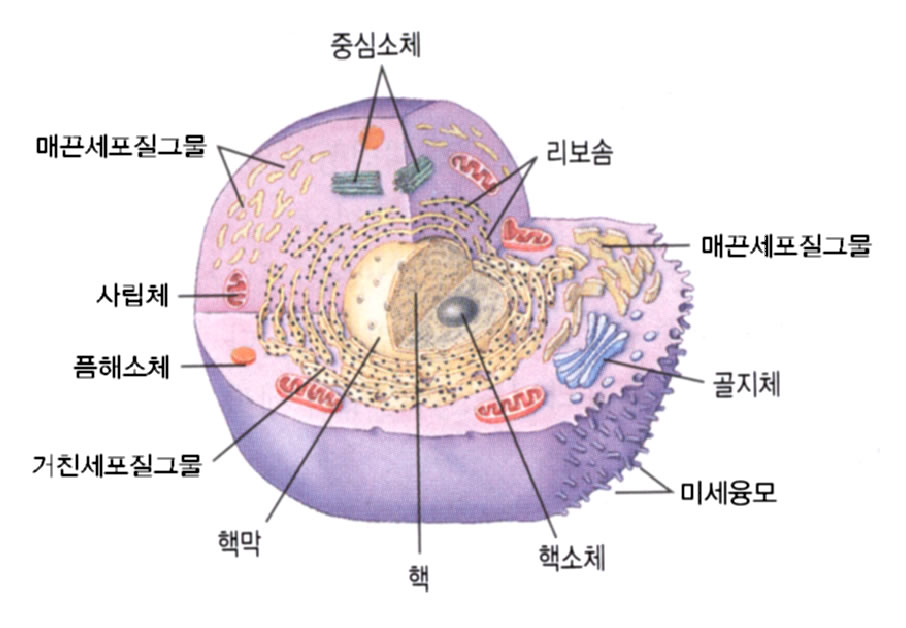 |
||
| MC | mass casualties; mast cell; Master of Surgery [Lat. Magister Chirurgiae]; maximum concentration; Med... |
|---|---|
| B-J protein | Bence-Jones Protein 의의; Multiple Myeloma |
| MM | Multiple Myeloma |
| MM | macromolecule; Maelzels metronome; major medical [insurance]; malignant melanoma; manubrium to malle... |
| PC-BMP | phosphorylcholine-m-binding myeloma protein |
| HMCL | human myeloma cell line |
|---|---|
| M.M. | Multiple Myeloma |
| MM | Myeloma |
| SMM | Smoldering multiple myeloma |
| ES cell | embryonic stem cell |
| myeloma cell | <haematology, oncology> Neoplastic plasma cell. The proliferating plasma cells often replace all the others within the marrow, leading to immune deficiency and frequently there is destruction of the bone cortex. Because they are monoclonal in origin they secrete a monoclonal immunoglobulin. Bence Jones proteins are monoclonal immunoglobulin light chains overproduced by myeloma cells and excreted in the urine. Myeloma cell lines are used for producing hybridomas in raising monoclonal antibodies. (18 Nov 1997) |
|---|
| giant cell myeloma | A bone tumour composed of cellular spindle-cell stroma containing scattered multinucleated giant cells resembling osteoclasts. The tumours range from benign to frankly malignant lesions. The tumour occurs most frequently in an end of a long tubular bone in young adults. (12 Dec 1998) |
|---|---|
| plasma cell myeloma | Cells resemble mature or immature plasma cells with nuclei that appear cleaved or resemble immunoblasts. The tumour cells are CD19- , CD20- , CD22- and SIg- , but are also cIg+ and CD38+. The Ig heavy and light chain genes can be translocated or deleted. These neoplasms are often disseminated BM tumours of adults and progress to multiple myeloma. (05 Mar 2000) |
| amyloidosis of multiple myeloma | Foci of amyloidosis in mesenchymal tissues of some persons with multiple myeloma; no direct relation between amyloid and Bence Jones protein is conclusively known. (05 Mar 2000) |
| cancer, multiple myeloma | A bone marrow cancer involving a type of white blood cell called a plasma (or myeloma) cell. The tumour cells can form a single collection (a plasmacytoma) or many tumours (multiple myeloma). Plasma cells are part of the immune system and make antibodies. Because patients have an excess of identical plasma cells, they have too much of one type of antibody. As myeloma cells increase in number, they damage and weaken the bones, causing pain and often fractures. When bones are damaged, calcium is released into the blood leading to hypercalcaemia (excess calcium in the blood) and that causes loss of appetite, nausea, thirst, fatigue, muscle weakness, restlessness, and confusion. Myeloma cells prevent the bone marrow from forming normal plasma cells and other white blood cells important to the immune system so patients may not be able to fight infections. The cancer cells can also prevent the growth of new red blood cells, causing anaemia. Excess antibody proteins and calcium may prevent the kidneys from filtering and cleaning the blood properly Cancer, non-Hodgkin's lymphoma: A lymphoma is a cancer that develops in the lymphatic system. The most common symptom of non-Hodgkin's lymphomas is a painless swelling in the lymph nodes in the neck, underarm, or groin. Non-Hodgkin's lymphomas are diagnosed with a biopsy of an enlarged lymph node. Follow-up examinations are important after lymphoma treatment. Most relapses occur in the first 2 years after therapy. (12 Dec 1998) |
| cancer, myeloma | A bone marrow cancer involving a type of white blood cell called a plasma (or myeloma) cell. The tumour cells can form a single collection (a plasmacytoma) or many tumours (multiple myeloma). Plasma cells are part of the immune system and make antibodies. Because patients have an excess of identical plasma cells, they have too much of one type of antibody. As myeloma cells increase in number, they damage and weaken the bones, causing pain and often fractures. When bones are damaged, calcium is released into the blood leading to hypercalcaemia (too much calcium in the blood) and that causes loss of appetite, nausea, thirst, fatigue, muscle weakness, restlessness, and confusion. Myeloma cells prevent the bone marrow from forming normal plasma cells and other white blood cells important to the immune system so patients may not be able to fight infections. The cancer cells can also prevent the growth of new red blood cells, causing anaemia. Excess antibody proteins and calcium may prevent the kidneys from filtering and cleaning the blood properly. (12 Dec 1998) |
| multiple myeloma | <oncology, tumour> See myeloma cell. (18 Nov 1997) |
| myeloma | <oncology, tumour> A malignant tumour composed of plasma cells of the type normally found in the bone marrow. (18 Nov 1997) |
| myeloma protein | <haematology, oncology> The immunoglobulins and Bence Jones proteins secreted by myeloma cells. (18 Nov 1997) |
| endothelial myeloma | A malignant primary bone tumour that arises most commonly in the first three decades of life. It is highly malignant (prone to spread) and often requires treatment with some combination of radiation therapy and chemotherapy. (27 Sep 1997) |
| L-chain myeloma | bence Jones myeloma |
| T-cell-rich, B-cell lymphoma | <tumour> A B-cell lymphoma in which more than 90% of the cells are of T-cell origin, masking the large cells that form the neoplastic B-cell component. See: adult T-cell lymphoma. (05 Mar 2000) |
| absorption cell | A small glass chamber with parallel sides, in which absorption spectra of solutions can be obtained. (05 Mar 2000) |
| acid cell | One of the cell's of the gastric glands; it lies upon the basement membrane, covered by the chief cell's, and secretes hydrochloric acid that reaches the lumen of the gland through fine intracellular and intercellular canals (canaliculi). Synonym: acid cell, oxyntic cell. (05 Mar 2000) |
| acidophil cell | A cell whose cytoplasm or its granules stain with acid dyes. (05 Mar 2000) |
| acinar cell | Any secreting cell lining an acinus, especially applied to the cell's of the pancreas that furnish pancreatic juice and enzymes to distinguish them from the cell's of ducts and the islets of Langerhans. Synonym: acinous cell. (05 Mar 2000) |
제품명 |
판매사 |
보험코드 | 성분/함량 | 구분/보험급여 |
|---|
제품명 |
판매사 |
보험코드 | 성분/함량 | 구분/보험급여 |
|---|