
| 영문 | muscle cell(=muscle fiber) | 한글 | 근육세포 |
|---|---|---|---|
| 설명 | 근육은 수의근(의식에 의해서 조절이 가능한 근육: 예를 들어 다리, 팔, 얼굴근육 등)과 불수의근(의식과 무관하게 조절하지 않아도 움직이는 근육: 예를 들어 심장근, 소화기관에 분포하는 근육 등)으로 나누어지며, 근육세포의 모양은 다음과 같다(수의근, 불수의근 외에 심장에 있는 심장근은 불수의근에 해당하지만 그 모양은 수의근과 같아 따로 분류한다).  |
||
| 영문 | white blood cell(WBC), leukocyte | 한글 | 백혈구 |
|---|---|---|---|
| 설명 | 혈액내에 골수구계세포와 림프계세포, 단핵구계세포를 모두 통틀어 말한다. 백혈구의 증가가 있으면 대개 감염이 있거나, 혹은 탈수현상이 있음을 의미한다. 또한 지나친 백혈구수의 감소는 인체내 면역기능이 떨어져 있음을 의미하며, 다른 질병에 의해 나타나는 이차적인 현상이 아닌지 꼭 진단을 받아보아야 한다. |
||
| 영문 | mast cell | 한글 | 비만 세포 |
|---|---|---|---|
| 설명 | 동물의 결합 조직 가운데 널리 분포하는 세포. 결합조직과 점막조직 내에 있는 호염기성 색소로 이염색성(metachromasia)을 나타내는 과립을 가진 방추형의 세포에 작은 둥근 핵을 가진다. 비만세포의 표면에는 IgE에 대한 수용체가 존재하며, 수용체에 결합한 IgE 분자들끼리 다가의 항원에 의해 서로 연결되면 비만세포 과립탈출 반응이 일어나, 히스타민, 세로토닌, 헤파린 등의 화학전달 물질이 방출되어, 즉시형 알레르기 반응 등의 증상을 일으킨다. 피부, 장막, 혈관 주위, 점막 주변에 있다. |
||
| 영문 | cell | 한글 | 세포 |
|---|---|---|---|
| 설명 | 생명체를 이루는 구조적, 기능적 단위. 핵의 유무에 따라서 유핵세포와 무핵세포로 나눌 수가 있다. 무핵세포란 핵이 없는 세포를 말한다. 핵이란 유전정보를 가지고 있는 염색체를 보관하는 곳인데 무핵세포에서는 염색체가 세포속에 그냥 노출되어 있다. 대개 세포 하나하나가 독립된 생명체의 역할을 하는 단세포생물로서 외부환경으로부터 자신을 보호할 수 있는 견고한 세포벽을 가지고 있다. 유핵세포란 핵을 가지고 있어서 유전정보가 있는 염색체가 세포의 다른 부분과 구분되어 핵속에 들어있다. 세포속에서 핵외의 부분(이를 세포질이라 한다)에는 여러 가지 세포의 소기관이 있어서 세포의 다양한 기능을 분담한다. ◈유핵세포의 기본 구조 1.세포막-세포를 둘러싸서 주위환경과 분리하여 세포의 내환경을 유지한다. 2.형질내세망(endoplasmic reticulum)-단위막으로 둘러쌓여 있는 불규칙한 망상구조이다. 이 망상구조의 내부를 소강, 소조라고 부른다. 여기에는 표면이 매끈한 무과립형질내세망과 표면이 불규칙한 과립형질내세망의 두 가지가 있다. 과립형질내세망의 경우는 표면에 단백질을 합성하는 리보솜이라는 것이 부착되어 있다. 이곳은 주로 세포밖으로 분비할 단백질을 합성하는 장소이다. 무과립형질내세망은 표면에 리보솜이 부착되어 있지 않은 것을 말하며, 이곳에서는 주로 해독작용, 글리코겐의 합성, 스테로이드호르몬의 합성 등이 일어난다. 3.리보솜-단백질을 합성하는 역할을 하는 곳이다.이것은 세포질에 존재하는 자유리보솜과 과립형질내세망에 부착이 되어 존재하는 부착리보솜의 두 가지로 나눈다. 자유리보솜은 주로 세포내에서 필요한 단백질을 만드는 역할을 하고 부착리보솜은 세포밖으로 분비할 단백질을 만드는 역할을 한다. 4.골지장치(Golgi apparatus)-핵주위에 분포하는 납작해진 주머니모양의 것이 중첩되어 형성된 층판 모양의 구조물로 과립형질내세망에서 생성되어 외부로 분비될 단백질을 모아서 농축, 포장하여 과립을 만드는 역할을 한다. 5.사립체(mitochondria)-구형, 난형의 긴 막대기 모양으로 크기가 다양한 구조물. 생물체의 에너지 저장물질인 ATP를 생산하는 역할을 한다. 또 세포와 다른 자신만의 유전정보를 가진 DNA, RNA를 가지고 있다. 모양, 크기가 세균과 비슷하며 자체증식성 등 독립된 생명체로서 필요한 요건을 갖추고 있어서 세포와 공생관계를 가진 독립된 세포로 생각하고 있다. 6.용해소체(lysosome)-작은 구형의 소체로 여러 가지 분해효소를 가진다. 세포외계에서 들어온 물질과 결합하여 그 물질들을 용해하는 역할을 하고, 오래된 세포소기관들을 제거하는 역할도 한다. 7.세포핵(nucleus)-구형, 난형으로 세포의 중심에 위치한다. 핵내에는 유전정보가 있는 물질인 염색체가 존재한다. 8.중심소체(centrosome)-핵주위에 존재하면서 핵의 분열시에 양쪽의 염색체를 당기는 작은 섬유를 만드는 역할을 하는 곳. 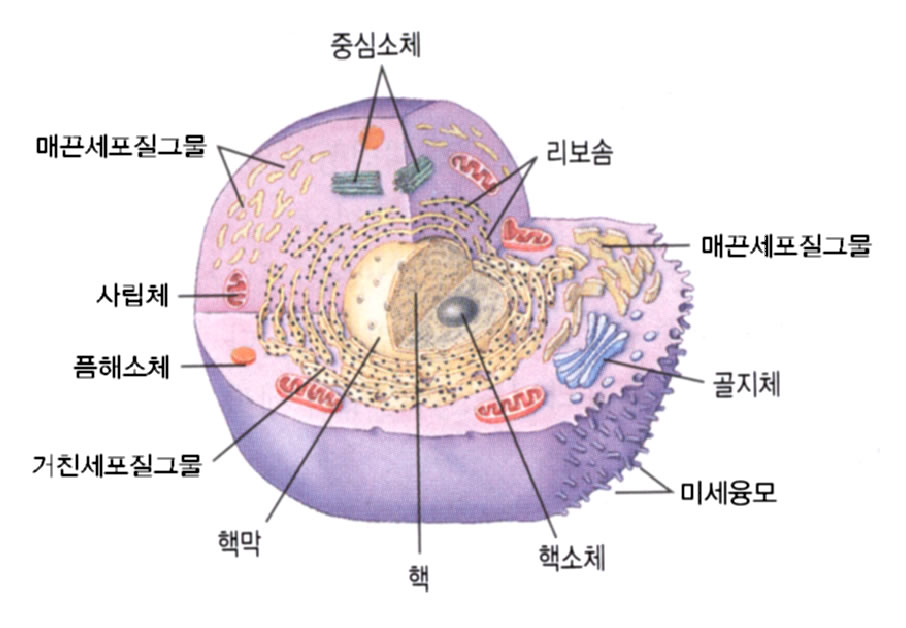 |
||
| 영문 | cell-mediated immunity | 한글 | 세포매개면역 |
|---|---|---|---|
| 설명 | 면역이란 신체를 외부의 물질로부터 보호하는 행위를 말한다. 여기에는 특이적 면역과 비특이적 면역의 두 가지가 있다. 비특이적 면역이라함은 특정한 물질에 관계하는 면역이 아니라 특정 대상이 없이 모든 외부 물체에 작용할 수 있는 면역을 말한다. 여기에는 소변의 흐름, 눈물의 흐름, 피부의 비투과성 등의 기계적인 것도 포함되고 피속에 돌아다니는 세포 중에서 비특이적으로 외부의 물질을 포식하는 세포들(예를 들면 큰포식세포(macrophage)의 활동도 포함이 된다. 세포매개면역이란 특이한 물질을 감지할 수 있는 세포를 생성하게 하여 그것으로 하여금 그 물질을 포식하게 하는 것을 말한다. |
||
| Mat, mat | maternal [origin]; mature |
|---|---|
| MICAM | maturation index for colostrum and mature milk |
| MC | mass casualties; mast cell; Master of Surgery [Lat. Magister Chirurgiae]; maximum concentration; Med... |
| ACC | accommodation; acetyl coenzyme A carboxylase; acinic cell carcinoma; acute care center; adenoid cyst... |
| GC | ganglion cell; gas chromatography; general circulation; general closure; general condition; generali... |
| IMV | Intracellular Mature Virus |
|---|---|
| MCT | Mature cystic teratomas |
| M | mature |
| ATL | Adult T Cell Leukaemia |
| ATL | Adult T cell leukaemia-lymphoma |
| mature cell leukaemia | Chronic granulocytic leukaemia. (05 Mar 2000) |
|---|
| mature | 1. Brought by natural process to completeness of growth and development; fitted by growth and development for any function, action, or state, appropriate to its kind; full-grown; ripe. "Now is love mature in ear." (Tennison) "How shall I meet, or how accost, the sage, Unskilled in speech, nor yet mature of age ?" (Pope) 2. Completely worked out; fully digested or prepared; ready for action; made ready for destined application or use; perfected; as, a mature plan. "This lies glowing, . . . And is almost mature for the violent breaking out." (Shak) 3. Of or pertaining to a condition of full development; as, a man of mature years. 4. Come to, or in a state of, completed suppuration. Synonym: Ripe, perfect, completed, prepared, digested, ready. Mature, Ripe. Both words describe fullness of growth. Mature brings to view the progressiveness of the process; ripe indicates the result. We speak of a thing as mature when thinking of the successive stayes through which it has passed; as ripe, when our attention is directed merely to its state. A mature judgment; mature consideration; ripe fruit; a ripe scholar. Origin: L. Maturus; prob. Akin to E. Matin. Source: Websters Dictionary (01 Mar 1998) |
|---|---|
| mature bacteriophage | The complete, infective form of bacteriophage. (05 Mar 2000) |
| mature cataract | A cataract in which both the nucleus and cortex are opaque. Synonym: complete cataract, ripe cataract. (05 Mar 2000) |
| mature neutrophil | A fully matured neutrophil that has at least 2 (and as many as 5) distinct lobes in the nucleus and manifests active ameboid motion. Synonym: mature neutrophil. (05 Mar 2000) |
| mature ovarian follicle | A follicle ready for ovulation; in the human ovary its antrum attains a diameter of 6 to 8 mm and presents a surface bulge; a first maturation (meiotic) division of the ovum usually occurs just prior to the rupture of the follicle. (05 Mar 2000) |
| adult T-cell leukaemia | Lymph nodes show a mixture of small and large atypical cells which are polymorphic and express nuclear pleiomorphism. Adult T-cell leukaemia is caused by HTLV-1 and is rare in the US and Europe but common in Japan. Tumour cells express CD2, CD3, CD5 and lack CD7. The most common chromosome change reported in adult T-cell leukaemia is presence of the 14q + marker (05 Mar 2000) |
| B-cell leukaemia | A test which detects the presence of antigens on the surface of B lymphocytes. These antigens can indicate the presence of leukaemia. most often this is used to detect and differentiate chronic lymphocytic leukaemia from acute lymphocytic leukaemia. Origin: Gr. Haima = blood (27 Sep 1997) |
| mast cell leukaemia | A form of granulocytic leukaemia in which there are unusually great numbers of basophilic granulocytes in the tissues and circulating blood; in some instances, the immature and mature basophilic forms may represent from 40 to 80% of the total numbers of white blood cells. Synonym: mast cell leukaemia. (05 Mar 2000) |
| Rieder cell leukaemia | A special form of acute granulocytic leukaemia in which the affected tissues and the circulating blood contain relatively large numbers of atypical myeloblasts (i.e., Rieder cells) that have the usual, faintly granular, immature type of cytoplasm, and a bizarre, comparatively mature nucleus with several wide and deep indentations (suggestive of lobulation). (05 Mar 2000) |
| mixed cell leukaemia | Term infrequently used as a designation for granulocytic leukaemia, thereby emphasizing the occurrence of different types of cells in the myeloid series (i.e., neutrophilic, eosinophilic, and basophilic granulocytes), in contrast to the comparatively monotonous pattern observed in lymphocytic and monocytic leukaemia. (05 Mar 2000) |
| plasma cell leukaemia | An unusual disease characterised by leukocytosis and other signs and symptoms that are suggestive of leukaemia, in association with diffuse infiltrations and aggregates of plasma cells in the spleen, liver, bone marrow, and lymph nodes, and the presence of considerable numbers of plasma cells in the circulating blood; the total number of leukocytes in the latter may range from normal levels to 80,000 or 90,000 per cu mm, and 5 to 90% may be plasma cells; multiple myelomas are observed in some examples of plasma cell leukaemia, but discrete nodules are not formed in bone. Although there are other clinicopathologic differences in the two conditions, they may be phases of the same basic process. (05 Mar 2000) |
| hairy cell leukaemia | <haematology, oncology> A rare chronic disorder characterised by proliferation of hairy cells in reticuloendothelial organs and blood. Origin: Gr. Haima = blood (13 Nov 1997) |
| human T-cell leukaemia virus | <virology> One of a group of retroviruses which causes the disease T-cell leukaemia in humans. T-cell leukaemia is a type of the cancer leukaemia where the body uncontrollably produces large amounts of abnormal (nonworking) T lymphocytes. (09 Oct 1997) |
| human T-cell lymphoma/leukaemia virus | A group of viruses (subfamily Oncovirinae, family Retroviridae) that are lymphotropic with a selective affinity for the helper/inducer cell subset of T lymphocytes and that are associated with adult T-cell leukaemia and lymphoma. Synonym: human T-cell lymphotropic virus. (05 Mar 2000) |
| stem cell leukaemia | A form of leukaemia in which the abnormal cells are thought to be the precursors of lymphoblasts, myeloblasts, or monoblasts. Synonym: embryonal leukaemia. (05 Mar 2000) |
제품명 |
판매사 |
보험코드 | 성분/함량 | 구분/보험급여 |
|---|
제품명 |
판매사 |
보험코드 | 성분/함량 | 구분/보험급여 |
|---|