
| 영문 | spinal tap, spinal puncture | 한글 | 허리천자, 요추천자, 요추뚫기 |
|---|---|---|---|
| 설명 | 질병의 진단이나 치료 또는 마취를 하기 위해 피부에서 거미막밑공간으로 바늘을 찌를 때가 있다. 이것은 셋째 허리뼈 아래쪽에서 시행한다. 척수가 첫째 허리뼈 아랫모서리에서 끝나고, 거미막밑공간은 둘째 엉치뼈 분절까지 뻗어 있기 때문에 이 부위는 바늘로 척수를 찌를 위험이 없다. 또 척추뼈고리판이 짧아 서로 겹쳐있지 않기 때문에 허리뼈 사이로 바늘을 찌를 수 있다. 이 부위의 거미막밑공간에는 척수신경 뿌리가 있으나, 이들은 뇌척수액속에 있기 때문에 바늘을 넣을 때 한쪽으로 밀려 손상받는 경우는 거의 없다. 배를 넓적다리에 붙일정도로 허리를 구부리면 고리판 사이가 더 벌어져 틈이 커진다. 바늘이 뚫고 지나가는 구조는 바깥에서 속으로 ① 피부, ② 피부밑조직, ③ 근육막, ④ 가시끝인대, ⑤ 가시사이인대, ⑥ 황색인대, ⑦ 경질막, ⑧ 거미막, ⑨ 뇌척수액이 된다.  |
||
| 영문 | mitral stenosis | 한글 | 승모판막 협착증 |
|---|---|---|---|
| 설명 | 승모판막(좌심방과 좌심실사이에 존재하는 판막)이 좁아져 있는 병적인 상태를 말함. 정상적으로 승모판사이의 공간면적은 4~6cm정도이며, 이 면적이 2.5cm이하가 되면 증상이 나타난다. 그리고 1~2cm이하가 되면 수술을 고려해야 한다. 운동성 호흡곤란이 주증상이며, 심장청진상 심잡음이 들린다. 증상과 협착의 정도에 따라 다르나, 대개 수술을 고려해야 하며, 수술은 판막대치술, 판막성형술 등이 있고, 판막대치술에도, 조직판막을 이용하는 방법과 기계판막을 이용하는 방법 2가지로 나눌 수 있다. |
||
| 영문 | spinal cord | 한글 | 척수 |
|---|---|---|---|
| 설명 | 척추내에 위치하는 중추신경계의 일부분. 위에서부터 목척수, 등척수, 허리척수, 엉치척수로 구분됨. 내부는 바깥쪽의 백색질과 안쪽의 회색질로 구분된다. 척수의 아래끝은 척수 원뿔이라 하며 첫번째 허리뼈 높이까지 내려온다. 뇌와 말초신경사이의 신경 통로 역할을 하며 척수반사(예: 무릎반사)에서는 뇌를 통하지 않고 반사의 중추 작용을 한다. 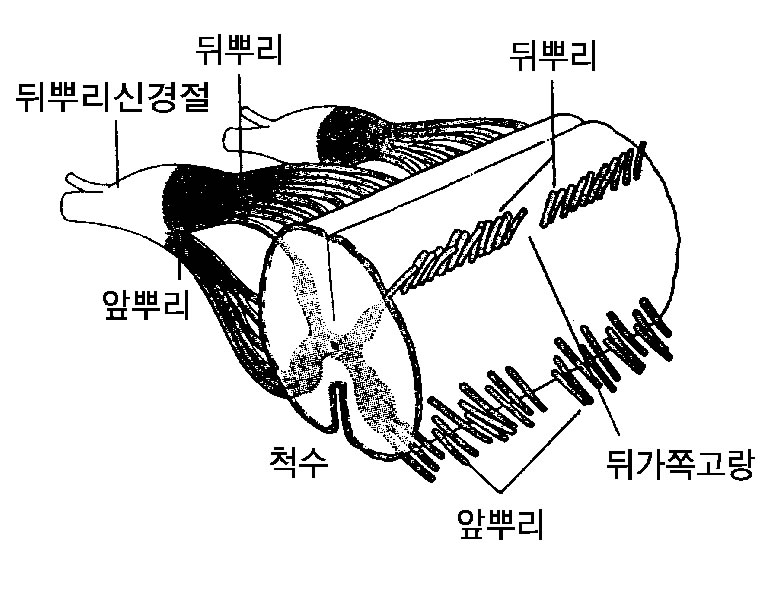 |
||
| 영문 | spinal nerve | 한글 | 척수신경 |
|---|---|---|---|
| 설명 | 척수의 앞뿔에서 출발하는 운동신경과 뒷뿔으로 들어오는 감각신경이 합쳐서 형성되는 신경으로서 총 31쌍이 존재함. 목뼈신경이 8쌍, 자등뼈신경이 12쌍, 허리뼈의 신경이 5쌍, 엉치뼈의 6쌍을 이룸. |
||
| JVP | [POMD P 49 - 52] 1) Jugular Vein Pressure 2) Jugular Venous Pulse ... |
|---|---|
| L | 1) Lumbar Vertebrae L1; 1st Lumbar Vertebrae &... |
| HIVD | Herniation(Herniated) of Inter-Vertebral Disc - Cervical HIVD &... |
| AS | acetylstrophanthidin; acidified serum; acoustic schwannoma; acoustic stimulation; active sarcoidosis... |
| HSAS | hydrocephalus due to stenosis of aqueduct of Sylvius; hypertrophic subaortic stenosis |
| LSS | Lumbar spinal stenosis |
|---|---|
| AS | Aortic stenosis |
| DS | Diameter stenosis |
| DSS | Discrete subaortic stenosis |
| HPS | Hypertrophic pyloric stenosis |
| spinal stenosis | An abnormal narrowing of the spinal canal that may be either congenital or acquired. Treatment is generally surgical to widen the spinal canal. Laminectomy may be the indicated surgical procedure to reduce pressure on the spinal cord. (27 Sep 1997) |
|---|---|
| ventral primary rami of lumbar spinal nerves | See: ventral primary ramus of spinal nerve. Synonym: rami ventrales nervorum lumbalium. (05 Mar 2000) |
| lumbar enlargement of spinal cord | A spindle-shaped swelling of the spinal cord beginning at the level of the tenth thoracic vertebra and tapering into the medullary cone, with maximum thickness opposite the last thoracic vertebra, consequential to the innervation of the lower limb. Synonym: intumescentia lumbalis, lumbar enlargement of spinal cord. (05 Mar 2000) |
| lumbar part of spinal cord | Portion of spinal cord which consists of the five lumbar segments (L1-L5) and from which five pairs of lumbar spinal nerves originate; in the adult it is located in the T10-L1 portion of the vertebral canal, and is enlarged relative to other parts of the cord due to its involvement in innervation of the lower limb. (05 Mar 2000) |
| lumbar segments of spinal cord | The five lumbar segments of the spinal cord which give rise to the five pairs of lumbar spinal nerves and constitute the lumbar part of the spinal cord. Synonym: segmenta medullae spinalis lumbaria. (05 Mar 2000) |
| aortic stenosis | Progressive narrowing of the aortic valve resulting in the obstructed passage of blood from the left ventricle into the aorta. Causes for aortic stenosis include rheumatic fever, congenital and idiopathic sclerosis. Chronic stenosis can lead to left ventricular enlargement and congestive heart failure. (27 Sep 1997) |
| aortic valve stenosis | Narrowing of the orifice of the aortic valve or of the supravalular or subvalvular regions. (12 Dec 1998) |
| aqueductal stenosis | <radiology> most common cause of congenital hydrocephalus (43%), aqueduct develops about the 6th week of gestation, M:F = 2:1, other congenital anomalies (16%): thumb deformities, prognosis: 11-30% mortality aetiology: infectious (50%): toxoplasmosis, CMV, syphillis, mumps, influenza, developmental: forking, narrowing, transverse septum (X-linked recessive), neoplastic (extremely rare): glioma, pinealoma, meningioma (12 Dec 1998) |
| buttonhole stenosis | Extreme narrowing, usually of the mitral valve. (05 Mar 2000) |
| calcific nodular aortic stenosis | Most common type of aortic stenosis, occurring usually in elderly men, in which the cusps contain calcified fibrous nodules on both surfaces; the causes include rheumatic fever, atherosclerosis, age-related degeneration, and congenitally bicuspid aortic valve. (05 Mar 2000) |
| valvular aortic stenosis | <radiology> Secondary to fusion of commisures between cusps types: bicuspid/unicuspid (95%): in 1-2% of population; M>F; commonly associated with coarctation, tricuspid (5%), dysplastic thickened aortic cusps in infants with crtical aortic stenosis: may stimulate neonatal sepsis, associated with L-R shunts (atrial septal defect, VSD), marked CMG (thickened wall of LV), pulmonary venous hypertension, congestive heart failure child/adult: LV configuration with normal heart size, postenotic dilatation, calcified valve (60% of patients greater than24 y.o.) see: aortic stenosis (12 Dec 1998) |
| carotid stenosis | The narrowing or stricture of a carotid artery that may lead to transient ischemic attacks (see cerebral ischemia, transient) and stroke (see cerebrovascular disorders). (12 Dec 1998) |
| renal artery stenosis | <cardiology, nephrology> A narrowing of the renal artery or one of its main branches accounts for 2 to 5% of cases of hypertension. (27 Sep 1997) |
| mitral stenosis | <cardiology> A congenital or acquired heart valve abnormality that describes the narrowing and ineffective opening of the mitral valve. (13 Nov 1997) |
| mitral valve stenosis | A rheumatic disease causing diffuse thickening of the mitral valve leaflets by fibrous tissue or calcific deposits. (harrisons' principles of internal medicine, 13th ed, p1052) (12 Dec 1998) |
| lumbar spinal stenosis |
Narrowing of the spinal canal in the lower back usually due to overgrowth of bone or ligaments of the spinal bones. Such narrowing can cause pressure on the nerves to the leg which may lead to pain, trouble walking, sensory or bladder symptoms. If symptoms are severe, then decompression of the spine may be necessary.
출처: www.neurosurgery.pitt.edu/conditions/
|
|---|---|
| lumbar spinal stenosis |
A degenerative spinal disease that causes narrowing of the spinal canal. This narrowing pinches the nerves and causes pain symptoms.
출처: www.spinalstenosis.org/glossary.php
|
| lumbar spinal stenosis |
A narrowing of the spinal canal caused by degenerative or traumatic changes at the level of the lumbar vertebrae. This condition causes back pain, often associated with pain that radiates into the legs, esp. when the patie
출처:
|
| lumbar spinal stenosis |
Reduction in the diameter of the spinal canal due to new bone formation which may result in pressure on the spinal cord or nerve roots occurring in the lower back.
출처: www.spinemenders.com/subfiles/spineglossary.htm
|
제품명 |
판매사 |
보험코드 | 성분/함량 | 구분/보험급여 |
|---|
제품명 |
판매사 |
보험코드 | 성분/함량 | 구분/보험급여 |
|---|