¼±Åà - È­»ìǥŰ/¿£ÅÍŰ ´Ý±â - ESC

 
"killer cell"¿¡ ´ëÇÑ °Ë»ö °á°úÀÔ´Ï´Ù. °Ë»ö °á°ú º¸´Â µµÁß¿¡ Tab ۸¦ ´©¸£½Ã¸é °Ë»ö âÀÌ ¼±Åõ˴ϴÙ.
¾Ë±â½¬¿î ÀÇÇпë¾îÇ®ÀÌÁý, ¼­¿ïÀÇ´ë ±³¼ö ÁöÁ¦±Ù, °í·ÁÀÇÇÐ ÃâÆÇ À¯»ç °Ë»ö °á°ú : 5 ÆäÀÌÁö: 1
¿µ¹® muscle cell(=muscle fiber) ÇÑ±Û ±ÙÀ°¼¼Æ÷
¼³¸í   
  ±ÙÀ°Àº ¼öÀDZÙ(ÀǽĿ¡ ÀÇÇØ¼­ Á¶ÀýÀÌ °¡´ÉÇÑ ±ÙÀ°: ¿¹¸¦ µé¾î ´Ù¸®, ÆÈ, ¾ó±¼±ÙÀ° µî)°ú ºÒ¼öÀDZÙ(Àǽİú ¹«°üÇϰԠÁ¶ÀýÇÏÁö ¾Ê¾Æµµ ¿òÁ÷À̴ ±ÙÀ°: ¿¹¸¦ µé¾î ½ÉÀå±Ù, ¼ÒÈ­±â°ü¿¡ ºÐÆ÷Çϴ ±ÙÀ° µî)À¸·Î ³ª´©¾îÁö¸ç, ±ÙÀ°¼¼Æ÷ÀÇ ¸ð¾çÀº ´ÙÀ½°ú °°´Ù(¼öÀDZÙ, ºÒ¼öÀDZ٠¿Ü¿¡ ½ÉÀå¿¡ Àִ ½ÉÀå±ÙÀº ºÒ¼öÀDZٿ¡ ÇØ´çÇÏÁö¸¸ ±× ¸ð¾çÀº ¼öÀDZٰú °°¾Æ µû·Î ºÐ·ùÇÑ´Ù).
  
  ±ÙÀ°¼¼Æ÷
¿µ¹® white blood cell(WBC), leukocyte ÇÑ±Û ¹éÇ÷±¸
¼³¸í   
  Ç÷¾×³»¿¡ °ñ¼ö±¸°è¼¼Æ÷¿Í ¸²ÇÁ°è¼¼Æ÷, ´ÜÇÙ±¸°è¼¼Æ÷¸¦ ¸ðµÎ ÅëÆ²¾î ¸»ÇÑ´Ù. ¹éÇ÷±¸ÀÇ Áõ°¡°¡ ÀÖÀ¸¸é ´ë°³ °¨¿°ÀÌ Àְųª, È¤Àº Å»¼öÇö»óÀÌ ÀÖÀ½À» ÀǹÌÇÑ´Ù. ¶ÇÇÑ Áö³ªÄ£ ¹éÇ÷±¸¼öÀÇ °¨¼Ò´Â ÀÎü³» ¸é¿ª±â´ÉÀÌ ¶³¾îÁ® ÀÖÀ½À» ÀǹÌÇϸç, ´Ù¸¥ Áúº´¿¡ ÀÇÇØ ³ªÅ¸³ª´Â ÀÌÂ÷ÀûÀΠÇö»óÀÌ ¾Æ´ÑÁö ²À Áø´ÜÀ» ¹Þ¾Æº¸¾Æ¾ß ÇÑ´Ù.
¿µ¹® mast cell ÇÑ±Û ºñ¸¸ ¼¼Æ÷
¼³¸í   
  µ¿¹°ÀÇ °áÇÕ Á¶Á÷ °¡¿îµ¥ ³Î¸® ºÐÆ÷Çϴ ¼¼Æ÷. °áÇÕÁ¶Á÷°ú Á¡¸·Á¶Á÷ ³»¿¡ Àִ ȣ¿°±â¼º »ö¼Ò·Î ÀÌ¿°»ö¼º(metachromasia)À» ³ªÅ¸³»´Â °ú¸³À» °¡Áø ¹æÃßÇüÀÇ ¼¼Æ÷¿¡ ÀÛÀº µÕ±Ù ÇÙÀ» °¡Áø´Ù. ºñ¸¸¼¼Æ÷ÀǠǥ¸é¿¡´Â IgE¿¡ ´ëÇÑ ¼ö¿ëü°¡ Á¸ÀçÇϸç, ¼ö¿ëü¿¡ °áÇÕÇÑ IgE ºÐÀڵ鳢¸® ´Ù°¡ÀÇ Ç׿ø¿¡ ÀÇÇØ ¼­·Î ¿¬°áµÇ¸é ºñ¸¸¼¼Æ÷ °ú¸³Å»Ãâ ¹ÝÀÀÀÌ ÀϾ, È÷½ºÅ¸¹Î, ¼¼·ÎÅä´Ñ, ÇìÆÄ¸° µîÀÇ È­ÇÐÀü´Þ ¹°ÁúÀÌ ¹æÃâµÇ¾î, Áï½ÃÇü ¾Ë·¹¸£±â ¹ÝÀÀ µîÀÇ Áõ»óÀ» ÀÏÀ¸Å²´Ù. ÇǺÎ, À帷, Ç÷°ü ÁÖÀ§, Á¡¸· ÁÖº¯¿¡ ÀÖ´Ù.
¿µ¹® cell ÇÑ±Û ¼¼Æ÷
¼³¸í   
  »ý¸íü¸¦ ÀÌ·ç´Â ±¸Á¶Àû, ±â´ÉÀû ´ÜÀ§.
  
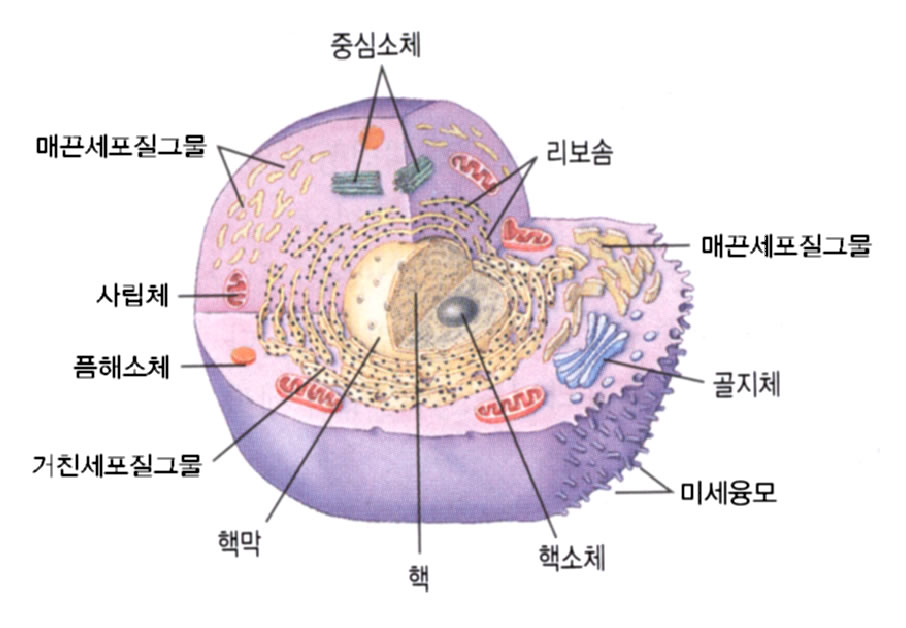
  ÇÙÀÇ À¯¹«¿¡ µû¶ó¼­ À¯ÇÙ¼¼Æ÷¿Í ¹«ÇÙ¼¼Æ÷·Î ³ª´­ ¼ö°¡ ÀÖ´Ù. ¹«ÇÙ¼¼Æ÷¶õ ÇÙÀÌ ¾ø´Â ¼¼Æ÷¸¦ ¸»ÇÑ´Ù. ÇÙÀ̶õ À¯ÀüÁ¤º¸¸¦ °¡Áö°í Àִ ¿°»öü¸¦ º¸°üÇϴ °÷Àε¥ ¹«ÇÙ¼¼Æ÷¿¡¼­´Â ¿°»öü°¡ ¼¼Æ÷¼Ó¿¡ ±×³É ³ëÃâµÇ¾î ÀÖ´Ù. ´ë°³ ¼¼Æ÷ ÇϳªÇϳª°¡ µ¶¸³µÈ »ý¸íüÀÇ ¿ªÇÒÀ» Çϴ ´Ü¼¼Æ÷»ý¹°·Î¼­ ¿ÜºÎȯ°æÀ¸·ÎºÎÅÍ ÀÚ½ÅÀ» º¸È£ÇÒ ¼ö Àִ °ß°íÇÑ ¼¼Æ÷º®À» °¡Áö°í ÀÖ´Ù. À¯ÇÙ¼¼Æ÷¶õ ÇÙÀ» °¡Áö°í À־ À¯ÀüÁ¤º¸°¡ Àִ ¿°»öü°¡ ¼¼Æ÷ÀÇ ´Ù¸¥ ºÎºÐ°ú ±¸ºÐµÇ¾î ÇÙ¼Ó¿¡ µé¾îÀÖ´Ù. ¼¼Æ÷¼Ó¿¡¼­ ÇÙ¿ÜÀÇ ºÎºÐ(À̸¦ ¼¼Æ÷ÁúÀ̶ó ÇÑ´Ù)¿¡´Â ¿©·¯ °¡Áö ¼¼Æ÷ÀÇ ¼Ò±â°üÀÌ À־ ¼¼Æ÷ÀÇ ´Ù¾çÇÑ ±â´ÉÀ» ºÐ´ãÇÑ´Ù.
  
  ¢ÂÀ¯ÇÙ¼¼Æ÷ÀÇ ±âº» ±¸Á¶
  
  1.¼¼Æ÷¸·-¼¼Æ÷¸¦ µÑ·¯½Î¼­ ÁÖÀ§È¯°æ°ú ºÐ¸®ÇÏ¿© ¼¼Æ÷ÀÇ ³»È¯°æÀ» À¯ÁöÇÑ´Ù.
  
  2.ÇüÁú³»¼¼¸Á(endoplasmic reticulum)-´ÜÀ§¸·À¸·Î µÑ·¯½×¿© Àִ ºÒ±ÔÄ¢ÇÑ ¸Á»ó±¸Á¶ÀÌ´Ù. ÀÌ ¸Á»ó±¸Á¶ÀÇ ³»ºÎ¸¦ ¼Ò°­, ¼ÒÁ¶¶ó°í ºÎ¸¥´Ù. ¿©±â¿¡´Â Ç¥¸éÀÌ ¸Å²öÇÑ ¹«°ú¸³ÇüÁú³»¼¼¸Á°ú Ç¥¸éÀÌ ºÒ±ÔÄ¢ÇÑ °ú¸³ÇüÁú³»¼¼¸ÁÀÇ µÎ °¡Áö°¡ ÀÖ´Ù. °ú¸³ÇüÁú³»¼¼¸ÁÀÇ °æ¿ì´Â Ç¥¸é¿¡ ´Ü¹éÁúÀ» ÇÕ¼ºÇϴ ¸®º¸¼ØÀ̶ó´Â °ÍÀÌ ºÎÂøµÇ¾î ÀÖ´Ù. À̰÷Àº ÁַΠ¼¼Æ÷¹ÛÀ¸·Î ºÐºñÇÒ ´Ü¹éÁúÀ» ÇÕ¼ºÇϴ Àå¼ÒÀÌ´Ù. ¹«°ú¸³ÇüÁú³»¼¼¸ÁÀº Ç¥¸é¿¡ ¸®º¸¼ØÀÌ ºÎÂøµÇ¾î ÀÖÁö ¾ÊÀº °ÍÀ» ¸»Çϸç, À̰÷¿¡¼­´Â ÁÖ·Î ÇØµ¶ÀÛ¿ë, ±Û¸®ÄÚ°ÕÀÇ ÇÕ¼º, ½ºÅ×·ÎÀ̵åÈ£¸£¸óÀÇ ÇÕ¼º µîÀÌ ÀϾ´Ù.
  
  3.¸®º¸¼Ø-´Ü¹éÁúÀ» ÇÕ¼ºÇϴ ¿ªÇÒÀ» Çϴ °÷ÀÌ´Ù.À̰ÍÀº ¼¼Æ÷Áú¿¡ Á¸ÀçÇϴ ÀÚÀ¯¸®º¸¼Ø°ú °ú¸³ÇüÁú³»¼¼¸Á¿¡ ºÎÂøÀÌ µÇ¾î Á¸ÀçÇϴ ºÎÂø¸®º¸¼ØÀÇ µÎ °¡Áö·Î ³ª´«´Ù. ÀÚÀ¯¸®º¸¼ØÀº ÁַΠ¼¼Æ÷³»¿¡¼­ ÇÊ¿äÇÑ ´Ü¹éÁúÀ» ¸¸µå´Â ¿ªÇÒÀ» Ç졒ʼÎÂø¸®º¸¼ØÀº ¼¼Æ÷¹ÛÀ¸·Î ºÐºñÇÒ ´Ü¹éÁúÀ» ¸¸µå´Â ¿ªÇÒÀ» ÇÑ´Ù.
  
  4.°ñÁöÀåÄ¡(Golgi apparatus)-ÇÙÁÖÀ§¿¡ ºÐÆ÷Çϴ ³³ÀÛÇØÁø ÁָӴϸð¾çÀÇ °ÍÀÌ ÁßøµÇ¾î Çü¼ºµÈ ÃþÆÇ ¸ð¾çÀÇ ±¸Á¶¹°·Î °ú¸³ÇüÁú³»¼¼¸Á¿¡¼­ »ý¼ºµÇ¾î ¿ÜºÎ·Î ºÐºñµÉ ´Ü¹éÁúÀ» ¸ð¾Æ¼­ ³óÃà, Æ÷ÀåÇÏ¿© °ú¸³À» ¸¸µå´Â ¿ªÇÒÀ» ÇÑ´Ù.
  
  5.»ç¸³Ã¼(mitochondria)-±¸Çü, ³­ÇüÀÇ ±ä ¸·´ë±â ¸ð¾çÀ¸·Î Å©±â°¡ ´Ù¾çÇÑ ±¸Á¶¹°. »ý¹°Ã¼ÀÇ ¿¡³ÊÁö ÀúÀå¹°ÁúÀΠATP¸¦ »ý»êÇϴ ¿ªÇÒÀ» ÇÑ´Ù. ¶Ç ¼¼Æ÷¿Í ´Ù¸¥ ÀڽŸ¸ÀÇ À¯ÀüÁ¤º¸¸¦ °¡Áø DNA, RNA¸¦ °¡Áö°í ÀÖ´Ù. ¸ð¾ç, Å©±â°¡ ¼¼±Õ°ú ºñ½ÁÇϸç ÀÚüÁõ½Ä¼º µî µ¶¸³µÈ »ý¸íü·Î¼­ ÇÊ¿äÇÑ ¿ä°ÇÀ» °®Ãß°í À־ ¼¼Æ÷¿Í °ø»ý°ü°è¸¦ °¡Áø µ¶¸³µÈ ¼¼Æ÷·Î »ý°¢Çϰí ÀÖ´Ù.
  
  6.¿ëÇØ¼Òü(lysosome)-ÀÛÀº ±¸ÇüÀÇ ¼Òü·Î ¿©·¯ °¡Áö ºÐÇØÈ¿¼Ò¸¦ °¡Áø´Ù. ¼¼Æ÷¿Ü°è¿¡¼­ µé¾î¿Â ¹°Áú°ú °áÇÕÇÏ¿© ±× ¹°ÁúµéÀ» ¿ëÇØÇϴ ¿ªÇÒÀ» Çϰí, ¿À·¡µÈ ¼¼Æ÷¼Ò±â°üµéÀ» Á¦°ÅÇϴ ¿ªÇÒµµ ÇÑ´Ù.
  
  7.¼¼Æ÷ÇÙ(nucleus)-±¸Çü, ³­ÇüÀ¸·Î ¼¼Æ÷ÀÇ Á߽ɿ¡ À§Ä¡ÇÑ´Ù. ÇÙ³»¿¡´Â À¯ÀüÁ¤º¸°¡ Àִ ¹°ÁúÀΠ¿°»öü°¡ Á¸ÀçÇÑ´Ù.
  
  8.Á߽ɼÒü(centrosome)-ÇÙÁÖÀ§¿¡ Á¸ÀçÇϸ鼭 ÇÙÀÇ ºÐ¿­½Ã¿¡ ¾çÂÊÀÇ ¿°»öü¸¦ ´ç±â´Â ÀÛÀº ¼¶À¯¸¦ ¸¸µå´Â ¿ªÇÒÀ» Çϴ °÷.
  
  ¼¼Æ÷
¿µ¹® cell-mediated immunity ÇÑ±Û ¼¼Æ÷¸Å°³¸é¿ª
¼³¸í   
  ¸é¿ªÀ̶õ ½Åü¸¦ ¿ÜºÎÀÇ ¹°Áú·ÎºÎÅÍ º¸È£Çϴ ÇàÀ§¸¦ ¸»ÇÑ´Ù. ¿©±â¿¡´Â Æ¯ÀÌÀû ¸é¿ª°ú ºñƯÀÌÀû ¸é¿ªÀÇ µÎ °¡Áö°¡ ÀÖ´Ù.
  
  ºñƯÀÌÀû ¸é¿ªÀ̶óÇÔÀº Æ¯Á¤ÇÑ ¹°Áú¿¡ °ü°èÇϴ ¸é¿ªÀÌ ¾Æ´Ï¶ó Æ¯Á¤ ´ë»óÀÌ ¾øÀÌ ¸ðµç ¿ÜºÎ ¹°Ã¼¿¡ ÀÛ¿ëÇÒ ¼ö Àִ ¸é¿ªÀ» ¸»ÇÑ´Ù. ¿©±â¿¡´Â ¼Òº¯ÀÇ È帧, ´«¹°ÀÇ È帧, ÇǺÎÀÇ ºñÅõ°ú¼º µîÀÇ ±â°èÀûÀΠ°Íµµ Æ÷ÇԵǰí ÇǼӿ¡ µ¹¾Æ´Ù´Ï´Â ¼¼Æ÷ Áß¿¡¼­ ºñƯÀÌÀûÀ¸·Î ¿ÜºÎÀÇ ¹°ÁúÀ» Æ÷½ÄÇϴ ¼¼Æ÷µé(¿¹¸¦ µé¸é Å«Æ÷½Ä¼¼Æ÷(macrophage)ÀǠȰµ¿µµ Æ÷ÇÔÀÌ µÈ´Ù. ¼¼Æ÷¸Å°³¸é¿ªÀ̶õ Æ¯ÀÌÇÑ ¹°ÁúÀ» °¨ÁöÇÒ ¼ö Àִ ¼¼Æ÷¸¦ »ý¼ºÇϰԠÇÏ¿© ±×°ÍÀ¸·Î ÇÏ¿©±Ý ±× ¹°ÁúÀ» Æ÷½ÄÇϰԠÇϴ °ÍÀ» ¸»ÇÑ´Ù.
´ëÇÑÀÇÇù ÀÇÇпë¾î »çÀü °Ë»ö ¸ÂÃã °Ë»ö °á°ú : 1 ÆäÀÌÁö: 1
  • ¿µ¹®
    ÇѱÛ
  • killer cell
    »ìÇØ¼¼Æ÷
´ëÇÑÀÇÇù ÀÇÇпë¾î »çÀü °Ë»ö À¯»ç °Ë»ö °á°ú : 15 ÆäÀÌÁö: 1
  • ¿µ¹®
    ÇѱÛ
  • cytotoxic killer T cell
    ¼¼Æ÷µ¶¼º»ìÇØT¼¼Æ÷
  • lymphokine-activated killer cell
    ¸²Æ÷Ä«ÀÎȰ¼º»ìÇØ¼¼Æ÷
  • natural killer cell leukemia
    ÀÚ¿¬»ìÇØ¼¼Æ÷¹éÇ÷º´
  • natural killer cell
    ÀÚ¿¬»ìÇØ¼¼Æ÷
  • killer lymphocyte
    »ìÇØ¸²ÇÁ±¸, ¼¼Æ÷µ¶¼º¸²ÇÁ±¸
  • acantholytic cell
    °¡½Ã¼¼Æ÷ºÐ¸®¼¼Æ÷
  • angioimmunoblastic T-cell lymphoma
    Ç÷°ü¸é¿ª¸ð±¸T¼¼Æ÷¸²ÇÁÁ¾
  • annular elastotic giant cell granuloma
    °í¸®Åº·Â¼¶À¯°Å´ë¼¼Æ÷À°¾ÆÁ¾, ȯ»óź·Â¼¶À¯°Å´ë¼¼Æ÷À°¾ÆÁ¾
  • accessory cell
    º¸Á¶¼¼Æ÷, µ¡¼¼Æ÷
  • antibody-dependent cell-mediated cytotoxicity
    Ç×üÀÇÁ¸¼¼Æ÷¸Å°³¼¼Æ÷µ¶¼º
  • antibody-producing cell
    Ç×ü»ý»ê¼¼Æ÷
  • antibody-screening cell
    Ç×ü¼±º°Ç÷±¸
  • antigen-presenting cell
    Ç׿øÁ¦½Ã¼¼Æ÷
  • antigen-reactive cell
    Ç׿ø¹ÝÀÀ¼¼Æ÷
  • antigen-recognizing cell
    Ç׿øÀÎÁö¼¼Æ÷
´ëÇÑÀÇÇù Çʼö ÀÇÇпë¾îÁý »çÀü °Ë»ö ¸ÂÃã °Ë»ö °á°ú : 1 ÆäÀÌÁö: 1
  • ¿µ¹®
    ÇѱÛ
  • killer cell
    »ìÇØ¼¼Æ÷
´ëÇÑÀÇÇù Çʼö ÀÇÇпë¾îÁý »çÀü °Ë»ö À¯»ç °Ë»ö °á°ú : 15 ÆäÀÌÁö: 1
  • ¿µ¹®
    ÇѱÛ
  • sickle cell anemia
    ³´ÀûÇ÷±¸ºóÇ÷
  • cell
    ¼¼Æ÷
  • accessory cell
    º¸Á¶¼¼Æ÷, µ¡¼¼Æ÷
  • acinar cell
    »ù²Ê¸®¼¼Æ÷
  • amacrine cell
    ¹«Ãà»è¼¼Æ÷
  • balloon cell
    dz¼±¼¼Æ÷
  • basal cell
    ¹Ù´Ú¼¼Æ÷, ±âÀú¼¼Æ÷
  • basal cell carcinoma
    ¹Ù´Ú¼¼Æ÷¾ÏÁ¾, ±âÀú¼¼Æ÷¾ÏÁ¾
  • basket cell
    ¹Ù±¸´Ï¼¼Æ÷
  • basophilic cell
    È£¿°±â¼¼Æ÷
  • beta cell
    º£Å¸¼¼Æ÷
  • bipolar cell
    µÎ±Ø¼¼Æ÷
  • blood cell
    Ç÷¾×¼¼Æ÷, Ç÷±¸
  • ethmoidal cell
    ¹úÁý»À¹úÁý
  • eukaryotic cell
    ÁøÇÙ¼¼Æ÷
¿¾ ´ëÇÑÀÇÇù ÀÇÇпë¾î »çÀü °Ë»ö ¸ÂÃã °Ë»ö °á°ú : 1 ÆäÀÌÁö: 1
  • ¿µ¹®
    ÇѱÛ
  • killer cell
    ¼¼Æ÷µ¶¼º¼¼Æ÷
¿¾ ´ëÇÑÀÇÇù ÀÇÇпë¾î »çÀü °Ë»ö À¯»ç °Ë»ö °á°ú : 15 ÆäÀÌÁö: 1
  • ¿µ¹®
    ÇѱÛ
  • lymphokine-activated killer cell
    ¸²Æ÷Ä«ÀÎȰ¼º¼¼Æ÷µ¶¼º¼¼Æ÷
  • natural killer cell
    ÀÚ¿¬¼¼Æ÷µ¶¼º¼¼Æ÷, ÀÚ¿¬¼¼Æ÷µ¶¼º¼¼Æ÷
  • killer lymphocyte
    ¼¼Æ÷µ¶¼º¸²ÇÁ±¸
  • acantholytic cell
    °¡½Ã¼¼Æ÷ÇØ¸®¼¼Æ÷
  • accessory cell
    º¸Á¶¼¼Æ÷, µ¡¼¼Æ÷
  • acidophilic cell
    È£»ê¼º¼¼Æ÷
  • acinar cell
    »ù²Ê¸®¼¼Æ÷
  • acinic cell carcinoma
    »ù²Ê¸®¼¼Æ÷¾ÏÁ¾, ¼¼¿±¼¼Æ÷¾ÏÁ¾
  • amacrine cell
    ¹«Ãà»è¼¼Æ÷
  • ameboid cell
    ¾Æ¸Þ¹Ù¸ð¾ç¼¼Æ÷
  • annular elastotic giant cell granuloma
    °í¸®Åº·Â¼¶À¯°Å´ë¼¼Æ÷À°¾ÆÁ¾, ȯ»óź·Â¼¶À¯°Å´ë¼¼Æ÷À°¾ÆÁ¾
  • antibody-dependent cell-mediated cytotoxicity
    Ç×üÀÇÁ¸¼¼Æ÷¸Å°³¼¼Æ÷µ¶¼º
  • antibody-producing cell
    Ç×ü»ý»ê¼¼Æ÷
  • antibody-screening cell
    Ç×ü¼±º°Ç÷±¸
  • antigen-presenting cell
    Ç׿øÀü´Þ¼¼Æ÷
¿¾ ´ëÇÑÀÇÇù 2 ÀÇÇпë¾î »çÀü °Ë»ö ¸ÂÃã °Ë»ö °á°ú : 1 ÆäÀÌÁö: 1
  • ¿µ¹®
    ÇѱÛ
  • Killer cells
    »ì¼¼Æ÷(ß¯á¬øà)
¿¾ ´ëÇÑÀÇÇù 2 ÀÇÇпë¾î »çÀü °Ë»ö À¯»ç °Ë»ö °á°ú : 15 ÆäÀÌÁö: 1
  • ¿µ¹®
    ÇѱÛ
  • NK cell [=natural killer cell]
    ÀÚ¿¬»ì»ó¼¼Æ÷
  • alpha cell glucagon cell
    ¾ËÆÄ¼¼Æ÷ ±Û·çÄ«°ï¼¼Æ÷
  • quiescent cell, Q cell
    Á¤Áö¼¼Æ÷
  • A cell
    A ¼¼Æ÷
  • B cell
    B¼¼Æ÷(~ á¬øà)
  • B cell
    B ¼¼Æ÷
  • B cell
    B ¼¼Æ÷.
  • B cell antigen
    B ¼¼Æ÷Ç׿ø
  • B cell differentiation factor (BCDF)
    B¼¼Æ÷ ºÐÈ­À¯¹ßÀÎÀÚ
  • B cell growth factor
    B ¼¼Æ÷¼ºÀåÀÎÀÚ
  • B cell growth factor (BCGF)
    B¼¼Æ÷ Áõ½ÄÃËÁøÀÎÀÚ
  • B cell hybridoma
    B¼¼Æ÷ ÇÏÀ̺긮µµ¸¶
  • B cell lymphoma
    B¼¼Æ÷¸²ÇÁÁ¾
  • B cell stimulating factor (BSF)
    B¼¼Æ÷ ÀÚ±ØÀÎÀÚ
  • B cell study
    B ¼¼Æ÷°Ë»ç
¿¾ ´ëÇÑÀÇÇù 3 ÀÇÇпë¾î »çÀü °Ë»ö ¸ÂÃã °Ë»ö °á°ú : 4 ÆäÀÌÁö: 1
  • ¿µ¹®
    ÇѱÛ
  • killer cell
    »ì¼¼Æ÷
  • killer cell
    »ì¼¼Æ÷(ß¯á¬øà).
  • killer cell
    »ì¼¼Æ÷(ß¯á¬øà).
  • killer cell
    »ì¼¼Æ÷(ß¯á¬øà).
¿¾ ´ëÇÑÀÇÇù 3 ÀÇÇпë¾î »çÀü °Ë»ö À¯»ç °Ë»ö °á°ú : 15 ÆäÀÌÁö: 1
  • ¿µ¹®
    ÇѱÛ
  • cytotoxic T-cell ; killer T-cell
    (¼¼Æ÷)»ì(ÇØ) T¼¼Æ÷.
  • cell, killer
    »ìÇØ¼¼Æ÷
  • cell, natural killer
    ÀÚ¿¬»ìÇØ¼¼Æ÷, NK¼¼Æ÷
  • killer T cell (Tc)
    »ìÇØT¼¼Æ÷
  • lymphokine activated killer (LAK) cell
    ¸²Æ÷Ä«ÀÎȰ¼º »ìÇØ¼¼Æ÷
  • lymphokine-activatcd killer cell
    ¸²Æ÷ŲȰ¼ºÈ­ »ì¼¼Æ÷
  • lymphokine-activated killer cell
    ¸²Æ÷Ų-Ȱ¼º »ì¼¼Æ÷
  • natural killer cell
    ÀÚ¿¬»ì¼¼Æ÷.
  • natural killer cell
    ÀÚ¿¬»ì¼¼Æ÷(¡­»ìá¬øà)
  • natural killer cell
    ÀÚ¿¬»ì¼¼Æ÷.
  • natural killer cell
    ÀÚ¿¬»ì¼¼Æ÷.
  • natural killer(NK) cell
  • killer lymphocyte
    »ìÇØ¸²ÇÁ±¸
  • alpha cell glucagon cell
    ¾ËÆÄ¼¼Æ÷ ±Û·çÄ«°ï¼¼Æ÷
  • beta cell insulin cell
    º£Å¸¼¼Æ÷ Àν´¸°¼¼Æ÷
´ëÇÑÇØºÎÇÐȸ ÀÇÇпë¾î »çÀü °Ë»ö À¯»ç °Ë»ö °á°ú : 15 ÆäÀÌÁö: 1
  • ¿µ¹®
    ÇѱÛ
  • Chief cell [Type I glomus cell]
    °ú¸³¼¼Æ÷
    [¿¾ ¿ë¾î] ÁÖ¼¼Æ÷(Á¦1Çü»ç±¸¼¼Æ÷)
  • Clear cell [Epinephrine cell]
    ¹àÀº¼¼Æ÷ [¿¡Çdz×ÇÁ¸°¼¼Æ÷]
    [¿¾ ¿ë¾î] ¸í¼¼Æ÷(¿¡Çdz×ÇÁ¸°ºÐºñ¼¼Æ÷)
  • Sustentacular cell [Sertoli cell]
    ¹öÆÀ¼¼Æ÷
    [¿¾ ¿ë¾î] ÁöÁÖ¼¼Æ÷
  • Beta cell [Insulin cell]
    º£Å¸¼¼Æ÷ [Àν´¸°¼¼Æ÷]
    [¿¾ ¿ë¾î] º£Å¸¼¼Æ÷
  • Secretory epithelial cell [Glandular cell]
    ºÐºñ»óÇǼ¼Æ÷ [»ù¼¼Æ÷]
    [¿¾ ¿ë¾î] ºÐºñ»óÇǼ¼Æ÷
  • Interstitial cell [Dark cell]
    »çÀÌÁú¼¼Æ÷
    [¿¾ ¿ë¾î] °£Áú¼¼Æ÷
  • Interstitial cell [Leydig`s cell]
    »çÀÌÁú¼¼Æ÷
    [¿¾ ¿ë¾î] °£Áú¼¼Æ÷
  • Bronchiolar cell [Clara cell]
    ¼¼±â°üÁö¼¼Æ÷
    [¿¾ ¿ë¾î] ºÐºñ¼¼Æ÷
  • Parafollicular cell [Calcitonin cell]
    ¼ÒÆ÷°ç¼¼Æ÷
    [¿¾ ¿ë¾î] ¼ÒÆ÷¹æ¼¼Æ÷
  • Neurolemmal cell [Schwann`s cell]
    ½Å°æÁý¼¼Æ÷
    [¿¾ ¿ë¾î] ½Å°æÃʼ¼Æ÷
  • Alpha cell [Glucagon cell]
    ¾ËÆÄ¼¼Æ÷ [±Û·çÄ«°ï¼¼Æ÷]
    [¿¾ ¿ë¾î] ¾ËÆÄ¼¼Æ÷
  • Dark cell [Norepinephrine cell]
    ¾îµÎ¿î¼¼Æ÷ [³ë¸£¿¡Çdz×ÇÁ¸°¼¼Æ÷]
    [¿¾ ¿ë¾î] ¾Ï¼¼Æ÷(³ë¸£¿¡Çdz×ÇÁ¸°ºÐºñ¼¼Æ÷)
  • Chief cell [Type I glomus cell]
    °ú¸³¼¼Æ÷
    [¿¾ ¿ë¾î] ÁÖ¼¼Æ÷
  • Supporting cell [Sertoli cell]
    ¹öÆÀ¼¼Æ÷
    [¿¾ ¿ë¾î] ÁöÁÖ¼¼Æ÷
  • Supporting cell [Type II glomus cell]
    ¹öÆÀ¼¼Æ÷
    [¿¾ ¿ë¾î] ÁöÁö¼¼Æ÷
´ëÇѱâ»ýÃæÇÐȸ ÀÇÇпë¾î »çÀü °Ë»ö À¯»ç °Ë»ö °á°ú : 9 ÆäÀÌÁö: 1
  • ¿µ¹®
    ÇѱÛ
  • excretory cell
    ¹è¼³¼¼Æ÷
  • flame cell
    ºÒ²É¼¼Æ÷
  • G cell G
    ¼¼Æ÷
  • germ cell
    ¹è¼¼Æ÷
  • interstitial plasma cell pneumonia
    °£Áú¼ºÇüÁú¼¼Æ÷Æó¿°
  • nurse cell
    º¸¸ð¼¼Æ÷
  • renette cell
    ¹è¼³¼¼Æ÷
  • tegumental cell
    Ç¥ÇǼ¼Æ÷
  • vitelline cell
    ³­È²¼¼Æ÷
´ëÇÑ»ýÈ­ÇкÐÀÚ»ý¹°ÇÐȸ ¿ë¾î »çÀü °Ë»ö ¸ÂÃã °Ë»ö °á°ú : 1 ÆäÀÌÁö: 1
  • ¿µ¹®
    ÇѱÛ
  • killer cell
    »ì¼¼Æ÷(ß¯á¬øà)
´ëÇÑ»ýÈ­ÇкÐÀÚ»ý¹°ÇÐȸ ¿ë¾î »çÀü °Ë»ö À¯»ç °Ë»ö °á°ú : 15 ÆäÀÌÁö: 1
  • ¿µ¹®
    ÇѱÛ
  • natural killer cell
    ÀÚ¿¬ »ì¼¼Æ÷(í»æÔß¯á¬øà)
  • killer particle
    »ìÀÔÀÚ(߯أí­)
  • killer plasmid
    »ì(߯)Çö󽺹̵å
  • killer strain
    »ì±ÕÁÖ(߯жñÁ)
  • killer T cells
    »ì(߯) T¼¼Æ÷(á¬øà)
  • killer toxin
    »ìµ¶¼Ò(߯ԸáÈ)
  • absorption cell
    Èí¼ö¼Ò°ü (ýåâ¥á³Î·)
  • amplifier T cell
    Áõ½Ä T ¼¼Æ÷(ñòãÖ T á¬øà)
  • antigen presenting cell
    Ç׿øº¸À¯¼¼Æ÷(ù÷ê«ÜÁêóá¬øà)
  • APUD cell
    APUD ¼¼Æ÷(á¬øà)
  • argentaffin cell
    ¾Æ¸£Á¨Å¸ÇÉ ¼¼Æ÷(á¬øà)
  • autosynthetic cell
    ÀÚ°¡ÇÕ¼º¼¼Æ÷ (í»Ê«ùêà÷á¬øà)
  • barrier layer cell
    À庮Ãþ(î¡Ûúöµ) ¼¼Æ÷(á¬øà)
  • B cell
    B ¼¼Æ÷(á¬øà)
  • cell adhesion
    ¼¼Æ÷ºÎÂø(á¬øàÜõó·)
KI ÀÇÇпë¾î »çÀü °Ë»ö À¯»ç °Ë»ö °á°ú : 15 ÆäÀÌÁö: 1
  • ¿µ¹®
    ÇѱÛ
  • acinar cell
    Æ÷»ó¼¼Æ÷
  • air cell
    ÇԱ⵿
  • alveolar cell carcinoma
    ÆóÆ÷¼¼Æ÷¾ÏÁ¾
  • basal cell carcinoma
    ±âÀú¼¼Æ÷¾ÏÁ¾
  • blast cell
    ¸ð¼¼Æ÷
  • blood cell
    Ç÷±¸
  • cell
    ¼¼Æ÷, ¹úÁý, ºÀ¼Ò, °ÇÀüÁö
  • chromaffin cell
    Å©·Òģȭ¼¼Æ÷
  • clear cell
    Åõ¸í ¼¼Æ÷
  • columnar cell
    ¿øÁÖ¼¼Æ÷
  • cuboidal cell
    ÀԹ漼Æ÷
  • daughter cell
    µþ¼¼Æ÷, ³¶¼¼Æ÷
  • dendrite cell
    ³ª¹«°¡Áö¼¼Æ÷, ¼ö»ó¼¼Æ÷
  • differentiated cell
    ºÐÈ­¼¼Æ÷
  • diffuse large cell lymphoma
    ¹Ì¸¸¼º Å«¼¼Æ÷ÀÓÆÄÁ¾
KMLE ÀÇÇоà¾î »çÀü À¯»ç °Ë»ö °á°ú : 5 ÆäÀÌÁö: 1
MC mass casualties; mast cell; Master of Surgery [Lat. Magister Chirurgiae]; maximum concentration; Med...
NK cell Natural Killer cell
K cell killer cell
ACC accommodation; acetyl coenzyme A carboxylase; acinic cell carcinoma; acute care center; adenoid cyst...
A-LAK adherent lymphokine-activated killer [cell]
KMLE ÀÚµ¿ÃßÃâ ÀÇÇоà¾î »çÀü À¯»ç °Ë»ö °á°ú : 5 ÆäÀÌÁö: 1
LAK cell lymphokine activated killer cell
NK cell natural killer cell
KIR Killer cell Ig-like Receptors
KIR Killer cell Immunoglobulin-like Receptors
KIR Killer cell inhibitory receptor
°æºÏ´ë Ä¡°ú´ëÇÐ ±¸°­³»°ú ±³½Ç »çÀü À¯»ç °Ë»ö °á°ú : 15 ÆäÀÌÁö: 1
  • ¿µ¹®
    ÇѱÛ
    ¼³¸í
  • killer T-cell
    ¼¼Æ÷ »óÇØ¼º T ¼¼Æ÷, ¼¼Æ÷»ì¼º T ¼¼Æ÷, »ìÇØ¼º T ¼¼Æ÷, ¼¼Æ÷»ìÇØ¼º T ¼¼Æ÷
  • clear cell basal cell carcinoma
    Åõ¸í ¼¼Æ÷ ±âÀú¼¼Æ÷¾Ï
  • Abbe-Zeiss counting cell
    ¾Ðº£-ÀÚÀ̽º Ç÷±¸ °è»ê
  • abnormality of cell interaction
    ¼¼Æ÷ »óÈ£ÀÛ¿ë ÀÌ»ó
    ¼¼Æ÷ »çÀÌ¿¡ ÀϾ´Â ÀÛ¿ëÀÌ ºñÁ¤»óÀûÀÎ °Í.
  • absolute cell increase
    Àý´ë ¼¼Æ÷ ¼ö Áõ°¡
  • absorptive cell
    Èí¼ö ¼¼Æ÷
  • accessory cell
    ºÎ¼¼Æ÷
    °ñÀú¼± Áß¿¡¼­ ÁÖ¼¼Æ÷, ¹æ¼¼Æ÷¿¡ ¼¯¿©¼­ Á¸ÀçÇÑ´Ù. ÀÔ¹æÇüÀ̸ç Á¡¾×¼ºÀÇ ¹°ÁúÀ» °£Á÷ÇÑ´Ù. ÇÙÀº ¼¼Æ÷Àú¿¡ Ä¡¿ìÃÄ ÀÖ¾î ÆíÆò¿¡ °¡±õ´Ù.
  • acinic cell carcinoma
    ¼±¹æ ¼¼Æ÷ ¾ÏÁ¾
    1. ¼±¹æ ¼¼Æ÷, ±Ù»óÇǼ¼Æ÷°¡ Áõ½ÄÇÏ¿© Çü¼ºµÇ°í ³·Àº ¾Ç¼ºµµ¸¦ º¸ÀδÙ. 2. Ÿ¾×¼± ¾à¼º Á¾¾ç Áß 5¹øÂ°ÀÇ ¹ß»ý ºñÀ²À» °®´Â Á¾¾çÀ¸·Î 90%¿¡¼­ ÀÌÇϼ±¿¡¼­ ¹ß»ýÇÏ¸ç ¾ÇÇϼ±°ú ¼ÒŸ¾×¼±¿¡¼­µµ µå¹°°Ô ¹ß»ýÇÑ´Ù. ¿©¼º¿¡¼­ ´Ù¼Ò È£¹ßÇϰí, ¾î´À ¿¬·É¿¡¼­³ª ¹ß»ýÇϳª ÁÖ·Î 30-70´ë¿¡ °ñ°í·ç ¹ß»ýÇÑ´Ù. ¿¹Àü¿¡´Â ¾ç¼ºÀ¸·Î »ý°¢ÇÏ¿© ¼±¹æ¼¼Æ÷Á¾À̶ó ºÎ¸¥ ÀûÀÌ ÀÖÀ¸³ª ºÐ¸íÇÑ ¾Ç¼ºÀ¸·Î ¼±¾ÏÁ¾À¸·Î ºÎ¸¥´Ù. Á¾¾ç ¼¼Æ÷´Â Àå¾×¼º ¼±¹æ¼¼Æ÷¿Í À¯»çÇÏÁö¸¸ ¿©·¯ °¡Áö ´Ù¸¥ ¼¼Æ÷µéÀÌ ³ªÅ¸³ª¸ç, °³Á¦°ü ¿¹ºñ¼¼Æ÷¿¡¼­ ±â¿øÇÑ´Ù°í º»´Ù.
  • adamantinoid basal cell carcinoma
    ¹ý¶û Á¾¾ç ±âÀú¼¼Æ÷¾Ï
  • adenoid basal cell carcinoma
    ¼±»ó ±âÀú¼¼Æ÷¾Ï
  • adenosquamous cell carcinoma
    ¼± ÆíÆò»óÇÇ ¼¼Æ÷¾Ï
    ¼± ¾Ï°ú ÆíÆò¼¼Æ÷ ¾ÏÀÌ È¥ÀçµÇ¾î ÀÖ´Â °Í. ÀÚ±Ã°æ ³»¸· »óÇÇÀÇ ±âÀú Ãþ¿¡ ÀÖ´Â ¿¹ºñ ¼¼Æ÷¿¡¼­ ¹ß»ý. ÀÌ´Â °°Àº º´±âÀÇ ÆíÆò¼¼Æ÷ ¾Ï°ú ºñ±³ÇÏ¿© ¿¹Èİ¡ ´õ ³ª»Ú´Ù.
  • adipose cell
    Áö¹æ ¼¼Æ÷
    Áö¹æÀ» °¡Áø ¼¼Æ÷·Î¼­ ¼¼Æ÷´Â ±¸ÇüÀ» ÀÌ·ç°í, ÇÙÀº ÇÑ ÂÊÀ¸·Î Ä¡¿ìÃÄ ÀÖ´Ù.
  • adrenal medullary chromaffin cell
    ºÎ½Å ¼öÁú Å©·Ò ģȭ ¼¼Æ÷
  • adult T cell leukemia
    ¼ºÀÎ T¼¼Æ÷ ¹éÇ÷º´
    ¹ßÁõ ¿¬·ÉÀº Æò±Õ 51¼¼, ÀϺ» Kyushu, Shikoku, Kii ¹Ýµµ Áö¹æ¿¡¼­ ´Ù¹ßÇϰí ÇǺΠħÀ± ¹× °£Àå, ºñÀå, ¸²ÇÁÀý Á¾´ë¸¦ ÈçÈ÷ º¼ ¼ö Àִµ¥ ºóÇ÷Àº ¾ø´ø°¡, À־ °æµµ, °ñ¼ö¿¡ÀÇ Ä§À±Àº º¸Åë ÇöÀúÇÏÁö ¾Ê´Ù. 50% »ýÁ¸Àº 4.4°³¿ù·Î ª´Ù. ¹éÇ÷º´ ¼¼Æ÷ÀÇ Æ¯Â¡Àº ÇÙÀÌ ÀÌÇüÀÌ¸ç ºÐ¿±»ó, È­ÆÇ»ó µîÀ¸·Î Áø´Ü¿¡ »ç¿ëµÈ´Ù.
  • aggressive basal cell carcinoma
    ħ½À ±âÀú¼¼Æ÷¾Ï
CancerWEB ¿µ¿µ ÀÇÇлçÀü ¸ÂÃã °Ë»ö °á°ú : 4 ÆäÀÌÁö: 1
killer cell 1. <immunology> Mammalian cells which can lyse antibody coated target cells. They have a receptor for the Fc portion of IgG and are probably of the mononuclear phagocyte lineage, though some may be lymphocytes. Not to be confused with cytotoxic T-cells which recognise targets by other means and are clearly a sub set of T lymphocytes. This confusion exists in the early literature.
2. Natural killer cell are CD3 negative large granular lymphocytes, mediating cytolytic reactions that do not require expression of Class I or II major histocompatibility antigens on the target cell.
3. Lymphokine activated killer cells are NK cells activated by interleukin-2 (LAK cells).
(13 Nov 1997)
killer cells Lymphocyte-like effector cells which mediate antibody-dependent cell cytotoxicity. They kill antibody-coated target cells which they bind with their fc receptors.
(12 Dec 1998)
killer cells, lymphokine-activated Cytolytic lymphocytes with the unique capacity of killing natural killer (nk)-resistant fresh tumour cells. They are interleukin-2-activated nk cells that have no MHC (major histocompatibility complex) restriction or need for antigen stimulation. Lak cells are used for adoptive immunotherapy in cancer patients.
(12 Dec 1998)
killer cells, natural Cells responsible for spontaneous cytotoxicity of a variety of tumour cells without prior immunization. These natural killer cells are found in non-immune humans and experimental animals and are thought by some to be the same as killer cells (killing by antibody-dependent cell cytotoxicity), but they can also kill in the absence of antibody.
(12 Dec 1998)
CancerWEB ¿µ¿µ ÀÇÇлçÀü À¯»ç °Ë»ö °á°ú : 15 ÆäÀÌÁö: 1
natural killer cell <haematology, immunology> A certain type of white blood cell that attacks tumour cells and infected body cells by binding to a tumour cell and releasing lethal chemicals. Natural killer cells are thought to play a key role in cancer prevention by killing abnormal cells before they multiply and grow.
(16 Dec 1997)
natural killer cell stimulating factor <cytokine> A 75 kD heterodimeric cytokine composed of disulfide-bonded 40 kD and 35 kD subunits that was originally identified by its ability to induce cytotoxic effector cells in synergy with less than optimal concentrations of interleukin-2.
It is released by macrophages in response to infection and promotes the activation of cell-mediated immunity. Specifically, IL-12 triggers the maturation of Thl CD4 cells, specific cytotoxic T-lymphocyte responses and an increase in the activity of NK cells and consequently, it is the initiator of cell-mediated immunity.
It enhances the lytic activity of NK cells, induces interferon production, stimulates the proliferation of activated T-cells and NK cells. Is secreted by human B lymphoblastoid cells (NC 37). May play a role in controlling immunoglobulin isotype selection as it also inhibits IgE synthesis (even in the presence of anti-IFN monoclonal antibody) and as a growth factor for activated CD4+ and CD8+ T-cells independently of interleukin-2, and for CD56+ NK cells but not resting peripheral blood mononuclear cells or resting or activated tonsillar B-cells.
It is likely that interleukin 12 has a major role in protective immunity against viruses and is under study as an immunotherapy in HIV infection.
Formerly referred to as cytotoxic lymphocyte maturation factor.
Acronym: IL-12
(12 Dec 1998)
killer T-cell 1. <immunology> Mammalian cells which can lyse antibody coated target cells. They have a receptor for the Fc portion of IgG and are probably of the mononuclear phagocyte lineage, though some may be lymphocytes. Not to be confused with cytotoxic T-cells which recognise targets by other means and are clearly a sub set of T lymphocytes. This confusion exists in the early literature.
2. Natural killer cell are CD3 negative large granular lymphocytes, mediating cytolytic reactions that do not require expression of Class I or II major histocompatibility antigens on the target cell.
3. Lymphokine activated killer cells are NK cells activated by interleukin-2 (LAK cells).
(13 Nov 1997)
monocytes, activated killer Monocytes made cytotoxic by ex vivo incubation with cytokines, especially interferon-gamma. Akm cells are used for adoptive immunotherapy in cancer patients.
(12 Dec 1998)
natural killer cells Large granular lymphocytes which do not express markers of either T or B-cell lineage. These cells do possess Fc receptors for IgG and can kill target cells using antibody-dependent cell-mediated cytotoxicity. NK cells can also use perforin to kill cells in the absence of antibody. Killing may occur without previous sensitization.
Synonym: NK cells.
(05 Mar 2000)
nine-killer <zoology> The northern butcher bird.
Origin: So called because it is believed to kill and impale on thorns nine birds, etc, in succession.
Source: Websters Dictionary
(01 Mar 1998)
killer 1. One who deprives of life; one who, or that which, kills.
2. <zoology> A voracious, toothed whale of the genus Orca, of which several species are known.
The killers have a high dorsal fin, and powerful jaws armed with large, sharp teeth. They capture, and swallow entire, large numbers of seals, porpoises, and dolphins, and are celebrated for their savage, combined attacks upon the right whales, which they are said to mutilate and kill. The common Atlantic species (Orca gladiator), is found both on the European and the American coast. Two species (Orca ater and O. Rectipinna) occur on the Pacific coast.
Source: Websters Dictionary
(01 Mar 1998)
killer plasmid <molecular biology> These plasmids are found in some strains of Kluyveromyces marxianus where the cells contain multiple cytoplasmic copies of dsDNA plasmids. Such cells secrete a glycoprotein toxin. The plasmids and the killer function can be transferred to yeast.
(18 Nov 1997)
killer yeast <microbiology> A yeast that secretes a toxin that can kill other yeasts.
(09 Oct 1997)
lady-killer A gallant who captivates the hearts of women. "A renowned dandy and lady-killer."
Source: Websters Dictionary
(01 Mar 1998)
T-cell-rich, B-cell lymphoma <tumour> A B-cell lymphoma in which more than 90% of the cells are of T-cell origin, masking the large cells that form the neoplastic B-cell component.
See: adult T-cell lymphoma.
(05 Mar 2000)
absorption cell A small glass chamber with parallel sides, in which absorption spectra of solutions can be obtained.
(05 Mar 2000)
acid cell One of the cell's of the gastric glands; it lies upon the basement membrane, covered by the chief cell's, and secretes hydrochloric acid that reaches the lumen of the gland through fine intracellular and intercellular canals (canaliculi).
Synonym: acid cell, oxyntic cell.
(05 Mar 2000)
acidophil cell A cell whose cytoplasm or its granules stain with acid dyes.
(05 Mar 2000)
acinar cell Any secreting cell lining an acinus, especially applied to the cell's of the pancreas that furnish pancreatic juice and enzymes to distinguish them from the cell's of ducts and the islets of Langerhans.
Synonym: acinous cell.
(05 Mar 2000)
MeSH(Medical Subject Headings) ¸ÂÃã °Ë»ö (http://www.nlm.nih.gov) °á°ú : 3 ÆäÀÌÁö: 1
  • Killer Cells - »õâ Lymphocyte-like effector cells which mediate antibody-dependent cell cytotoxicity. They kill antibody-coated target cells which they bind with their Fc receptors.
    Synonyms : Cell, K, Cell, Killer, Cells, K, Cells, Killer, K Cell, Killer Cell
  • Killer Cells, Lymphokine-Activated - »õâ Cytolytic lymphocytes with the unique capacity of killing natural killer (NK)-resistant fresh tumor cells. They are interleukin-2-activated NK cells that have no MHC (major histocompatibility complex) restriction or need for antigen stimulation. LAK cells are used for adoptive immunotherapy in cancer patients.
    Synonyms : Cell, LAK, Cell, Lymphokine-Activated Killer, Cells, LAK, Cells, Lymphokine-Activated Killer, Killer Cell, Lymphokine-Activated, Killer Cells, Lymphokine Activated, LAK Cell, Lymphokine Activated Killer Cells, Lymphokine-Activated Killer Cell
  • Killer Cells, Natural - »õâ Cells responsible for spontaneous cytotoxicity of a variety of tumor cells without prior immunization. These natural killer cells are found in non-immune humans and experimental animals and are thought by some to be the same as KILLER CELLS (killing by antibody-dependent cell cytotoxicity), but they can also kill in the absence of antibody.
    Synonyms : Cell, NK, Cell, Natural Killer, Cells, NK, Cells, Natural Killer, Killer Cell, Natural, NK Cell, Natural Killer Cell
¿ÜºÎ ¸µÅ© - Merriam-Webster's ÀÇÇлçÀü ¸ÂÃã °Ë»ö (https://www.merriam-webster.com) °á°ú: 1 ÆäÀÌÁö: 1
KMLE À¥ ¿ë¾î ¸ÂÃã °Ë»ö °á°ú : 4 ÆäÀÌÁö: 1
killer cell killer T cell: T cell with CD8 receptor that recognizes antigens on the surface of a virus-infected cell and binds to the infected cell and kill it
Ãâó: wordnet.princeton.edu/perl/webwn
killer cell A white blood cell that attacks tumor cells and body cells that have been invaded by foreign substances.
Ãâó: www.stjude.org/glossary
killer cell a generalized name for IMMUNE SYSTEM cells that kill cancerous and VIRUS-infected cells. Among the killer cells are killer T CELLS (CYTOTOXIC T LYMPHOCYTES), NATURAL KILLER CELLS and K CELLS.
Ãâó: www.gmhc.org/health/glossary3.html
killer cell inhibitory receptor ABBR: KIR. Molecules on the surface of natural killer (NK) cells that bind with major histocompatibility complex (MHC) class I markers and inhibit the ability of NK cells to destroy target cells. Different groups
Ãâó:
ÇÑ¿µ/¿µÇÑ »çÀü À¯»ç °Ë»ö °á°ú : 15 ÆäÀÌÁö: 1
  • ¿µ¹®
    ÇѱÛ
  • killer
    »ìÀÎÀÚ
  • cow killer
    °³¹Ì¹ú(ƯÈ÷ ¹Ì±¹ ³²ºÎÀÇ)
  • curve killer
    ¿ìµî»ý
  • humane killer
    ¹«Åë µµÃà±â
  • killer
    Á×ÀÌ´Â »ç¶÷(µ¿¹°,°Í);»ìÀÎÀÚ
  • time killer
    ½É½ÉÇ®À̰¡ µÇ´Â°Í
  • cell
    ¼¼Æ÷
  • HeLa cell
    Èú·¯ ¼¼Æ÷(¿¬±¸¿ëÀ¸·Î ¹è¾çµÇ°í ÀÖ´Â ¾Ï¼¼Æ÷ÀÇ ÀÏÁ¾)
  • blood cell
    Ç÷±¸
  • brain cell
    ³ú½Å°æ¼¼Æ÷
  • cadmium cell
    Ä«µå¹Å ÀüÁö
  • cell
    ÀÛÀº¹æ;¾ÏÀÚ(¼öµµ¿ø ºÎ¼ÓÀÇ);»ç½Ç;¿ÀµÎ¸·Áý;¹«´ý;(±³µµ¼ÒÀÇ)µ¶¹æ;(¹úÁýÀÇ)±¸¸Û;²É°¡·çÁÖ¸Ó´Ï;ÀüÁö;¼¼Æ÷;(Á¶Á÷³»ÀÇ)ÀÛÀº °øµ¿;¼¼Æ÷(°ø»ê´ç µîÀÇ);°¡½ºÅë(±â±¸ÀÇ);ºñÆ®ÀÇ ±â¾ï¼ÒÀÚ;µ¶¹æ»ìÀÌÇÏ´Ù;ÀÛÀº ¹æ¿¡ Ʋ¾î¹ÚÈ÷´Ù
  • cell body
    ¼¼Æ÷ÀÇ
  • cell cycle
    ¼¼Æ÷ÁÖ±â;ºÐ¿­ÁÖ±â
  • cell division
    ¼¼Æ÷ºÐ¿­
¿ÜºÎ ¸µÅ© - American Heritage Dictionary ¿µ¿µ»çÀü ¸ÂÃã °Ë»ö (https://www.ahdictionary.com) °á°ú: 1 ÆäÀÌÁö: 1
ÀÌ ¾Æ·¡ ºÎÅÍ´Â °á°ú°¡ ¾ø½À´Ï´Ù.
KMLE ¾àǰ/ÀǾàǰ ¸ÂÃã °Ë»ö °á°ú : 0 ÆäÀÌÁö: 1
  • Á¦Ç°¸í
    ¼ººÐ/ÇÔ·®
    ±¸ºÐ/º¸Çè±Þ¿©
KMLE ¾àǰ/ÀǾàǰ À¯»ç °Ë»ö °á°ú : 0 ÆäÀÌÁö: 1
  • Á¦Ç°¸í
    ¼ººÐ/ÇÔ·®
    ±¸ºÐ/º¸Çè±Þ¿©
¾Ë±â½¬¿î ÀÇÇпë¾îÇ®ÀÌÁý, ¼­¿ïÀÇ´ë ±³¼ö ÁöÁ¦±Ù, °í·ÁÀÇÇÐ ÃâÆÇ ¸ÂÃã °Ë»ö °á°ú : 0 ÆäÀÌÁö: 1
´ëÇÑÇØºÎÇÐȸ ÀÇÇпë¾î »çÀü °Ë»ö ¸ÂÃã °Ë»ö °á°ú : 0 ÆäÀÌÁö: 1
  • ¿µ¹®
    ÇѱÛ
´ëÇѽŰæ¿Ü°úÇÐȸ ÀÇÇпë¾î »çÀü °Ë»ö ¸ÂÃã °Ë»ö °á°ú : 0 ÆäÀÌÁö: 1
  • ¿µ¹®
    ÇѱÛ
    ÇÑÀÚ
´ëÇѽŰæ¿Ü°úÇÐȸ ÀÇÇпë¾î »çÀü °Ë»ö À¯»ç °Ë»ö °á°ú : 0 ÆäÀÌÁö: 1
  • ¿µ¹®
    ÇѱÛ
    ÇÑÀÚ
´ëÇѱâ»ýÃæÇÐȸ ÀÇÇпë¾î »çÀü °Ë»ö ¸ÂÃã °Ë»ö °á°ú : 0 ÆäÀÌÁö: 1
  • ¿µ¹®
    ÇѱÛ
KI ÀÇÇпë¾î »çÀü °Ë»ö ¸ÂÃã °Ë»ö °á°ú : 0 ÆäÀÌÁö: 1
  • ¿µ¹®
    ÇѱÛ
KMLE ÀÇÇоà¾î »çÀü ¸ÂÃã °Ë»ö °á°ú : 0 ÆäÀÌÁö: 1
KMLE ÀÚµ¿ÃßÃâ ÀÇÇоà¾î »çÀü ¸ÂÃã °Ë»ö °á°ú : 0 ÆäÀÌÁö: 1
ÀÇÇÐ³í¹® ¾àÀÚ(Pubmed/Entrez) °Ë»ö ¸ÂÃã °Ë»ö °á°ú : 0 ÆäÀÌÁö: 1
Çѱ¹Ç¥ÁØÁúº´»çÀκзù ¾àÀÚ ¸ÂÃã °Ë»ö °á°ú : 0 ÆäÀÌÁö: 1
  • ÄÚµå
    ¿µ¹®
    ÇѱÛ
Çѱ¹Ç¥ÁØÁúº´»çÀκзù ¾àÀÚ À¯»ç °Ë»ö °á°ú : 0 ÆäÀÌÁö: 1
  • ÄÚµå
    ¿µ¹®
    ÇѱÛ
°æºÏ´ë Ä¡°ú´ëÇÐ ±¸°­³»°ú ±³½Ç »çÀü ¸ÂÃã °Ë»ö °á°ú : 0 ÆäÀÌÁö: 1
  • ¿µ¹®
    ÇѱÛ
    ¼³¸í
MeSH(Medical Subject Headings) À¯»ç °Ë»ö (http://www.nlm.nih.gov) °á°ú : 0 ÆäÀÌÁö: 1
¿ÜºÎ ¸µÅ© - Merriam-Webster's ÀÇÇлçÀü À¯»ç °Ë»ö (https://www.merriam-webster.com) °á°ú: 0 ÆäÀÌÁö: 1
¿ÜºÎ ¸µÅ© - A.D.A.M. Medical Encyclopedia ¸ÂÃã °Ë»ö (http://www.nlm.nih.gov) °á°ú: 0 ÆäÀÌÁö: 1
¿ÜºÎ ¸µÅ© - A.D.A.M. Medical Encyclopedia À¯»ç °Ë»ö (http://www.nlm.nih.gov) °á°ú: 0 ÆäÀÌÁö: 1
¿ÜºÎ ¸µÅ© - MedlinePlus Health Topics ¸ÂÃã °Ë»ö (http://www.nlm.nih.gov) °á°ú: 0 ÆäÀÌÁö: 1
¿ÜºÎ ¸µÅ© - MedlinePlus Health Topics À¯»ç °Ë»ö (http://www.nlm.nih.gov) °á°ú: 0 ÆäÀÌÁö: 1
¿ÜºÎ ¸µÅ© - µå·¯±×ÀÎÆ÷ ¾àÇÐ Á¤º¸ ¸ÂÃã °Ë»ö (http://www.druginfo.co.kr) °á°ú: 0 ÆäÀÌÁö: 1
Á¦Ç°¸í
ÆÇ¸Å»ç
º¸ÇèÄÚµå ¼ººÐ/ÇÔ·®
±¸ºÐ/º¸Çè±Þ¿©
¿ÜºÎ ¸µÅ© - µå·¯±×ÀÎÆ÷ ¾àÇÐ Á¤º¸ À¯»ç °Ë»ö (http://www.druginfo.co.kr) °á°ú: 0 ÆäÀÌÁö: 1
Á¦Ç°¸í
ÆÇ¸Å»ç
º¸ÇèÄÚµå ¼ººÐ/ÇÔ·®
±¸ºÐ/º¸Çè±Þ¿©
¿ÜºÎ ¸µÅ© - WebMD.com Drug Reference ¸ÂÃã °Ë»ö (http://www.webmd.com) °á°ú: 0 ÆäÀÌÁö: 1
¿ÜºÎ ¸µÅ© - WebMD.com Drug Reference À¯»ç °Ë»ö (http://www.webmd.com) °á°ú: 0 ÆäÀÌÁö: 1
¿ÜºÎ ¸µÅ© - Drug.com Drugs by Medical Condition ¸ÂÃã °Ë»ö (http://www.drugs.com) °á°ú: 0 ÆäÀÌÁö: 1
¿ÜºÎ ¸µÅ© - Drug.com Drugs by Medical Condition À¯»ç °Ë»ö (http://www.drugs.com) °á°ú: 0 ÆäÀÌÁö: 1
KMLE À¥ ¿ë¾î À¯»ç °Ë»ö °á°ú : 0 ÆäÀÌÁö: 1
ÇÑ¿µ/¿µÇÑ »çÀü ¸ÂÃã °Ë»ö °á°ú : 0 ÆäÀÌÁö: 1
  • ¿µ¹®
    ÇѱÛ
WordNet ÀÏ¹Ý ¿µ¿µ »çÀü °Ë»ö °á°ú : 0 ÆäÀÌÁö: 1
¿ÜºÎ ¸µÅ© - American Heritage Dictionary ¿µ¿µ»çÀü À¯»ç °Ë»ö (https://www.ahdictionary.com) °á°ú: 0 ÆäÀÌÁö: 1
ÅëÇÕ°Ë»ö ¿Ï·á