
| 영문 | spinal tap, spinal puncture | 한글 | 허리천자, 요추천자, 요추뚫기 |
|---|---|---|---|
| 설명 | 질병의 진단이나 치료 또는 마취를 하기 위해 피부에서 거미막밑공간으로 바늘을 찌를 때가 있다. 이것은 셋째 허리뼈 아래쪽에서 시행한다. 척수가 첫째 허리뼈 아랫모서리에서 끝나고, 거미막밑공간은 둘째 엉치뼈 분절까지 뻗어 있기 때문에 이 부위는 바늘로 척수를 찌를 위험이 없다. 또 척추뼈고리판이 짧아 서로 겹쳐있지 않기 때문에 허리뼈 사이로 바늘을 찌를 수 있다. 이 부위의 거미막밑공간에는 척수신경 뿌리가 있으나, 이들은 뇌척수액속에 있기 때문에 바늘을 넣을 때 한쪽으로 밀려 손상받는 경우는 거의 없다. 배를 넓적다리에 붙일정도로 허리를 구부리면 고리판 사이가 더 벌어져 틈이 커진다. 바늘이 뚫고 지나가는 구조는 바깥에서 속으로 ① 피부, ② 피부밑조직, ③ 근육막, ④ 가시끝인대, ⑤ 가시사이인대, ⑥ 황색인대, ⑦ 경질막, ⑧ 거미막, ⑨ 뇌척수액이 된다.  |
||
| 영문 | spinal cord | 한글 | 척수 |
|---|---|---|---|
| 설명 | 척추내에 위치하는 중추신경계의 일부분. 위에서부터 목척수, 등척수, 허리척수, 엉치척수로 구분됨. 내부는 바깥쪽의 백색질과 안쪽의 회색질로 구분된다. 척수의 아래끝은 척수 원뿔이라 하며 첫번째 허리뼈 높이까지 내려온다. 뇌와 말초신경사이의 신경 통로 역할을 하며 척수반사(예: 무릎반사)에서는 뇌를 통하지 않고 반사의 중추 작용을 한다. 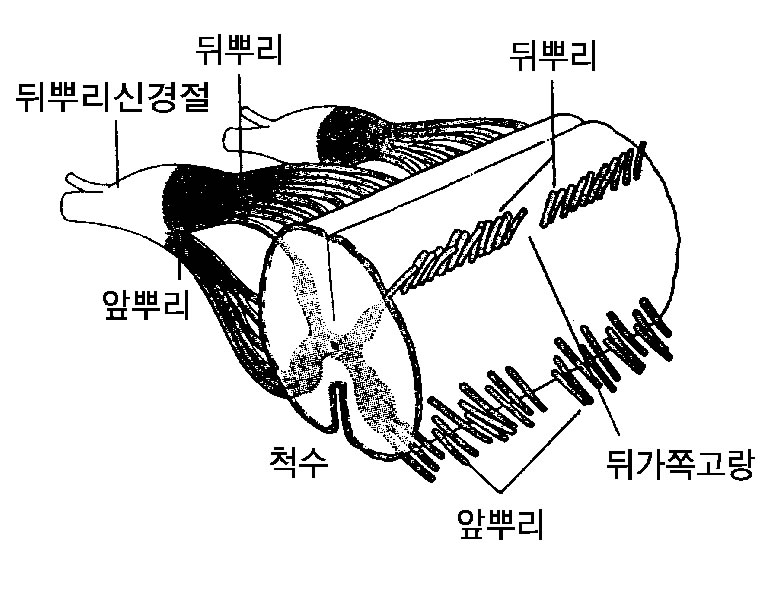 |
||
| 영문 | spinal nerve | 한글 | 척수신경 |
|---|---|---|---|
| 설명 | 척수의 앞뿔에서 출발하는 운동신경과 뒷뿔으로 들어오는 감각신경이 합쳐서 형성되는 신경으로서 총 31쌍이 존재함. 목뼈신경이 8쌍, 자등뼈신경이 12쌍, 허리뼈의 신경이 5쌍, 엉치뼈의 6쌍을 이룸. |
||
| PSA | parasternal short axis; pleomorphic salivary gland adenoma; polyethylene sulfonic acid; polysacchari... |
|---|---|
| SC | conditioned stimulus; sacrococcygeal; Sanitary Corps; scalenus [muscle]; scapula; Schwann cell; scia... |
| ACA | abnormal coronary artery; acrodermatitis chronica atrophicans; acute cerebellar ataxia; adenocarcino... |
| ADR | activation, depression, repetition [in bone remodeling]; adrenodoxin reductase; Adriamycin; adverse ... |
| AEM | Academic Emergency Medicine [journal]; analytical electron microscopy; ambulatory electrocardiograph... |
| HCSMA | Hereditary Canine Spinal Muscular Atrophy |
|---|---|
| AT | Ataxia Telangiectasis |
| ATM | Ataxia Telangiectasia Mutated |
| ADCA | Autosomal Dominant Cerebellar Ataxia |
| FA | Friedreich ataxia |
| hereditary spinal ataxia | Sclerosis of the posterior and lateral columns of the spinal cord, occurring in children and marked by ataxia in the lower extremities, extending to the upper, followed by paralysis and contractures; autosomal recessive inheritance. See: spinocerebellar ataxia. Synonym: Friedreich's ataxia, heredotaxia. (05 Mar 2000) |
|---|
| hereditary ataxia | A simple autosomal recessive trait in fox terrier dogs that produces a progressive general ataxia. (05 Mar 2000) |
|---|---|
| hereditary cerebellar ataxia | A disease of later childhood and early adult life, marked by ataxic gait, hesitating and explosive speech, nystagmus, and sometimes optic neuritis. It probably comprises several distinct conditions with diverse patterns of inheritance. Collective term for a number of hereditary disorders in which cerebellar signs are the most prominent finding. (05 Mar 2000) |
| spinal ataxia | Ataxia due to spinal cord disease, as in tabes dorsalis. (05 Mar 2000) |
| equine spinal ataxia | A disease of young horses characterised by progressive weakness and incoordination, most evident in the hind legs; it is associated with lesions in the cervical region of the spinal cord and is the result of compression of the spinal cord by malformed cervical vertebrae. (05 Mar 2000) |
| acute ataxia | Generalised ataxia of abrupt onset, most often caused by drug intoxications, poisonings, or vestibular neuronitis. (05 Mar 2000) |
| ataxia | <neurology> Failure of muscular coordination, irregularity of muscular action. Origin: Gr. Taxis = order (16 Dec 1997) |
| ataxia cordis | <cardiology> A condition where there is disorganised electrical conduction in the atria, resulting in ineffective pumping of blood into the ventricle. Acronym: AF (02 Jan 1998) |
| ataxia of calves | A specific cerebellar ataxia in the Jersey breed, probably a recessive genetic trait. (05 Mar 2000) |
| ataxia of lambs | Myelination failure seen in ewes on a copper-deficient diet. (05 Mar 2000) |
| ataxia-telangiectasia | <neurology, oncology> An intriguing autosomal recessive disorder in which a single defective gene produces myriad and protean effects, presents with cerebellar ataxia, telangiectasias in the eyes and skin, immune deficiency and autoimmune phenomena, propensity for lymphoid and other malignancies, excessive sensitivity to ionising radiation, increased serum alpha-fetoprotein concentrations and a tendency for chromosome breakage and translocation. A syndrome characterised by choreoathetosis beginning in childhood, progressive cerebellar ataxia, telangiectasis of conjunctiva and skin, slowly progressive mental deterioration and increasing cerebellar degeneration. There is evidence that heterozygotes show an increased susceptibility to malignancy as well, with breast cancer often cited. The gene was localised by linkage studies to chromosome 11q22-23, and recently cloned, revealing it to be homologous to the PI-3 kinase family so that prenatal diagnosis by RFLP analysis is possible. Other related genes are suspected to exist. Diagnosis in affected patients is made on clinical grounds, by detection of high concentrations of alpha-fetoprotein, and by a specialised cell culture assay for radiosensitivity and atypical radioresistant DNA synthesis. These cell culture methods are also used for prenatal diagnosis. A characteristic autopsy feature of ataxia-telangiectasia is the presence of empty basket cells in the cerebellum which results from degeneration of the previously contained Purkinje cells. Inheritance: autosomal recessive. (16 Dec 1998) |
| ataxia telangiectasia syndrome | ataxia telangiectasia |
| bovine congenital ataxia | An autosomal recessive ataxia seen in several European breeds of cattle. (05 Mar 2000) |
| Briquet's ataxia | Weakening of the muscle sense and increased sensibility of the skin, in hysteria. Synonym: hysterical ataxia. (05 Mar 2000) |
| Bruns ataxia | Difficulty in initiation of movements of the feet when they are in contact with the ground; a condition related to a frontal lobe lesion. (05 Mar 2000) |
| vasomotor ataxia | A form of autonomic ataxia causing irregularity in the peripheral circulation, marked by alternations of pallor and suffusion, due to spasm of the smaller blood vessels. (05 Mar 2000) |
제품명 |
판매사 |
보험코드 | 성분/함량 | 구분/보험급여 |
|---|
제품명 |
판매사 |
보험코드 | 성분/함량 | 구분/보험급여 |
|---|