
| 영문 | sympathetic nervous system | 한글 | 교감신경계 |
|---|---|---|---|
| 설명 | 자율신경계의 일종으로 내장기능을 주로 항진시켜 활동을 증가시키는 기능을 가진다. 자율신경계의 다른 계열인 부교감신경계는 반대로 내장기능을 억제시켜 에너지를 비축하는 기능을 가진다. 자율신경계의 해부학적 특성은 신경이 중추신경계에서 나와 목표장기에 도달하기 전에 한번의 시냅스(synapse)를 이룬다는 점이며, 따라서 자율신경계는 두 개의 신경(시냅스를 이루기 전의 절전신경과 이룬 후의 절후신경)으로 구성된다. 자율신경계중 교감신경계는 중추신경계 즉 척수 부근의 교감신경절(sympathetic ganglion)에서 시냅스가 일어나고, 부교감 신경계는 중추신경계에서 멀리 떨어진 목표 장기부근의 신경절(ganglion)에서 시냅스가 일어나는 점이 다르다. |
||
| 영문 | nervous system | 한글 | 신경계 |
|---|---|---|---|
| 설명 | 여러 기관들의 서로간 상호연결체계가 바로 신경계이다. 여기에는 중추신경계(central nerve system: CNS)와 말초신경계(peripheral nerve system: PNS)가 있는데, 중추신경계란 뇌와 척수를 말한다. 그리고 말초신경계에는 12쌍의 뇌신경(cranial nerve: 뇌에서 기시하여 주로 얼굴부위와 목 부위에 분포한다)과 31쌍의 척수신경(spinal nerve:spinal cord에서 각기 양쪽으로 쌍을 이루어 나오는데 주로 목이하부위의 신체 각부분으로 분포하게 된다)으로 구성되어 있다. 또한 말초신경계는 3가지의 신경조직들로 구성되어 있는데 앞에서 말한 뇌신경과 척수신경외에 자율신경계가 여기에 해당된다. 자율신경계는 다시 교감신경과 부교감신경으로 나뉘어져 서로간의 올바른 상호작용으로 생체 여러 가지 작용을 수행한다. |
||
| 영문 | autonomic nervous system | 한글 | 자율신경계 |
|---|---|---|---|
| 설명 | 사람의 의지와 관계없이, 침을 흘리거나 소화운동 등과 같은 스스로 조정이 되어 움직이는 신경계이며 여기에는 다음과 같은 두 가지가 있다. 1.교감신경계(sympathetic nervous system)-사람이 위험상태에 이르렀을 경우에 흥분이 되는 자율신경계. 즉 심박수의 증가, 소화기 운동의 감소 등의 일이 이곳을 통해서 일어난다. 교감신경이 흥분되면 교감신경의 말단에서 epinephrine, norepinephrine 등의 물질이 분비되고 이것들에 의해서 말초장기가 변화를 일으킨다. 하지만 장기에 따라서 epinephrine이나 norepinephrine의 수용체를 가지고 있어서 여러 가지 다른 장기의 반응을 볼 수가 있다. 수용체는 다음과 같다. -알파수용체(alpha-receptor): 말초혈관의 수축, 기관지의 수축, 동공의 근육의 수축 -베타1수용체(beta 1-receptor): 심장에 존재하는 수용체, 심장을 빨리 뛰게하는 역할을 한다. -베타2수용체(beta 2-receptor): 혈관의 이완, 기관지의 이완, 즉 각 장기들은 그 장기가 가지고 있는 교감신경의 수용체에 따라 교감신경의 흥분(교감신경 말단에서의 epinephrine의 분비)에 대한 반응이 달라진다(예-교감신경이 흥분시에 beta 1-수용체를 가지고 있는 심장은 빨리 뛰게 된다. 교감신경 흥분시에 동공의 근육이 수축해서 동공의 크기가 커진다) 2.부교감신경계(parasympathetic nervous system)-교감신경과 반대로 작용한다. 즉 사람이 졸리거나 쉴 경우에 흥분한다. 부교감신경이 흥분할 때에는 신경의 말단에서 아세칠콜린의 분비가 일어나고 이것으로 인해서 각 장기의 변화가 일어난다. |
||
| 영문 | central nervous system(CNS) | 한글 | 중추신경계 |
|---|---|---|---|
| 설명 | 신경계는 중추신경계와 말초신경계로 분류할 수가 있다. 중추신경계란 뇌와 척수로 구성되어 있는 신경계를 이르는 말이다. 말초신경계란 이 이외의 모든 신경계를 이르는 말이다. |
||
| 영문 | white matter | 한글 | 백색질 |
|---|---|---|---|
| 설명 | 1. 뇌는 두 부분으로 나뉘어져 있다. 대뇌겉질이나 뇌의 중앙부에 위치하는 핵(예를 들면 시상, 시상하부, 바닥핵 등)이 회색질이고 그 외는 백색질이다. 척수의 경우에는 바깥쪽의 하얀부분을 백색질이라 하고, 안쪽의 색깔이 어두운 부분을 회색질이라 한다. 이중 실제적으로 대부분의 신경세포의 돌기 특히 축삭과 말이집으로 구성된 것이 백색질이며, 회색질은 신경세포와 보조하는 세포들이 많은 곳이다. 또한 척수도 백색질과 회색질로 나뉘어 있다. 2. 치아에 점착된 백색 물질로서 세균 및 사상 미생물을 함유한 점액 및 상피세포로 구성된다. 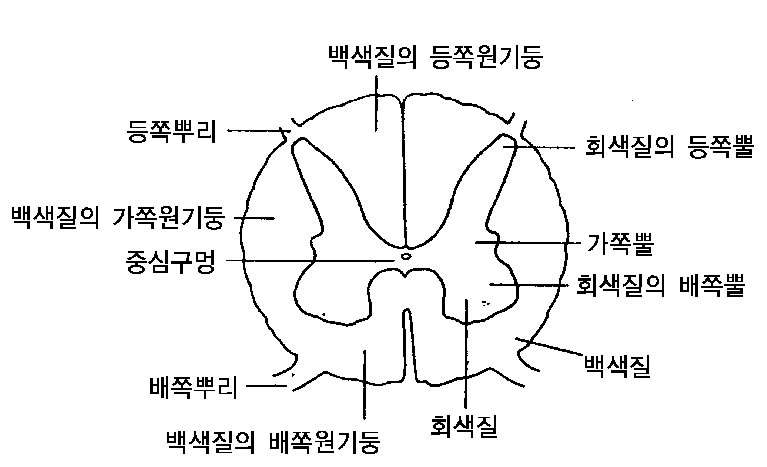 |
||
| PNS | paraneoplastic syndrome; parasympathetic nervous system; partial nonprogressive stroke; peripheral n... |
|---|---|
| CGM | central gray matter |
| GM | gastric mucosa; Geiger-Muller [counter]; general medicine; genetic manipulation; geometric mean; gia... |
| PAG | periaqueductal gray [matter]; polyacrylamide gel; pregnancy-associated globulin; proliferation-assoc... |
| ISIS | image selected in vivo spectroscopy; imaging science and information system; information system-imag... |
| GM | Gray matter |
|---|---|
| PAG | Periaquaeductal gray matter |
| DPAG | dorsal periaqueductal gray matter |
| ANS | Autonomic Nervous System |
| CNS | cental nervous system |
| matter, gray | The cortex of the brain which contains nerve cell bodies. The gray matter is as opposed to the white matter, the part of the brain that contains myelinated nerve fibres. The gray matter is so named because it in fact appears gray. In the mysterious affair at styles (1920), agatha christie first quoted the fictional belgian detective hercule poirot in regard to his gray matter: 'this affair must be unravelled from within.' he tapped his forehead. 'these little grey cells. It is up to them as you say over here.' (12 Dec 1998) |
|---|---|
| gray matter | The cortex of the brain which contains nerve cell bodies. The gray matter is in contrast to the white matter, the part of the brain that contains myelinated nerve fibres. The gray matter is so named because it in fact appears gray. The white matter is white because that is the colour of myelin, the insulation covering the nerve fibres. In the mysterious affair at styles (1920), agatha christie first quoted the fictional belgian detective hercule poirot in regard to his gray matter: 'this affair must be unravelled from within.' he tapped his forehead. 'these little grey cells. It is up to them as you say over here.' (12 Dec 1998) |
| pontine gray matter | The massive gray matter filling the basilar pons. The nuclei are of fairly homogeneous architecture and project to the cortex of the contralateral cerebellar hemisphere by way of the middle cerebellar peduncle. Their main afferents come from the entire extent of the cerebral neocortex by way of the longitudinal pontine bundles (corticopontine fibres); thus, the pontine nuclei form a major way-station in the impulse conduction from the cerebral cortex of one hemisphere to the posterior lobe of the opposite cerebellum. Synonym: nuclei pontis, pontine gray matter. (05 Mar 2000) |
| heterotopic gray matter | <radiology> Presence of cortical neurons in an abnormal location secondary to arrest of migrating neuroblasts from ventricular walls to brain surface between 7-24 weeks of gestational age, frequency: 3% of healthy population associated with: agenesis of corpus callosum, aqueductal stenosis, microcephaly, schisencephaly, encephalocele X-ray: single/multiple bilateral subependymal nodules along lateral ventricles Differential diagnosis: subependymal spread of neoplasm, subependymal haemorrhage, vascular malformation, tuberous sclerosis, intraventricular meningioma, neurofibromatosis (12 Dec 1998) |
| gray level also gray value | <microscopy> The brightness of pixels in a digitised video image, commonly expressed in integers ranging from 0 (black) to 255 (white) for an 8-bit digital signal. (05 Aug 1998) |
| autonomic nervous system | <anatomy> Neurons that are not under conscious control, comprising two antagonistic components, the sympathetic and parasympathetic nervous systems. The autonomic nervous system regulates key functions including the activity of the cardiac (heart) muscle, smooth muscles (e.g., of the gut), and glands. The autonomic nervous system has two divisions: 1. The sympathetic nervous system that accelerates the heart rate, constricts blood vessels, and raises blood pressure. 2. The parasympathetic nervous system slows the heart rate, increases intestinal and gland activity, and relaxes sphincter muscles. (03 Jul 1999) |
| autonomic nervous system diseases | Diseases that have their major effects on the autonomic nervous system. The autonomic nervous system may be seriously affected in many other disorders including other peripheral nervous system diseases, infectious diseases (e.g., tetanus, diphtheria), immunologic diseases (e.g., acquired immunodeficiency syndrome), and systemic disorders (e.g., diabetic neuropathy, amyloid neuropathy, thyroid diseases). Disorders of central autonomic control also contribute substantially to a wide variety of problems (e.g., eating disorders, panic disorder, water-electrolyte imbalance, cardiovascular diseases). (12 Dec 1998) |
| vegetative nervous system | <anatomy> Neurons that are not under conscious control, comprising two antagonistic components, the sympathetic and parasympathetic nervous systems. The autonomic nervous system regulates key functions including the activity of the cardiac (heart) muscle, smooth muscles (e.g., of the gut), and glands. The autonomic nervous system has two divisions: 1. The sympathetic nervous system that accelerates the heart rate, constricts blood vessels, and raises blood pressure. 2. The parasympathetic nervous system slows the heart rate, increases intestinal and gland activity, and relaxes sphincter muscles. (03 Jul 1999) |
| ventral nervous system defective | <molecular biology> A Drosophila gene encoding an integral membrane glycoprotein related to amyloidogenic glycoprotein. (12 Jan 1998) |
| parasympathetic nervous system | <anatomy, neurology> One of the two divisions of the vertebrate autonomic nervous sytem. Parasympathetic nerves emerge cranially as pre ganglionic fibres from oculomotor, facial, glossopharyngeal and vagus and from the sacral region of the spinal cord. most neurons are cholinergic and responses are mediated by muscarinic receptors. The parasympathetic system innervates, for example: salivary glands, thoracic and abdominal viscera, bladder and genitalia. Compare:. Sympathetic nervous system. (18 Nov 1997) |
| visceral nervous system | <anatomy> Neurons that are not under conscious control, comprising two antagonistic components, the sympathetic and parasympathetic nervous systems. The autonomic nervous system regulates key functions including the activity of the cardiac (heart) muscle, smooth muscles (e.g., of the gut), and glands. The autonomic nervous system has two divisions: 1. The sympathetic nervous system that accelerates the heart rate, constricts blood vessels, and raises blood pressure. 2. The parasympathetic nervous system slows the heart rate, increases intestinal and gland activity, and relaxes sphincter muscles. (03 Jul 1999) |
| central nervous system | <anatomy, neurology> Pertaining to the brain, cranial nerves and spinal cord. It does not include muscles or peripheral nerves. In invertebrates, the central nervous system is composed of the segmental ganglia of the ventral nerve cord together with the fused ganglia or brain at the anterior end. Acronym: CNS (12 Jan 1998) |
| central nervous system agents | A class of drugs producing both physiological and psychological effects through a variety of mechanisms. They can be divided into "specific" agents, e.g., affecting an identifiable molecular mechanism unique to target cells bearing receptors for that agent, and "non-specific" agents, those producing effects on different target cells and acting by diverse molecular mechanisms. Those with non-specific mechanisms are generally further classed according to whether they produce behavioural depression or stimulation. Those with specific mechanisms are classed by locus of action or specific therapeutic use. (12 Dec 1998) |
| central nervous system depressants | A very loosely defined group of drugs that tend to reduce the activity of the central nervous system. The major groups included here are ethyl alcohol, anaesthetics, hypnotics and sedatives, narcotics, and tranquillising agents (antipsychotics and antianxiety agents). (12 Dec 1998) |
| central nervous system infections | Diseases of the central nervous sytem collectively, caused by pathogenic organisms. (12 Dec 1998) |
제품명 |
판매사 |
보험코드 | 성분/함량 | 구분/보험급여 |
|---|
제품명 |
판매사 |
보험코드 | 성분/함량 | 구분/보험급여 |
|---|