
| 영문 | open heart surgery | 한글 | 개심술, 심장절개술 |
|---|---|---|---|
| 설명 | 심장의 한 개 또는 그 이상의 방실 절개하는 수술. 심방사이막결손증, 심실사이막결손증, 순수형 허파동맥판막협착증, 팔로(Fallot) 사징후 등이 적용이 된다. 이 수술을 위해서는 인공심폐장치가 필요하다. |
||
| 영문 | hypertensive heart disease | 한글 | 고혈압심장병 |
|---|---|---|---|
| 설명 | 고혈압에 의해서 생기는 심장병. 고혈압심장병이라는 진단을 붙이기 위해서는 최소한 다음과 같은 조건이 부합되어야 하는데, 첫째 심장혈관계에 심장병을 유발할 수 있을 만한 다른 병변이 없이 좌심실 비대가 있어야 하며, 둘째 고혈압을 앓았다는 병력이 있어야 한다. 주로 고혈압에 의한 심장병은 초기에는 좌심실이 비후라는 것으로 특징되어진다. 즉 혈압이 높으므로 혈액을 순환시키기 위해서는 그만큼 심장의 혈액을 보내는 힘이 좋아야 한다. 그 힘을 얻기위해서는 심근의 비후가 필요로 하여 좌심실 근육의 비후가 생긴다. 그리고 고혈압이 지속이 될 경우에는 결국 심장이 제 구실을 하지 못하고 펌프로서의 기능을 잃어버리게 되어 심장기능상실에 빠지게 된다. |
||
| 영문 | rheumatic heart disease | 한글 | 류마티스심장병 |
|---|---|---|---|
| 설명 | 사슬알균감염 후 생기는 심장판막병이다. 원인은 A군 -용혈사슬알에 의한 인두염후 일종의 면역반응으로 발병한다. 진단은 존의 기준에 의한다. (1) 주요기준은 관절염 심장염(심장비대, 심장잡음, 심장기능상실 등) 무도증: 무당이 춤을 추는 것 같은 행동의 발작증세. 연변홍반: 빨간 테두리를 가진 피부병변은 피하결절(subcutaneous nodule): 피부 밑에 생긴 결절, (2)참고 기준은 열, 관절통, EKG상 PR연장: 심전도 소견 급성기 반응물질(예: ESR, CRP)의 상승, 류마티스열 치료는 페니실린으로 치료하고 심장의 후유증 또한 페니실린으로 예방한다. |
||
| 영문 | congenital heart disease | 한글 | 선천심장병 |
|---|---|---|---|
| 설명 | 선천적으로 심장의 구조에 이상이 있는 병. |
||
| 영문 | heart | 한글 | 심장 |
|---|---|---|---|
| 설명 | 심장은 가슴의 중앙에 위치하며 오른쪽과 왼쪽반으로 나눌 수 있다. 각각은 정맥에서 피가 들어오는 방과 동맥으로 피를 내보내는 실이 있다. 심장은 정중앙선에서 왼쪽에 놓여 있다. 심장의 2개의 심방과 2개의 심실, 그리고 심방사이의 심방중격, 심실사이의 심실중격이 존재한다. 심실은 혈액을 주로 순환시키는 힘을 내는 곳으로 강한 근육층이 존재를 한다. 반면에 심방은 심실에 들어가기전에 일시적으로 피가 모이는 곳으로 근육층의 발달이 미약하다. 심방과 심실사이에 삼첨판과 승모판, 심실의 유출로에 대동맥판과 폐동맥판이 있다. 이것들은 혈액이 흐르는 방향에 거슬러 진행하는 것을 막는 기능을 한다. 그리고 심장에는 심장의 근육에 혈액을 공급하는 관상동맥이 있다. 이 심장동맥은 심장을 쌓듯이 존재한다. 심장박동의 신호는 특수한 장치에 의해서 발생이 되고 특수한 전도계를 통해서 전체의 심장으로 전도된다. 심장박동의 신호는 우선 우심방에 위치하는 동방결절(SA node)라는 곳에서 우선 생긴다. 여기에서 보내는 전기적 신호가 바로 심장을 뛰게하는 신호인 것이다. 이 신호로 말미암아 심방이 우선 수축을 한다. 그리고는 심방과 심실사이에 위치하는 방실결절(AV node)라는 곳에 일정하게 정해진 통로없이 전체의 심방을 통해서 전달이 되고 이 신호를 받은 방실결절(AV node)는 히스 다발(His bundle)과 심장전도근육섬유를 통해서 심실의 심장근육에게 이 신호를 보내주어 심실근육을 수축하게 한다. 히스다발과 심장전도근육섬유는 전체의 심실의 심근섬유에 동시에 전기적 신호를 보내어 줄 수 있게 하는 일종의 전기줄과 같은 역할을 한다. 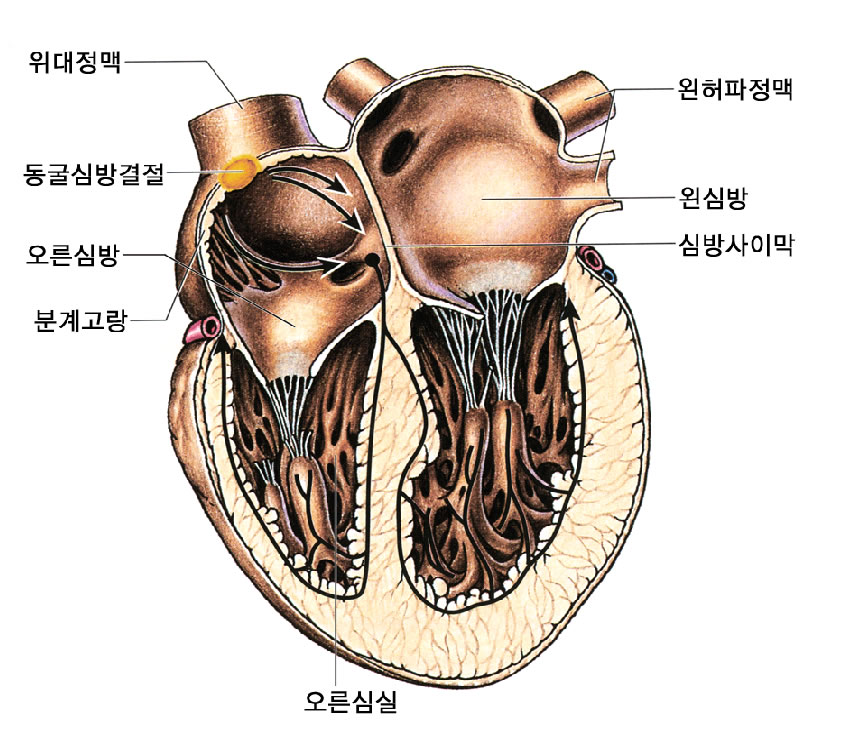 |
||
| IHD | Ischemic Heart Disease = Coronary Heart(Artery) Disease = Atheroscler... |
|---|---|
| JVP | [POMD P 49 - 52] 1) Jugular Vein Pressure 2) Jugular Venous Pulse ... |
| AHD | acquired hepatocerebral degeneration; acute heart disease; antihyaluronidase; antihypertensive drug;... |
| CHD | Chediak-Higashi disease; childhood disease; chronic hemodialysis; congenital or congestive heart dis... |
| HT | Hashimoto thyroiditis; hearing test; hearing threshold; heart; heart transplantation, heart transpla... |
| FHR | Foetal heart rate |
|---|---|
| IUGR | Intrauterine foetal growth retardation |
| ACC-AHA | American College of Cardiology - American Heart Association |
| AHA | American Heart Association |
| AH | Artificial heart |
| foetal heart | The heart of the foetus of any viviparous animal. It refers to the heart in the postembryonic period and is differentiated from the embryonic heart (heart/embryology) only on the basis of time. (12 Dec 1998) |
|---|---|
| foetal heart rate | In the foetus, the number of heart beats per minute, normally 120 to 160. (05 Mar 2000) |
| baseline foetal heart rate | <paediatrics> The average heart rate for a particular foetus during the diastolic phase of uterine contractions. (05 Mar 2000) |
|---|---|
| baseline variability of foetal heart rate | The beat-to-beat changes in foetal heart rate as recorded on a graph. (05 Mar 2000) |
| heart rate, foetal | The heart rate of the foetus. The normal range at term is between 120 and 160 beats per minute. (12 Dec 1998) |
| baby, foetal alcohol syndrome | <syndrome> Alcohol is capable of causing birth defects. FAS (foetal alcohol syndrome) always involves brain damage. And impaired growth. FAS also always involves head and face abnormalities. No amount of alcohol has been proven safe during pregnancy. Women who are or may become pregnant are advised to avoid alcohol. (12 Dec 1998) |
| rate, foetal mortality | The ratio of foetal deaths divided by the sum of the births (the live births + the foetal deaths) in that year. In the united states, the foetal mortality rate plummeted from 19.2 per 1,000 births in 1950 to 9.2 per 1,000 births in 1980. (12 Dec 1998) |
| marked foetal bradycardia | A foetal heart rate less than 100 beats per minute. (05 Mar 2000) |
| version, foetal | The manual conversion of or changing of the polarity of the foetus with reference to the mother. (12 Dec 1998) |
| maternal-foetal exchange | Exchange of substances between the maternal blood and the foetal blood through the placental barrier. It excludes microbial or viral transmission. (12 Dec 1998) |
| persistent foetal circulation syndrome | <syndrome> A syndrome of persistent pulmonary hypertension in the newborn infant, without demonstrable cardiac disease. It is characterised by cyanosis and acidosis, severe pulmonary vasoconstriction, hypertrophy of pulmonary arterial muscle, and elevated pulmonary vascular resistance, with resultant right-to-left shunting of blood through a patent ductus arteriosus and at times a patent foramen ovale. (12 Dec 1998) |
| circulation, foetal | The blood circulation in the foetus (the unborn baby). Before birth, the blood from the heart that is destined (in the pulmonary artery) for the lungs is shunted away from the lungs and returned to the greatest of arteries (the aorta). The shunt is through a short vessel called the ductus arteriosus. When this shunt is open, it is said to be a patent (pronounced pá tent) ductus arteriosus (PDA). The PDA usually closes at or shortly after birth and blood is permitted to course freely to the lungs. (12 Dec 1998) |
| mild foetal bradycardia | A foetal heart rate less than 120 beats per minute. (05 Mar 2000) |
| mortality rate, foetal | The ratio of foetal deaths to the sum of the births (the live births + the foetal deaths) in that year. In the united states, the foetal mortality rate plummeted from 19.2 per 1,000 births in 1950 to 9.2 per 1,000 births in 1980. (12 Dec 1998) |
| hereditary persistence of foetal haemoglobin | <haematology> Hereditary persistence of foetal haemoglobin is a genetic condition where adult types of haemoglobin fail to develop and the types of haemoglobin the individual had as a foetus remains present well past the point when they would normally have stopped being produced. (09 Oct 1997) |
| hypoplastic foetal chondrodystrophy | A developmental error of the epiphyses characterised by severe deformities, epiphyses ossified from several discrete centres and with a stippled appearance, and thickened shafts of the long bones; congenital cataract and mental retardation are often present. There is an autosomal dominant form and an autosomal recessive form. Synonym: chondrodysplasia punctata, chondrodystrophia calcificans congenita, hypoplastic foetal chondrodystrophy, stippled epiphysis. (05 Mar 2000) |
| syndrome, foetal alcohol | The sum total of a person's problems caused by maternal alcohol intake during pregancy. (12 Dec 1998) |
제품명 |
판매사 |
보험코드 | 성분/함량 | 구분/보험급여 |
|---|
제품명 |
판매사 |
보험코드 | 성분/함량 | 구분/보험급여 |
|---|