
| 영문 | muscle cell(=muscle fiber) | 한글 | 근육세포 |
|---|---|---|---|
| 설명 | 근육은 수의근(의식에 의해서 조절이 가능한 근육: 예를 들어 다리, 팔, 얼굴근육 등)과 불수의근(의식과 무관하게 조절하지 않아도 움직이는 근육: 예를 들어 심장근, 소화기관에 분포하는 근육 등)으로 나누어지며, 근육세포의 모양은 다음과 같다(수의근, 불수의근 외에 심장에 있는 심장근은 불수의근에 해당하지만 그 모양은 수의근과 같아 따로 분류한다).  |
||
| 영문 | white blood cell(WBC), leukocyte | 한글 | 백혈구 |
|---|---|---|---|
| 설명 | 혈액내에 골수구계세포와 림프계세포, 단핵구계세포를 모두 통틀어 말한다. 백혈구의 증가가 있으면 대개 감염이 있거나, 혹은 탈수현상이 있음을 의미한다. 또한 지나친 백혈구수의 감소는 인체내 면역기능이 떨어져 있음을 의미하며, 다른 질병에 의해 나타나는 이차적인 현상이 아닌지 꼭 진단을 받아보아야 한다. |
||
| 영문 | mast cell | 한글 | 비만 세포 |
|---|---|---|---|
| 설명 | 동물의 결합 조직 가운데 널리 분포하는 세포. 결합조직과 점막조직 내에 있는 호염기성 색소로 이염색성(metachromasia)을 나타내는 과립을 가진 방추형의 세포에 작은 둥근 핵을 가진다. 비만세포의 표면에는 IgE에 대한 수용체가 존재하며, 수용체에 결합한 IgE 분자들끼리 다가의 항원에 의해 서로 연결되면 비만세포 과립탈출 반응이 일어나, 히스타민, 세로토닌, 헤파린 등의 화학전달 물질이 방출되어, 즉시형 알레르기 반응 등의 증상을 일으킨다. 피부, 장막, 혈관 주위, 점막 주변에 있다. |
||
| 영문 | cell | 한글 | 세포 |
|---|---|---|---|
| 설명 | 생명체를 이루는 구조적, 기능적 단위. 핵의 유무에 따라서 유핵세포와 무핵세포로 나눌 수가 있다. 무핵세포란 핵이 없는 세포를 말한다. 핵이란 유전정보를 가지고 있는 염색체를 보관하는 곳인데 무핵세포에서는 염색체가 세포속에 그냥 노출되어 있다. 대개 세포 하나하나가 독립된 생명체의 역할을 하는 단세포생물로서 외부환경으로부터 자신을 보호할 수 있는 견고한 세포벽을 가지고 있다. 유핵세포란 핵을 가지고 있어서 유전정보가 있는 염색체가 세포의 다른 부분과 구분되어 핵속에 들어있다. 세포속에서 핵외의 부분(이를 세포질이라 한다)에는 여러 가지 세포의 소기관이 있어서 세포의 다양한 기능을 분담한다. ◈유핵세포의 기본 구조 1.세포막-세포를 둘러싸서 주위환경과 분리하여 세포의 내환경을 유지한다. 2.형질내세망(endoplasmic reticulum)-단위막으로 둘러쌓여 있는 불규칙한 망상구조이다. 이 망상구조의 내부를 소강, 소조라고 부른다. 여기에는 표면이 매끈한 무과립형질내세망과 표면이 불규칙한 과립형질내세망의 두 가지가 있다. 과립형질내세망의 경우는 표면에 단백질을 합성하는 리보솜이라는 것이 부착되어 있다. 이곳은 주로 세포밖으로 분비할 단백질을 합성하는 장소이다. 무과립형질내세망은 표면에 리보솜이 부착되어 있지 않은 것을 말하며, 이곳에서는 주로 해독작용, 글리코겐의 합성, 스테로이드호르몬의 합성 등이 일어난다. 3.리보솜-단백질을 합성하는 역할을 하는 곳이다.이것은 세포질에 존재하는 자유리보솜과 과립형질내세망에 부착이 되어 존재하는 부착리보솜의 두 가지로 나눈다. 자유리보솜은 주로 세포내에서 필요한 단백질을 만드는 역할을 하고 부착리보솜은 세포밖으로 분비할 단백질을 만드는 역할을 한다. 4.골지장치(Golgi apparatus)-핵주위에 분포하는 납작해진 주머니모양의 것이 중첩되어 형성된 층판 모양의 구조물로 과립형질내세망에서 생성되어 외부로 분비될 단백질을 모아서 농축, 포장하여 과립을 만드는 역할을 한다. 5.사립체(mitochondria)-구형, 난형의 긴 막대기 모양으로 크기가 다양한 구조물. 생물체의 에너지 저장물질인 ATP를 생산하는 역할을 한다. 또 세포와 다른 자신만의 유전정보를 가진 DNA, RNA를 가지고 있다. 모양, 크기가 세균과 비슷하며 자체증식성 등 독립된 생명체로서 필요한 요건을 갖추고 있어서 세포와 공생관계를 가진 독립된 세포로 생각하고 있다. 6.용해소체(lysosome)-작은 구형의 소체로 여러 가지 분해효소를 가진다. 세포외계에서 들어온 물질과 결합하여 그 물질들을 용해하는 역할을 하고, 오래된 세포소기관들을 제거하는 역할도 한다. 7.세포핵(nucleus)-구형, 난형으로 세포의 중심에 위치한다. 핵내에는 유전정보가 있는 물질인 염색체가 존재한다. 8.중심소체(centrosome)-핵주위에 존재하면서 핵의 분열시에 양쪽의 염색체를 당기는 작은 섬유를 만드는 역할을 하는 곳. 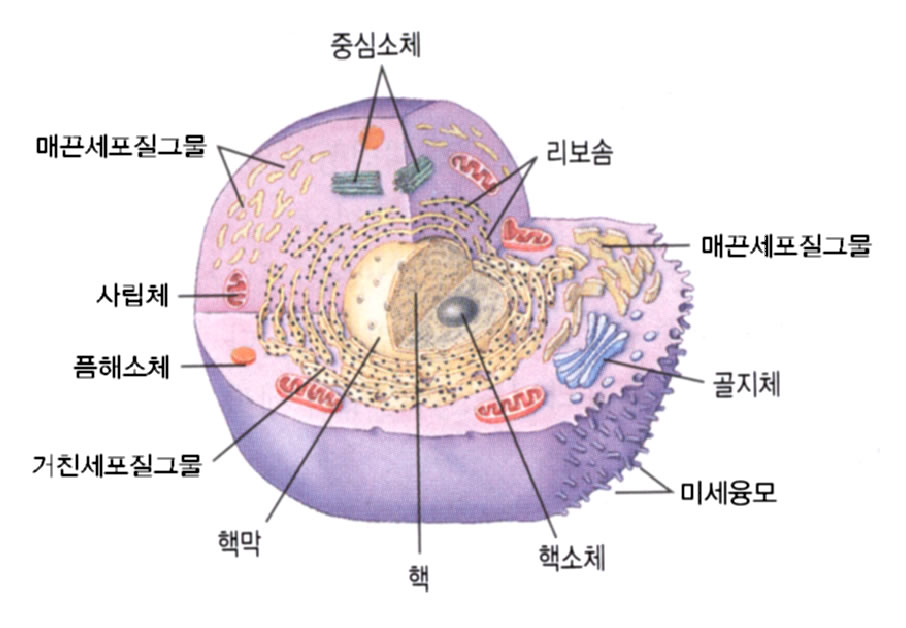 |
||
| 영문 | cell-mediated immunity | 한글 | 세포매개면역 |
|---|---|---|---|
| 설명 | 면역이란 신체를 외부의 물질로부터 보호하는 행위를 말한다. 여기에는 특이적 면역과 비특이적 면역의 두 가지가 있다. 비특이적 면역이라함은 특정한 물질에 관계하는 면역이 아니라 특정 대상이 없이 모든 외부 물체에 작용할 수 있는 면역을 말한다. 여기에는 소변의 흐름, 눈물의 흐름, 피부의 비투과성 등의 기계적인 것도 포함되고 피속에 돌아다니는 세포 중에서 비특이적으로 외부의 물질을 포식하는 세포들(예를 들면 큰포식세포(macrophage)의 활동도 포함이 된다. 세포매개면역이란 특이한 물질을 감지할 수 있는 세포를 생성하게 하여 그것으로 하여금 그 물질을 포식하게 하는 것을 말한다. |
||
| MC | mass casualties; mast cell; Master of Surgery [Lat. Magister Chirurgiae]; maximum concentration; Med... |
|---|---|
| ACC | accommodation; acetyl coenzyme A carboxylase; acinic cell carcinoma; acute care center; adenoid cyst... |
| GC | ganglion cell; gas chromatography; general circulation; general closure; general condition; generali... |
| ADCC cell | Antibody Dependent Cellular(= Cell-Mediated) Cytotoxicity cell |
| HCG, hCG | Human Chorionic Gonadotropin; 사람융모성성선자극호르몬 1. Placental Glycoprotein Hormone &nbs... |
| DF | Dietary fibre |
|---|---|
| FOTI | Fibre optic transillumination |
| NDF | Neutral detergent fibre |
| RF | Reissner's fibre |
| RNFL | Retinal nerve fibre layer |
| fibre cell | <plant biology> Greatly elongated type of plant cell with very thick lignified wall. Usually dead at maturity, this cell type is specialised for the provision of mechanical strength. Fibre cells and sclereids together make up the tissue known as sclerenchyma. (18 Nov 1997) |
|---|
| argyrophilic fibre | Reticular connective tissue fibre's that react with silver salts and appear black microscopically. (05 Mar 2000) |
|---|---|
| bowel disorders and fibre | High fibre diets help delay the progression of diverticulosis and, at least, reduce the bouts of diverticulitis. In many cases, it helps reduce the symptoms of the Irritable Bowel Syndrome ( IBS ). It is generally accepted that a diet high in fibre is protective, or at least reduces the incidence, of colon polyps and colon cancer. (12 Dec 1998) |
| glaucomatous nerve-fibre bundle scotoma | See: caecocentral scotoma. (05 Mar 2000) |
| Reissner's fibre | A rodlike, highly refractive fibre running caudally from the subcommissural organ throughout the length of the central canal of the brainstem and spinal cord. (05 Mar 2000) |
| medullated nerve fibre | An axon enveloped by a myelin sheath formed by oligodendroglia cells (in brain and spinal cord) or Schwann cells (in peripheral nerves). Synonym: medullated nerve fibre. (05 Mar 2000) |
| reticular fibre | <cell biology> A fine fibre of reticulin found in the extracellular matrix. They are fibres of type III collagen which form the distinctive loose connective tissue stroma of embryonic tissues, mesenchyme, red pulp of the spleen, cortex and medulla of lymph nodes, and the haematopoietic compartments of bone marrow and comprise a substantial portion of the collagen fibres of the skin, blood vessels, synovial membrane, uterine tissue, and granulation tissue. They are characterised by their organization as a reticular meshwork of fine filaments and an affinity for silver and for periodic acid-Schiff stains. (17 Jul 2002) |
| retraction fibre | Thin projections from crawling cells associated with areas where the cell body is becoming detached from the substratum, but focal adhesions persist. Usually contain a bundle of microfilaments that are under tension. (18 Nov 1997) |
| rod fibre | A part of the rod cell of the retina that extends to either side of the cell body; the inner rod fibre terminates in the spherule, a synaptic ending located in the outer plexiform layer. (05 Mar 2000) |
| chromatic fibre | The coiled filament in which the genes are located, which extends the entire length of a chromosome and exhibits an intensely positive Feulgen test for DNA. Synonym: chromatic fibre. Origin: chromo-+ G. Nema, thread (05 Mar 2000) |
| Rosenthal fibre | An oval or elongated eosinophilic mass believed to represent a modified process of an astrocyte; seen in large numbers in certain slowly growing astrocytomas and areas of chronic reactive gliosis. (05 Mar 2000) |
| collagen fibre | An individual fibre that varies in diameter from less than 1 um to about 12 um and is composed of fibrils; the fibre's, which are usually arranged in bundles, undergo some branching and are of indefinite length; chemically the fibre is a glycoprotein, collagen, which yields gelatin upon boiling; they make up the principal element of irregular connective tissue, tendons, aponeuroses, and most ligaments, and occur in the matrix of cartilage and osseous tissue. Synonym: white fibre. (05 Mar 2000) |
| white fibre | White mammalian muscle fibres; larger in diameter than red fibres they have less myoglobin, sarcoplasm, and mitochondria, and contract more quickly. Synonym: collagen fibre. (05 Mar 2000) |
| cone fibre | A part of the cone cell of the retina; the inner cone fibre is a slender axon-like part of the cone extending from the cell body to the pedicle located in the outer plexiform layer of the retina; in the outer fovea, where the cones are much elongated, they narrow to an (05 Mar 2000) |
| muscle fibre | <pathology> Component of a skeletal muscle comprising a single syncytial cell that contains myofibrils. Any of the cells of skeletal or cardiac muscle tissue. Skeletal muscle fibres are cylindrical multinucleate cells containing contracting myofibrils, across which run transverse striations, enclosed in a sarcolemma. Cardiac muscle fibres contain one or sometimes two nuclei and myofibrils and are separated from one another by an intercalated disk; although striated, cardiac fibres branch to form an interlacing network. 2. fast-twitch muscles. Skeletal muscle fibres having high myofibrillar atpase activity, high glycolytic enzyme activities, and an intermediate glycogen content which produce a fast twitch. There are two types. Fast fatigable fibres, also called white fibres, have a low myoglobin content, and a small mitochondrial content, and fatigue rapidly due to their limited glycogen content and low capacity for oxidative metabolism. Fast fatigue-resistant fibres, also called red fibres, have a large mitochondrial content and a high myoglobin content, related to their resistance to fatigue. 3. slow-twitch muscles. Skeletal muscle fibres having low myofibrillar atpase activity, low glycogen content, and high myoglobin content, high mitochondrial oxidative enzyme activities, and an intermediate mitochondrial content which produce a slow twitch and are fatigue-resistant. (12 Dec 1998) |
| pole fibre | <cell biology> Microtubules inserted into the pole regions of the mitotic spindle (each pole is the product of the division of the centrioles and constitutes a microtubule organising centre. (18 Nov 1997) |
제품명 |
판매사 |
보험코드 | 성분/함량 | 구분/보험급여 |
|---|
제품명 |
판매사 |
보험코드 | 성분/함량 | 구분/보험급여 |
|---|