
| 영문 | open heart surgery | 한글 | 개심술, 심장절개술 |
|---|---|---|---|
| 설명 | 심장의 한 개 또는 그 이상의 방실 절개하는 수술. 심방사이막결손증, 심실사이막결손증, 순수형 허파동맥판막협착증, 팔로(Fallot) 사징후 등이 적용이 된다. 이 수술을 위해서는 인공심폐장치가 필요하다. |
||
| 영문 | hypertensive heart disease | 한글 | 고혈압심장병 |
|---|---|---|---|
| 설명 | 고혈압에 의해서 생기는 심장병. 고혈압심장병이라는 진단을 붙이기 위해서는 최소한 다음과 같은 조건이 부합되어야 하는데, 첫째 심장혈관계에 심장병을 유발할 수 있을 만한 다른 병변이 없이 좌심실 비대가 있어야 하며, 둘째 고혈압을 앓았다는 병력이 있어야 한다. 주로 고혈압에 의한 심장병은 초기에는 좌심실이 비후라는 것으로 특징되어진다. 즉 혈압이 높으므로 혈액을 순환시키기 위해서는 그만큼 심장의 혈액을 보내는 힘이 좋아야 한다. 그 힘을 얻기위해서는 심근의 비후가 필요로 하여 좌심실 근육의 비후가 생긴다. 그리고 고혈압이 지속이 될 경우에는 결국 심장이 제 구실을 하지 못하고 펌프로서의 기능을 잃어버리게 되어 심장기능상실에 빠지게 된다. |
||
| 영문 | rheumatic heart disease | 한글 | 류마티스심장병 |
|---|---|---|---|
| 설명 | 사슬알균감염 후 생기는 심장판막병이다. 원인은 A군 -용혈사슬알에 의한 인두염후 일종의 면역반응으로 발병한다. 진단은 존의 기준에 의한다. (1) 주요기준은 관절염 심장염(심장비대, 심장잡음, 심장기능상실 등) 무도증: 무당이 춤을 추는 것 같은 행동의 발작증세. 연변홍반: 빨간 테두리를 가진 피부병변은 피하결절(subcutaneous nodule): 피부 밑에 생긴 결절, (2)참고 기준은 열, 관절통, EKG상 PR연장: 심전도 소견 급성기 반응물질(예: ESR, CRP)의 상승, 류마티스열 치료는 페니실린으로 치료하고 심장의 후유증 또한 페니실린으로 예방한다. |
||
| 영문 | congenital heart disease | 한글 | 선천심장병 |
|---|---|---|---|
| 설명 | 선천적으로 심장의 구조에 이상이 있는 병. |
||
| 영문 | heart | 한글 | 심장 |
|---|---|---|---|
| 설명 | 심장은 가슴의 중앙에 위치하며 오른쪽과 왼쪽반으로 나눌 수 있다. 각각은 정맥에서 피가 들어오는 방과 동맥으로 피를 내보내는 실이 있다. 심장은 정중앙선에서 왼쪽에 놓여 있다. 심장의 2개의 심방과 2개의 심실, 그리고 심방사이의 심방중격, 심실사이의 심실중격이 존재한다. 심실은 혈액을 주로 순환시키는 힘을 내는 곳으로 강한 근육층이 존재를 한다. 반면에 심방은 심실에 들어가기전에 일시적으로 피가 모이는 곳으로 근육층의 발달이 미약하다. 심방과 심실사이에 삼첨판과 승모판, 심실의 유출로에 대동맥판과 폐동맥판이 있다. 이것들은 혈액이 흐르는 방향에 거슬러 진행하는 것을 막는 기능을 한다. 그리고 심장에는 심장의 근육에 혈액을 공급하는 관상동맥이 있다. 이 심장동맥은 심장을 쌓듯이 존재한다. 심장박동의 신호는 특수한 장치에 의해서 발생이 되고 특수한 전도계를 통해서 전체의 심장으로 전도된다. 심장박동의 신호는 우선 우심방에 위치하는 동방결절(SA node)라는 곳에서 우선 생긴다. 여기에서 보내는 전기적 신호가 바로 심장을 뛰게하는 신호인 것이다. 이 신호로 말미암아 심방이 우선 수축을 한다. 그리고는 심방과 심실사이에 위치하는 방실결절(AV node)라는 곳에 일정하게 정해진 통로없이 전체의 심방을 통해서 전달이 되고 이 신호를 받은 방실결절(AV node)는 히스 다발(His bundle)과 심장전도근육섬유를 통해서 심실의 심장근육에게 이 신호를 보내주어 심실근육을 수축하게 한다. 히스다발과 심장전도근육섬유는 전체의 심실의 심근섬유에 동시에 전기적 신호를 보내어 줄 수 있게 하는 일종의 전기줄과 같은 역할을 한다. 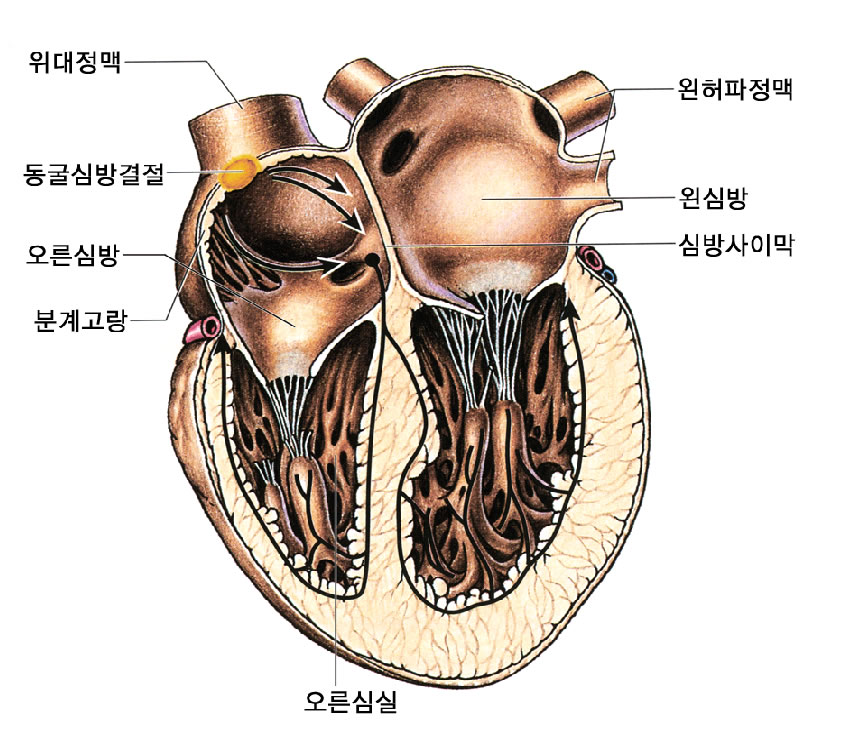 |
||
| ECG | Electro-Cardio-Graphy(-Gram); 심전도 = EKG 1. Conducting System Structu... |
|---|---|
| OFAGE | orthogonal field alternation gel electrophoresis |
| ES | ejection sound; elastic stocking; electrical stimulus, electrical stimulation; electroshock; emergen... |
| TES | thymic epithelial supernatant; toxic epidemic syndrome; transcutaneous electrical stimulation; trans... |
| IHD | Ischemic Heart Disease = Coronary Heart(Artery) Disease = Atheroscler... |
| DA | Delayed Alternation |
|---|---|
| OFAGE | Orthogonal field alternation gel electrophoresis |
| SA | Spontaneous alternation |
| BER | Basic Electrical Rhythm |
| BIA | Bio-electrical impedance analysis |
| electrical alternation of heart | A disorder in which the ventricular or atrial complexes or both are regular in time but of alternating pattern; detected by electrocardiography. The P, QRS, T, QRS-T, or P-QRST alternate singly or in combination. (05 Mar 2000) |
|---|
| mechanical alternation of the heart | A disorder in which contractions of the heart are regular but are alternately stronger and weaker. (05 Mar 2000) |
|---|---|
| electrical heart position | A description of the heart's assumed electrical habitus based upon the form of the QRS complexes in leads aVL, aVF, V1, and V6. Sometimes loosely (and inaccurately) used to describe the frontal plane electric axis. Synonym: heart position. (05 Mar 2000) |
| alternation | 1. The reciprocal succession of things in time or place; the act of following and being followed by turns; alternate succession, performance, or occurrence; as, the alternation of day and night, cold and heat, summer and winter, hope and fear. 2. <mathematics> Permutation. 3. The response of the congregation speaking alternately with the minister. Alternation of generation. See Generation. Origin: L. Alternatio: cf. F. Alternation. Source: Websters Dictionary (01 Mar 1998) |
| alternation of generations | The occurrence in one life history of two or more different forms differently produced, usually an alternation of a sexual with an asexual form. (09 Oct 1997) |
| cardiac alternation | The occurrence of any cardiac phenomenon every other beat. (05 Mar 2000) |
| concordant alternation | The alternation in either the mechanical or electrical activity of the heart, occurring in both systemic and pulmonary circulations. (05 Mar 2000) |
| discordant alternation | The alternation in cardiac activities of either the systemic or the pulmonary circulations, but not of both, or in both but oppositely directed in each. (05 Mar 2000) |
| basic electrical rhythm | A slow wave of depolarisation of smooth muscle from the fundus to the pylorus that coordinates gastric peristalsis and emptying. (05 Mar 2000) |
| magneto-electrical | <physics> Pertaining to, or characterised by, electricity by the action of magnets; as, magneto-electric induction. Magneto-electric machine, a form of dynamo-electric machine in which the field is maintained by permanent steel magnets instead of electromagnets. Source: Websters Dictionary (01 Mar 1998) |
| mean electrical axis | The average magnitude and direction of all the electromotive forces developed during the cardiac event under consideration; e.g., atrial or ventricular depolarisation, or ventricular repolarization. See: axis deviation. (05 Mar 2000) |
| normal electrical axis | A mean electrical axis of the heart situated between -30 |
| instantaneous electrical axis | The resultant axis of the electromotive forces developing in the heart at any given moment. (05 Mar 2000) |
| electrical | 1. Pertaining to electricity; consisting of, containing, derived from, or produced by, electricity; as, electric power or virtue; an electric jar; electric effects; an electric spark. 2. Capable of occasioning the phenomena of electricity; as, an electric or electrical machine or substance. 3. Electrifying; thrilling; magnetic. "Electric Pindar." Electric atmosphere, or Electric aura. See Aura. Electrical battery. See Battery. Electrical brush. See Brush. Electric cable. See Telegraph cable, under Telegraph. Electric candle. See Candle. <medicine> Electric cat, any fish which has an electrical organ by means of which it can give an electrical shock. The best known kinds are the torpedo, the gymnotus, or electrical eel, and the electric cat. See Torpedo, and Gymnotus. Electric fluid, the supposed matter of electricity; lightning. <physics> Electrical image, the torpedo. Electric telegraph. See Telegraph. Origin: L. Electrum amber, a mixed metal, Gr.; akin to the beaming sun, cf. Skr. Arc to beam, shine: cf. F. Electrique. The name came from the production of electricity by the friction of amber. Source: Websters Dictionary (01 Mar 1998) |
| electrical alternans | Electrical alternation of the heart. (05 Mar 2000) |
| electrical axis | The net direction of the electromotive forces developed in the heart during its activation, usually represented in the frontal plane. See: triaxial reference system. (05 Mar 2000) |
제품명 |
판매사 |
보험코드 | 성분/함량 | 구분/보험급여 |
|---|
제품명 |
판매사 |
보험코드 | 성분/함량 | 구분/보험급여 |
|---|