
| 영문 | dura mater | 한글 | 경질막 |
|---|---|---|---|
| 설명 | 중추신경계를 싸고 있는 뇌막 중에서 가장 바깥쪽에 있는 질기고 두꺼운 결합조직성 막. 뇌막이란 뇌를 싸고 있는 막으로 크게 세 개의 막으로 이루어져 있다. 그 중에 가장 바깥에 있는 막을 말한다. 그 다음의 막이 거미막이다. 그리고 뇌에 강하게 밀착되어 있는 가장 안쪽의 막이 유막이다. |
||
| 영문 | spinal tap, spinal puncture | 한글 | 허리천자, 요추천자, 요추뚫기 |
|---|---|---|---|
| 설명 | 질병의 진단이나 치료 또는 마취를 하기 위해 피부에서 거미막밑공간으로 바늘을 찌를 때가 있다. 이것은 셋째 허리뼈 아래쪽에서 시행한다. 척수가 첫째 허리뼈 아랫모서리에서 끝나고, 거미막밑공간은 둘째 엉치뼈 분절까지 뻗어 있기 때문에 이 부위는 바늘로 척수를 찌를 위험이 없다. 또 척추뼈고리판이 짧아 서로 겹쳐있지 않기 때문에 허리뼈 사이로 바늘을 찌를 수 있다. 이 부위의 거미막밑공간에는 척수신경 뿌리가 있으나, 이들은 뇌척수액속에 있기 때문에 바늘을 넣을 때 한쪽으로 밀려 손상받는 경우는 거의 없다. 배를 넓적다리에 붙일정도로 허리를 구부리면 고리판 사이가 더 벌어져 틈이 커진다. 바늘이 뚫고 지나가는 구조는 바깥에서 속으로 ① 피부, ② 피부밑조직, ③ 근육막, ④ 가시끝인대, ⑤ 가시사이인대, ⑥ 황색인대, ⑦ 경질막, ⑧ 거미막, ⑨ 뇌척수액이 된다.  |
||
| 영문 | spinal cord | 한글 | 척수 |
|---|---|---|---|
| 설명 | 척추내에 위치하는 중추신경계의 일부분. 위에서부터 목척수, 등척수, 허리척수, 엉치척수로 구분됨. 내부는 바깥쪽의 백색질과 안쪽의 회색질로 구분된다. 척수의 아래끝은 척수 원뿔이라 하며 첫번째 허리뼈 높이까지 내려온다. 뇌와 말초신경사이의 신경 통로 역할을 하며 척수반사(예: 무릎반사)에서는 뇌를 통하지 않고 반사의 중추 작용을 한다. 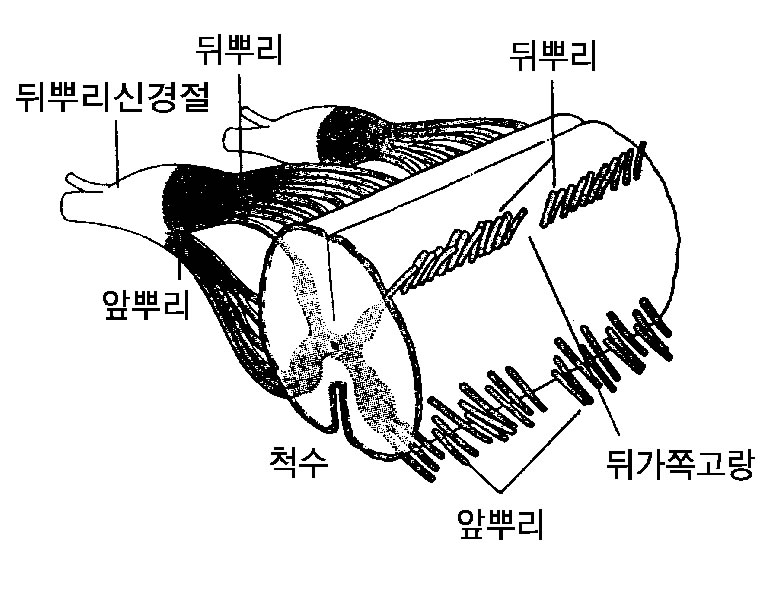 |
||
| 영문 | spinal nerve | 한글 | 척수신경 |
|---|---|---|---|
| 설명 | 척수의 앞뿔에서 출발하는 운동신경과 뒷뿔으로 들어오는 감각신경이 합쳐서 형성되는 신경으로서 총 31쌍이 존재함. 목뼈신경이 8쌍, 자등뼈신경이 12쌍, 허리뼈의 신경이 5쌍, 엉치뼈의 6쌍을 이룸. |
||
| 영문 | vocal cord | 한글 | 성대 |
|---|---|---|---|
| 설명 | 목소리를 내는 데 꼭 필요한 중요한 구조물이다. 성대주위에는 작은 근육들이 존재하여, 하는 소리가 나오도록 해 주는 데, 이 근육들은 주로 되돌이후두신경의 지배를 받고 있으며, 성대의 감각신경은 위후두신경이 맡고 있다. 이중 왼쪽 반회후두신경은 신경의 주행경로상 밑으로 내려갔다 다시 올라와 분포하게 되므로 폐암으로 인한 폐수술시에 손상받기 쉬워서, 수술합병증으로 목쉰소리가 남기도 한다. 또한 성대가 막히면, 공기의 통로가 막히게 되므로 호흡곤란을 유발한다. 성대나 그 주위에서 종양이 발생할 수 있으며, 흡연이 주요한 원인이다. 성대자체에서 종양이 발생하면 목쉰소리가 나타나 쉽게 알 수 있으나, 성대이하부위나, 이상부위에서 발생하면 증상이 늦게 나타나므로, 다른 곳으로의 전이소견이나, 혹은 호흡곤란으로 나타나기도 한다. |
||
| SC | conditioned stimulus; sacrococcygeal; Sanitary Corps; scalenus [muscle]; scapula; Schwann cell; scia... |
|---|---|
| ASCI | acute spinal cord injury; American Society for Clinical Investigation |
| BSCP | bovine spinal cord protein |
| CCSCS | central cervical spinal cord syndrome |
| ESCC | epidural spinal cord compression |
| ESCP | Evoked spinal cord potential |
|---|---|
| MSCC | Metastatic Spinal Cord Compression |
| SC | Spinal Cord |
| SCI | Spinal Cord Injured |
| SCI | Spinal Cord Injury |
| dura mater of spinal cord | Single-layered strong membrane, comparable to and continuous with (at foramen magnum) the meningeal layer of the intracranial dura mater of the brain. It does not (in contrast to the dura mater of brain) adhere to the enveloping bony structures (vertebrae) or their periosteum, being separated from the latter by a considerable space, the vertebral epidural space-a true space containing the internal vertebral venous plexus embedded in a matrix of epidural fat. Synonym: dura mater spinalis, endorrhachis, theca vertebralis. (05 Mar 2000) |
|---|
| filum of spinal dura mater | The thread-like termination of the spinal dura mater, surrounding and fused to the filum terminale of the cord, and attached to the deep dorsal sacrococcygeal ligament; extends from S2-3 to Co2 vertebral levels. Synonym: filum durae matris spinalis. (05 Mar 2000) |
|---|---|
| cerebral part of dura mater | The intracranial dura mater, consisting of two layers: the outer periosteal layer which normally always adheres to the periosteum of the bones of the cranial vault; and the inner meningeal layer which in most places is fused with the outer. The two layers separate to accommodate meningeal vessels and large venous (dural) sinuses. The meningeal layer is also involved in the formation of the various dural folds, such as the falx cerebri and tentorium cerebelli and is comparable to and continuous with the dural mater of the spinal cord. The cranial epidural space is then a potential space between the bone and the combined periosteum/periosteal layer of the dura mater realised only pathologically and is neither continuous with or comparable to the vertebral epidural space. Synonym: dura mater cranialis, dura mater encephali, cerebral part of dura mater, cranial epidural space. (05 Mar 2000) |
| meningeal layer of dura mater | See: dura mater of brain. (05 Mar 2000) |
| periosteal layer of dura mater | See: dura mater of brain. (05 Mar 2000) |
| sinuses of dura mater | Endothelium-lined venous channels in the dura mater. Synonym: sinus durae matris, cerebral sinuses, cranial sinuses, sinuses of dura mater, venous sinuses. (05 Mar 2000) |
| dura mater | <anatomy> The outermost, toughest and most fibrous of the three membranes (meninges) covering the brain and spinal cord. Synonym: pachymeninx. Origin: L. = hard mother (18 Nov 1997) |
| dura mater cranialis | The intracranial dura mater, consisting of two layers: the outer periosteal layer which normally always adheres to the periosteum of the bones of the cranial vault; and the inner meningeal layer which in most places is fused with the outer. The two layers separate to accommodate meningeal vessels and large venous (dural) sinuses. The meningeal layer is also involved in the formation of the various dural folds, such as the falx cerebri and tentorium cerebelli and is comparable to and continuous with the dural mater of the spinal cord. The cranial epidural space is then a potential space between the bone and the combined periosteum/periosteal layer of the dura mater realised only pathologically and is neither continuous with or comparable to the vertebral epidural space. Synonym: dura mater cranialis, dura mater encephali, cerebral part of dura mater, cranial epidural space. (05 Mar 2000) |
| dura mater encephali | An alternate term for dura mater of brain. (05 Mar 2000) |
| dura mater of brain | The intracranial dura mater, consisting of two layers: the outer periosteal layer which normally always adheres to the periosteum of the bones of the cranial vault; and the inner meningeal layer which in most places is fused with the outer. The two layers separate to accommodate meningeal vessels and large venous (dural) sinuses. The meningeal layer is also involved in the formation of the various dural folds, such as the falx cerebri and tentorium cerebelli and is comparable to and continuous with the dural mater of the spinal cord. The cranial epidural space is then a potential space between the bone and the combined periosteum/periosteal layer of the dura mater realised only pathologically and is neither continuous with or comparable to the vertebral epidural space. Synonym: dura mater cranialis, dura mater encephali, cerebral part of dura mater, cranial epidural space. (05 Mar 2000) |
| dura mater spinalis | Single-layered strong membrane, comparable to and continuous with (at foramen magnum) the meningeal layer of the intracranial dura mater of the brain. It does not (in contrast to the dura mater of brain) adhere to the enveloping bony structures (vertebrae) or their periosteum, being separated from the latter by a considerable space, the vertebral epidural space-a true space containing the internal vertebral venous plexus embedded in a matrix of epidural fat. Synonym: dura mater spinalis, endorrhachis, theca vertebralis. (05 Mar 2000) |
| acute spinal cord compression | <radiology> Signs and symptoms of cord compression show progression within 24 hours or less: pain, weakness, autonomic dysfunction, sensory loss, ataxia Diagnostic considerations: Primary or secondary malignancy of epidural space or vertebrae, Trauma, Inflammatory process, Osteoarthritis REF: MacNeil BJ, Abrams HL. Brigham and Women's Hospital Handbook of Diagnostic Imaging. Chapter 35. (12 Dec 1998) |
| anterior median fissure of spinal cord | A deep median fissure on the anterior surface of the spinal cord. Synonym: fissura mediana anterior medullae spinalis, anteromedian groove, sulcus ventralis. (05 Mar 2000) |
| anterolateral column of spinal cord | The lateral white column of the spinal cord between the lines of exit and entrance of the anterior and posterior nerve roots. Synonym: funiculus lateralis, anterolateral column of spinal cord, lateral funiculus of spinal cord. (05 Mar 2000) |
| arachnoid of spinal cord | That portion of the arachnoid which lies within the vertebral canal and surrounds the spinal cord and the vertebral portion of the subarachnoid space. It extends from the foramen magnum above to the S-2 vertebral level. Since the spinal cord ends at the L-2 vertebral level, a wide separation occurs between the arachnoid and pia mater, the lumbar cistern, filled with cerebrospinal fluid in which the cauda equina is suspended. Synonym: arachnoidea mater spinalis, spinal part of arachnoid. (05 Mar 2000) |
| glioma of the spinal cord | A glial tumour of the spinal cord, commonly an ependymoma; neoplasms of the spinal cord are relatively rare, but glioma's constitute approximately one-fourth of the total. (05 Mar 2000) |
제품명 |
판매사 |
보험코드 | 성분/함량 | 구분/보험급여 |
|---|
제품명 |
판매사 |
보험코드 | 성분/함량 | 구분/보험급여 |
|---|