
| 영문 | cystic fibrosis | 한글 | 낭성섬유증 |
|---|---|---|---|
| 설명 | 유전병의 하나로 땀샘, 기관지에서 점액을 분비하는 샘, 이자등의 외분비샘(몸 밖으로 액체를 분비하는 샘. 내분비샘을 제외한 모든 샘을 이른다)의 이상을 특징으로 하는 병이다. 중요한 병적인 변화는 주로 기관지에서 점액을 분비하는 분비샘에서 지나치게 점도가 높은 점액이 분비되어 기관지를 막아 호흡장애를 일으키는 폐의 병터이며, 땀에서 과도한 전해질 특히 염화나트륨(NaCl)이 분비되어 몸에 전해질이 부족하게 된다. 또 이자의 소화액을 분비하는 분비샘의 이상으로 이자관이 막히거나 이자의 기능이 떨어져서 소화의 장애를 일으키기도 한다. 유태계에 많으며 우리나라에는 아주 드물다. |
||
| 영문 | hepatic duct | 한글 | 간관 |
|---|---|---|---|
| 설명 | 간에서 생성된 담즙이 지나는 통로로 간에서 직접 담즙을 운반하는 관을 말한다. 간에서 만들어진 담즙은 간관, 쓸개주머니관를 거쳐서 쓸개에 보관되었다가 온쓸개관을 통해서 샘창자로 보내진다.  |
||
| 영문 | lacrimal duct | 한글 | 눈물관 |
|---|---|---|---|
| 설명 | 눈물이 흘러내리는 통로에 해당한다. 눈물은 대개 눈물샘에서 만들어져 눈을 적신 뒤에, 여기를 거쳐서 눈물주머니에 모인 뒤, 코눈물관으로 흘러 코 안쪽으로 내려가게 된다. 만약 여기가 막히면, 눈물이 계속 고이게 되어 계속 눈물을 흘리게 되며, 또한 병균의 서식처가 되어 감염의 위험성이 높아진다. 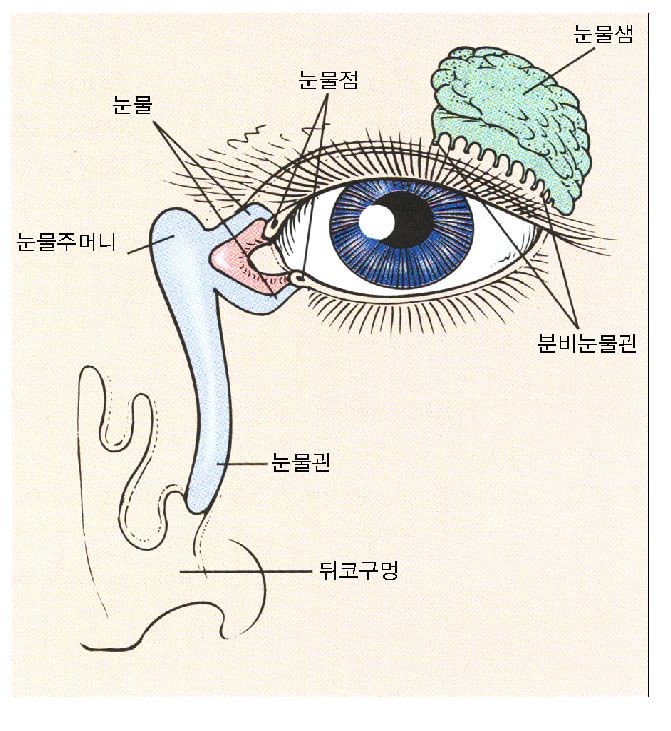 |
||
| 영문 | pancreatic duct | 한글 | 이자관, 췌장관 |
|---|---|---|---|
| 설명 | 이자에서 이자액을 분비하도록 샘창자로 이어진 관. 이자관은 샘창자의 중간부에서 온쓸개관과 같이 개구한다. |
||
| 영문 | nasolacrimal duct | 한글 | 코눈물관 |
|---|---|---|---|
| 설명 | 눈물은 대개 눈물샘에서 만들어져 눈을 적신 뒤에 누관을 거쳐서 눈물주머니에 모인 뒤에 이 코눈물관으로 흘러 코 안쪽으로 내려가게 된다. 만일 여기가 막히면, 눈물이 계속 고이게 되어 계속 눈물을 흘리게 되며, 또한 병균의 서식처가 되어 감염의 위험성이 높아진다. |
||
| ESWL | Extracorporeal Shock-Wave Lithotripsy - Ix for Gall Stone ... |
|---|---|
| CD | cadaver donor; canine distemper; canine dose; carbohydrate dehydratase; carbon dioxide; cardiac dise... |
| CFF | critical flicker fusion [test]; critical fusion frequency; cystic fibrosis factor; Cystic Fibrosis F... |
| CFP | chronic false positive; Clinical Fellowship Program; cyclophosphamide, fluorouracil, prednisone; cys... |
| CH | case history; Chediak-Higashi [syndrome]; chiasma; Chinese hamster; chloral hydrate; cholesterol; Ch... |
| GB | Gall Bladder |
|---|---|
| GBC | gall-bladder carcinoma |
| ACDK | Acquired cystic disease of the kidney |
| ACKD | Acquired cystic kidney disease |
| ARCD | Acquired renal cystic disease |
| cystic gall duct | The ductus leading from the gallbladder; it joins the hepatic duct to form the common bile duct. Synonym: ductus cysticus. (05 Mar 2000) |
|---|
| gall duct | An obsolete term for bile duct. (05 Mar 2000) |
|---|---|
| cystic duct | <anatomy> A bile duct that connects the gallbladder to the common bile duct. A gallstone that blocks the cystic duct can lead to inflammation and infection of the gallbladder. See: common bile duct. (27 Sep 1997) |
| cystic duct cholangiography | Radiography of the biliary system after introduction of contrast medium through the cystic duct. (05 Mar 2000) |
| spiral fold of cystic duct | A series of crescentic folds of mucous membrane in the upper part of the cystic duct, arranged in a somewhat spiral manner. Synonym: plica spiralis ductus cystici, Amussat's valve, Heister's valve, spiral valve of cystic duct, valvula spiralis. (05 Mar 2000) |
| spiral valve of cystic duct | A series of crescentic folds of mucous membrane in the upper part of the cystic duct, arranged in a somewhat spiral manner. Synonym: plica spiralis ductus cystici, Amussat's valve, Heister's valve, spiral valve of cystic duct, valvula spiralis. (05 Mar 2000) |
| gall | 1. To fret and wear away by friction; to hurt or break the skin of by rubbing; to chafe; to injure the surface of by attrition; as, a saddle galls the back of a horse; to gall a mast or a cable. "I am loth to gall a new-healed wound." (Shak) 2. To fret; to vex; as, to be galled by sarcasm. "They that are most galled with my folly, They most must laugh." (Shak) 3. To injure; to harass; to annoy; as, the troops were galled by the shot of the enemy. "In our wars against the French of old, we used to gall them with our longbows, at a greater distance than they could shoot their arrows." (Addison) Origin: OE. Gallen; cf. F. Galer to scratch, rub, gale scurf, scab, G. Galle a disease in horses' feet, an excrescence under the tongue of horses; of uncertain origin. Cf. Gall gallnut. A wound in the skin made by rubbing. 1. <physiology> The bitter, alkaline, viscid fluid found in the gall bladder, beneath the liver. It consists of the secretion of the liver, or bile, mixed with that of the mucous membrane of the gall bladder. 2. The gall bladder. 3. Anything extremely bitter; bitterness; rancor. "He hath . . . Compassed me with gall and travail." (Lam. Iii. 5) "Comedy diverted without gall." (Dryden) 4. Impudence; brazen assurance. <anatomy> Gall bladder, the membranous sac, in which the bile, or gall, is stored up, as secreted by the liver; the cholecystis. Gall duct, a duct which conveys bile, as the cystic duct, or the hepatic duct. Gall sickness, a remitting bilious fever in the Netherlands. <botany> Gall of the earth, an herbaceous composite plant with variously lobed and cleft leaves, usually the Prenanthes serpentaria. Origin: OE. Galle, gal, AS. Gealla; akin to D. Gal, OS. & OHG. Galla, Icel. Gall, SW. Galla, Dan. Galde, L. Fel, Gr, and prob. To E. Yellow. See Yellow, and cf. Choler. <zoology> An excrescence of any form produced on any part of a plant by insects or their larvae. They are most commonly caused by small Hymenoptera and Diptera which puncture the bark and lay their eggs in the wounds. The larvae live within the galls. Some galls are due to aphids, mites, etc. See Gallnut. The galls, or gallnuts, of commerce are produced by insects of the genus Cynips, chiefly on an oak (Quercus infectoria or Lusitanica) of Western Asia and Southern Europe. They contain much tannin, and are used in the manufacture of that article and for making ink and a black dye, as well as in medicine. <medicine> Gall insect See Gallfly. Origin: F. Galle, noix de galle, fr. L. Galla. Source: Websters Dictionary (01 Mar 1998) |
| Gall, Franz | <person> German-Austrian anatomist, 1758-1828. See: Gall's craniology. (05 Mar 2000) |
| Gall's craniology | 1. <study> The science of the special functions of the several parts of the brain, or of the supposed connection between the various faculties of the mind and particular organs in the brain. 2. In popular usage, the physiological hypothesis of Gall, that the mental faculties, and traits of character, are shown on the surface of the head or skull; craniology. Gall marked out on his model of the head the places of twenty-six organs, as round inclosures with vacant interspaces. Spurzheim and Combe divided the whole scalp into oblong and conterminous patches. Origin: Gr, the mind: cf. F. Phrenologie. Source: Websters Dictionary (01 Mar 1998) |
| crown gall | Gall or tumour, found in many dicotyledonous plants, caused by the bacterium Agrobacterium tumefaciens. (18 Nov 1997) |
| crown gall plasmid | A plasmid, or type of circular DNA, found in the bacteria Agrobacterium tumefaciens which infects dicot plants. Part of the plasmid inserts itself into the plant genome and causes tumours to form in the roots or in the stems nearest the roots. The plasmid has been used by geneticists, minus the tumour-causing parts, as a vector towards the genetic engineering of plants. (09 Oct 1997) |
| crown gall tumour | A disease which afflicts dicot plants, caused by the bacteria Agrobacterium tumefaciens. The disease causes large tumours to form in the roots or in the stems nearest the roots, deforming the plant along its base (where it meets the ground). (09 Oct 1997) |
| adenoid cystic carcinoma | <tumour> A histologic type of carcinoma characterised by large epithelial masses containing round, glandlike spaces or cysts which frequently contain mucus or collagen and are bordered by a few or many layers of epithelial cells without intervening stroma, forming a cribriform pattern like a slice of Swiss cheese; perineural invasion and haematogenous metastasis are common; occurs most commonly in salivary glands. Synonym: cylindromatous carcinoma. (05 Mar 2000) |
| carcinoma, adenoid cystic | Carcinoma characterised by bands or cylinders of hyalinised or mucinous stroma separating or surrounded by nests or cords of small epithelial cells. When the cylinders occur within masses of epithelial cells, they give the tissue a perforated, sievelike, or cribriform appearance. Such tumours occur in the mammary glands, the mucous glands of the upper and lower respiratory tract, and the salivary glands. They are malignant but slow-growing, and tend to spread locally via the nerves. (12 Dec 1998) |
| pancreatic cystic neoplasms | <radiology> Microcystic adenoma, glycogen, benign, mucinous cystic neoplasm, macrocystic adenoma, cystadenoma/cystadenocarcinoma, mucin, pre-malignant, Both occur more commonly in women, peak in middle age (12 Dec 1998) |
| papillary cystic adenoma | <tumour> An adenoma in which the lumens of the acini are frequently distended by fluid, and the neoplastic epithelial elements tend to form irregular, fingerlike projections. (05 Mar 2000) |
제품명 |
판매사 |
보험코드 | 성분/함량 | 구분/보험급여 |
|---|
제품명 |
판매사 |
보험코드 | 성분/함량 | 구분/보험급여 |
|---|