
| 영문 | alimentary tract | 한글 | 소화관, 영양관 |
|---|---|---|---|
| 설명 | 입에서 시작하여 항문으로 끝나는 소화를 담당하는 이르는 말. 위창자관이라고도 불린다. |
||
| 영문 | biliary tract | 한글 | 쓸개길, 담도, 담관 |
|---|---|---|---|
| 설명 | 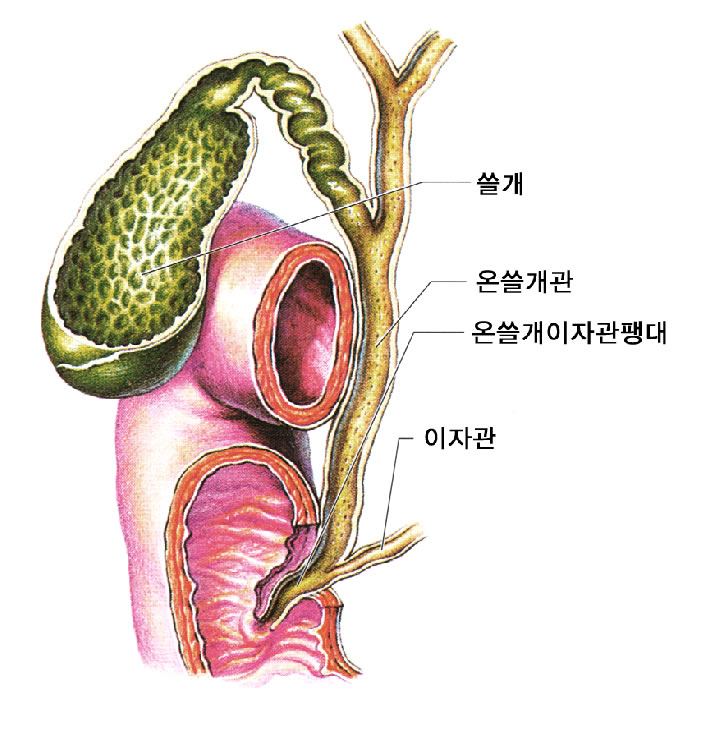 간에서 만들어진 쓸개즙을 수송하는 관조직의 일부. 간에서 만들어진 담즙은 간관, 쓸개관을 거쳐서 쓸개에 보관되었다가 온쓸개관을 통해서 샘창자로 보내진다. 이처럼 간에서 만들어진 담즙이 샘창자까지 배설되는 길로서 길이는 6~7cm 이며 간관, 쓸개관, 온쓸개관 따위로 이루어져 있다. |
||
| 영문 | urinary tract | 한글 | 요로 |
|---|---|---|---|
| 설명 | 오줌을 몸 밖으로 배출하기 위한 길. 콩팥, 요관, 방광, 요도로 이루어져 있다. |
||
| ECG | Electro-Cardio-Graphy(-Gram); 심전도 = EKG 1. Conducting System Structu... |
|---|---|
| LRI | lamina rara interna; lower respiratory [tract] illness; lower respiratory [tract] infection; lymphoc... |
| LRTI | lower respiratory tract illness; lower respiratory tract infection |
| CD | cadaver donor; canine distemper; canine dose; carbohydrate dehydratase; carbon dioxide; cardiac dise... |
| CEID | crossed electroimmunodiffusion |
| CCD | Crossed Cerebellar Diaschisis |
|---|---|
| CRIE | Crossed Radioimmunoelectrophoresis |
| CIE | Crossed immuno-electrophoresis |
| CUD | Crossed-Uncrossed Difference |
| COCB | crossed olivo-cochlear bundle |
| crossed pyramidal tract | Those fibres of the pyramidal tract that cross to the opposite side in the pyramidal decussation and descend in the dorsal half of the lateral funiculus of the spinal cord; they are distributed throughout the length of the spinal cord to interneurons of the zona intermedia of the spinal gray matter. See: pyramidal tract. Synonym: tractus corticospinalis lateralis, tractus pyramidalis lateralis, crossed pyramidal tract, fasciculus corticospinalis lateralis, fasciculus pyramidalis lateralis, lateral corticospinal tract, lateral pyramidal fasciculus. (05 Mar 2000) |
|---|---|
| callosal | Relating to the corpus callosum. (05 Mar 2000) |
| callosal convolution | cingulate gyrus |
| callosal gyrus | cingulate gyrus |
| callosal sulcus | The fissure between the corpus callosum and the cingulate gyrus. Synonym: sulcus corporis callosi, callosal sulcus. (05 Mar 2000) |
| dorsal callosal vein | It originates on the superior surface of the corpus callosum and runs posteriorly to terminate in the great cerebral vein. Synonym: dorsal callosal vein, dorsal vein of corpus callosum, posterior marginal vein, posterior pericallosal vein. (05 Mar 2000) |
| crossed adductor jerk | Contraction of the adductors of the thigh and inward rotation of the limb elicited by tapping the sole. Synonym: crossed adductor jerk. (05 Mar 2000) |
| crossed adductor reflex | Contraction of the adductors of the thigh and inward rotation of the limb elicited by tapping the sole. Synonym: crossed adductor jerk. (05 Mar 2000) |
| crossed anaesthesia | Anaesthesia of one side of the head and the other side of the body due to a brainstem lesion. (05 Mar 2000) |
| crossed aphasia | Aphasia in a right-handed person due to a solely right cerebral lesion. (05 Mar 2000) |
| crossed cylinders | A lens used in refraction to determine the strength and axis of a cylindrical lens to correct astigmatism; a combination of concave and convex cylinders of like power whose axes are at right angles to each other. (05 Mar 2000) |
| crossed embolism | Passage of a clot (thrombus) from a vein to an artery. When clots in veins break off (embolise) , they travel first to the right side of the heart and, normally, then to the lungs where they lodge. The lungs act as a filter to prevent the clots from entering the arterial circulation. However, when there is a hole in the wall between the two upper chambers of the heart (an atrial septal defect), a clot can crossparadoxically from the right to the left side of the heart, then pass into the arteries. Once in the arterial circulation, a clot can travel to the brain, block a vessel there, and cause a stroke (cerebrovascular accident). Because of the risk of stroke from crossed embolism, it is usually recommended that even small atrial septal defects be closed (repaired). Also called: paradoxical embolism. (12 Dec 1998) |
| crossed extension reflex | Extension of the contralateral hind limb when the paw of an animal is painfully stimulated or the central cut end of an afferent nerve, e.g., the peroneal, is stimulated; sometimes occurs in humans upon tapping the skin. (05 Mar 2000) |
| crossed eyes | <clinical sign> A deviation of the eye which the patient cannot overcome. The visual axes assume a position relative to each other different from that required by the physiological conditions. The various forms of strabismus are spoken of as tropias, their direction being indicated by the appropriate prefix, as cyclo tropia, esotropia, exotropia, hypertropia and hypotropia. Also called cast, heterotropia, manifest deviation and squint. Origin: Gr. Strabismos = a squinting (18 Nov 1997) |
| crossed fixation | In convergent strabismus, the use of the right inturned eye to look at objects to the left and the left inturned eye to look at objects to the right, in order to avoid ocular rotation. (05 Mar 2000) |
제품명 |
판매사 |
보험코드 | 성분/함량 | 구분/보험급여 |
|---|
제품명 |
판매사 |
보험코드 | 성분/함량 | 구분/보험급여 |
|---|