
| 영문 | white blood cell(WBC), leukocyte | 한글 | 백혈구 |
|---|---|---|---|
| 설명 | 혈액내에 골수구계세포와 림프계세포, 단핵구계세포를 모두 통틀어 말한다. 백혈구의 증가가 있으면 대개 감염이 있거나, 혹은 탈수현상이 있음을 의미한다. 또한 지나친 백혈구수의 감소는 인체내 면역기능이 떨어져 있음을 의미하며, 다른 질병에 의해 나타나는 이차적인 현상이 아닌지 꼭 진단을 받아보아야 한다. |
||
| 영문 | blood clotting, blood coagulation | 한글 | 혈액응고 |
|---|---|---|---|
| 설명 | 사람의 몸에 상처가 나서 출혈이 있을 경우에 이것을 막고 피를 더이상 나지 않게 하는 것을 지혈이라고 한다. 지혈의 과정에는 크게 두 가지 단계가 있다. 첫번째 단계는 혈소판들이 상처가 나서 손상된 혈관의 부위를 막는 것이다. 이렇게 하면 우선 혈관의 손상부위로 부터 피가 나오는 것을 막을 수가 있다. 다음의 단계는 상처를 막고 있는 혈소판위에 여러 가지 물질들이 작용해서 더욱 단단하게 하여 상처가 난 혈관에서 피가 새는 것을 영구히 막는 것이다. 쉽게 말하면 혈소판은 벽돌에 해당하는 것이고 두번째 과정에 참여하는 물질들은 시멘트에 해당하는 것이다. 이 두 과정이 완전할 경우에 지혈이 순조롭게 일어난다. 혈액응고란 두번째 단계를 지칭하는 말로써 매우 복잡한 단계를 거치는 반응으로 마지막 단계는 섬유소라는 물질이 만들어져서 이 물질이 혈소판과 그 외의 세포를 단단하게 고정시켜 피가 상처난 혈관으로 새는 것을 막는다. 이것을 가장 간단히 설명하자면 크게 다음과 같은 3가지 단계로 이루어진다. 첫번째 단계는 혈관손상에 의해서 프로트롬빈 활성제라는 것이 만들어지는 단계이다. 두번째 단계는 이 프로트롬빈 활성제라는 물질에 의해서 혈액속에 있는 프로트롬빈이라는 물질이 트롬빈이라는 물질로 바뀌는 단계이다. 세번째 단계는 트롬빈이라는 물질에 의해서 섬유소원이라는 물질이 섬유소으로 바뀌는 단계이다. |
||
| 영문 | muscle cell(=muscle fiber) | 한글 | 근육세포 |
|---|---|---|---|
| 설명 | 근육은 수의근(의식에 의해서 조절이 가능한 근육: 예를 들어 다리, 팔, 얼굴근육 등)과 불수의근(의식과 무관하게 조절하지 않아도 움직이는 근육: 예를 들어 심장근, 소화기관에 분포하는 근육 등)으로 나누어지며, 근육세포의 모양은 다음과 같다(수의근, 불수의근 외에 심장에 있는 심장근은 불수의근에 해당하지만 그 모양은 수의근과 같아 따로 분류한다).  |
||
| 영문 | mast cell | 한글 | 비만 세포 |
|---|---|---|---|
| 설명 | 동물의 결합 조직 가운데 널리 분포하는 세포. 결합조직과 점막조직 내에 있는 호염기성 색소로 이염색성(metachromasia)을 나타내는 과립을 가진 방추형의 세포에 작은 둥근 핵을 가진다. 비만세포의 표면에는 IgE에 대한 수용체가 존재하며, 수용체에 결합한 IgE 분자들끼리 다가의 항원에 의해 서로 연결되면 비만세포 과립탈출 반응이 일어나, 히스타민, 세로토닌, 헤파린 등의 화학전달 물질이 방출되어, 즉시형 알레르기 반응 등의 증상을 일으킨다. 피부, 장막, 혈관 주위, 점막 주변에 있다. |
||
| 영문 | cell | 한글 | 세포 |
|---|---|---|---|
| 설명 | 생명체를 이루는 구조적, 기능적 단위. 핵의 유무에 따라서 유핵세포와 무핵세포로 나눌 수가 있다. 무핵세포란 핵이 없는 세포를 말한다. 핵이란 유전정보를 가지고 있는 염색체를 보관하는 곳인데 무핵세포에서는 염색체가 세포속에 그냥 노출되어 있다. 대개 세포 하나하나가 독립된 생명체의 역할을 하는 단세포생물로서 외부환경으로부터 자신을 보호할 수 있는 견고한 세포벽을 가지고 있다. 유핵세포란 핵을 가지고 있어서 유전정보가 있는 염색체가 세포의 다른 부분과 구분되어 핵속에 들어있다. 세포속에서 핵외의 부분(이를 세포질이라 한다)에는 여러 가지 세포의 소기관이 있어서 세포의 다양한 기능을 분담한다. ◈유핵세포의 기본 구조 1.세포막-세포를 둘러싸서 주위환경과 분리하여 세포의 내환경을 유지한다. 2.형질내세망(endoplasmic reticulum)-단위막으로 둘러쌓여 있는 불규칙한 망상구조이다. 이 망상구조의 내부를 소강, 소조라고 부른다. 여기에는 표면이 매끈한 무과립형질내세망과 표면이 불규칙한 과립형질내세망의 두 가지가 있다. 과립형질내세망의 경우는 표면에 단백질을 합성하는 리보솜이라는 것이 부착되어 있다. 이곳은 주로 세포밖으로 분비할 단백질을 합성하는 장소이다. 무과립형질내세망은 표면에 리보솜이 부착되어 있지 않은 것을 말하며, 이곳에서는 주로 해독작용, 글리코겐의 합성, 스테로이드호르몬의 합성 등이 일어난다. 3.리보솜-단백질을 합성하는 역할을 하는 곳이다.이것은 세포질에 존재하는 자유리보솜과 과립형질내세망에 부착이 되어 존재하는 부착리보솜의 두 가지로 나눈다. 자유리보솜은 주로 세포내에서 필요한 단백질을 만드는 역할을 하고 부착리보솜은 세포밖으로 분비할 단백질을 만드는 역할을 한다. 4.골지장치(Golgi apparatus)-핵주위에 분포하는 납작해진 주머니모양의 것이 중첩되어 형성된 층판 모양의 구조물로 과립형질내세망에서 생성되어 외부로 분비될 단백질을 모아서 농축, 포장하여 과립을 만드는 역할을 한다. 5.사립체(mitochondria)-구형, 난형의 긴 막대기 모양으로 크기가 다양한 구조물. 생물체의 에너지 저장물질인 ATP를 생산하는 역할을 한다. 또 세포와 다른 자신만의 유전정보를 가진 DNA, RNA를 가지고 있다. 모양, 크기가 세균과 비슷하며 자체증식성 등 독립된 생명체로서 필요한 요건을 갖추고 있어서 세포와 공생관계를 가진 독립된 세포로 생각하고 있다. 6.용해소체(lysosome)-작은 구형의 소체로 여러 가지 분해효소를 가진다. 세포외계에서 들어온 물질과 결합하여 그 물질들을 용해하는 역할을 하고, 오래된 세포소기관들을 제거하는 역할도 한다. 7.세포핵(nucleus)-구형, 난형으로 세포의 중심에 위치한다. 핵내에는 유전정보가 있는 물질인 염색체가 존재한다. 8.중심소체(centrosome)-핵주위에 존재하면서 핵의 분열시에 양쪽의 염색체를 당기는 작은 섬유를 만드는 역할을 하는 곳. 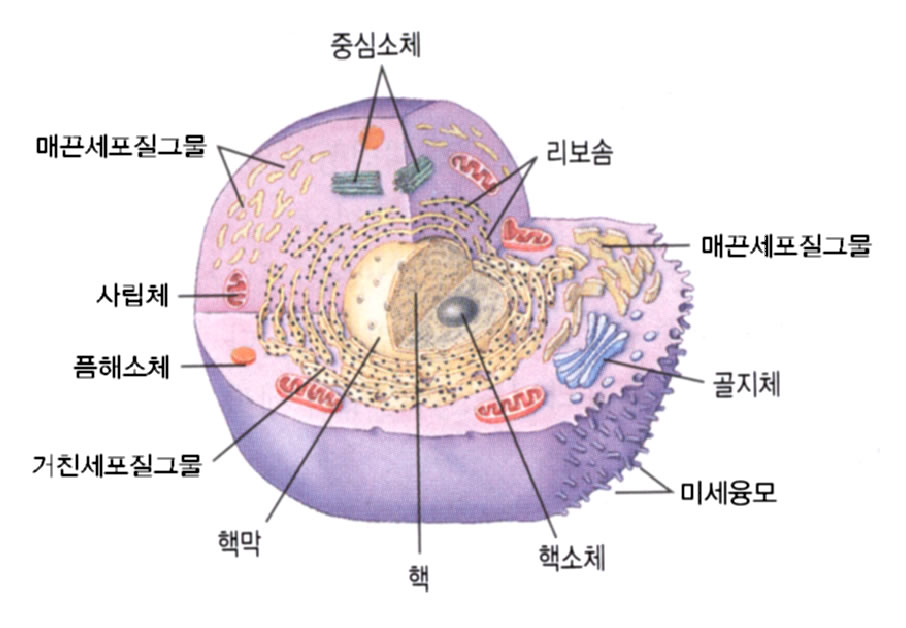 |
||
| WBC | well baby care/clinic; white blood cell; white blood cell count; whole blood cell count |
|---|---|
| CBC | capillary blood gases; carbenicillin; child behavior characteristics; complete blood cell count |
| CBV | capillary blood cell velocity; catheter balloon valvuloplasty; central blood volume; cerebral blood ... |
| BC | Bachelor of Surgery [Lat. Baccal-aureus Chirurgiae]; back care; bactericidal concentration; basal ce... |
| cbc | complete blood cell count |
| CBC | Complete blood cell count |
|---|---|
| CBC | Complete blood count |
| RBC | Red Blood Cell Count |
| WBC | White Blood Cell Count |
| WBCC | white blood cell count |
| complete blood count | <haematology, investigation> The number of red blood cells, white blood cells and platelets are present in the patients sample of blood is determined. most common test done on the blood. Acronym: CBC Synonym: full blood count. (16 Mar 1998) |
|---|---|
| blood cell count | A count of the number of leukocytes and erythrocytes per unit volume in a sample of venous blood. A complete blood count (cbc) also includes measurement of the haemoglobin, haematocrit, and erythrocyte indices. (12 Dec 1998) |
| red blood cell count | A normal value is 4.6-6.2 million RBC's per cubic millimetre of blood. This number can increase in cases of dehydration (fluid loss) or severe lung disease. Interestingly, red blood cell counts are much higher in those who live at high altitude, because of the increased demand for oxygen carrying capacity. (27 Sep 1997) |
| white blood cell count | <haematology> A laboratory test which measures the number of white blood cells per cubic millimetre of blood. Normal white blood cell counts are variable with age and sex. Normal adult range is 4, 500 to 11,000 cells per cubic millimetre of blood. Slightly higher counts are seen in children. Elevated counts can be seen in cases of inflammation and infection. (13 Nov 1997) |
| blood count | <haematology, investigation> The determination of the proper number of red blood cells, white blood cells and platelets are present in the patients blood. Acronym: FBC (16 Dec 1997) |
| Schilling's blood count | A method of counting blood in which the polymorphonuclear neutrophils are separated into four groups according to the number and arrangement of the nuclear masses in these cells. Synonym: Schilling's index. (05 Mar 2000) |
| differential white blood count | An estimate of the percentage of white blood cell types which make up the total white blood cell count. (05 Mar 2000) |
| Full Blood Count | <haematology, investigation> The determination of the proper number of red blood cells, white blood cells and platelets are present in the patients blood. Acronym: FBC (16 Dec 1997) |
| b and t cell count | A test that measures the respective quantities of B lymphocytes and T lymphocytes. This test is often performed in the analysis of an immune deficiency disorder. Normal values include: 68 to 75% of total lymphocytes are T lymphocytes and 10 to 20% are B lymphocytes. Increased T-cell counts can indicate infectious mononucleosis, acute lymphocytic leukaemia or multiple myeloma. Increased B lymphocytes can indicate chronic lymphocytic leukaemia, multiple myeloma, Waldenstrom's macroglobulinaemia or Di George syndrome. Decreased T-cells may indicate congenital T-cell deficiency, Wiskott-Aldrich syndrome or AIDS. Decreased B-cells may indicate acute lymphocytic leukaemia or a congenital immunoglobulin deficiency disorder. (27 Sep 1997) |
| viable cell count | Number of cells in a given area or volume that are thriving. (05 Mar 2000) |
| CD4 cell count | The most commonly used surrogate marker for assessing the state of the immune system. As CD4 cell count declines, the risk of developing opportunistic infections increases. The normal range for CD4 cell counts is 500 to 1500 per cubic millimetre of blood. CD4 count should be rechecked at least every six to twelve months if CD4s are greater than 500/mm3. If the count is lower, testing every three months is advised. (09 Oct 1997) |
| cell count | A count of the number of cells of a specific kind, usually measured per unit volume of sample. (12 Dec 1998) |
| total cell count | Number of cells in a given area or volume. (05 Mar 2000) |
| complete abortion | The complete expulsion or extraction from its mother of a foetus or embryo, complete expulsion of any other product of gestation. (e.g., hydatidiform mole). (05 Mar 2000) |
| complete achromatopsia | Achromatopsia with absent colour vision, nystagmus, reduced visual acuity, and light aversion. Synonym: rod monochromatism, typical achromatopsia. (05 Mar 2000) |
제품명 |
판매사 |
보험코드 | 성분/함량 | 구분/보험급여 |
|---|
제품명 |
판매사 |
보험코드 | 성분/함량 | 구분/보험급여 |
|---|