
| 영문 | semicircular canal | 한글 | 반고리뼈관 |
|---|---|---|---|
| 설명 | 귓속에서 평형감각을 맡고 있는 기관. 관자뼈 바위의 속귀에 있으며 막성 반고리관과 골뼈반고리관이 있다. 전자는 평형감각기의 일부이고, 후자는 그것을 수용하고 있는 똑같은 모양의 뼈관이다. 막성 반고리관은 폐쇄된 주머니로 되어 있고, 세 개의 관으로 이루어진다. 이 관들은 전-후-외측반고리관이라고 하며, 어느 것이나 모두 C자형으로서 각각 양끝에서 난형낭으로 열려 있다. 이 개구부에는 각 관에 하나씩 팽대부가 있고 이 팽대부 내면의 C자형 팽대능선 부분에 감각상피가 배열되어 있다. 전반고리관은 관자뼈 바위의 긴 축에 직각 방향으로, 후반고리관은 그 긴 축에 평행 방향, 외측반고리관은 바깥쪽으로 수평으로 돌출해 있다. 반고리관의 굵기는 지름 약 0.3~0.5mm로서 관의 내부에는 림프액이 차 있는데, 몸이 회전하면 림프액은 흘러서 감각상피를 자극한다. 뼈반고리관은 막성 반고리관의 4~5배 굵기이고, 각각 앞-뒤-가쪽뼈반고리관으로 나뉜다. 이들 관은 다섯 개의 개구가 안뜰으로 열려 있고, 그 안뜰에 난형낭과 구형낭이 들어 있다. |
||
| 영문 | hepatic duct | 한글 | 간관 |
|---|---|---|---|
| 설명 | 간에서 생성된 담즙이 지나는 통로로 간에서 직접 담즙을 운반하는 관을 말한다. 간에서 만들어진 담즙은 간관, 쓸개주머니관를 거쳐서 쓸개에 보관되었다가 온쓸개관을 통해서 샘창자로 보내진다.  |
||
| 영문 | lacrimal duct | 한글 | 눈물관 |
|---|---|---|---|
| 설명 | 눈물이 흘러내리는 통로에 해당한다. 눈물은 대개 눈물샘에서 만들어져 눈을 적신 뒤에, 여기를 거쳐서 눈물주머니에 모인 뒤, 코눈물관으로 흘러 코 안쪽으로 내려가게 된다. 만약 여기가 막히면, 눈물이 계속 고이게 되어 계속 눈물을 흘리게 되며, 또한 병균의 서식처가 되어 감염의 위험성이 높아진다. 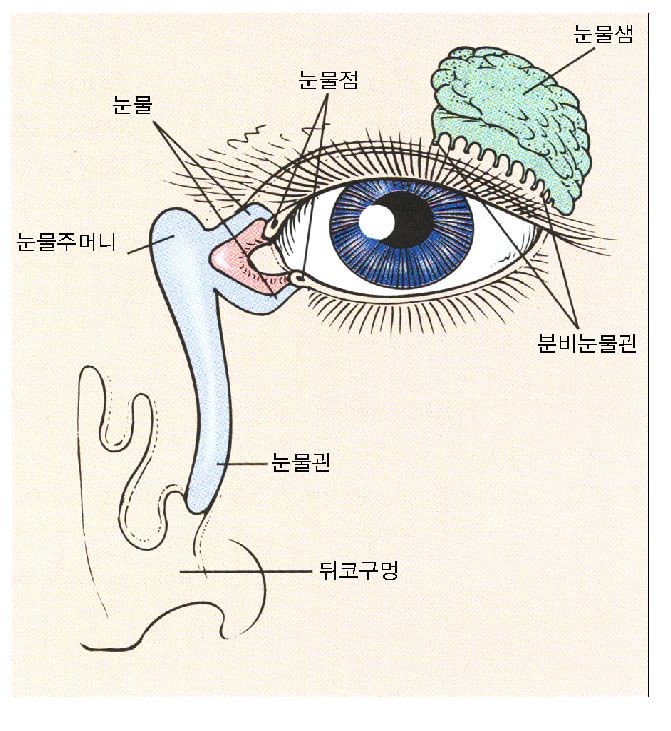 |
||
| 영문 | pancreatic duct | 한글 | 이자관, 췌장관 |
|---|---|---|---|
| 설명 | 이자에서 이자액을 분비하도록 샘창자로 이어진 관. 이자관은 샘창자의 중간부에서 온쓸개관과 같이 개구한다. |
||
| 영문 | nasolacrimal duct | 한글 | 코눈물관 |
|---|---|---|---|
| 설명 | 눈물은 대개 눈물샘에서 만들어져 눈을 적신 뒤에 누관을 거쳐서 눈물주머니에 모인 뒤에 이 코눈물관으로 흘러 코 안쪽으로 내려가게 된다. 만일 여기가 막히면, 눈물이 계속 고이게 되어 계속 눈물을 흘리게 되며, 또한 병균의 서식처가 되어 감염의 위험성이 높아진다. |
||
| CC | calcaneal-cuboid; calcium cyclamate; cardiac catheterization; cardiac contusion; cardiac cycle; card... |
|---|---|
| CD | cadaver donor; canine distemper; canine dose; carbohydrate dehydratase; carbon dioxide; cardiac dise... |
| MN | a blood group in the MNSs blood group system; malignant nephrosclerosis; Master of Nursing; meganewt... |
| SC | conditioned stimulus; sacrococcygeal; Sanitary Corps; scalenus [muscle]; scapula; Schwann cell; scia... |
| LSCC | lateral semicircular canal |
| P.S.C. | Posterior Semicircular Canal |
|---|---|
| CBD | Common Bile Duct |
| CBDL | Common bile duct ligation |
| CBDS | Common bile duct stones |
| CBDE | common bile duct exploration |
| common limb of membranous saemicircular ducts | The united, nonampullary ends of the superior and posterior saemicircular ducts. Synonym: crus membranaceum commune ductus saemicircularis, common limb of membranous saemicircular ducts. (05 Mar 2000) |
|---|---|
| semicircular | 1. Having the form of half of a circle. 2. <anatomy> Semicircular canals, certain canals of the inner ear. Source: Websters Dictionary (01 Mar 1998) |
| semicircular canal | <anatomy> Three membranous semicircular tubes contained in the bony labyrinth of the inner ear. They are concerned with equilibrium and the interpretation of the bodys position in space. (27 Sep 1997) |
| common crus of saemicircular ducts | The united, nonampullary ends of the superior and posterior saemicircular ducts. Synonym: crus membranaceum commune ductus saemicircularis, common limb of membranous saemicircular ducts. (05 Mar 2000) |
| simple membranous limb of saemicircular duct | The non-ampullary end of the lateral saemicircular duct that opens independently into the utricle. Synonym: crus membranaceum simplex ductus saemicircularis, simple membranous limb of saemicircular duct. (05 Mar 2000) |
| common bile duct | <anatomy> A duct that carries bile from the liver and gallbladder to the duodenum (first part of the small intestine). (27 Sep 1997) |
| common bile duct calculi | The presence of gallstones in the common bile duct. It is usually the result of passage of gallstones formed in the gallbladder into the common duct. Less commonly, stones form in a duct behind an obstruction caused by a stricture or ampullary stenosis. Stone type helps to determine site of origin: cholesterol or black pigment stones more likely form in the gallbladder, while almost all brown pigment stones in patients from western countries form in the bile ducts. (12 Dec 1998) |
| common bile duct diseases | Diseases of the common bile duct, vater's ampulla, or oddi's sphincter. (12 Dec 1998) |
| common bile duct neoplasms | Neoplasms of the common bile duct including vater's ampulla and oddi's sphincter. (12 Dec 1998) |
| common duct | <anatomy> This is the main bile duct, which is formed as the right and left hepatic bile ducts join, this common duct empties bile into the duodenum. (09 Oct 1997) |
| common hepatic duct | The part of the biliary duct system that is formed by the confluence of right and left hepatic ducts. at the porta hepatis it is joined by the cystic duct to become the common bile duct. Synonym: ductus hepaticus communis, hepatocystic duct. (05 Mar 2000) |
| hepatic duct, common | Predominantly extrahepatic bile duct which is formed by the junction of the right and left hepatic ducts, which are predominantly intrahepatic, and, in turn, joins the cystic duct to form the common bile duct. (12 Dec 1998) |
| sphincter muscle of common bile duct | Smooth muscle sphincter of the common bile duct immediately proximal to the hepatopancreatic ampulla; it is this sphincter that controls the flow of bile in the duodenum. Synonym: musculus sphincter ductus choledochi, Boyden's sphincter, choledochal sphincter, sphincter muscle of common bile duct. (05 Mar 2000) |
| sphincter of common bile duct | Smooth muscle sphincter of the common bile duct immediately proximal to the hepatopancreatic ampulla; it is this sphincter that controls the flow of bile in the duodenum. Synonym: musculus sphincter ductus choledochi, Boyden's sphincter, choledochal sphincter, sphincter muscle of common bile duct. (05 Mar 2000) |
| simple crus of saemicircular duct | The non-ampullary end of the lateral saemicircular duct that opens independently into the utricle. Synonym: crus membranaceum simplex ductus saemicircularis, simple membranous limb of saemicircular duct. (05 Mar 2000) |
제품명 |
판매사 |
보험코드 | 성분/함량 | 구분/보험급여 |
|---|
제품명 |
판매사 |
보험코드 | 성분/함량 | 구분/보험급여 |
|---|