
| 영문 | hepatic duct | 한글 | 간관 |
|---|---|---|---|
| 설명 | 간에서 생성된 담즙이 지나는 통로로 간에서 직접 담즙을 운반하는 관을 말한다. 간에서 만들어진 담즙은 간관, 쓸개주머니관를 거쳐서 쓸개에 보관되었다가 온쓸개관을 통해서 샘창자로 보내진다.  |
||
| 영문 | lacrimal duct | 한글 | 눈물관 |
|---|---|---|---|
| 설명 | 눈물이 흘러내리는 통로에 해당한다. 눈물은 대개 눈물샘에서 만들어져 눈을 적신 뒤에, 여기를 거쳐서 눈물주머니에 모인 뒤, 코눈물관으로 흘러 코 안쪽으로 내려가게 된다. 만약 여기가 막히면, 눈물이 계속 고이게 되어 계속 눈물을 흘리게 되며, 또한 병균의 서식처가 되어 감염의 위험성이 높아진다. 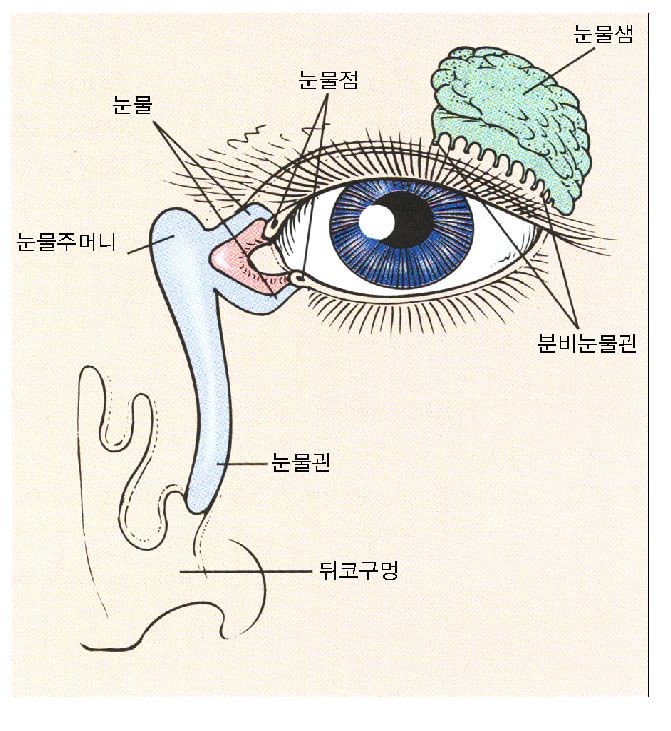 |
||
| 영문 | pancreatic duct | 한글 | 이자관, 췌장관 |
|---|---|---|---|
| 설명 | 이자에서 이자액을 분비하도록 샘창자로 이어진 관. 이자관은 샘창자의 중간부에서 온쓸개관과 같이 개구한다. |
||
| 영문 | nasolacrimal duct | 한글 | 코눈물관 |
|---|---|---|---|
| 설명 | 눈물은 대개 눈물샘에서 만들어져 눈을 적신 뒤에 누관을 거쳐서 눈물주머니에 모인 뒤에 이 코눈물관으로 흘러 코 안쪽으로 내려가게 된다. 만일 여기가 막히면, 눈물이 계속 고이게 되어 계속 눈물을 흘리게 되며, 또한 병균의 서식처가 되어 감염의 위험성이 높아진다. |
||
| CBD | Common Bile Duct - Absolute Ix of CBD Exploration 1. Palp... |
|---|---|
| CBDE | common bile duct exploration |
| CDE | canine distemper encephalitis; chlordiazepoxide; color Doppler energy [imaging]; common duct explora... |
| ECBD | exploration of common bile duct |
| CD | cadaver donor; canine distemper; canine dose; carbohydrate dehydratase; carbon dioxide; cardiac dise... |
| CBDE | common bile duct exploration |
|---|---|
| CBD | Common Bile Duct |
| CBDL | Common bile duct ligation |
| CBDS | Common bile duct stones |
| CHD | common hepatic duct |
| exploration | <medicine> The act of exploring, penetrating, or ranging over for purposes of discovery, especially of geographical discovery; examination; as, the exploration of unknown countries; physical examination. ""An exploration of doctrine."" (Bp. Hall) Origin: L. Exploratio: cf. F. Exploration. Source: Websters Dictionary (01 Mar 1998) |
|---|---|
| common bile duct | <anatomy> A duct that carries bile from the liver and gallbladder to the duodenum (first part of the small intestine). (27 Sep 1997) |
| common bile duct calculi | The presence of gallstones in the common bile duct. It is usually the result of passage of gallstones formed in the gallbladder into the common duct. Less commonly, stones form in a duct behind an obstruction caused by a stricture or ampullary stenosis. Stone type helps to determine site of origin: cholesterol or black pigment stones more likely form in the gallbladder, while almost all brown pigment stones in patients from western countries form in the bile ducts. (12 Dec 1998) |
| common bile duct diseases | Diseases of the common bile duct, vater's ampulla, or oddi's sphincter. (12 Dec 1998) |
| common bile duct neoplasms | Neoplasms of the common bile duct including vater's ampulla and oddi's sphincter. (12 Dec 1998) |
| common duct | <anatomy> This is the main bile duct, which is formed as the right and left hepatic bile ducts join, this common duct empties bile into the duodenum. (09 Oct 1997) |
| common hepatic duct | The part of the biliary duct system that is formed by the confluence of right and left hepatic ducts. at the porta hepatis it is joined by the cystic duct to become the common bile duct. Synonym: ductus hepaticus communis, hepatocystic duct. (05 Mar 2000) |
| hepatic duct, common | Predominantly extrahepatic bile duct which is formed by the junction of the right and left hepatic ducts, which are predominantly intrahepatic, and, in turn, joins the cystic duct to form the common bile duct. (12 Dec 1998) |
| sphincter muscle of common bile duct | Smooth muscle sphincter of the common bile duct immediately proximal to the hepatopancreatic ampulla; it is this sphincter that controls the flow of bile in the duodenum. Synonym: musculus sphincter ductus choledochi, Boyden's sphincter, choledochal sphincter, sphincter muscle of common bile duct. (05 Mar 2000) |
| sphincter of common bile duct | Smooth muscle sphincter of the common bile duct immediately proximal to the hepatopancreatic ampulla; it is this sphincter that controls the flow of bile in the duodenum. Synonym: musculus sphincter ductus choledochi, Boyden's sphincter, choledochal sphincter, sphincter muscle of common bile duct. (05 Mar 2000) |
| carotid artery, common | The two principal arteries supplying the structures of the head and neck. They ascend in the neck, one on each side, and at the level of the upper border of the thyroid cartilage, each divides into two branches, the external (carotid artery, external) and internal (carotid artery, internal) carotid arteries. (12 Dec 1998) |
| migraine, common | Migraine without aura. The most frequent type, accounting for about 80-85% of migraines. See migraine. (12 Dec 1998) |
| cold, common | A viral upper respiratory tract infection. A contagious illness caused by a number of different types of viruses. Because of the great number of viruses that can cause a cold, the body never builds up resistance (immune) against all of them. For this reason, colds are a frequent and recurring problem. In fact, preschool children average 9 colds a year; those in kindergarten, 12 colds a year; and adolescents and adults, 7 colds per year. Going out into the cold weather has no effect on the spread of a cold. Antibiotics do not help the common cold. (12 Dec 1998) |
| common acute lymphoblastic leukaemia | <haematology, oncology> A sub-type of acute lymphoblastic leukaemia affecting cells early in the B lymphocyte lineage which accounts for about 80% of all acute lymphoblastic leukaemia. Origin: Gr. Haima = blood (13 Nov 1997) |
| common antigen | Cross reacting antigen (epitope), a common antigen that occurs in 2 or more different molecules/organisms. Synonym: heterogenic enterobacterial antigen. (05 Mar 2000) |
제품명 |
판매사 |
보험코드 | 성분/함량 | 구분/보험급여 |
|---|
제품명 |
판매사 |
보험코드 | 성분/함량 | 구분/보험급여 |
|---|