
| 영문 | axon | 한글 | 축삭 |
|---|---|---|---|
| 설명 | 뉴런(신경원-신경세포)의 한부분으로 신경의 전기적 신호를 다른 신경이나 기관에 전해주는 긴 구조를 이르는 말. 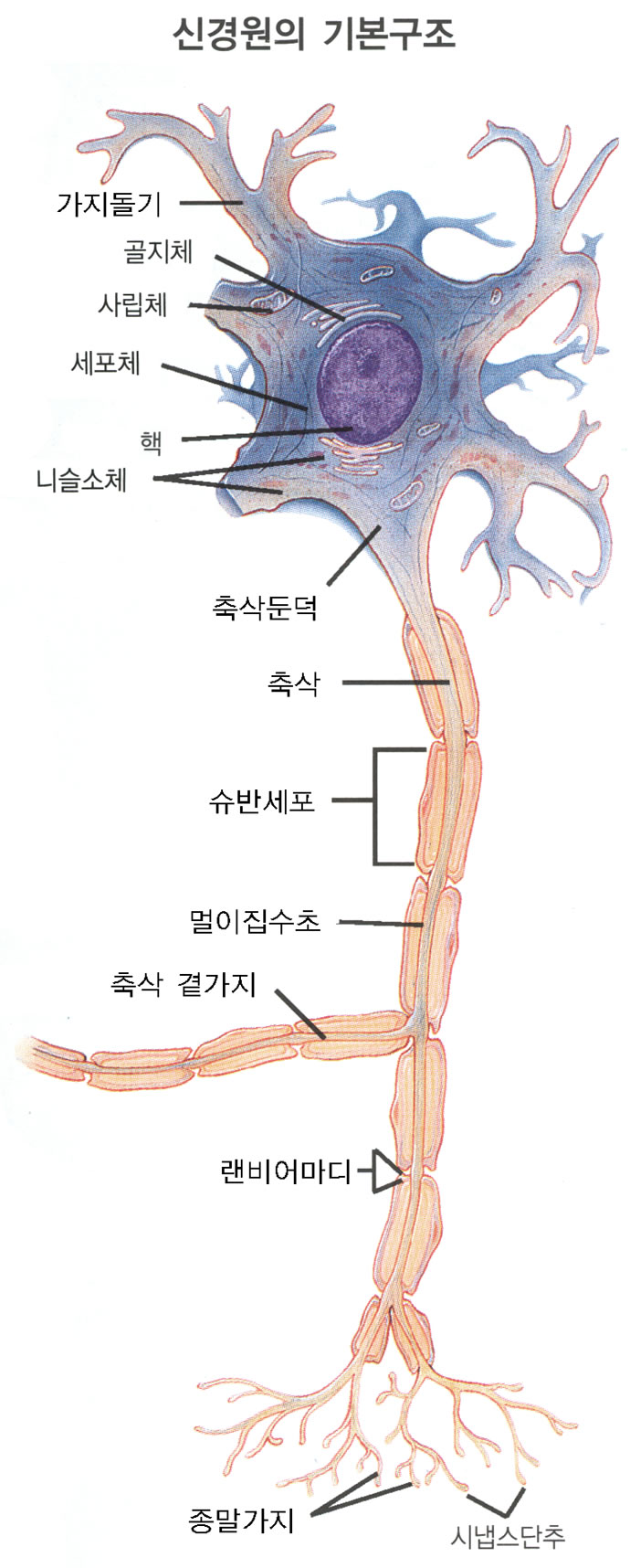 |
||
| 영문 | cervix, neck | 한글 | 목, 경부 |
|---|---|---|---|
| 설명 | 목, 경부를 지칭하는 말. 특히 자궁의 목을 지칭하는데 쓰인다. 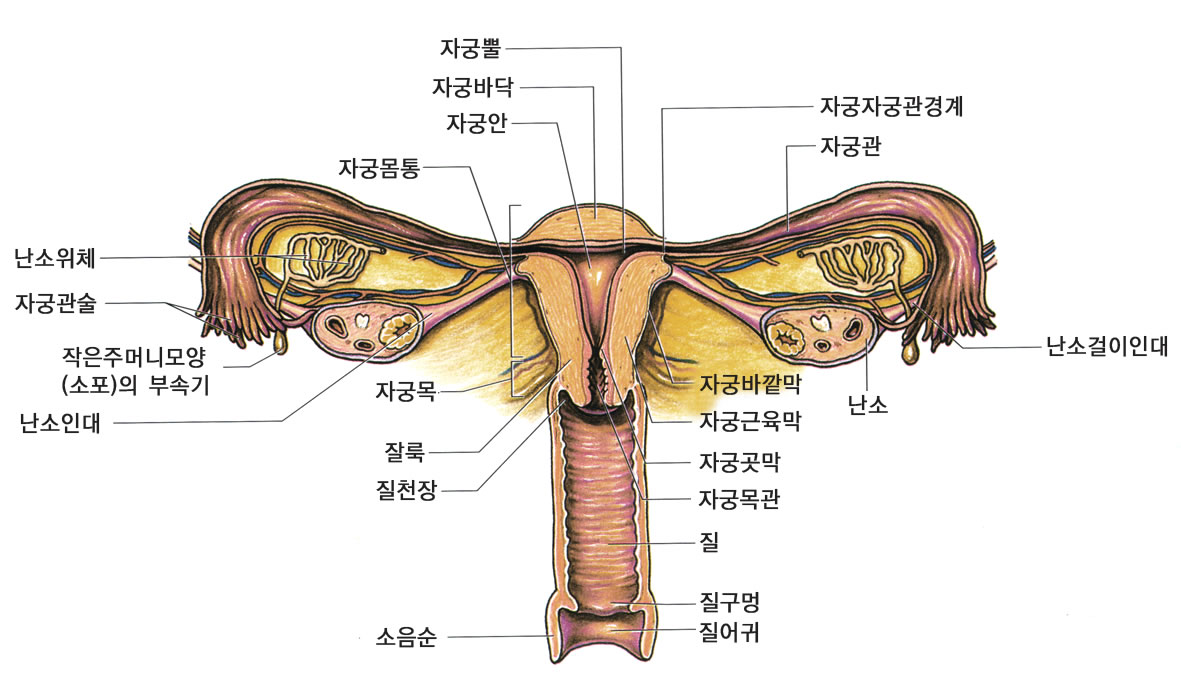 |
||
| 영문 | cervix cancer | 한글 | 자궁목암, 자궁경부암 |
|---|---|---|---|
| 설명 | 자궁의 목은 자궁이 질과 연결된 부위로 자궁의 입구에 해당하는 부위이다. 이곳의 상피세포에서 발생하는 암을 자궁목암이라고 한다. 자궁목암의 발생을 살펴보면 자궁목의 상피세포가 여러 가지 자극에 의해서 정상세포와 차이나는 암성변화를 한 세포가 생기게 된다. 이 암성변화를 한 세포는 처음에는 자궁목의 상피세포층의 일부를 이루고 있게 된다. 그러다가 점점 더 진행이 되면 암성세포가 자궁목 상피세포의 모든 층을 꽉채우게 된다. 그리고 계속 진행하면 상피세포의 맨 밑에 있는 바닥막을 뚫고 버팀조직으로 침윤해 들어가게 된다. 암성변화를 한 세포가 자궁의 상피층의 일부를 채우는 것을 자궁목형성이상(cervical dysplasia)라고 하고 암성변화를 한 세포가 자궁의 상피층을 모두 채워버려 정상적인 세포가 없는 경우를 상피내암종(carcinoma in situ)라고 한다. 그리고 바닥막을 뚫고 밑의 버팀조직으로 침범해 나가는 경우를 침윤암(invasive cancer)라고 한다. 자궁목암은 여러 명의 상대와 성관계를 가지는 여자, 그리고 첫 성경험의 나이가 어린 여자에게서 흔하고 또 사회적, 경제적 수준이 낮은 사람에게서 잘 걸리는 것으로 되어 있다. 이런 것으로 미루어 자궁목세포의 암성변화에는 성병과 같은 감염이 중요할 것으로 생각되고, 또 몇가지 바이러스의 감염이 자궁목암의 원인이라는 것이 밝혀져 있다. 자궁목암의 진단방법으로는 질세포검사, 콜포스코피, 생검(biopsy) 등이 있다. 세포검사란 조기진단 목적으로 가장 많이 사용되는 방법으로 솜봉으로 자궁목을를 문질러서 자궁목상피세포를 얻고 이것을 현미경으로 관찰하여 상피세포의 변화를 보는 것이다. 콜포스코피란 자궁의 목을 4~10배 정도 확대해서 보는 일종의 확대경검사으로 자궁목암으로 인한 자궁목의 병적변화를 관찰하여 진단하는 것이다. 생검란 진단을 위해서 직접 자궁목의 조직을 떼어 채취하여 현미경으로 관찰하여 진단하는 것으로 가장 정확한 진단법이다. 치료로는 병의 진행정도에 따라 다르겠지만 암의 진행이 거의 없어 형성이상이나 제자리암종 또는 아주 조금 침윤하였을 경우에는 수술적요법으로 자궁을 적출하는 것이 치료의 원칙이고 많은 진행을 보여 다른 조직으로 암의 침윤이 있을 경우에는 방사선 치료를 원칙으로 한다. |
||
| GnRH | Gonadotropin Releasing Hormone [HP 1898, 2034] = LHRH = Go... |
|---|---|
| GAN | giant axon neuropathy |
| MA | malignant arrhythmia; management and administration; mandelic acid; masseter; Master of Arts; matern... |
| QSART | quantitative sudomotor axon reflex testing |
| Cx | 1) Complication 2) Cervix(= Cervical); 경(頸) |
| Q-SART | Quantitative Sudomotor Axon Reflex Test |
|---|---|
| MGA | medial giant axon |
| cervix of the axon | The constricted portion of the axon just before the myelin sheath begins. (05 Mar 2000) |
|---|
| axon | <cell biology> A long process of a neuron, that carries efferent (outgoing) action potentials from the cell body towards target cells. Each nerve cell has one axon, which can be over a foot long. A nerve cell communicates with another nerve cell by transmitting signals from the branches at the end of its axon. At the terminal end of the axon, the impulses are transmitted to other nerve cells or to effector organs. In the peripheral nervous system, the larger (myelinated) axons are surrounded by a myelin sheath formed by concentric layers of plasma membrane of the schwann cell. In the central nervous system, the function of the schwann cell is supplied by oligodendrocytes (oligodendroglia). See: dendrite. (03 Jul 1999) |
|---|---|
| axon degeneration | A type of peripheral nerve fibre response to insult, wherein axon death and subsequent breakdown occurs, with secondary breakdown of the myelin sheath associated; caused by focal injury to peripheral nerve fibres; often referred to as wallerian degeneration. Synonym: axon degeneration. (05 Mar 2000) |
| axon hillock | <cell biology> Tapering region between a neuron's cell body and its axon. This region is responsible for summating the graded inputs from the dendrites and producing action potentials if the threshold is exceeded. (12 Mar 1998) |
| axon loss polyneuropathy | A type of polyneuropathy in which axon degeneration is the sole/predominant feature; many aetiologies, particularly toxic and metabolic; on nerve conduction studies, affects amplitudes of the responses, but does not cause conduction slowing or block. Synonym: axonal polyneuropathy. (05 Mar 2000) |
| axon reflex | An effect brought about by the passage of the nerve impulses from a sensory ending to the effector organ along divisions of the nerve fibre without traversing a synapse, e.g., as in the vasodilation resulting from stimulation of the skin or the irritation of the conjunctiva; the reaction occurs even when the nerve fibre has been sectioned and thus isolated from the nervous centres. (05 Mar 2000) |
| axon terminals | The somewhat enlarged, often club-shaped endings by which axons make synaptic contacts with other nerve cells or with effector cells (muscle or gland cells). As isolated, by homogenizing brain or spinal cord, they contain acetylcholine and the related enzymes. Terminals contain neurotransmitters of various kinds, sometimes more than one. These can be demonstrated by chemical analysis and immunocytochemical methods. See: synapse. Synonym: axonal terminal boutons, end-feet, neuropodia, pieds terminaux, synaptic boutons, synaptic endings, synaptic terminals, terminal boutons, bouton terminaux. (05 Mar 2000) |
| giant axon | <biology> Extraordinarily large unmyelinated axons found in invertebrates. Some, like the squid giant axon, can approach 1 mm diameter. Large axons have high conduction speeds, the giant axons are invariably involved in panic or escape responses and may (e.g. Crayfish) have electrical synapses to further increase speed. Vertebrate axons with high conduction velocites are much narrower: they are myelinated, allowing saltatory conduction. (17 Dec 1997) |
| squid giant axon | <physiology> Large axons, up to 1mm in diameter, that innervate the mantle of the squid. Because of their large size, many of the pioneering investigations of the mechanisms underlying resting and action potentials in excitable cells were done on these fibres. (10 Mar 1998) |
| cancer, cervix | Cancer of the entrance to the womb (uterus). Regular pelvic exams and Pap testing can detect precancerous changes in the cervix. Precancerous changes in the cervix may be treated with cryosurgery, cauterization, or laser surgery. The most common symptom of cancer of the cervix is abnormal bleeding. Cancer of the cervix can be diagnosed using a Pap test or other procedures that sample the cervix tissue. Cancer of the cervix requires different treatment than cancer that begins in other parts of the uterus. (12 Dec 1998) |
| vaginal portion of cervix | The part of the cervix uteri contained within the vagina. Synonym: portio vaginalis. (05 Mar 2000) |
| cervix | Neck, a term denoting the front portion of the collum or neck (the part connecting the head and trunk) or a constricted part of an organ (for example cervix uteri). C. Of axon, a constricted part of an axon, before the myelin sheath is added. C. Columnae posterioris medullae spinalis NA alternative for c. Cornus dorsalis medullae spinalis. C. Cornus dorsalis medullae spinalis, neck of dorsal horn of spinal cord: the constricted portion of the dorsal horn or column, of grey matter in the spinal cord between the base of the horn and the head, also called c. Cornus posterioris medullae spinalis (NA alternative) and neck of posterior horn of spinal cord. C. Dentis, the slightly constricted region of union of the crown and the root or roots of a tooth, also called collum dentis, dental neck and neck of tooth. C. Glandis, collum glandis penis. Incompetent c., one that is abnormally prone to dilate in the second trimester of pregnancy, resulting in premature expulsion of the foetus (middle trimester abortion). C. Mallei, collum mallei. Tapiroid c., a uterine cervix with a peculiarly elongated anterior lip. C. Uteri, neck of uterus: the lower and narrow end of the uterus, between the isthmus and the ostium uteri. (18 Nov 1997) |
| cervix columnae posterioris | A slight constriction of the posterior gray column of the spinal cord, seen on cross-section just behind the gray commissure. (05 Mar 2000) |
| cervix dentis | The slightly constricted part of a tooth, between the crown and the root. Synonym: cervix dentis, cervical margin of tooth, cervical zone of tooth, collum dentis, dental neck. (05 Mar 2000) |
| cervix dysplasia | A spectrum of histologic changes in the epithelium of the cervix uteri which may begin as a superficial lesion and progress to invasive carcinoma. (12 Dec 1998) |
| cervix, incompetant | A cervix that is abnormally liable to dilate and so is not competant to hold the foetus and keep it from being spontaneously aborted (miscarried). (12 Dec 1998) |
제품명 |
판매사 |
보험코드 | 성분/함량 | 구분/보험급여 |
|---|
제품명 |
판매사 |
보험코드 | 성분/함량 | 구분/보험급여 |
|---|