
| 영문 | skeleton | 한글 | 뼈대, 골격 |
|---|---|---|---|
| 설명 | 몇 가지 뼈가 조합되어 동물체의 기본형을 이루는 견고한 구조물. 체격 및 자세를 지탱하며, 운동의 토대가 되고, 내장의 모든 기관을 지탱-보호하는 역할을 한다. 척추동물에서는 머리뼈와 척추뼈가 중심을 이루며, 사지뼈가 부속되어 있다. 그러나 종류와 생활양식에 따라 그 형상이나 수효 등이 차이가 있다. 뼈가 골격을 구성하는 결합방법에는 세 종류가 있다. ① 관절결합: 골격의 대부분은 관절로서 움직이도록 되어 있다. ② 봉합: 머리뼈는 뼈와 뼈의 결합부분이 톱니바퀴처럼 결합되어 있다. ③ 연골결합: 좌우의 두덩뼈나 상-하 척추뼈 사이에는 연골조직이 있어 그것이 뼈와 뼈 사이를 결합시킨다. 사람의 골격은 200개 이상 뼈로 구성되어 있는데, 몸통뼈와 팔다리뼈로 크게 나눈다. 뼈는 머리뼈와 몸통뼈, 팔다리뼈는 팔뼈와 다리뼈를 말한다. 머리뼈는 26개의 벼로 구성되어 있다. 아래턱뼈만이 관절로 결합되어 있고, 다른 것은 봉합에 의해 결합되어 있다. 몸통뼈란 척주와 흉곽을 말한다. 척주는 32~34개의 척추뼈가 결합되어 있는 것인데, 목뼈 7, 등뼈 12, 허리뼈 5, 엉치뼈 5, 꼬리뼈 3~5개이며, 엉치뼈와 꼬리뼈는 각각 융합해 한 개의 엉치뼈-꼬리뼈로 되어 있다. |
||
| 영문 | muscle cell(=muscle fiber) | 한글 | 근육세포 |
|---|---|---|---|
| 설명 | 근육은 수의근(의식에 의해서 조절이 가능한 근육: 예를 들어 다리, 팔, 얼굴근육 등)과 불수의근(의식과 무관하게 조절하지 않아도 움직이는 근육: 예를 들어 심장근, 소화기관에 분포하는 근육 등)으로 나누어지며, 근육세포의 모양은 다음과 같다(수의근, 불수의근 외에 심장에 있는 심장근은 불수의근에 해당하지만 그 모양은 수의근과 같아 따로 분류한다).  |
||
| 영문 | white blood cell(WBC), leukocyte | 한글 | 백혈구 |
|---|---|---|---|
| 설명 | 혈액내에 골수구계세포와 림프계세포, 단핵구계세포를 모두 통틀어 말한다. 백혈구의 증가가 있으면 대개 감염이 있거나, 혹은 탈수현상이 있음을 의미한다. 또한 지나친 백혈구수의 감소는 인체내 면역기능이 떨어져 있음을 의미하며, 다른 질병에 의해 나타나는 이차적인 현상이 아닌지 꼭 진단을 받아보아야 한다. |
||
| 영문 | mast cell | 한글 | 비만 세포 |
|---|---|---|---|
| 설명 | 동물의 결합 조직 가운데 널리 분포하는 세포. 결합조직과 점막조직 내에 있는 호염기성 색소로 이염색성(metachromasia)을 나타내는 과립을 가진 방추형의 세포에 작은 둥근 핵을 가진다. 비만세포의 표면에는 IgE에 대한 수용체가 존재하며, 수용체에 결합한 IgE 분자들끼리 다가의 항원에 의해 서로 연결되면 비만세포 과립탈출 반응이 일어나, 히스타민, 세로토닌, 헤파린 등의 화학전달 물질이 방출되어, 즉시형 알레르기 반응 등의 증상을 일으킨다. 피부, 장막, 혈관 주위, 점막 주변에 있다. |
||
| 영문 | cell | 한글 | 세포 |
|---|---|---|---|
| 설명 | 생명체를 이루는 구조적, 기능적 단위. 핵의 유무에 따라서 유핵세포와 무핵세포로 나눌 수가 있다. 무핵세포란 핵이 없는 세포를 말한다. 핵이란 유전정보를 가지고 있는 염색체를 보관하는 곳인데 무핵세포에서는 염색체가 세포속에 그냥 노출되어 있다. 대개 세포 하나하나가 독립된 생명체의 역할을 하는 단세포생물로서 외부환경으로부터 자신을 보호할 수 있는 견고한 세포벽을 가지고 있다. 유핵세포란 핵을 가지고 있어서 유전정보가 있는 염색체가 세포의 다른 부분과 구분되어 핵속에 들어있다. 세포속에서 핵외의 부분(이를 세포질이라 한다)에는 여러 가지 세포의 소기관이 있어서 세포의 다양한 기능을 분담한다. ◈유핵세포의 기본 구조 1.세포막-세포를 둘러싸서 주위환경과 분리하여 세포의 내환경을 유지한다. 2.형질내세망(endoplasmic reticulum)-단위막으로 둘러쌓여 있는 불규칙한 망상구조이다. 이 망상구조의 내부를 소강, 소조라고 부른다. 여기에는 표면이 매끈한 무과립형질내세망과 표면이 불규칙한 과립형질내세망의 두 가지가 있다. 과립형질내세망의 경우는 표면에 단백질을 합성하는 리보솜이라는 것이 부착되어 있다. 이곳은 주로 세포밖으로 분비할 단백질을 합성하는 장소이다. 무과립형질내세망은 표면에 리보솜이 부착되어 있지 않은 것을 말하며, 이곳에서는 주로 해독작용, 글리코겐의 합성, 스테로이드호르몬의 합성 등이 일어난다. 3.리보솜-단백질을 합성하는 역할을 하는 곳이다.이것은 세포질에 존재하는 자유리보솜과 과립형질내세망에 부착이 되어 존재하는 부착리보솜의 두 가지로 나눈다. 자유리보솜은 주로 세포내에서 필요한 단백질을 만드는 역할을 하고 부착리보솜은 세포밖으로 분비할 단백질을 만드는 역할을 한다. 4.골지장치(Golgi apparatus)-핵주위에 분포하는 납작해진 주머니모양의 것이 중첩되어 형성된 층판 모양의 구조물로 과립형질내세망에서 생성되어 외부로 분비될 단백질을 모아서 농축, 포장하여 과립을 만드는 역할을 한다. 5.사립체(mitochondria)-구형, 난형의 긴 막대기 모양으로 크기가 다양한 구조물. 생물체의 에너지 저장물질인 ATP를 생산하는 역할을 한다. 또 세포와 다른 자신만의 유전정보를 가진 DNA, RNA를 가지고 있다. 모양, 크기가 세균과 비슷하며 자체증식성 등 독립된 생명체로서 필요한 요건을 갖추고 있어서 세포와 공생관계를 가진 독립된 세포로 생각하고 있다. 6.용해소체(lysosome)-작은 구형의 소체로 여러 가지 분해효소를 가진다. 세포외계에서 들어온 물질과 결합하여 그 물질들을 용해하는 역할을 하고, 오래된 세포소기관들을 제거하는 역할도 한다. 7.세포핵(nucleus)-구형, 난형으로 세포의 중심에 위치한다. 핵내에는 유전정보가 있는 물질인 염색체가 존재한다. 8.중심소체(centrosome)-핵주위에 존재하면서 핵의 분열시에 양쪽의 염색체를 당기는 작은 섬유를 만드는 역할을 하는 곳. 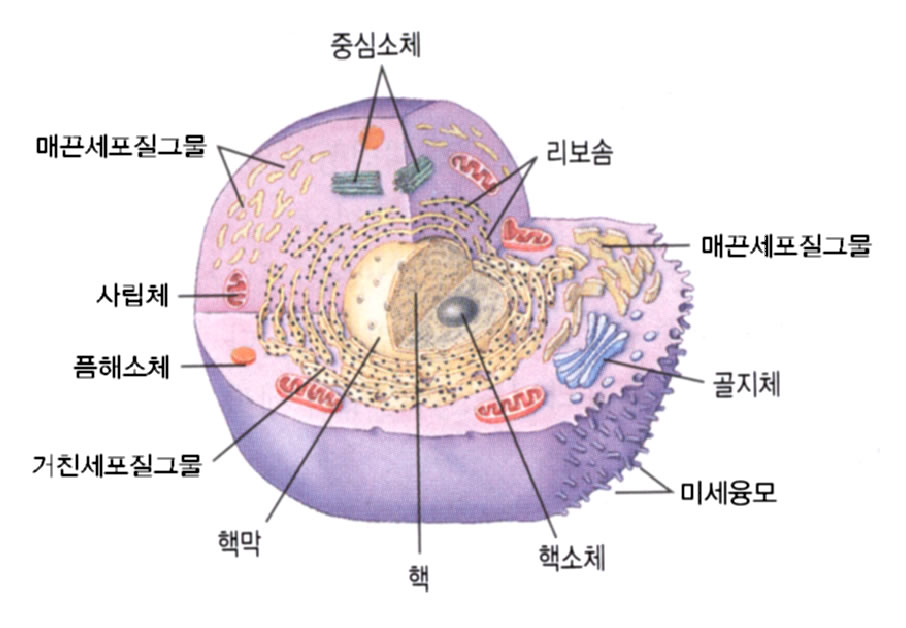 |
||
| ECG | Electro-Cardio-Graphy(-Gram); 심전도 = EKG 1. Conducting System Structu... |
|---|---|
| CWS | cell wall skeleton; chest wall stimulation; child welfare service; cold water-soluble; cotton wool s... |
| skel | skeleton, skeletal |
| CW | cardiac work; case work; cell wall; chemical warfare; chemical weapon; chest wall; children's ward; ... |
| MC | mass casualties; mast cell; Master of Surgery [Lat. Magister Chirurgiae]; maximum concentration; Med... |
| N-CWS | Nocardia rubra cell wall skeleton |
|---|---|
| CWS | cell wall skeleton |
| SCW | Streptococcal cell wall |
| CW | Chest wall |
| ESWS | End systolic wall stress |
| cell wall skeleton | <chemical> A mucoprotein found in the cell wall of various types of bacteria. It has adjuvant and antitumour activities and has been used to augment the production of lymphokine-activated killer (lak) cells. Pharmacological action: adjuvants, immunologic. (12 Dec 1998) |
|---|
| cell wall | 1. <cell biology> Extracellular material serving a structural role. 2. <plant biology> In plants the primary wall is pectin rich, the secondary wall mostly composed of cellulose. 3. <microbiology> In bacteria, cell wall structure is complex: the walls of gram-positive and gram-negative bacteria are distinctly different. Removal of the wall leaves a protoplast or spheroplast. (07 Apr 1998) |
|---|---|
| primary cell wall | <plant biology> A plant cell wall that is still able to expand, permitting cell growth. Growth is normally prevented when a secondary wall has formed. Primary cell walls contain more pectin than secondary walls and no lignin is present until a secondary wall has formed on top of them. (06 Mar 1998) |
| helicoidal cell wall | Type of plant cell wall in which each wall layer contains parallel microfibrils, but in which the orientation of the microfibrils changes by a fixed angle from one layer to the next. Gives a characteristic herringbone pattern in transmission electron microscopy. A similar architecture of fibrillar material is seen in some insect exoskeletons. (18 Nov 1997) |
| sporulation-specific cell wall hydrolase | <enzyme> From bacillus subtilis; 255-amino acid protein mw 27.146 kD; hydrolyzes both vegetative cell walls and spore peptidoglycan genbank d14666 Registry number: EC 3.- Synonym: cwlc gene product (26 Jun 1999) |
| appendicular skeleton | <anatomy> The bony structure that makes up the shoulder girdle, upper extremity, pelvis and lower extremities. (10 Jan 1998) |
| articulated skeleton | Mounted skeleton, one with the various parts connected in such a way as to demonstrate normal relationships and allow motion between components as in the living body. (05 Mar 2000) |
| axial skeleton | Articulated bones of head and vertebral column, i.e., head and trunk, as opposed to the appendicular skeleton, the articulated bones of the upper and lower limbs. Synonym: skeleton axiale. (05 Mar 2000) |
| cardiac fibrous skeleton | A complex framework of dense collagen forming four fibrous rings (annuli fibrosi), which surround the ostia of the valves, a right and left fibrous trigone, formed by connecting the rings, and the membranous portions of the interatrial and interventricular septa; it is found in association with the base of the ventricles, i.e., at the level of the coronary sulcus; its functions include: 1) contributing reinforcement of the valvular ostia while providing attachment for the leaflets and cusps of the valves; 2) providing origin and insertion for the myocardium; and 3) serving as a sort of electrical "insulator," separating the electrically conducted impulses of the atria and ventricles and providing passage for the common atrioventricular bundle of conductive tissue through the right fibrous trigone and membranous interventricular septum. Synonym: cardiac fibrous skeleton, cardiac skeleton, skeleton of heart. (05 Mar 2000) |
| cardiac skeleton | A complex framework of dense collagen forming four fibrous rings (annuli fibrosi), which surround the ostia of the valves, a right and left fibrous trigone, formed by connecting the rings, and the membranous portions of the interatrial and interventricular septa; it is found in association with the base of the ventricles, i.e., at the level of the coronary sulcus; its functions include: 1) contributing reinforcement of the valvular ostia while providing attachment for the leaflets and cusps of the valves; 2) providing origin and insertion for the myocardium; and 3) serving as a sort of electrical "insulator," separating the electrically conducted impulses of the atria and ventricles and providing passage for the common atrioventricular bundle of conductive tissue through the right fibrous trigone and membranous interventricular septum. Synonym: cardiac fibrous skeleton, cardiac skeleton, skeleton of heart. (05 Mar 2000) |
| gill arch skeleton | Cartilages associated with the visceral portion of the embryonic mammalian chondrocranium, representing the gill arch (branchial) skeletons as seen in shark-type fishes; they are the primordia of Meckel's cartilage, the styloid, hyoid, cricoid, thyroid, and arytenoid cartilages, and the auditory ossicles. See: branchial arches. (05 Mar 2000) |
| visceral skeleton | 1. <anatomy> Any bony formation in an organ, as in the heart, tongue, or penis of certain animals; the term also includes, according to some anatomists, the cartilaginous rings of the trachea and bronchi. 2. That part of the skeleton connected with the sense organs and the viscera. The bony framework protecting the viscera, such as the ribs and sternum, the pelvic bones, and the anterior portion of the skull. Synonym: splanchnoskeleton, visceral skeleton. Origin: Gr. An entrail + E. Skeleton. Source: Websters Dictionary (05 Mar 2000) |
| skeleton | <anatomy> A solid or fluid system which allows muscles to relax after contracting (in general, because there is an opposing muscle which pulls the skeletal part in the opposite direction when it contracts). The skeletal system may also be a support structure or a form of protection. Types of skeletons include hydroskeletons and exoskeletons. (09 Oct 1997) |
| skeleton appendiculare | <anatomy> The bony structure that makes up the shoulder girdle, upper extremity, pelvis and lower extremities. (10 Jan 1998) |
| skeleton axiale | Articulated bones of head and vertebral column, i.e., head and trunk, as opposed to the appendicular skeleton, the articulated bones of the upper and lower limbs. Synonym: skeleton axiale. (05 Mar 2000) |
| skeleton hand | Extension of fingers with atrophy of tissues; occurs in progressive muscular atrophy. (05 Mar 2000) |
Synonyms :
제품명 |
판매사 |
보험코드 | 성분/함량 | 구분/보험급여 |
|---|
제품명 |
판매사 |
보험코드 | 성분/함량 | 구분/보험급여 |
|---|