
| 영문 | surface tension | 한글 | 표면장력 |
|---|---|---|---|
| 설명 | 액체의 자유표면에서 표면을 작게하려고 작용하는 장력. 비누방울이나 액체 속의 기포-물방울 등이 구상이 되는 것은 이 힘이 액면에 작용하기 때문이며, 용기의 가장자리에 액체가 넘쳐 올라간 모양이 되어 쏟아지지 않는 것도 액체 표면에 장력이 작용하기 때문이다. 수면에 떨어뜨린 기름방울이 금방 퍼지는 것은 물의 표면장력이 기름의 표면장력보다 크고, 기름층이 물의 표면장력에 의해 잡아 늘여지기 때문이다. |
||
| 영문 | muscle cell(=muscle fiber) | 한글 | 근육세포 |
|---|---|---|---|
| 설명 | 근육은 수의근(의식에 의해서 조절이 가능한 근육: 예를 들어 다리, 팔, 얼굴근육 등)과 불수의근(의식과 무관하게 조절하지 않아도 움직이는 근육: 예를 들어 심장근, 소화기관에 분포하는 근육 등)으로 나누어지며, 근육세포의 모양은 다음과 같다(수의근, 불수의근 외에 심장에 있는 심장근은 불수의근에 해당하지만 그 모양은 수의근과 같아 따로 분류한다).  |
||
| 영문 | white blood cell(WBC), leukocyte | 한글 | 백혈구 |
|---|---|---|---|
| 설명 | 혈액내에 골수구계세포와 림프계세포, 단핵구계세포를 모두 통틀어 말한다. 백혈구의 증가가 있으면 대개 감염이 있거나, 혹은 탈수현상이 있음을 의미한다. 또한 지나친 백혈구수의 감소는 인체내 면역기능이 떨어져 있음을 의미하며, 다른 질병에 의해 나타나는 이차적인 현상이 아닌지 꼭 진단을 받아보아야 한다. |
||
| 영문 | mast cell | 한글 | 비만 세포 |
|---|---|---|---|
| 설명 | 동물의 결합 조직 가운데 널리 분포하는 세포. 결합조직과 점막조직 내에 있는 호염기성 색소로 이염색성(metachromasia)을 나타내는 과립을 가진 방추형의 세포에 작은 둥근 핵을 가진다. 비만세포의 표면에는 IgE에 대한 수용체가 존재하며, 수용체에 결합한 IgE 분자들끼리 다가의 항원에 의해 서로 연결되면 비만세포 과립탈출 반응이 일어나, 히스타민, 세로토닌, 헤파린 등의 화학전달 물질이 방출되어, 즉시형 알레르기 반응 등의 증상을 일으킨다. 피부, 장막, 혈관 주위, 점막 주변에 있다. |
||
| 영문 | cell | 한글 | 세포 |
|---|---|---|---|
| 설명 | 생명체를 이루는 구조적, 기능적 단위. 핵의 유무에 따라서 유핵세포와 무핵세포로 나눌 수가 있다. 무핵세포란 핵이 없는 세포를 말한다. 핵이란 유전정보를 가지고 있는 염색체를 보관하는 곳인데 무핵세포에서는 염색체가 세포속에 그냥 노출되어 있다. 대개 세포 하나하나가 독립된 생명체의 역할을 하는 단세포생물로서 외부환경으로부터 자신을 보호할 수 있는 견고한 세포벽을 가지고 있다. 유핵세포란 핵을 가지고 있어서 유전정보가 있는 염색체가 세포의 다른 부분과 구분되어 핵속에 들어있다. 세포속에서 핵외의 부분(이를 세포질이라 한다)에는 여러 가지 세포의 소기관이 있어서 세포의 다양한 기능을 분담한다. ◈유핵세포의 기본 구조 1.세포막-세포를 둘러싸서 주위환경과 분리하여 세포의 내환경을 유지한다. 2.형질내세망(endoplasmic reticulum)-단위막으로 둘러쌓여 있는 불규칙한 망상구조이다. 이 망상구조의 내부를 소강, 소조라고 부른다. 여기에는 표면이 매끈한 무과립형질내세망과 표면이 불규칙한 과립형질내세망의 두 가지가 있다. 과립형질내세망의 경우는 표면에 단백질을 합성하는 리보솜이라는 것이 부착되어 있다. 이곳은 주로 세포밖으로 분비할 단백질을 합성하는 장소이다. 무과립형질내세망은 표면에 리보솜이 부착되어 있지 않은 것을 말하며, 이곳에서는 주로 해독작용, 글리코겐의 합성, 스테로이드호르몬의 합성 등이 일어난다. 3.리보솜-단백질을 합성하는 역할을 하는 곳이다.이것은 세포질에 존재하는 자유리보솜과 과립형질내세망에 부착이 되어 존재하는 부착리보솜의 두 가지로 나눈다. 자유리보솜은 주로 세포내에서 필요한 단백질을 만드는 역할을 하고 부착리보솜은 세포밖으로 분비할 단백질을 만드는 역할을 한다. 4.골지장치(Golgi apparatus)-핵주위에 분포하는 납작해진 주머니모양의 것이 중첩되어 형성된 층판 모양의 구조물로 과립형질내세망에서 생성되어 외부로 분비될 단백질을 모아서 농축, 포장하여 과립을 만드는 역할을 한다. 5.사립체(mitochondria)-구형, 난형의 긴 막대기 모양으로 크기가 다양한 구조물. 생물체의 에너지 저장물질인 ATP를 생산하는 역할을 한다. 또 세포와 다른 자신만의 유전정보를 가진 DNA, RNA를 가지고 있다. 모양, 크기가 세균과 비슷하며 자체증식성 등 독립된 생명체로서 필요한 요건을 갖추고 있어서 세포와 공생관계를 가진 독립된 세포로 생각하고 있다. 6.용해소체(lysosome)-작은 구형의 소체로 여러 가지 분해효소를 가진다. 세포외계에서 들어온 물질과 결합하여 그 물질들을 용해하는 역할을 하고, 오래된 세포소기관들을 제거하는 역할도 한다. 7.세포핵(nucleus)-구형, 난형으로 세포의 중심에 위치한다. 핵내에는 유전정보가 있는 물질인 염색체가 존재한다. 8.중심소체(centrosome)-핵주위에 존재하면서 핵의 분열시에 양쪽의 염색체를 당기는 작은 섬유를 만드는 역할을 하는 곳. 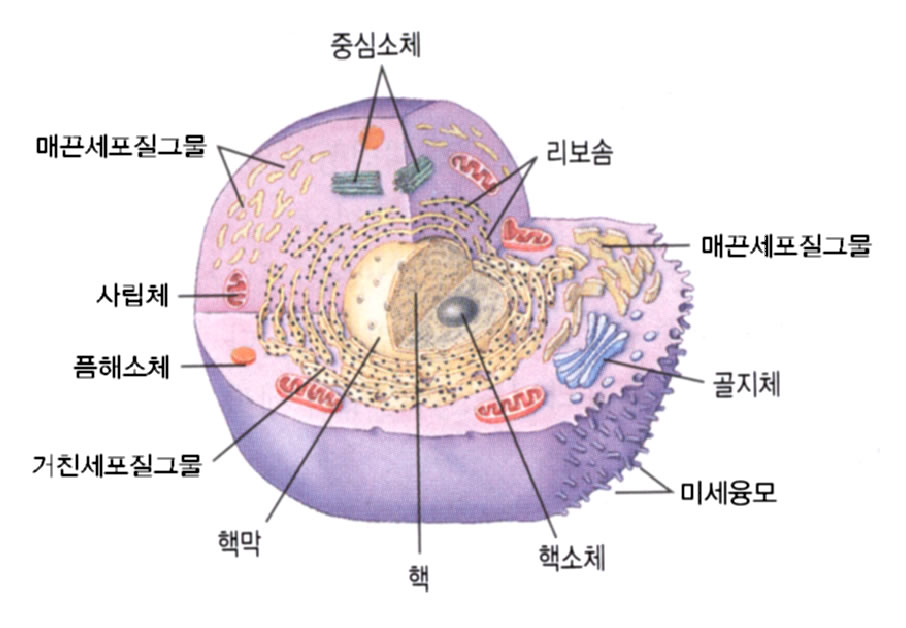 |
||
| MC | mass casualties; mast cell; Master of Surgery [Lat. Magister Chirurgiae]; maximum concentration; Med... |
|---|---|
| SC | conditioned stimulus; sacrococcygeal; Sanitary Corps; scalenus [muscle]; scapula; Schwann cell; scia... |
| SCM | Schwann cell membrane; sensation, circulation, and motion; Society of Computer Medicine; soluble cyt... |
| ACC | accommodation; acetyl coenzyme A carboxylase; acinic cell carcinoma; acute care center; adenoid cyst... |
| Gm | an allotype marker on the heavy chains of immunoglobins |
| MAS | Marker Assisted Selection |
|---|---|
| OMP | Olfactory Marker Protein |
| SMP 30 | Senescence marker protein 30 |
| SMC | Supernumerary Marker Chromosome |
| Lin | lineage marker |
| cell surface marker | <cell biology> Any molecule characteristic of the plasma membrane of a cell or in some cases of a specific cell type. 5' nucleotidase and Na/K ATPase are often used as plasma membrane markers. (26 Mar 1998) |
|---|
| cell marker | <cell biology> Biochemical or genetic characteristics which distinguish and discriminate between different cell types. (26 Mar 1998) |
|---|---|
| allotypic marker | Synonym: allotype. (05 Mar 2000) |
| genetic marker | A gene which has an easily identifiable phenotype so that one can tell apart cells or individuals which have the gene and those which do not have it. Such a gene can also be used as a probe to mark cell nuclei or chromosomes so that they can easily be isolated or identified from other nuclei or chromosomes later. (09 Oct 1997) |
| marker | An identifiable physical location on a chromosome (for example, restriction enzyme cuttingsite, gene) whose inheritance can bemonitored. Markers can beexpressed regions of DNA (genes) or some segment of DNA with no knowncoding function but whose pattern of inheritance can be determined. See: restriction fragment length polymorphism. (09 Oct 1997) |
| marker chromosome | An abnormal chromosome that is distinctive in appearance but not fully identified. For example, the fragile x chromosome was once called the marker x. (12 Dec 1998) |
| marker enzyme | <enzyme> An enzyme that is used to identify a specific cell type, cell organelle, or cell component. (05 Mar 2000) |
| marker gene | Gene that confers some readily detectable phenotype on cells carrying the gene, either in culture or in transgenic or chimeric organisms. Gene could be an enzymic reporter gene, a selectable marker conferring antibiotic resistance or a cell membrane protein with a characteristic epitope. (18 Nov 1997) |
| marker locus | A locus on a chromosome or in a stretch of DNA that can be identified (e.g., a restriction fragment length polymorphism) and can serve in linkage analysis and in the isolation of a disease gene. See: linkage marker. (05 Mar 2000) |
| marker, object | <microscopy> A small abrasive stylus, set in a rotating holder mounted on the lower end of the drawtube. The desired part of the specimen is placed in the centre of the field, and the abrasive point is pressed against the slide or cover, and rotated. It describes a tiny circle around the desired object field. (05 Aug 1998) |
| marker trait | A trait that may be of little importance in itself but which by association, linkage, or other means facilitates the detection, anticipation, or understanding of a disease or (for genetic diseases) the localization of the causative gene on the karyotype. (05 Mar 2000) |
| selectable marker | <molecular biology> A gene whose expression allows one to identify cells that have been transforrned or transfected with a vector containing the marker gene. (09 Oct 1997) |
| hypoxanthine-guanine phosphoribosyl tranferase marker | The gene which codes for the enzyme hypoxanthine-guanine phosphoribosyl transferase. It is a selectable marker because cells which have a defective version of this gene are resistant to poisoning by toxic purine derivatives which result from the metabolic pathway that the HGPRT enzyme catalyses. (The purine derivatives are toxic because they incorporate into DNA as a result of the HGPRT enzyme's actions). Because the defective gene cannot produce the enzyme, no toxic purine derivatives are produced, the gene can therefore be selected for. (09 Oct 1997) |
| surrogate marker | <biology> A laboratory measurement of biological activity within the body that indirectly indicates the effect of treatment on disease state. CD4 cell counts and viral load are examples of surrogate markers in HIV infection. (19 Jan 1998) |
| oncofetal marker | A tumour marker produced by tumour tissue and by foetal tissue of the same type as the tumour, but not by normal adult tissue from which the tumour arises. (05 Mar 2000) |
| time marker | An instrument that marks the time, usually in seconds or fractions of seconds, on a kymograph record in physiologic experiments. (05 Mar 2000) |
제품명 |
판매사 |
보험코드 | 성분/함량 | 구분/보험급여 |
|---|
제품명 |
판매사 |
보험코드 | 성분/함량 | 구분/보험급여 |
|---|