
| 영문 | muscle cell(=muscle fiber) | 한글 | 근육세포 |
|---|---|---|---|
| 설명 | 근육은 수의근(의식에 의해서 조절이 가능한 근육: 예를 들어 다리, 팔, 얼굴근육 등)과 불수의근(의식과 무관하게 조절하지 않아도 움직이는 근육: 예를 들어 심장근, 소화기관에 분포하는 근육 등)으로 나누어지며, 근육세포의 모양은 다음과 같다(수의근, 불수의근 외에 심장에 있는 심장근은 불수의근에 해당하지만 그 모양은 수의근과 같아 따로 분류한다).  |
||
| 영문 | white blood cell(WBC), leukocyte | 한글 | 백혈구 |
|---|---|---|---|
| 설명 | 혈액내에 골수구계세포와 림프계세포, 단핵구계세포를 모두 통틀어 말한다. 백혈구의 증가가 있으면 대개 감염이 있거나, 혹은 탈수현상이 있음을 의미한다. 또한 지나친 백혈구수의 감소는 인체내 면역기능이 떨어져 있음을 의미하며, 다른 질병에 의해 나타나는 이차적인 현상이 아닌지 꼭 진단을 받아보아야 한다. |
||
| 영문 | mast cell | 한글 | 비만 세포 |
|---|---|---|---|
| 설명 | 동물의 결합 조직 가운데 널리 분포하는 세포. 결합조직과 점막조직 내에 있는 호염기성 색소로 이염색성(metachromasia)을 나타내는 과립을 가진 방추형의 세포에 작은 둥근 핵을 가진다. 비만세포의 표면에는 IgE에 대한 수용체가 존재하며, 수용체에 결합한 IgE 분자들끼리 다가의 항원에 의해 서로 연결되면 비만세포 과립탈출 반응이 일어나, 히스타민, 세로토닌, 헤파린 등의 화학전달 물질이 방출되어, 즉시형 알레르기 반응 등의 증상을 일으킨다. 피부, 장막, 혈관 주위, 점막 주변에 있다. |
||
| 영문 | cell | 한글 | 세포 |
|---|---|---|---|
| 설명 | 생명체를 이루는 구조적, 기능적 단위. 핵의 유무에 따라서 유핵세포와 무핵세포로 나눌 수가 있다. 무핵세포란 핵이 없는 세포를 말한다. 핵이란 유전정보를 가지고 있는 염색체를 보관하는 곳인데 무핵세포에서는 염색체가 세포속에 그냥 노출되어 있다. 대개 세포 하나하나가 독립된 생명체의 역할을 하는 단세포생물로서 외부환경으로부터 자신을 보호할 수 있는 견고한 세포벽을 가지고 있다. 유핵세포란 핵을 가지고 있어서 유전정보가 있는 염색체가 세포의 다른 부분과 구분되어 핵속에 들어있다. 세포속에서 핵외의 부분(이를 세포질이라 한다)에는 여러 가지 세포의 소기관이 있어서 세포의 다양한 기능을 분담한다. ◈유핵세포의 기본 구조 1.세포막-세포를 둘러싸서 주위환경과 분리하여 세포의 내환경을 유지한다. 2.형질내세망(endoplasmic reticulum)-단위막으로 둘러쌓여 있는 불규칙한 망상구조이다. 이 망상구조의 내부를 소강, 소조라고 부른다. 여기에는 표면이 매끈한 무과립형질내세망과 표면이 불규칙한 과립형질내세망의 두 가지가 있다. 과립형질내세망의 경우는 표면에 단백질을 합성하는 리보솜이라는 것이 부착되어 있다. 이곳은 주로 세포밖으로 분비할 단백질을 합성하는 장소이다. 무과립형질내세망은 표면에 리보솜이 부착되어 있지 않은 것을 말하며, 이곳에서는 주로 해독작용, 글리코겐의 합성, 스테로이드호르몬의 합성 등이 일어난다. 3.리보솜-단백질을 합성하는 역할을 하는 곳이다.이것은 세포질에 존재하는 자유리보솜과 과립형질내세망에 부착이 되어 존재하는 부착리보솜의 두 가지로 나눈다. 자유리보솜은 주로 세포내에서 필요한 단백질을 만드는 역할을 하고 부착리보솜은 세포밖으로 분비할 단백질을 만드는 역할을 한다. 4.골지장치(Golgi apparatus)-핵주위에 분포하는 납작해진 주머니모양의 것이 중첩되어 형성된 층판 모양의 구조물로 과립형질내세망에서 생성되어 외부로 분비될 단백질을 모아서 농축, 포장하여 과립을 만드는 역할을 한다. 5.사립체(mitochondria)-구형, 난형의 긴 막대기 모양으로 크기가 다양한 구조물. 생물체의 에너지 저장물질인 ATP를 생산하는 역할을 한다. 또 세포와 다른 자신만의 유전정보를 가진 DNA, RNA를 가지고 있다. 모양, 크기가 세균과 비슷하며 자체증식성 등 독립된 생명체로서 필요한 요건을 갖추고 있어서 세포와 공생관계를 가진 독립된 세포로 생각하고 있다. 6.용해소체(lysosome)-작은 구형의 소체로 여러 가지 분해효소를 가진다. 세포외계에서 들어온 물질과 결합하여 그 물질들을 용해하는 역할을 하고, 오래된 세포소기관들을 제거하는 역할도 한다. 7.세포핵(nucleus)-구형, 난형으로 세포의 중심에 위치한다. 핵내에는 유전정보가 있는 물질인 염색체가 존재한다. 8.중심소체(centrosome)-핵주위에 존재하면서 핵의 분열시에 양쪽의 염색체를 당기는 작은 섬유를 만드는 역할을 하는 곳. 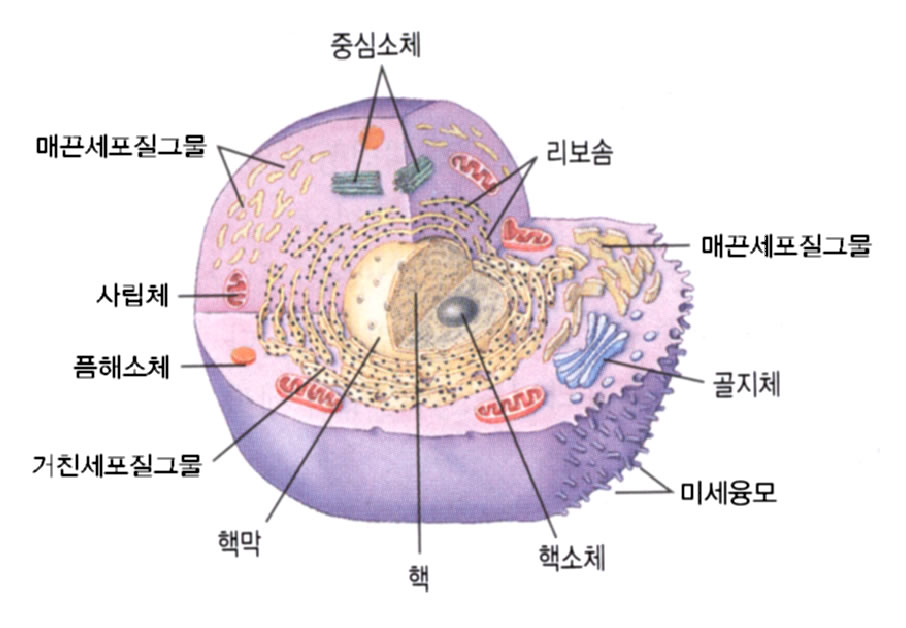 |
||
| 영문 | cell-mediated immunity | 한글 | 세포매개면역 |
|---|---|---|---|
| 설명 | 면역이란 신체를 외부의 물질로부터 보호하는 행위를 말한다. 여기에는 특이적 면역과 비특이적 면역의 두 가지가 있다. 비특이적 면역이라함은 특정한 물질에 관계하는 면역이 아니라 특정 대상이 없이 모든 외부 물체에 작용할 수 있는 면역을 말한다. 여기에는 소변의 흐름, 눈물의 흐름, 피부의 비투과성 등의 기계적인 것도 포함되고 피속에 돌아다니는 세포 중에서 비특이적으로 외부의 물질을 포식하는 세포들(예를 들면 큰포식세포(macrophage)의 활동도 포함이 된다. 세포매개면역이란 특이한 물질을 감지할 수 있는 세포를 생성하게 하여 그것으로 하여금 그 물질을 포식하게 하는 것을 말한다. |
||
| MC | mass casualties; mast cell; Master of Surgery [Lat. Magister Chirurgiae]; maximum concentration; Med... |
|---|---|
| MAP | malignant atrophic papulosis; mandibular angle plane; maturation-activated protein; maximal aerobic ... |
| SEP | self-evaluation process; sensory-evoked potential; septum; somatosensory evoked potential; sperm ent... |
| ACC | accommodation; acetyl coenzyme A carboxylase; acinic cell carcinoma; acute care center; adenoid cyst... |
| PC | avoirdupois weight [Lat. pondus civile]; packed cells; paper chromatography; paracortex; parent cell... |
| AP | Action Potential |
|---|---|
| APA | Action potential amplitude |
| APD | Action potential duration |
| APD(50) | Action potential duration |
| APD90 | Action potential duration |
| cell potential | <cell biology, physiology> The voltage of an electrochemical cell, the larger the cell potential, the greater the extent of reaction when equilibrium is reached. (26 Mar 1998) |
|---|
| action potential | <physiology> The sequential, electrochemical polarization and depolarisation that travels across the membrane of a nerve cell (neuron) in response to stimulation (touch, pain, cold, etc.) (09 Oct 1997) |
|---|---|
| bioelectric potential | Electrical potential's occurring in living organisms. (05 Mar 2000) |
| biological hazard potential | <radiobiology> Measure of the hazard posed by a given quantity of radioactive material in which the variation in biological effects of the various elements are accounted for. See: integrated biological hazard potential. (21 Mar 1998) |
| biotic potential | <biology, ecology> The potential growth a population of living things can expect if it were living under ideal environmental circumstances. (19 Jan 1998) |
| body surface potential mapping | Recording of regional electrophysiological information by analysis of surface potentials to give a complete picture of the effects of the currents from the heart on the body surface. It has been applied to the diagnosis of old inferior myocardial infarction, localization of the bypass pathway in wolff-parkinson-white syndrome, recognition of ventricular hypertrophy, estimation of the size of a myocardial infarct, and the effects of different interventions designed to reduce infarct size. The limiting factor at present is the complexity of the recording and analysis, which requires 100 or more electrodes, sophisticated instrumentation, and dedicated personnel. (12 Dec 1998) |
| brain potential | <physiology> The electrical charge of the brain as compared to a point on the body; the potential may be steady (DC potential) or may fluctuate at specific frequencies when recorded against time, giving rise to the electroencephalogram. (05 Mar 2000) |
| pacemaker potential | The voltage inscribed by impulses from an artificial electronic pacemaker. (05 Mar 2000) |
| generator potential | Local depolarisation of the membrane potential at the end of a sensory neurone in graded response to the strength of a stimulus applied to the associated receptor organ, e.g., a pacinian corpuscle; if the generator potential becomes large enough (because the stimulus is at least of threshold strength), it causes excitation at the nearest node of Ranvier and a propagated action potential. (05 Mar 2000) |
| receptor potential | The transmembrane potential difference of a sensory cell. Such cells are not generally excitable, but their response to stimulation is a gradual change in their resting potential. (18 Nov 1997) |
| redox potential | <chemistry> The reducing/oxidizing power of a system measured by the potential at a hydrogen electrode. (18 Nov 1997) |
| reduction potential | The inherent tendency of a compound to act as an electron donor or an electron acceptor. Measured in volts. (09 Oct 1997) |
| visual evoked potential | Voltage fluctuations that may be recorded from the occipital area of the scalp as the result of retinal stimulation by a light flashing at 1/4-second intervals; commonly summated and averaged by computer. (05 Mar 2000) |
| resting potential | <physiology> The electrical potential of the inside of a cell, relative to its surroundings. Almost all animal cells are negative inside, resting potentials are in the range 20 to 100mV, 70mV typical. Resting potentials reflect the action of the sodium pump only indirectly, they are mainly caused by the subsequent diffusion of potassium out of the cell through potassium leak channels. The resting potential is thus close to the Nernst potential for potassium. See: action potential. (10 Mar 1998) |
| membrane potential | <physiology> More correctly, transmembrane potential difference: the electrical potential difference across a plasma membrane. See: resting potential, action potential. (18 Nov 1997) |
| chemical potential | <chemistry> The work required (in j mol 1) to bring a molecule from a standard state (usually infinitely separated in a vacuum) to a specified concentration. More usually employed as chemical potential difference, the work required to bring one mole of a substance from a solution at one concentration to another at a different concentration, __ = RT.In (c2/cl). This definition is useful in studies of active transport, note that, for charged molecules, the electrical potential difference must also be considered (see electrochemical potential). (18 Nov 1997) |
제품명 |
판매사 |
보험코드 | 성분/함량 | 구분/보험급여 |
|---|
제품명 |
판매사 |
보험코드 | 성분/함량 | 구분/보험급여 |
|---|