
| 영문 | hypoxia | 한글 | 저산소증 |
|---|---|---|---|
| 설명 | 산소운반과 활용 과정에 장애를 발생하여, 동맥혈 산소함량(PaO2)이 감소하며, 조직 속의 산소가 정상치 이하로 감소한 상태. 대별하면 ① 저산소성저산소증, ② 빈혈저산소증, ③ 울혈저산소증, ④ 조직독성저산소증, ⑤ 수용성 저산소증을 분류된다. 초기증상은 의식혼란, 두통, 어지럼증, 구역, 가쁜 호흡, 빠른 맥 등으로, 증상이 진행하면 청색증(혈증 환원 Hb 가 5g/100mL 이상), 의식소실, 경련, 느린맥, 부정맥, 호흡억제, 심장정지에 이른다. 산소요법, 기계적 인공호흡을 실시한다. 그 종류를 원인별로 분류하면 다음과 같다. ① 저산소성저산소증(hypoxic hypoxia): 동맥혈의 산소분압이 감소되어 초래된 저산소증으로 흡입 공기 중의 산소 농도가 감소한 경우, 호흡 중추억제-기도폐쇄-호흡근마비 등 폐포환기가 감소한 경우, 무기폐-폐렴-폐부종 등 폐포에서의 가스 교환이 부적절하여 일어나는 경우, 고열-신진대사항진 등 조직의 산소 소모가 증가하여 일어나는 경우, 이산화질호(N2O)를 이용한 전신마취 후에 드물게 나타나는 확산성 저산소증 등에 의해 발생할 수 있다. ② 빈혈저산소증(anemic hypoxia) : 혈색소가 정상 이하로 감소한 경우, 일산화 탄소중독처럼 혈색소가 산소를 운반할 수 없는 경우에 나타나는 저산소증으로서 산소분압은 정상 범위 내에 있으나 동맥혈의 산소 함량이 크게 감소되어 있는 경우가 대부분이다. ③ 울혈저산소증(stagnant hypoxia) : 동맥혈의 산소분압은 정상이나 조직의 혈액순환이 장애를 받아 나타나는 저산소증으로 심박출량이 감소하여 오는 경우도 있고, 색전증-외상-혈관수축-정맥폐쇄 등에 의해 발생할 수도 있다. ④ 조직독성저산소증(histotoxic hypoxia) : 사립체의 산소 이용률이 낮아진 경우에 나타난다. 혈관 확장제를 과량 사용하게 되면 세포 내 효소의 독성에 의해 저산소증이 올 수 있다. |
||
| 영문 | muscle cell(=muscle fiber) | 한글 | 근육세포 |
|---|---|---|---|
| 설명 | 근육은 수의근(의식에 의해서 조절이 가능한 근육: 예를 들어 다리, 팔, 얼굴근육 등)과 불수의근(의식과 무관하게 조절하지 않아도 움직이는 근육: 예를 들어 심장근, 소화기관에 분포하는 근육 등)으로 나누어지며, 근육세포의 모양은 다음과 같다(수의근, 불수의근 외에 심장에 있는 심장근은 불수의근에 해당하지만 그 모양은 수의근과 같아 따로 분류한다).  |
||
| 영문 | white blood cell(WBC), leukocyte | 한글 | 백혈구 |
|---|---|---|---|
| 설명 | 혈액내에 골수구계세포와 림프계세포, 단핵구계세포를 모두 통틀어 말한다. 백혈구의 증가가 있으면 대개 감염이 있거나, 혹은 탈수현상이 있음을 의미한다. 또한 지나친 백혈구수의 감소는 인체내 면역기능이 떨어져 있음을 의미하며, 다른 질병에 의해 나타나는 이차적인 현상이 아닌지 꼭 진단을 받아보아야 한다. |
||
| 영문 | mast cell | 한글 | 비만 세포 |
|---|---|---|---|
| 설명 | 동물의 결합 조직 가운데 널리 분포하는 세포. 결합조직과 점막조직 내에 있는 호염기성 색소로 이염색성(metachromasia)을 나타내는 과립을 가진 방추형의 세포에 작은 둥근 핵을 가진다. 비만세포의 표면에는 IgE에 대한 수용체가 존재하며, 수용체에 결합한 IgE 분자들끼리 다가의 항원에 의해 서로 연결되면 비만세포 과립탈출 반응이 일어나, 히스타민, 세로토닌, 헤파린 등의 화학전달 물질이 방출되어, 즉시형 알레르기 반응 등의 증상을 일으킨다. 피부, 장막, 혈관 주위, 점막 주변에 있다. |
||
| 영문 | cell | 한글 | 세포 |
|---|---|---|---|
| 설명 | 생명체를 이루는 구조적, 기능적 단위. 핵의 유무에 따라서 유핵세포와 무핵세포로 나눌 수가 있다. 무핵세포란 핵이 없는 세포를 말한다. 핵이란 유전정보를 가지고 있는 염색체를 보관하는 곳인데 무핵세포에서는 염색체가 세포속에 그냥 노출되어 있다. 대개 세포 하나하나가 독립된 생명체의 역할을 하는 단세포생물로서 외부환경으로부터 자신을 보호할 수 있는 견고한 세포벽을 가지고 있다. 유핵세포란 핵을 가지고 있어서 유전정보가 있는 염색체가 세포의 다른 부분과 구분되어 핵속에 들어있다. 세포속에서 핵외의 부분(이를 세포질이라 한다)에는 여러 가지 세포의 소기관이 있어서 세포의 다양한 기능을 분담한다. ◈유핵세포의 기본 구조 1.세포막-세포를 둘러싸서 주위환경과 분리하여 세포의 내환경을 유지한다. 2.형질내세망(endoplasmic reticulum)-단위막으로 둘러쌓여 있는 불규칙한 망상구조이다. 이 망상구조의 내부를 소강, 소조라고 부른다. 여기에는 표면이 매끈한 무과립형질내세망과 표면이 불규칙한 과립형질내세망의 두 가지가 있다. 과립형질내세망의 경우는 표면에 단백질을 합성하는 리보솜이라는 것이 부착되어 있다. 이곳은 주로 세포밖으로 분비할 단백질을 합성하는 장소이다. 무과립형질내세망은 표면에 리보솜이 부착되어 있지 않은 것을 말하며, 이곳에서는 주로 해독작용, 글리코겐의 합성, 스테로이드호르몬의 합성 등이 일어난다. 3.리보솜-단백질을 합성하는 역할을 하는 곳이다.이것은 세포질에 존재하는 자유리보솜과 과립형질내세망에 부착이 되어 존재하는 부착리보솜의 두 가지로 나눈다. 자유리보솜은 주로 세포내에서 필요한 단백질을 만드는 역할을 하고 부착리보솜은 세포밖으로 분비할 단백질을 만드는 역할을 한다. 4.골지장치(Golgi apparatus)-핵주위에 분포하는 납작해진 주머니모양의 것이 중첩되어 형성된 층판 모양의 구조물로 과립형질내세망에서 생성되어 외부로 분비될 단백질을 모아서 농축, 포장하여 과립을 만드는 역할을 한다. 5.사립체(mitochondria)-구형, 난형의 긴 막대기 모양으로 크기가 다양한 구조물. 생물체의 에너지 저장물질인 ATP를 생산하는 역할을 한다. 또 세포와 다른 자신만의 유전정보를 가진 DNA, RNA를 가지고 있다. 모양, 크기가 세균과 비슷하며 자체증식성 등 독립된 생명체로서 필요한 요건을 갖추고 있어서 세포와 공생관계를 가진 독립된 세포로 생각하고 있다. 6.용해소체(lysosome)-작은 구형의 소체로 여러 가지 분해효소를 가진다. 세포외계에서 들어온 물질과 결합하여 그 물질들을 용해하는 역할을 하고, 오래된 세포소기관들을 제거하는 역할도 한다. 7.세포핵(nucleus)-구형, 난형으로 세포의 중심에 위치한다. 핵내에는 유전정보가 있는 물질인 염색체가 존재한다. 8.중심소체(centrosome)-핵주위에 존재하면서 핵의 분열시에 양쪽의 염색체를 당기는 작은 섬유를 만드는 역할을 하는 곳. 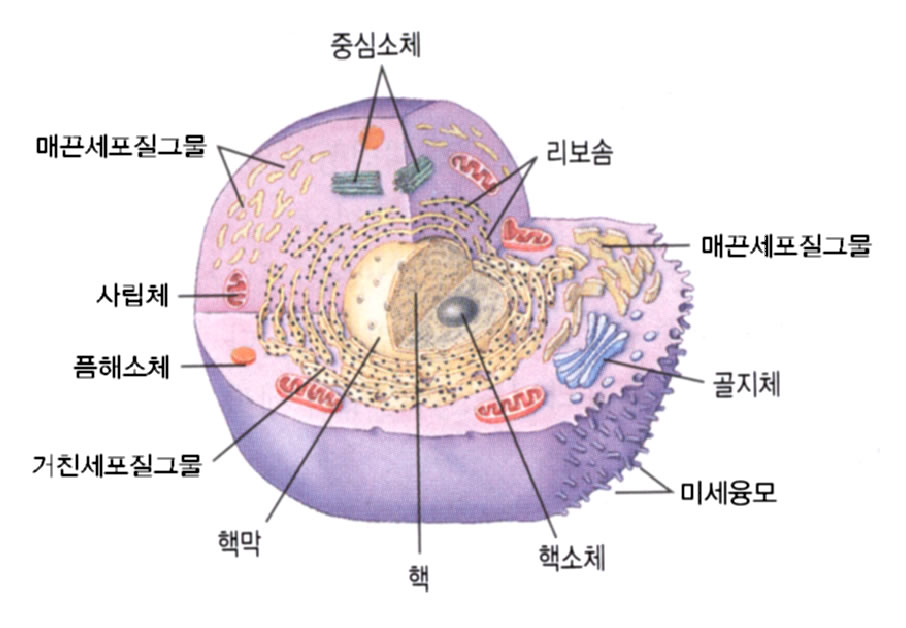 |
||
| MC | mass casualties; mast cell; Master of Surgery [Lat. Magister Chirurgiae]; maximum concentration; Med... |
|---|---|
| ACC | accommodation; acetyl coenzyme A carboxylase; acinic cell carcinoma; acute care center; adenoid cyst... |
| GC | ganglion cell; gas chromatography; general circulation; general closure; general condition; generali... |
| ADCC cell | Antibody Dependent Cellular(= Cell-Mediated) Cytotoxicity cell |
| HCG, hCG | Human Chorionic Gonadotropin; 사람융모성성선자극호르몬 1. Placental Glycoprotein Hormone &nbs... |
| CH | Chronic hypoxia |
|---|---|
| H | Hypoxia |
| HYP | Hypoxia |
| HIF-1 | Hypoxia Inducible Factor-1 |
| HIF | Hypoxia inducible factor |
| cell hypoxia | A condition of decreased oxygen content at the cellular level. (12 Dec 1998) |
|---|
| anaemic hypoxia | Hypoxia resulting from a decreased concentration of functional haemoglobin or a reduced number of erythrocytes; it is caused by haemorrhage or anaemia of various types, or by poisoning with CO2, nitrites, or chlorates. (05 Mar 2000) |
|---|---|
| cerebral hypoxia | A lack of oxygen to the cerebral hemispheres (the brain). Depending on the duration and extent of hypoxia, symptoms can be mild (for example lethargy) or serious neurologic damage can result (for example coma, seizures, death). (27 Sep 1997) |
| hypoxia | Reduction of oxygen supply to tissue below physiological levels despite adequate perfusion of the tissue by blood. (cf. Anoxia). (18 Nov 1997) |
| hypoxia-ischemia | See hypoxia. Ischemia refers to blood flow to cells and organs that is not sufficient to maintain their normal function. (12 Dec 1998) |
| hypoxia warning system | A device designed to produce an audio or visual signal at a predetermined level of oxygen partial pressure; ideally, the system would warn of impending hypoxia in time for corrective action to be taken. (05 Mar 2000) |
| hypoxic hypoxia | Hypoxia resulting from a defective mechanism of oxygenation in the lungs; may be caused by a low tension of oxygen, abnormal pulmonary function or respiratory obstruction, or a right-to-left shunt in the heart. (05 Mar 2000) |
| stagnant hypoxia | Tissue hypoxia characterised not by tissue oligaemia (tissue blood volume being normal or even increased), but by intravascular stasis due to impairment of venous outflow or (in some instances) to decreased arterial inflow. (05 Mar 2000) |
| delayed coma after hypoxia | Coma that develops a few days to 3 weeks after an acute hypoxic insult; the latter was usually severe enough to cause an initial bout of coma, which cleared, and was followed by a transient interval of apparent normality. Synonym: severe postanoxic encephalopathy. (05 Mar 2000) |
| diffusion hypoxia | Abrupt transient decrease in alveolar oxygen tension when room air is inhaled at the conclusion of a nitrous oxide anaesthesia, because nitrous oxide diffusing out of the blood dilutes the alveolar oxygen. (05 Mar 2000) |
| ischemic hypoxia | Tissue hypoxia characterised by tissue oligaemia and caused by arterial or arteriolar obstruction or vasoconstriction. (05 Mar 2000) |
| oxygen affinity hypoxia | Hypoxia due to reduced ability of haemoglobin to release oxygen. (05 Mar 2000) |
| T-cell-rich, B-cell lymphoma | <tumour> A B-cell lymphoma in which more than 90% of the cells are of T-cell origin, masking the large cells that form the neoplastic B-cell component. See: adult T-cell lymphoma. (05 Mar 2000) |
| absorption cell | A small glass chamber with parallel sides, in which absorption spectra of solutions can be obtained. (05 Mar 2000) |
| acid cell | One of the cell's of the gastric glands; it lies upon the basement membrane, covered by the chief cell's, and secretes hydrochloric acid that reaches the lumen of the gland through fine intracellular and intercellular canals (canaliculi). Synonym: acid cell, oxyntic cell. (05 Mar 2000) |
| acidophil cell | A cell whose cytoplasm or its granules stain with acid dyes. (05 Mar 2000) |
Synonyms : Anoxia, Cell, Anoxias, Cell, Anoxias, Cellular, Cell Anoxias, Cell Hypoxias, Cellular Anoxia, Cellular Anoxias, Cellular Hypoxia, Cellular Hypoxias, Hypoxia, Cell, Hypoxias, Cell, Hypoxias, Cellular
제품명 |
판매사 |
보험코드 | 성분/함량 | 구분/보험급여 |
|---|
제품명 |
판매사 |
보험코드 | 성분/함량 | 구분/보험급여 |
|---|