
| 영문 | Bile | 한글 | 쓸개즙, 담즙 |
|---|---|---|---|
| 설명 | 간에서 만들어지는 갈색이나 또는 초록색을 띠는 액체. 간에서 만들어져 병, 쓸개주머니관(cystic duct)를 거쳐서 쓸개에 보관되었다가 온쓸개관을 통해서 샘창자로 보내진다. -담즙의 성분-담즙에는 콜레스테롤이 몇가지 대사의 단계를 거친 담즙산(bile acid), 인지질, 빌리루빈(bilirubin)등이 있다. 여기서 빌리루빈이란 적혈구의 색소인 혈색소(hemoglobin)의 분해산물로 원래는 물에 녹지 않는 물질이지만 간에서 변화를 거쳐 물에 녹는 성질을 가지게 된다. -담즙의 기능-우선 지방의 소화에 관여한다. 대부분의 지방을 흡수하는 작은창자의 표면에는 아주 얇은 수막이 형성되어 있다. 물에 녹을 수가 있는 단백질이나 탄수화물 등의 영양소는 이곳을 잘 통과할 수 있지만 물에 녹지 않는 지방은 이곳을 통과할 수가 없다. 담즙은 이런 지방을 물에 녹을 수가 있는 작은 덩어리(micell)로 만들어 소장으로 하여금 흡수할 수 있게 만들어준다. 그리고 담즙은 인체에서 유일한 콜레스테롤(cholesterol)의 분비 통로라는 데에 의의를 가진다. |
||
| 영문 | hepatic duct | 한글 | 간관 |
|---|---|---|---|
| 설명 | 간에서 생성된 담즙이 지나는 통로로 간에서 직접 담즙을 운반하는 관을 말한다. 간에서 만들어진 담즙은 간관, 쓸개주머니관를 거쳐서 쓸개에 보관되었다가 온쓸개관을 통해서 샘창자로 보내진다.  |
||
| 영문 | lacrimal duct | 한글 | 눈물관 |
|---|---|---|---|
| 설명 | 눈물이 흘러내리는 통로에 해당한다. 눈물은 대개 눈물샘에서 만들어져 눈을 적신 뒤에, 여기를 거쳐서 눈물주머니에 모인 뒤, 코눈물관으로 흘러 코 안쪽으로 내려가게 된다. 만약 여기가 막히면, 눈물이 계속 고이게 되어 계속 눈물을 흘리게 되며, 또한 병균의 서식처가 되어 감염의 위험성이 높아진다. 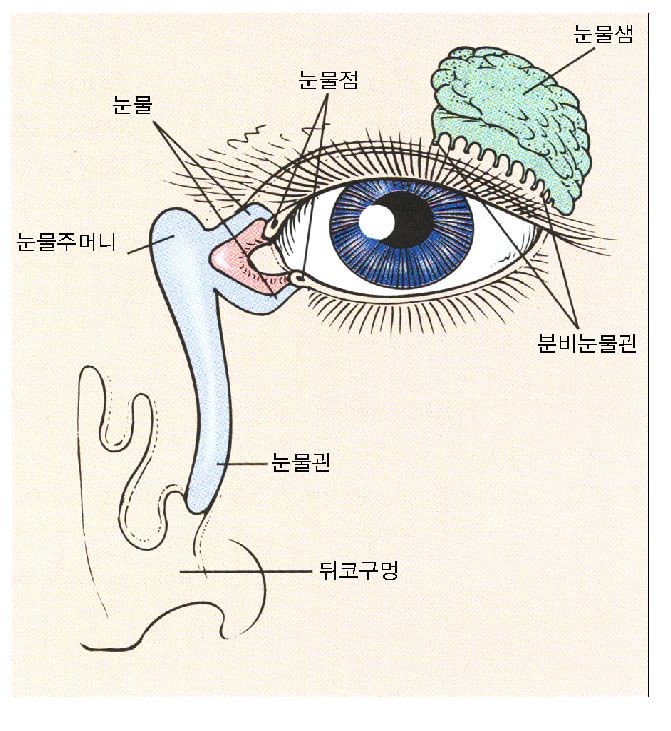 |
||
| 영문 | pancreatic duct | 한글 | 이자관, 췌장관 |
|---|---|---|---|
| 설명 | 이자에서 이자액을 분비하도록 샘창자로 이어진 관. 이자관은 샘창자의 중간부에서 온쓸개관과 같이 개구한다. |
||
| 영문 | nasolacrimal duct | 한글 | 코눈물관 |
|---|---|---|---|
| 설명 | 눈물은 대개 눈물샘에서 만들어져 눈을 적신 뒤에 누관을 거쳐서 눈물주머니에 모인 뒤에 이 코눈물관으로 흘러 코 안쪽으로 내려가게 된다. 만일 여기가 막히면, 눈물이 계속 고이게 되어 계속 눈물을 흘리게 되며, 또한 병균의 서식처가 되어 감염의 위험성이 높아진다. |
||
| EHBD | extrahepatic bile duct |
|---|---|
| CD | cadaver donor; canine distemper; canine dose; carbohydrate dehydratase; carbon dioxide; cardiac dise... |
| EHO | extrahepatic obstruction |
| CAO | chronic airway obstruction; coronary artery obstruction |
| SAO | small airway obstruction; splanchnic artery occlusion; subvalvular aortic obstruction |
| EHBD | Extrahepatic bile duct |
|---|---|
| EHPVO | Extrahepatic portal vein obstruction |
| BDL | Bile Duct Ligated |
| BD | Bile duct |
| BDL | Bile duct ligation |
| bile duct obstruction, extrahepatic | Impairment of bile flow through the hepatic, cystic, or common bile ducts or vater's ampulla. This is sometimes called surgical jaundice. (12 Dec 1998) |
|---|
| bile ducts, extrahepatic | Passages external to the liver for the conveyance of bile. These include the common bile duct and the common hepatic duct (hepatic duct, common). (12 Dec 1998) |
|---|---|
| lacrimal duct obstruction | Interference with the secretion of tears by the lacrimal glands. Obstruction of the lacrimal sac or nasolacrimal duct causing acute or chronic inflammation of the lacrimal sac (dacryocystitis). It is caused also in infants by failure of the nasolacrimal duct to open into the inferior meatus and occurs about the third week of life. In adults occlusion may occur spontaneously or after injury or nasal disease. (12 Dec 1998) |
| extrahepatic | Outside of, or unrelated to, the liver. (05 Mar 2000) |
| adenoma, bile duct | A benign tumour of the intrahepatic bile ducts. (12 Dec 1998) |
| bile duct | <anatomy> A duct that carries bile from the liver and gallbladder to the duodenum (first part of the small intestine). (27 Sep 1997) |
| bile duct pressure | <radiology> Normal: 15-20 cm H2O (12 Dec 1998) |
| bile duct stricture | <surgery> An abnormal narrowing of the common bile duct. A potential cause for biliary obstruction. Risk factors are prior surgery, pancreatitis, trauma and gallstones. Symptoms include jaundice, fever, chills and abdominal pain. Endoscopic surgery has been successful in removing strictures of the bile duct. (27 Sep 1997) |
| common bile duct | <anatomy> A duct that carries bile from the liver and gallbladder to the duodenum (first part of the small intestine). (27 Sep 1997) |
| common bile duct calculi | The presence of gallstones in the common bile duct. It is usually the result of passage of gallstones formed in the gallbladder into the common duct. Less commonly, stones form in a duct behind an obstruction caused by a stricture or ampullary stenosis. Stone type helps to determine site of origin: cholesterol or black pigment stones more likely form in the gallbladder, while almost all brown pigment stones in patients from western countries form in the bile ducts. (12 Dec 1998) |
| common bile duct diseases | Diseases of the common bile duct, vater's ampulla, or oddi's sphincter. (12 Dec 1998) |
| common bile duct neoplasms | Neoplasms of the common bile duct including vater's ampulla and oddi's sphincter. (12 Dec 1998) |
| sphincter muscle of common bile duct | Smooth muscle sphincter of the common bile duct immediately proximal to the hepatopancreatic ampulla; it is this sphincter that controls the flow of bile in the duodenum. Synonym: musculus sphincter ductus choledochi, Boyden's sphincter, choledochal sphincter, sphincter muscle of common bile duct. (05 Mar 2000) |
| sphincter of common bile duct | Smooth muscle sphincter of the common bile duct immediately proximal to the hepatopancreatic ampulla; it is this sphincter that controls the flow of bile in the duodenum. Synonym: musculus sphincter ductus choledochi, Boyden's sphincter, choledochal sphincter, sphincter muscle of common bile duct. (05 Mar 2000) |
| adynamic ileus simulating bowel obstruction | <radiology> Chronic idiopathic intestinal pseudo-obstrction, pelvic surgery, urinary retention, pancreatitis, acute intermittent porphyria, ceroidosis, neonatal adynamic ileus (12 Dec 1998) |
| airway obstruction | Any hindrance to the passage of air into and out of the lungs. (12 Dec 1998) |
제품명 |
판매사 |
보험코드 | 성분/함량 | 구분/보험급여 |
|---|
제품명 |
판매사 |
보험코드 | 성분/함량 | 구분/보험급여 |
|---|