
| 영문 | Bile | 한글 | 쓸개즙, 담즙 |
|---|---|---|---|
| 설명 | 간에서 만들어지는 갈색이나 또는 초록색을 띠는 액체. 간에서 만들어져 병, 쓸개주머니관(cystic duct)를 거쳐서 쓸개에 보관되었다가 온쓸개관을 통해서 샘창자로 보내진다. -담즙의 성분-담즙에는 콜레스테롤이 몇가지 대사의 단계를 거친 담즙산(bile acid), 인지질, 빌리루빈(bilirubin)등이 있다. 여기서 빌리루빈이란 적혈구의 색소인 혈색소(hemoglobin)의 분해산물로 원래는 물에 녹지 않는 물질이지만 간에서 변화를 거쳐 물에 녹는 성질을 가지게 된다. -담즙의 기능-우선 지방의 소화에 관여한다. 대부분의 지방을 흡수하는 작은창자의 표면에는 아주 얇은 수막이 형성되어 있다. 물에 녹을 수가 있는 단백질이나 탄수화물 등의 영양소는 이곳을 잘 통과할 수 있지만 물에 녹지 않는 지방은 이곳을 통과할 수가 없다. 담즙은 이런 지방을 물에 녹을 수가 있는 작은 덩어리(micell)로 만들어 소장으로 하여금 흡수할 수 있게 만들어준다. 그리고 담즙은 인체에서 유일한 콜레스테롤(cholesterol)의 분비 통로라는 데에 의의를 가진다. |
||
| 영문 | hepatic duct | 한글 | 간관 |
|---|---|---|---|
| 설명 | 간에서 생성된 담즙이 지나는 통로로 간에서 직접 담즙을 운반하는 관을 말한다. 간에서 만들어진 담즙은 간관, 쓸개주머니관를 거쳐서 쓸개에 보관되었다가 온쓸개관을 통해서 샘창자로 보내진다.  |
||
| 영문 | lacrimal duct | 한글 | 눈물관 |
|---|---|---|---|
| 설명 | 눈물이 흘러내리는 통로에 해당한다. 눈물은 대개 눈물샘에서 만들어져 눈을 적신 뒤에, 여기를 거쳐서 눈물주머니에 모인 뒤, 코눈물관으로 흘러 코 안쪽으로 내려가게 된다. 만약 여기가 막히면, 눈물이 계속 고이게 되어 계속 눈물을 흘리게 되며, 또한 병균의 서식처가 되어 감염의 위험성이 높아진다. 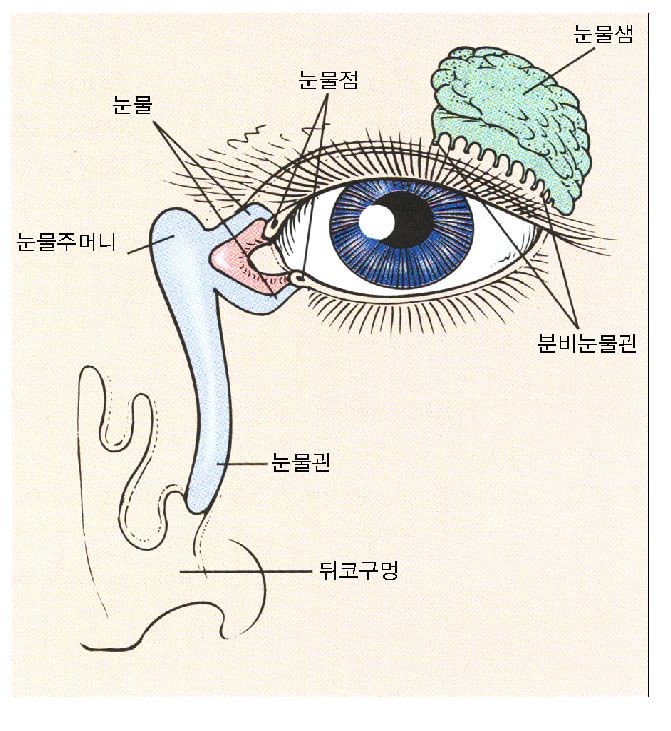 |
||
| 영문 | pancreatic duct | 한글 | 이자관, 췌장관 |
|---|---|---|---|
| 설명 | 이자에서 이자액을 분비하도록 샘창자로 이어진 관. 이자관은 샘창자의 중간부에서 온쓸개관과 같이 개구한다. |
||
| 영문 | nasolacrimal duct | 한글 | 코눈물관 |
|---|---|---|---|
| 설명 | 눈물은 대개 눈물샘에서 만들어져 눈을 적신 뒤에 누관을 거쳐서 눈물주머니에 모인 뒤에 이 코눈물관으로 흘러 코 안쪽으로 내려가게 된다. 만일 여기가 막히면, 눈물이 계속 고이게 되어 계속 눈물을 흘리게 되며, 또한 병균의 서식처가 되어 감염의 위험성이 높아진다. |
||
| CD | cadaver donor; canine distemper; canine dose; carbohydrate dehydratase; carbon dioxide; cardiac dise... |
|---|---|
| CBD | Common Bile Duct - Absolute Ix of CBD Exploration 1. Palp... |
| BD | barbital-dependent; barbiturate dependence; base deficit; base of prism down; basophilic degeneratio... |
| BDE | bile duct examination |
| BDL | behaviors of daily living; below detectable limits; bile duct ligation |
| BDL | Bile Duct Ligated |
|---|---|
| BD | Bile duct |
| BDL | Bile duct ligation |
| CBD | Common Bile Duct |
| CBDL | Common bile duct ligation |
| bile duct | <anatomy> A duct that carries bile from the liver and gallbladder to the duodenum (first part of the small intestine). (27 Sep 1997) |
|---|---|
| bile duct obstruction, extrahepatic | Impairment of bile flow through the hepatic, cystic, or common bile ducts or vater's ampulla. This is sometimes called surgical jaundice. (12 Dec 1998) |
| bile duct pressure | <radiology> Normal: 15-20 cm H2O (12 Dec 1998) |
| bile duct stricture | <surgery> An abnormal narrowing of the common bile duct. A potential cause for biliary obstruction. Risk factors are prior surgery, pancreatitis, trauma and gallstones. Symptoms include jaundice, fever, chills and abdominal pain. Endoscopic surgery has been successful in removing strictures of the bile duct. (27 Sep 1997) |
| bile ducts, extrahepatic | Passages external to the liver for the conveyance of bile. These include the common bile duct and the common hepatic duct (hepatic duct, common). (12 Dec 1998) |
| bile ducts, intrahepatic | Passages within the liver for the conveyance of bile. Includes right and left hepatic ducts even though these may join outside the liver to form the common hepatic duct. (12 Dec 1998) |
| adenoma, bile duct | A benign tumour of the intrahepatic bile ducts. (12 Dec 1998) |
|---|---|
| common bile duct | <anatomy> A duct that carries bile from the liver and gallbladder to the duodenum (first part of the small intestine). (27 Sep 1997) |
| common bile duct calculi | The presence of gallstones in the common bile duct. It is usually the result of passage of gallstones formed in the gallbladder into the common duct. Less commonly, stones form in a duct behind an obstruction caused by a stricture or ampullary stenosis. Stone type helps to determine site of origin: cholesterol or black pigment stones more likely form in the gallbladder, while almost all brown pigment stones in patients from western countries form in the bile ducts. (12 Dec 1998) |
| common bile duct diseases | Diseases of the common bile duct, vater's ampulla, or oddi's sphincter. (12 Dec 1998) |
| common bile duct neoplasms | Neoplasms of the common bile duct including vater's ampulla and oddi's sphincter. (12 Dec 1998) |
| sphincter muscle of common bile duct | Smooth muscle sphincter of the common bile duct immediately proximal to the hepatopancreatic ampulla; it is this sphincter that controls the flow of bile in the duodenum. Synonym: musculus sphincter ductus choledochi, Boyden's sphincter, choledochal sphincter, sphincter muscle of common bile duct. (05 Mar 2000) |
| sphincter of common bile duct | Smooth muscle sphincter of the common bile duct immediately proximal to the hepatopancreatic ampulla; it is this sphincter that controls the flow of bile in the duodenum. Synonym: musculus sphincter ductus choledochi, Boyden's sphincter, choledochal sphincter, sphincter muscle of common bile duct. (05 Mar 2000) |
| aberrant bile ducts | Small duct's occasionally present in the ligaments of the liver or originating from the surface of the liver. (05 Mar 2000) |
| bile | <gastroenterology> A greenish-yellow fluid secreted by the liver and stored in the gallbladder. Bile plays an important role in the intestinal absorption of fats. Bile is secreted by the liver and contains cholesterol, bile salts and waste products such as bilirubin. Bile salts aid in the digestion of fats. Bile passes out of the liver via the bile duct where it is stored in the gallbladder and released in response to a fat-containing meal. (27 Sep 1997) |
| bile acid 3alpha-sulfate sulfohydrolase | <enzyme> Used for determination of serum 3alpha-sulfated bile acids; converts 3alpha-sulfated bile acids into 3beta-hydroxy bile acids Registry number: EC 3.1.6.- Synonym: 3alpha-sulfated bile acid sulfohydrolase, ba-3s sulfohydrolase (26 Jun 1999) |
| bile acid 7alpha-dehydratase | <enzyme> Enzyme in the bacterial bile acid 7alpha-dehydroxylation pathway Registry number: EC 4.2.1.- Synonym: c24 bile acid 7alpha-dehydratase, ba7alphad, baie gene product (26 Jun 1999) |
| bile acid 7 alpha-dehydroxylase | <enzyme> Mechanism is questionable: cholic acid - deoxycholic acid - chenodeoxycholic acid - lithocholic acid Registry number: EC 1.14.- Synonym: 7 alpha-dehydroxylase, bile acid 7-dehydroxylase, bile acid 7-alpha-dehydroxylase, bai a1, bai a2, bai a3, cholic acid 7alpha-dehydroxylase (26 Jun 1999) |
| bile acid-CoA ligase | <enzyme> Catalyses the synthesis of all bile acid-coas; in order to measure the activity of all bile acids, the bile acid is coupled with c(14)-glycine and measured with bile acid-CoA glycine-taurine n-acetyltransferase Registry number: EC 6.2.1.- (26 Jun 1999) |
| bile acids | Steroid acids found in bile; e.g., taurocholic and glycocholic acid's, used when biliary secretion is inadequate and for biliary colic. Their physiological roles include fat emulsification. Their synthesis is reduced in disorders of the peroxisomes. (05 Mar 2000) |
| bile acids and salts | <chemical> Steroid acids and salts. The primary bile acids are derived from cholesterol in the liver and usually conjugated with glycine or taurine. The secondary bile acids are further modified by bacteria in the intestine. They play an important role in the digestion and absorption of fat. They have also been used pharmacologically, especially in the treatment of gallstones. Pharmacological action: cholagogues and choleretics, gastrointestinal agents. (12 Dec 1998) |
Synonyms : Bile Duct Disease, Disease, Bile Duct, Diseases, Bile Duct, Duct Disease, Bile, Duct Diseases, Bile
Synonyms : Cancer of the Bile Duct, Neoplasms, Bile Duct, Bile Duct Cancers, Bile Duct Neoplasm, Cancer, Bile Duct, Cancers, Bile Duct, Neoplasm, Bile Duct
Synonyms : Bile Duct, Duct, Bile, Ducts, Bile
Synonyms : Bile Duct, Extrahepatic, Biliary System, Extrahepatic, Biliary Systems, Extrahepatic, Duct, Extrahepatic Bile, Ducts, Extrahepatic Bile, Extrahepatic Bile Duct, Extrahepatic Bile Ducts, Extrahepatic Biliary Systems, System, Extrahepatic Biliary
Synonyms : Bile Duct, Intrahepatic, Duct, Intrahepatic Bile, Ducts, Intrahepatic Bile, Intrahepatic Bile Duct, Intrahepatic Bile Ducts
| bile duct cystadenoma |
a large multiloculated cystic tumor of the liver, usually in the right lobe and filled with clear or cloudy fluid.
출처: www.mercksource.com/pp/us/cns/cns_hl_dorlands.jspz...
|
|---|---|
| bile ducts |
The tubular structures that range from microscopic size located between cells of the liver to larger structures outside of the liver. The gallbladder is attached to the bile ducts.
출처: www.gastromd.com/definitionsb.html
|
| bile ducts |
According to Flint, the most common point at which union actually occurs is within 1 cm of the upper border of the duodenum (H). In 28 cases there were no supraduodenal common bile ducts at all (T), the union taking place at a point anywhere from behind the upper border of the duodenum to the part embedded in the pancreas, and in 3 cases the only representative of the common duct was the part that lies in the wall of the duodenum (U).
출처: www.vh.org/adult/provider/anatomy/AnatomicVariants...
|
| bile ducts |
tubes that carry bile from the liver to the gallbladder for storage, and to the small intestine for use in digestion.
출처: www.luhs.org/health/topics/glossary/b.htm
|
| bile ducts |
the tubes through which bile flows
출처: www.surgery.usc.edu/divisions/hep/patientguide/glo...
|
| bile duct | a duct formed by the hepatic and cystic ducts |
|---|
제품명 |
판매사 |
보험코드 | 성분/함량 | 구분/보험급여 |
|---|
제품명 |
판매사 |
보험코드 | 성분/함량 | 구분/보험급여 |
|---|