
| 영문 | open heart surgery | 한글 | 개심술, 심장절개술 |
|---|---|---|---|
| 설명 | 심장의 한 개 또는 그 이상의 방실 절개하는 수술. 심방사이막결손증, 심실사이막결손증, 순수형 허파동맥판막협착증, 팔로(Fallot) 사징후 등이 적용이 된다. 이 수술을 위해서는 인공심폐장치가 필요하다. |
||
| 영문 | hypertensive heart disease | 한글 | 고혈압심장병 |
|---|---|---|---|
| 설명 | 고혈압에 의해서 생기는 심장병. 고혈압심장병이라는 진단을 붙이기 위해서는 최소한 다음과 같은 조건이 부합되어야 하는데, 첫째 심장혈관계에 심장병을 유발할 수 있을 만한 다른 병변이 없이 좌심실 비대가 있어야 하며, 둘째 고혈압을 앓았다는 병력이 있어야 한다. 주로 고혈압에 의한 심장병은 초기에는 좌심실이 비후라는 것으로 특징되어진다. 즉 혈압이 높으므로 혈액을 순환시키기 위해서는 그만큼 심장의 혈액을 보내는 힘이 좋아야 한다. 그 힘을 얻기위해서는 심근의 비후가 필요로 하여 좌심실 근육의 비후가 생긴다. 그리고 고혈압이 지속이 될 경우에는 결국 심장이 제 구실을 하지 못하고 펌프로서의 기능을 잃어버리게 되어 심장기능상실에 빠지게 된다. |
||
| 영문 | rheumatic heart disease | 한글 | 류마티스심장병 |
|---|---|---|---|
| 설명 | 사슬알균감염 후 생기는 심장판막병이다. 원인은 A군 -용혈사슬알에 의한 인두염후 일종의 면역반응으로 발병한다. 진단은 존의 기준에 의한다. (1) 주요기준은 관절염 심장염(심장비대, 심장잡음, 심장기능상실 등) 무도증: 무당이 춤을 추는 것 같은 행동의 발작증세. 연변홍반: 빨간 테두리를 가진 피부병변은 피하결절(subcutaneous nodule): 피부 밑에 생긴 결절, (2)참고 기준은 열, 관절통, EKG상 PR연장: 심전도 소견 급성기 반응물질(예: ESR, CRP)의 상승, 류마티스열 치료는 페니실린으로 치료하고 심장의 후유증 또한 페니실린으로 예방한다. |
||
| 영문 | congenital heart disease | 한글 | 선천심장병 |
|---|---|---|---|
| 설명 | 선천적으로 심장의 구조에 이상이 있는 병. |
||
| 영문 | heart | 한글 | 심장 |
|---|---|---|---|
| 설명 | 심장은 가슴의 중앙에 위치하며 오른쪽과 왼쪽반으로 나눌 수 있다. 각각은 정맥에서 피가 들어오는 방과 동맥으로 피를 내보내는 실이 있다. 심장은 정중앙선에서 왼쪽에 놓여 있다. 심장의 2개의 심방과 2개의 심실, 그리고 심방사이의 심방중격, 심실사이의 심실중격이 존재한다. 심실은 혈액을 주로 순환시키는 힘을 내는 곳으로 강한 근육층이 존재를 한다. 반면에 심방은 심실에 들어가기전에 일시적으로 피가 모이는 곳으로 근육층의 발달이 미약하다. 심방과 심실사이에 삼첨판과 승모판, 심실의 유출로에 대동맥판과 폐동맥판이 있다. 이것들은 혈액이 흐르는 방향에 거슬러 진행하는 것을 막는 기능을 한다. 그리고 심장에는 심장의 근육에 혈액을 공급하는 관상동맥이 있다. 이 심장동맥은 심장을 쌓듯이 존재한다. 심장박동의 신호는 특수한 장치에 의해서 발생이 되고 특수한 전도계를 통해서 전체의 심장으로 전도된다. 심장박동의 신호는 우선 우심방에 위치하는 동방결절(SA node)라는 곳에서 우선 생긴다. 여기에서 보내는 전기적 신호가 바로 심장을 뛰게하는 신호인 것이다. 이 신호로 말미암아 심방이 우선 수축을 한다. 그리고는 심방과 심실사이에 위치하는 방실결절(AV node)라는 곳에 일정하게 정해진 통로없이 전체의 심방을 통해서 전달이 되고 이 신호를 받은 방실결절(AV node)는 히스 다발(His bundle)과 심장전도근육섬유를 통해서 심실의 심장근육에게 이 신호를 보내주어 심실근육을 수축하게 한다. 히스다발과 심장전도근육섬유는 전체의 심실의 심근섬유에 동시에 전기적 신호를 보내어 줄 수 있게 하는 일종의 전기줄과 같은 역할을 한다. 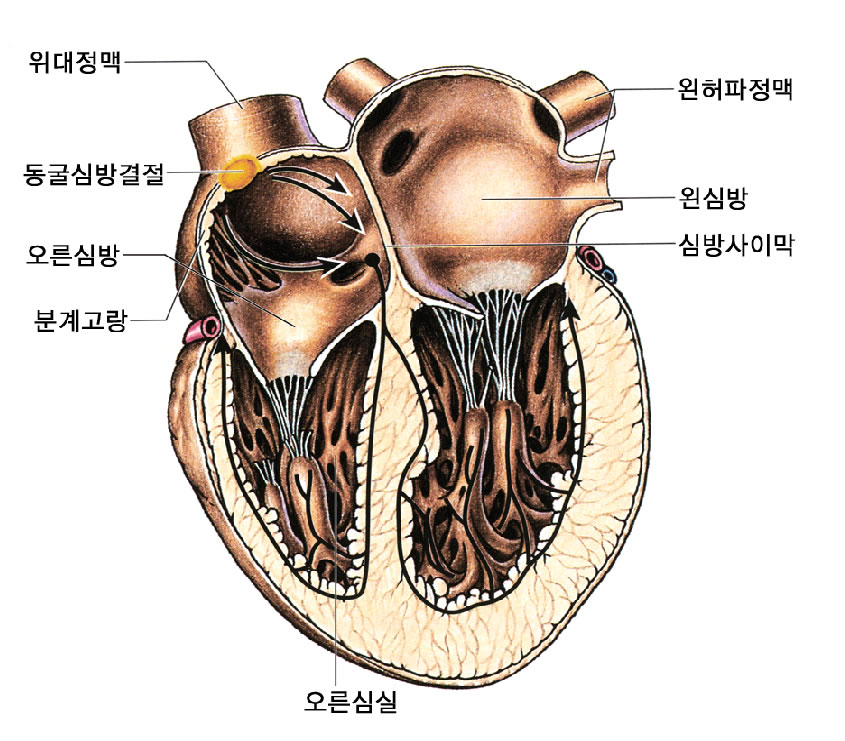 |
||
| JVP | [POMD P 49 - 52] 1) Jugular Vein Pressure 2) Jugular Venous Pulse ... |
|---|---|
| BD | barbital-dependent; barbiturate dependence; base deficit; base of prism down; basophilic degeneratio... |
| IHD | Ischemic Heart Disease = Coronary Heart(Artery) Disease = Atheroscler... |
| AHD | acquired hepatocerebral degeneration; acute heart disease; antihyaluronidase; antihypertensive drug;... |
| CHD | Chediak-Higashi disease; childhood disease; chronic hemodialysis; congenital or congestive heart dis... |
| kb | 4.0-kilo base |
|---|---|
| bp | 1,000-base-pair |
| ABB | Acid base balance |
| BE | Base Excess |
| BER | Base Excision Repair |
stabilized occlusion
| base of heart | That part of the heart that lies opposite the apex, formed mainly by the left atrium but to a small extent by the posterior part of the right atrium; it is directed backward and to the right and is separated from the vertebral column by the oesophagus and aorta. Synonym: basis cordis. (05 Mar 2000) |
|---|
| acid-base balance | The normal balance between acid and base in the blood plasma, expressed in the hydrogen ion concentration or pH, resulting from the relative amounts of acidic and basic materials ingested and produced by body metabolism, compared to the relative amounts of acidic and basic materials excreted from the body and consumed by body metabolism; the normal state of acid-base balance is not one of neutrality, with equal concentrations of hydrogen and hydroxyl ions, but a more alkaline state with a certain excess of hydroxyl ions. Synonym: acid-base equilibrium. (05 Mar 2000) |
|---|---|
| acid-base equilibrium | A condition in which the net rate of acid or alkali production by the body is balanced by the net rate of acid or alkali excretion from the body, resulting in a stable concentration of hydrogen ions in the body fluids. (12 Dec 1998) |
| acid-base imbalance | Disturbances in the acid-base equilibrium of the body. (12 Dec 1998) |
| acrylic resin base | A form made of acrylic resin molded to conform to the tissues of the alveolar process and used to support the teeth of a prosthesis. (05 Mar 2000) |
| aldehyde base | An obsolete term for an imide. (05 Mar 2000) |
| anterior cranial base | The portion of the internal base of the skull, anterior to the sphenoidal ridges and limbus, in which the frontal lobes of the brain rest. Synonym: fossa cranii anterior, anterior cranial base. (05 Mar 2000) |
| Bandrowski's base | <chemical> Reported cause of anaphylactic reaction. Synonym: n',n'-bis(4-aminophenyl)-2,5-diamino-1,4-quinonediimine (26 Jun 1999) |
| base | <chemistry> The nonacid part of a salt, a substance that combines with acids to form salts, a substance that dissociates to give hydroxide ions in aqueous solutions, a substance whose molecule or ion can combine with a proton (hydrogen ion), a substance capable of donating a pair of electrons (to an acid) for the formation of a coordinate covalent bond. (13 Nov 1997) |
| base analogue | <biochemistry> A chemical which resembles a nucleotide base. They can substitute the Purine and pyrimidine bases that normally appear in DNA, despite minor differences in structure. May be used for inducing mutations, including point mutations. For example: 5 bromouracil can replace thymine or 2 aminopurine replace adenine. (13 Nov 1997) |
| base composition | <biochemistry> In reference to nucleic acid, the proportion of the total bases consisting of guanine plus cytosine or thymine plus adenine base pairs. Usually expressed as a guanine + cytosine (G+C) value, for example 60% G+C. (09 Oct 1997) |
| base deficit | A decrease in the total concentration of blood buffer base, indicative of metabolic acidosis or compensated respiratory alkalosis. (05 Mar 2000) |
| base dissociation constant | <chemistry> This is the equilibrium constant for the reaction in which a weak base breaks apart in water to form its conjugate acid and hydroxide ion. (09 Oct 1997) |
| base excess | A measure of metabolic alkalosis, usually predicted from the Siggaard-Andersen nomogram; the amount of strong acid that would have to be added per unit volume of whole blood to titrate it to pH 7.4 while at 37캜 and at a carbon dioxide pressure of 40 mm Hg. (05 Mar 2000) |
| base hospital | A hospital unit located in a military or recreational encampment; usually of small size and limited facilities, for immediate care of illnesses and injuries. Synonym: camp hospital. (05 Mar 2000) |
| base in DNA | A unit of the DNA. There are 4 bases: adenine (A), guanine (G), thymine (T), and cytosine (C). The sequence of bases (for example, CAG) is the genetic code. (12 Dec 1998) |
제품명 |
판매사 |
보험코드 | 성분/함량 | 구분/보험급여 |
|---|
제품명 |
판매사 |
보험코드 | 성분/함량 | 구분/보험급여 |
|---|