
| 영문 | axon | 한글 | 축삭 |
|---|---|---|---|
| 설명 | 뉴런(신경원-신경세포)의 한부분으로 신경의 전기적 신호를 다른 신경이나 기관에 전해주는 긴 구조를 이르는 말. 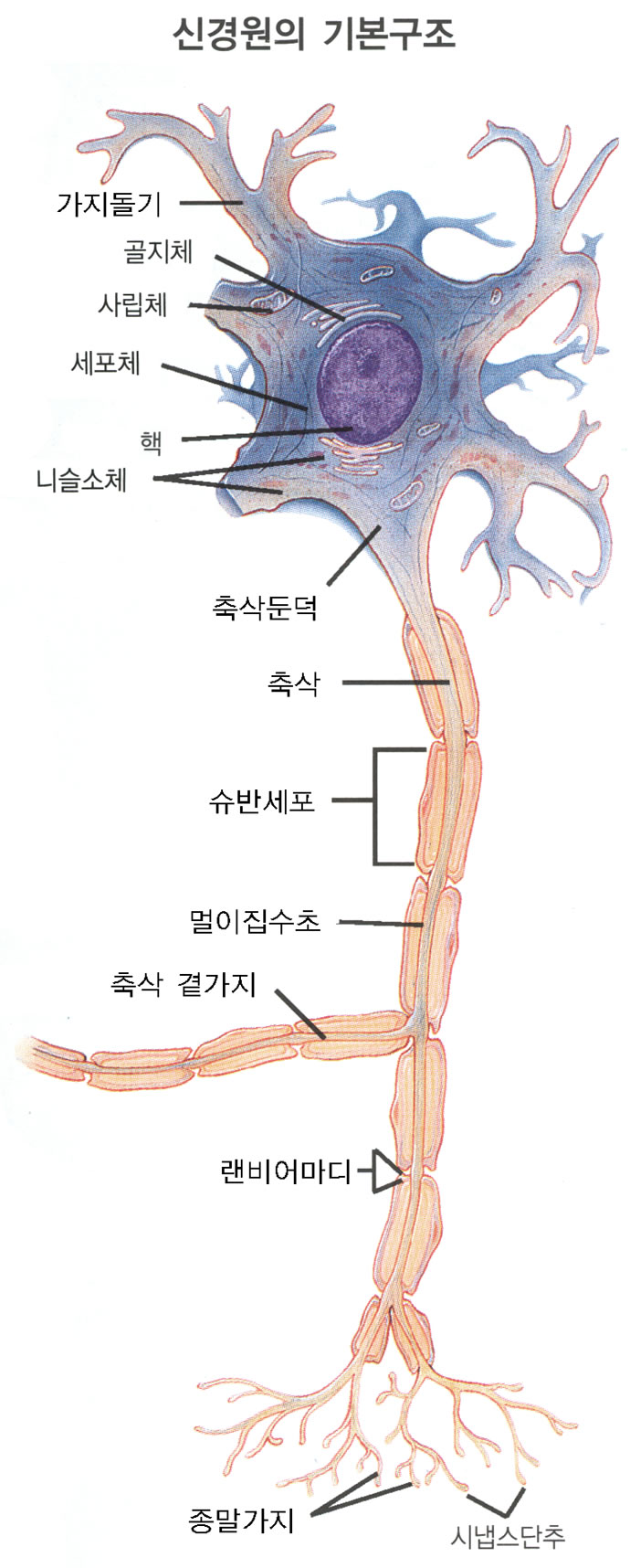 |
||
| TB | Taussig-Bind [syndrome]; terabyte; term birth; terminal bronchiole; terminal bronchus; thromboxane B... |
|---|---|
| ter | rub [Lat. tere]; terminal [end of chromosome]; terminal or end; ternary; tertiary; three times; thre... |
| TML | terminal midline; terminal motor latency; tetramethyl lead |
| GnRH | Gonadotropin Releasing Hormone [HP 1898, 2034] = LHRH = Go... |
| GAN | giant axon neuropathy |
| Q-SART | Quantitative Sudomotor Axon Reflex Test |
|---|---|
| MGA | medial giant axon |
| C-terminal | carboxy terminal |
| LTR | 1-long terminal repeat |
| JNK | 4/Jun NH2 terminal kinase |
| axon terminals | The somewhat enlarged, often club-shaped endings by which axons make synaptic contacts with other nerve cells or with effector cells (muscle or gland cells). As isolated, by homogenizing brain or spinal cord, they contain acetylcholine and the related enzymes. Terminals contain neurotransmitters of various kinds, sometimes more than one. These can be demonstrated by chemical analysis and immunocytochemical methods. See: synapse. Synonym: axonal terminal boutons, end-feet, neuropodia, pieds terminaux, synaptic boutons, synaptic endings, synaptic terminals, terminal boutons, bouton terminaux. (05 Mar 2000) |
|---|
| axon | <cell biology> A long process of a neuron, that carries efferent (outgoing) action potentials from the cell body towards target cells. Each nerve cell has one axon, which can be over a foot long. A nerve cell communicates with another nerve cell by transmitting signals from the branches at the end of its axon. At the terminal end of the axon, the impulses are transmitted to other nerve cells or to effector organs. In the peripheral nervous system, the larger (myelinated) axons are surrounded by a myelin sheath formed by concentric layers of plasma membrane of the schwann cell. In the central nervous system, the function of the schwann cell is supplied by oligodendrocytes (oligodendroglia). See: dendrite. (03 Jul 1999) |
|---|---|
| axon degeneration | A type of peripheral nerve fibre response to insult, wherein axon death and subsequent breakdown occurs, with secondary breakdown of the myelin sheath associated; caused by focal injury to peripheral nerve fibres; often referred to as wallerian degeneration. Synonym: axon degeneration. (05 Mar 2000) |
| axon hillock | <cell biology> Tapering region between a neuron's cell body and its axon. This region is responsible for summating the graded inputs from the dendrites and producing action potentials if the threshold is exceeded. (12 Mar 1998) |
| axon loss polyneuropathy | A type of polyneuropathy in which axon degeneration is the sole/predominant feature; many aetiologies, particularly toxic and metabolic; on nerve conduction studies, affects amplitudes of the responses, but does not cause conduction slowing or block. Synonym: axonal polyneuropathy. (05 Mar 2000) |
| axon reflex | An effect brought about by the passage of the nerve impulses from a sensory ending to the effector organ along divisions of the nerve fibre without traversing a synapse, e.g., as in the vasodilation resulting from stimulation of the skin or the irritation of the conjunctiva; the reaction occurs even when the nerve fibre has been sectioned and thus isolated from the nervous centres. (05 Mar 2000) |
| giant axon | <biology> Extraordinarily large unmyelinated axons found in invertebrates. Some, like the squid giant axon, can approach 1 mm diameter. Large axons have high conduction speeds, the giant axons are invariably involved in panic or escape responses and may (e.g. Crayfish) have electrical synapses to further increase speed. Vertebrate axons with high conduction velocites are much narrower: they are myelinated, allowing saltatory conduction. (17 Dec 1997) |
| cervix of the axon | The constricted portion of the axon just before the myelin sheath begins. (05 Mar 2000) |
| squid giant axon | <physiology> Large axons, up to 1mm in diameter, that innervate the mantle of the squid. Because of their large size, many of the pioneering investigations of the mechanisms underlying resting and action potentials in excitable cells were done on these fibres. (10 Mar 1998) |
| absolute terminal innervation ratio | The number of motor endplates divided by the number of terminal axons related to them. (05 Mar 2000) |
| amino-terminal | <biochemistry> The end of a protein or polypeptide chain with the unattached amino group or the aminoacyl residue containing it. Each amino acid in the chain has an amino group on one side, which is attached to the carboxyl group (COOH group) of the previous amino acid, and a carboxyl group on the other side (which is attached to the amino group of the next amino acid). The other end of the polypeptide chain is called the carboxyl terminal. Synonym: NH2-terminal. (14 Aug 2000) |
| amino-terminal residue | <biochemistry> The only amino acid residue in a polypeptide chain that has a free alpha-amino group, it defines the amino terminus of the polypeptide. (09 Oct 1997) |
| axonal terminal boutons | The somewhat enlarged, often club-shaped endings by which axons make synaptic contacts with other nerve cells or with effector cells (muscle or gland cells). As isolated, by homogenizing brain or spinal cord, they contain acetylcholine and the related enzymes. Terminals contain neurotransmitters of various kinds, sometimes more than one. These can be demonstrated by chemical analysis and immunocytochemical methods. See: synapse. Synonym: axonal terminal boutons, end-feet, neuropodia, pieds terminaux, synaptic boutons, synaptic endings, synaptic terminals, terminal boutons, bouton terminaux. (05 Mar 2000) |
| carboxyl terminal | The end of a polypeptide chain with the unattached carboxyl group (a -COOH group). Each amino acid in the middle of the chain has an amino group (a -NH2 group) on one side (which is attached to the carboxyl group of the previous amino acid) and a carboxyl group on the other side (which is attached to the amino group of the next amino acid). The other end of the polypeptide chain is called the amino terminal. (09 Oct 1997) |
| carboxyl-terminal residue | This amino acid residue defines the carboxylterminus of the polypeptide, its the only residue with a free alpha-carboxyl group. (09 Oct 1997) |
| carboxy terminal | The end of a peptide or protein having a free carboxyl (-COOH) group. (05 Mar 2000) |
제품명 |
판매사 |
보험코드 | 성분/함량 | 구분/보험급여 |
|---|
제품명 |
판매사 |
보험코드 | 성분/함량 | 구분/보험급여 |
|---|