
| 영문 | axon | 한글 | 축삭 |
|---|---|---|---|
| 설명 | 뉴런(신경원-신경세포)의 한부분으로 신경의 전기적 신호를 다른 신경이나 기관에 전해주는 긴 구조를 이르는 말. 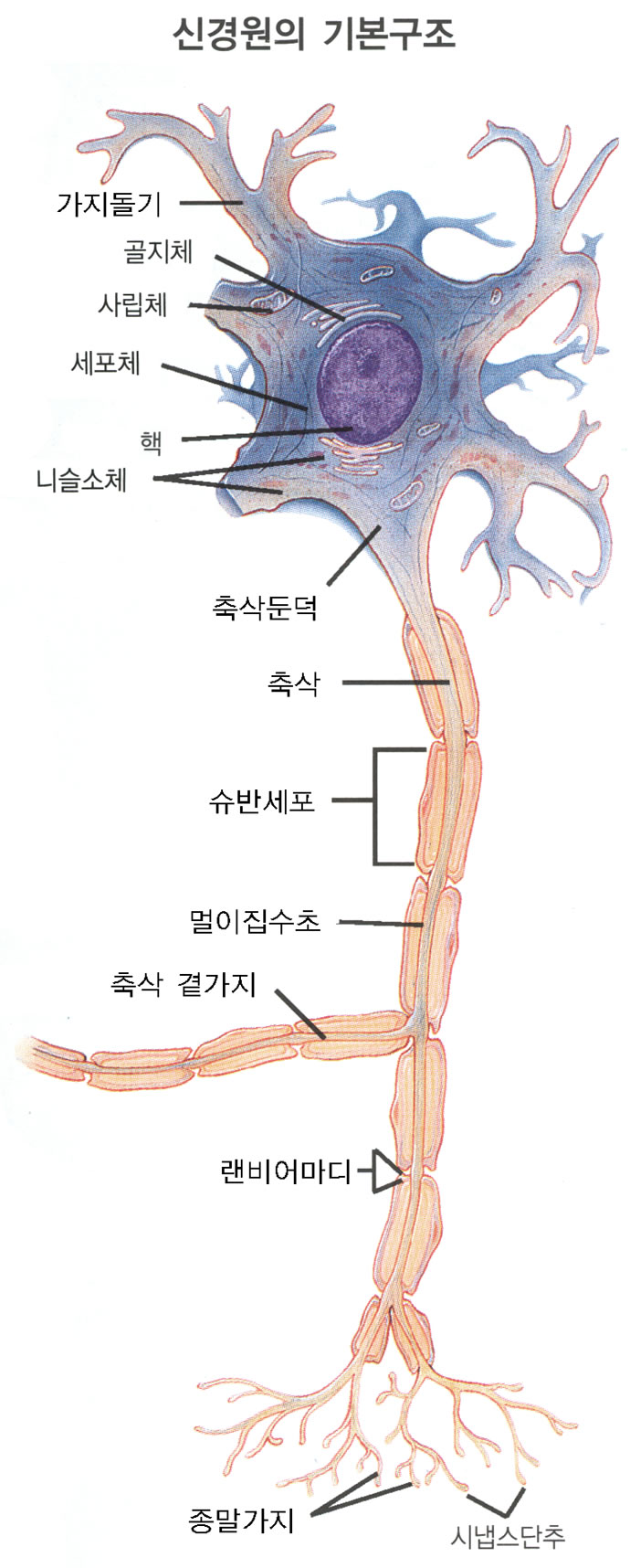 |
||
| 영문 | immunological reaction | 한글 | 면역반응 |
|---|---|---|---|
| 설명 | 생체의 몸 안에서 생긴 물질이나 몸 밖에서 들어온 물질이 생체와 다를 때 자기 체내의 통일성과 개체의 생존 유지 및 종의 존속을 위하여 그 물질들을 제거하는 일련의 생체 반응. 다시 말해 B세포에 의한 항체생산, T세포를 중심으로 하는 세포성 면역, 면역관용, 면역기억 등의 생체 내 반응을 말한다. 큰포식세포는 항원을 처리해서 특이적인 항원결정기를 갖는 분자로 바꿔, 항원과 주요조직 적합유전자복합체를 세포표면에 표현하며, T세포로 전달한다. 한편 B세포는 큰포식세포 내에서 처리된 항원의 결정기를 인식하여 대응하는 특이적항체를 생산하여 항원을 처리한다. |
||
| 영문 | reaction formation | 한글 | 반동형성, 반응형성 |
|---|---|---|---|
| 설명 | 억압보다 더 적극적인 방어메커니즘이며, 무의식적인 생각, 소원, 충동이 너무나도 받아들여질 수 없는 것일 경우에 이와는 정반대 방향의 것을 강조함으로써 그런 무의식적인 것들이 의식되지 않게 하는 과정. 예를 들면 가장 가학적인 성격의 사람이 생체해부 반대론자가 되는 경우를 들 수 있다. 이것은 또 가슴 깊이 잠겨있는 두려움이 의식되는 것을 피하기 위해서 두려움의 대상이 되는 행동에 골몰하는 경우도 포함이 된다. 예를 들면, 남자에게 상처받지 않을까 하는 두려움에 가득 찬 소녀가 이 같은 두려움을 부정하려는 수단으로 난잡한 성행위에 골몰하는 경우가 있다. 또 전처의 자녀를 미워하는 계모가 오히려 지나칠 정도로 그 아이를 귀여워하는 일 따위이다. |
||
| 영문 | complement fixation reaction | 한글 | 보체결합 반응, 도움체결합반응 |
|---|---|---|---|
| 설명 | 항체와의 반응에 있어서 보체와 결합하는 항체를 검사하는 방법으로, 이 반응은 최초에 기지항원, 피검혈청 및 보체를 혼합한다. 제2단계에서는 적혈구와 이것에 대응하는 용혈소의 혼합액을 가한다. 본 반응후 용혈이 일어나지 않으면 본체는 항원항체결합물에 결합한 것이 되어 양성이 되지만, 용혈이 일어난 경우 보체는 결합하지 않아 소비되지 않기 때문에 음성이 된다. 본 반응은 기지혈청을 써서 항원검출에 응용할 수 있으며, 마이코플라스마, 리케챠, 클라미디아, 바이러스, 매독 등의 진단에 쓰인다. |
||
| 영문 | transfusion reaction | 한글 | 수혈부작용, 수혈반응 |
|---|---|---|---|
| 설명 | 수혈하였을 때에 환자에게 일어나는 반응. 알레르기 반응과 용혈 반응이 있다. |
||
| LR | labeled release; laboratory references; laboratory report; labor room; lactated Ringer [solution]; l... |
|---|---|
| GnRH | Gonadotropin Releasing Hormone [HP 1898, 2034] = LHRH = Go... |
| GAN | giant axon neuropathy |
| MA | malignant arrhythmia; management and administration; mandelic acid; masseter; Master of Arts; matern... |
| QSART | quantitative sudomotor axon reflex testing |
| Q-SART | Quantitative Sudomotor Axon Reflex Test |
|---|---|
| MGA | medial giant axon |
| AR | Acrosome reaction |
| ADR | Adverse Drug Reaction |
| AS-PCR | Allele specific polymerase chain reaction |
| axon | <cell biology> A long process of a neuron, that carries efferent (outgoing) action potentials from the cell body towards target cells. Each nerve cell has one axon, which can be over a foot long. A nerve cell communicates with another nerve cell by transmitting signals from the branches at the end of its axon. At the terminal end of the axon, the impulses are transmitted to other nerve cells or to effector organs. In the peripheral nervous system, the larger (myelinated) axons are surrounded by a myelin sheath formed by concentric layers of plasma membrane of the schwann cell. In the central nervous system, the function of the schwann cell is supplied by oligodendrocytes (oligodendroglia). See: dendrite. (03 Jul 1999) |
|---|---|
| axon degeneration | A type of peripheral nerve fibre response to insult, wherein axon death and subsequent breakdown occurs, with secondary breakdown of the myelin sheath associated; caused by focal injury to peripheral nerve fibres; often referred to as wallerian degeneration. Synonym: axon degeneration. (05 Mar 2000) |
| axon hillock | <cell biology> Tapering region between a neuron's cell body and its axon. This region is responsible for summating the graded inputs from the dendrites and producing action potentials if the threshold is exceeded. (12 Mar 1998) |
| axon loss polyneuropathy | A type of polyneuropathy in which axon degeneration is the sole/predominant feature; many aetiologies, particularly toxic and metabolic; on nerve conduction studies, affects amplitudes of the responses, but does not cause conduction slowing or block. Synonym: axonal polyneuropathy. (05 Mar 2000) |
| axon reflex | An effect brought about by the passage of the nerve impulses from a sensory ending to the effector organ along divisions of the nerve fibre without traversing a synapse, e.g., as in the vasodilation resulting from stimulation of the skin or the irritation of the conjunctiva; the reaction occurs even when the nerve fibre has been sectioned and thus isolated from the nervous centres. (05 Mar 2000) |
| axon terminals | The somewhat enlarged, often club-shaped endings by which axons make synaptic contacts with other nerve cells or with effector cells (muscle or gland cells). As isolated, by homogenizing brain or spinal cord, they contain acetylcholine and the related enzymes. Terminals contain neurotransmitters of various kinds, sometimes more than one. These can be demonstrated by chemical analysis and immunocytochemical methods. See: synapse. Synonym: axonal terminal boutons, end-feet, neuropodia, pieds terminaux, synaptic boutons, synaptic endings, synaptic terminals, terminal boutons, bouton terminaux. (05 Mar 2000) |
| giant axon | <biology> Extraordinarily large unmyelinated axons found in invertebrates. Some, like the squid giant axon, can approach 1 mm diameter. Large axons have high conduction speeds, the giant axons are invariably involved in panic or escape responses and may (e.g. Crayfish) have electrical synapses to further increase speed. Vertebrate axons with high conduction velocites are much narrower: they are myelinated, allowing saltatory conduction. (17 Dec 1997) |
| cervix of the axon | The constricted portion of the axon just before the myelin sheath begins. (05 Mar 2000) |
| squid giant axon | <physiology> Large axons, up to 1mm in diameter, that innervate the mantle of the squid. Because of their large size, many of the pioneering investigations of the mechanisms underlying resting and action potentials in excitable cells were done on these fibres. (10 Mar 1998) |
| accelerated reaction | A response occurring in a shorter time than expected; the cutaneous manifestations occurring during the period between the second and tenth day following smallpox vaccination; because it is intermediate between a primary reaction and an immediate reaction, it is regarded as evidence of some degree of resistance. Synonym: vaccinoid reaction. (05 Mar 2000) |
| acid reaction | Any test by which an acid reaction is recognised such as the change of blue litmus paper to red, an excess of hydrogen ions over hydroxide ions in aqueous solution indicated by a pH value less than 7 (at 22캜). Compare: dissociation constant of water. (05 Mar 2000) |
| acute-phase reaction | <immunology, rheumatology> Refers to the changes in synthesis of certain proteins within the serum during an inflammatory response, which provides rapid protection for the host against microorganisms via non-specific defense mechanisms. It consists of fever, an increase in inflammatory humoral factors, and an increased synthesis by hepatocytes of a number of proteins or glycoproteins usually found in the plasma; the reaction is mediated by endogenous pyrogens, the hypothalamus, adrenal hormones, and other factors. (12 Jul 2000) |
| acute situational reaction | An acute emotional reaction related to extreme environmental stress. Synonym: acute situational reaction. (05 Mar 2000) |
| acute stress reaction | A sudden bout of anxiety that is often accompanied by the features of hyperventilation (tingling around mouth and in fingertips, rapid breathing, faintness or fainting). (27 Sep 1997) |
| addition reaction | <chemistry> Any reaction in which two chemicals combine to form a single chemical. (15 Jan 1998) |
제품명 |
판매사 |
보험코드 | 성분/함량 | 구분/보험급여 |
|---|
제품명 |
판매사 |
보험코드 | 성분/함량 | 구분/보험급여 |
|---|