
| 영문 | muscle cell(=muscle fiber) | 한글 | 근육세포 |
|---|---|---|---|
| 설명 | 근육은 수의근(의식에 의해서 조절이 가능한 근육: 예를 들어 다리, 팔, 얼굴근육 등)과 불수의근(의식과 무관하게 조절하지 않아도 움직이는 근육: 예를 들어 심장근, 소화기관에 분포하는 근육 등)으로 나누어지며, 근육세포의 모양은 다음과 같다(수의근, 불수의근 외에 심장에 있는 심장근은 불수의근에 해당하지만 그 모양은 수의근과 같아 따로 분류한다).  |
||
| 영문 | axon | 한글 | 축삭 |
|---|---|---|---|
| 설명 | 뉴런(신경원-신경세포)의 한부분으로 신경의 전기적 신호를 다른 신경이나 기관에 전해주는 긴 구조를 이르는 말. 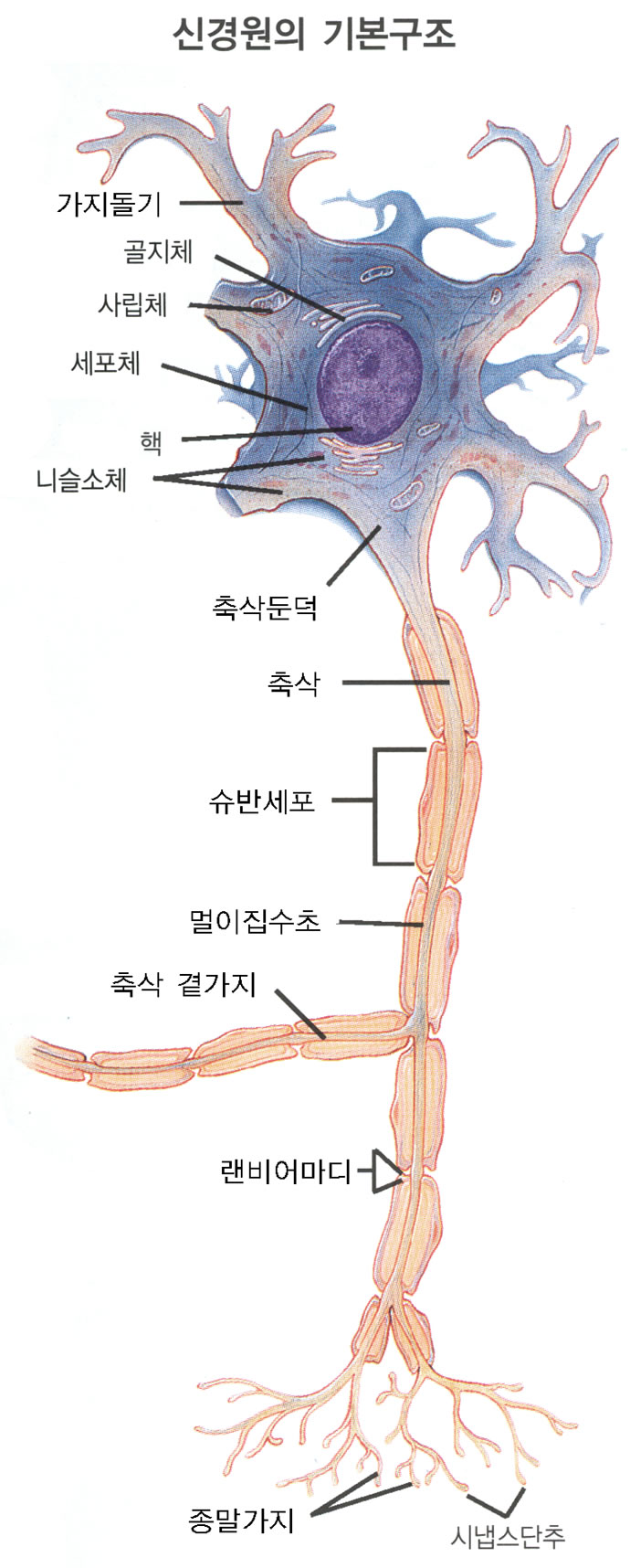 |
||
| 영문 | olfactory sense | 한글 | 후각 |
|---|---|---|---|
| 설명 | 냄새감각. 냄새감각은 비강의 가장 위쪽에서 이루어진다. 콧구멍을 통해 들어온 공기의 일부는 위로 올라가 냄새감각을 일으키게 하고, 일부는 코안을 거쳐, 인두를 넘어가 폐로 이어져 호흡활동을 하게 된다. 코안각을 담당하는 세포는 중추신경계 대부분의 세포가 손상되었을 때 재생이 안되는 것과 별개로 재생이 가능하다. |
||
| 영문 | sensory nerve | 한글 | 감각신경 |
|---|---|---|---|
| 설명 | 감각세포가 받은 자극을 중추신경에 전달하는 신경. 눈이나 피부 등에 있는 감각기가 외부로부터 자극을 받으면 감각신경을 거쳐 척수와 대뇌겉질까지 감각이 전달된다. 이와 같이 외부로부터 내부를 향해 전달되는 감각신경은 구심성 신경계통이며, 원심성 운동신경계통 및 자율신경계통에 필적하는 말초신경의 하나이다. 이 감각신경에는 후각신경(뇌신경Ⅰ)-시각신경(뇌신경Ⅱ)-눈돌림신경(뇌신경Ⅲ)-삼차신경(뇌신경Ⅴ)-얼굴신경(뇌신경Ⅶ)-청각신경(뇌신경Ⅷ)-혀인두신경(뇌신경Ⅸ)-미주신경(뇌신경Ⅹ) 및 척수신경이 있다. 감각신경 중 미주신경을 제외하면 모두 두부에 분포되어 있고, 후각신경-시각신경-청각신경의 세가지는 특히 분화된 감각상피를 지배한다. 혀인두신경은 미각의 말단장치와 그 밖의 부분에 연결되고 미주신경은 흉강과 복강의 기관에 분포되어 구심성 충격을 중추에 전달하며 삼차신경은 척수의 각 마디에 있는 신경에 해당하여(머리의 피부-점막 등의 표면감각과 심부감각을 관장한다. 척수의 감각신경계통에도 피부와 심부, 내장의 분포에 따른 구별이 있다. |
||
| 영문 | cranial nerve | 한글 | 뇌신경 |
|---|---|---|---|
| 설명 | 대부분의 신경은 척수를 통해서 나간다. 그러나 몇몇의 신경은 뇌에서 바로 나간다. 이렇게 뇌에서 바로 나가는 신경을 뇌신경이라고 한다. 이 뇌신경은 12개로 모두 대칭적인 쌍으로 존재한다. 이 뇌신경은 주로 특수감각(시각, 청각, 후각, 미각)과 얼굴 등의 일부 근육을 지배하고 심장이나 내장의 지배도 일부 담당하고 있다. 12개의 신경은 각각 다음과 같은 이름과 고유번호를 가지고 있다. -후각신경(olfactory nerve)-후각을 담당하는 신경, -시각신경(optic nerve)-시각을 담당하는 신경. -눈돌림신경(oculomotor nerve)-운동을 담당하는 신경, -도르래신경(trochlear nerve)-눈의 운동을 담당하는 신경. -삼차신경(trigeminal nerve)-3개의 가지를 가지는 신경으로 얼굴의 감각과 씹기를 위한 근육을 움직이는 역할을 한다. -가돌림신경(abducent nerve)-눈의 운동을 담당하는 신경. -얼굴신경(facial nerve)-얼굴 근육의 운동을 담당하는 신경. 즉 얼굴이 여러 가지 표정을 내는 것은 이 신경의 작용이다. 그리고 혀의 앞부분의 미각을 담당하는 역할도 한다. -안뜰달팽이신경(vestibulocochlear nerve)-안뜰신경과 달팽이신경의 2가지 신경으로 이루어진 신경으로 모두 귀를 지배하는 신경이다. 안뜰신경은 평형감각을 담당하는 곳인 귀의 안뜰에서 나오는 신경으로 평형감각의 정보를 뇌에 전하는 역할을 한다. 그리고 달팽이신경은 청각을 감지하는 달팽이껍질의 모양을 가진 달팽이에서 기원하는 신경으로 청각의 정보를 뇌에 전달하는 역할을 한다. -혀인두신경(glossopharyngeal nerve)-말 그대로 혀와 인두부에 분포하는 신경으로 인후부의 움직임과 혀의 뒷부분의 미각을 담당한다. -미주신경(vagus nerve)-말 그대로 아주 여러 곳에 분포하여 분포영역이 모호한 신경이다(vagus란 모호한 이란 뜻을 가진다). 대부분의 내장에 분포하고 또 심장에 분포하여 심장의 박동수를 조정하는 역할도 한다. -더부신경(accessory nerve)-등의 근육과 목의 근육의 일부를 지배하는 신경. -혀밑신경(hypoglossal nerve)-혀의 움직임을 관장하는 신경. |
||
| NFL | nerve fiber layer; neurofilament protein, light polypeptide |
|---|---|
| NFLD | nerve fiber layer defect |
| GnRH | Gonadotropin Releasing Hormone [HP 1898, 2034] = LHRH = Go... |
| GAN | giant axon neuropathy |
| MA | malignant arrhythmia; management and administration; mandelic acid; masseter; Master of Arts; matern... |
| Q-SART | Quantitative Sudomotor Axon Reflex Test |
|---|---|
| MGA | medial giant axon |
| ON | Olfactory nerve |
| ANF | auditory nerve fiber |
| NFL | Nerve fiber layer |
| olfactory nerve | <anatomy, nerve> The olfactory nerve carries impulses for the sense of smell. Synonym: cranial nerve I. (27 Sep 1997) |
|---|---|
| axon | <cell biology> A long process of a neuron, that carries efferent (outgoing) action potentials from the cell body towards target cells. Each nerve cell has one axon, which can be over a foot long. A nerve cell communicates with another nerve cell by transmitting signals from the branches at the end of its axon. At the terminal end of the axon, the impulses are transmitted to other nerve cells or to effector organs. In the peripheral nervous system, the larger (myelinated) axons are surrounded by a myelin sheath formed by concentric layers of plasma membrane of the schwann cell. In the central nervous system, the function of the schwann cell is supplied by oligodendrocytes (oligodendroglia). See: dendrite. (03 Jul 1999) |
| axon degeneration | A type of peripheral nerve fibre response to insult, wherein axon death and subsequent breakdown occurs, with secondary breakdown of the myelin sheath associated; caused by focal injury to peripheral nerve fibres; often referred to as wallerian degeneration. Synonym: axon degeneration. (05 Mar 2000) |
| axon hillock | <cell biology> Tapering region between a neuron's cell body and its axon. This region is responsible for summating the graded inputs from the dendrites and producing action potentials if the threshold is exceeded. (12 Mar 1998) |
| axon loss polyneuropathy | A type of polyneuropathy in which axon degeneration is the sole/predominant feature; many aetiologies, particularly toxic and metabolic; on nerve conduction studies, affects amplitudes of the responses, but does not cause conduction slowing or block. Synonym: axonal polyneuropathy. (05 Mar 2000) |
| axon reflex | An effect brought about by the passage of the nerve impulses from a sensory ending to the effector organ along divisions of the nerve fibre without traversing a synapse, e.g., as in the vasodilation resulting from stimulation of the skin or the irritation of the conjunctiva; the reaction occurs even when the nerve fibre has been sectioned and thus isolated from the nervous centres. (05 Mar 2000) |
| axon terminals | The somewhat enlarged, often club-shaped endings by which axons make synaptic contacts with other nerve cells or with effector cells (muscle or gland cells). As isolated, by homogenizing brain or spinal cord, they contain acetylcholine and the related enzymes. Terminals contain neurotransmitters of various kinds, sometimes more than one. These can be demonstrated by chemical analysis and immunocytochemical methods. See: synapse. Synonym: axonal terminal boutons, end-feet, neuropodia, pieds terminaux, synaptic boutons, synaptic endings, synaptic terminals, terminal boutons, bouton terminaux. (05 Mar 2000) |
| giant axon | <biology> Extraordinarily large unmyelinated axons found in invertebrates. Some, like the squid giant axon, can approach 1 mm diameter. Large axons have high conduction speeds, the giant axons are invariably involved in panic or escape responses and may (e.g. Crayfish) have electrical synapses to further increase speed. Vertebrate axons with high conduction velocites are much narrower: they are myelinated, allowing saltatory conduction. (17 Dec 1997) |
| cervix of the axon | The constricted portion of the axon just before the myelin sheath begins. (05 Mar 2000) |
| squid giant axon | <physiology> Large axons, up to 1mm in diameter, that innervate the mantle of the squid. Because of their large size, many of the pioneering investigations of the mechanisms underlying resting and action potentials in excitable cells were done on these fibres. (10 Mar 1998) |
| vein of olfactory gyrus | A tributary of the basal vein which drains the medial olfactory stria. Synonym: vein of olfactory gyrus. (05 Mar 2000) |
| region of olfactory mucosa | The specialised olfactory receptive area that includes the upper one-third of the nasal septum and the lateral wall above the superior concha; it is lined with olfactory mucosa. Synonym: regio olfactoria tunicae mucosae nasi, olfactory region of tunica mucosa of nose, Schultze's membrane. (05 Mar 2000) |
| glomerular layer of olfactory bulb | A layer composed of spherical bodies, called glomeruli, formed by the synapses of mitral cells with the olfactory nerve fibres derived from the cells of the olfactory epithelium. (05 Mar 2000) |
| roots of olfactory tract | Lateral and medial, the two fibre bands that form the caudal continuation of the olfactory tract which, upon diverging, enclose the olfactory tubercle. (05 Mar 2000) |
| molecular layers of olfactory bulb | The layer's, composed mainly of nerve fibres, on the outer and inner sides of the layer of mitral cells of the bulb. (05 Mar 2000) |
제품명 |
판매사 |
보험코드 | 성분/함량 | 구분/보험급여 |
|---|
제품명 |
판매사 |
보험코드 | 성분/함량 | 구분/보험급여 |
|---|