
| 영문 | muscle cell(=muscle fiber) | 한글 | 근육세포 |
|---|---|---|---|
| 설명 | 근육은 수의근(의식에 의해서 조절이 가능한 근육: 예를 들어 다리, 팔, 얼굴근육 등)과 불수의근(의식과 무관하게 조절하지 않아도 움직이는 근육: 예를 들어 심장근, 소화기관에 분포하는 근육 등)으로 나누어지며, 근육세포의 모양은 다음과 같다(수의근, 불수의근 외에 심장에 있는 심장근은 불수의근에 해당하지만 그 모양은 수의근과 같아 따로 분류한다).  |
||
| 영문 | white blood cell(WBC), leukocyte | 한글 | 백혈구 |
|---|---|---|---|
| 설명 | 혈액내에 골수구계세포와 림프계세포, 단핵구계세포를 모두 통틀어 말한다. 백혈구의 증가가 있으면 대개 감염이 있거나, 혹은 탈수현상이 있음을 의미한다. 또한 지나친 백혈구수의 감소는 인체내 면역기능이 떨어져 있음을 의미하며, 다른 질병에 의해 나타나는 이차적인 현상이 아닌지 꼭 진단을 받아보아야 한다. |
||
| 영문 | mast cell | 한글 | 비만 세포 |
|---|---|---|---|
| 설명 | 동물의 결합 조직 가운데 널리 분포하는 세포. 결합조직과 점막조직 내에 있는 호염기성 색소로 이염색성(metachromasia)을 나타내는 과립을 가진 방추형의 세포에 작은 둥근 핵을 가진다. 비만세포의 표면에는 IgE에 대한 수용체가 존재하며, 수용체에 결합한 IgE 분자들끼리 다가의 항원에 의해 서로 연결되면 비만세포 과립탈출 반응이 일어나, 히스타민, 세로토닌, 헤파린 등의 화학전달 물질이 방출되어, 즉시형 알레르기 반응 등의 증상을 일으킨다. 피부, 장막, 혈관 주위, 점막 주변에 있다. |
||
| 영문 | cell | 한글 | 세포 |
|---|---|---|---|
| 설명 | 생명체를 이루는 구조적, 기능적 단위. 핵의 유무에 따라서 유핵세포와 무핵세포로 나눌 수가 있다. 무핵세포란 핵이 없는 세포를 말한다. 핵이란 유전정보를 가지고 있는 염색체를 보관하는 곳인데 무핵세포에서는 염색체가 세포속에 그냥 노출되어 있다. 대개 세포 하나하나가 독립된 생명체의 역할을 하는 단세포생물로서 외부환경으로부터 자신을 보호할 수 있는 견고한 세포벽을 가지고 있다. 유핵세포란 핵을 가지고 있어서 유전정보가 있는 염색체가 세포의 다른 부분과 구분되어 핵속에 들어있다. 세포속에서 핵외의 부분(이를 세포질이라 한다)에는 여러 가지 세포의 소기관이 있어서 세포의 다양한 기능을 분담한다. ◈유핵세포의 기본 구조 1.세포막-세포를 둘러싸서 주위환경과 분리하여 세포의 내환경을 유지한다. 2.형질내세망(endoplasmic reticulum)-단위막으로 둘러쌓여 있는 불규칙한 망상구조이다. 이 망상구조의 내부를 소강, 소조라고 부른다. 여기에는 표면이 매끈한 무과립형질내세망과 표면이 불규칙한 과립형질내세망의 두 가지가 있다. 과립형질내세망의 경우는 표면에 단백질을 합성하는 리보솜이라는 것이 부착되어 있다. 이곳은 주로 세포밖으로 분비할 단백질을 합성하는 장소이다. 무과립형질내세망은 표면에 리보솜이 부착되어 있지 않은 것을 말하며, 이곳에서는 주로 해독작용, 글리코겐의 합성, 스테로이드호르몬의 합성 등이 일어난다. 3.리보솜-단백질을 합성하는 역할을 하는 곳이다.이것은 세포질에 존재하는 자유리보솜과 과립형질내세망에 부착이 되어 존재하는 부착리보솜의 두 가지로 나눈다. 자유리보솜은 주로 세포내에서 필요한 단백질을 만드는 역할을 하고 부착리보솜은 세포밖으로 분비할 단백질을 만드는 역할을 한다. 4.골지장치(Golgi apparatus)-핵주위에 분포하는 납작해진 주머니모양의 것이 중첩되어 형성된 층판 모양의 구조물로 과립형질내세망에서 생성되어 외부로 분비될 단백질을 모아서 농축, 포장하여 과립을 만드는 역할을 한다. 5.사립체(mitochondria)-구형, 난형의 긴 막대기 모양으로 크기가 다양한 구조물. 생물체의 에너지 저장물질인 ATP를 생산하는 역할을 한다. 또 세포와 다른 자신만의 유전정보를 가진 DNA, RNA를 가지고 있다. 모양, 크기가 세균과 비슷하며 자체증식성 등 독립된 생명체로서 필요한 요건을 갖추고 있어서 세포와 공생관계를 가진 독립된 세포로 생각하고 있다. 6.용해소체(lysosome)-작은 구형의 소체로 여러 가지 분해효소를 가진다. 세포외계에서 들어온 물질과 결합하여 그 물질들을 용해하는 역할을 하고, 오래된 세포소기관들을 제거하는 역할도 한다. 7.세포핵(nucleus)-구형, 난형으로 세포의 중심에 위치한다. 핵내에는 유전정보가 있는 물질인 염색체가 존재한다. 8.중심소체(centrosome)-핵주위에 존재하면서 핵의 분열시에 양쪽의 염색체를 당기는 작은 섬유를 만드는 역할을 하는 곳. 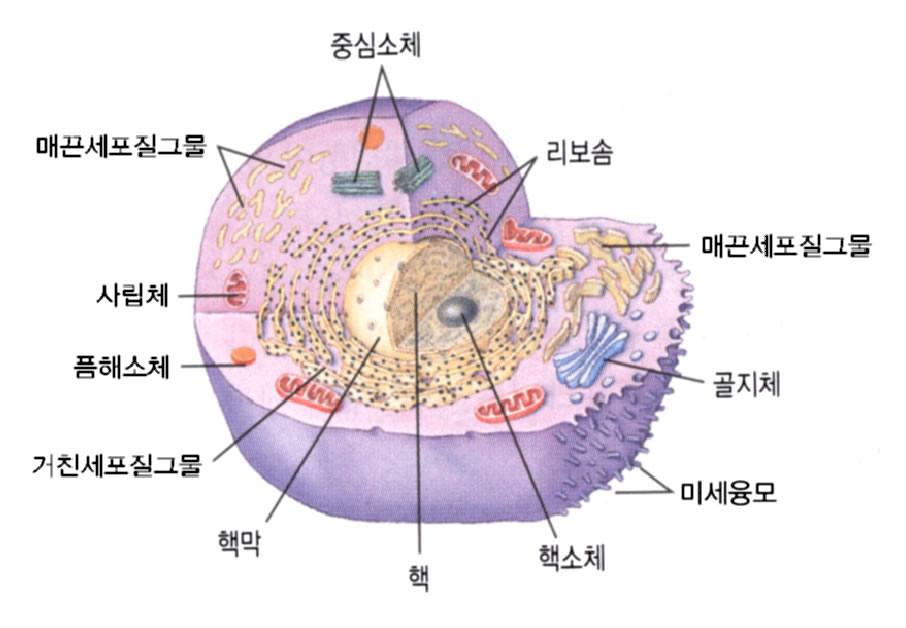 |
||
| 영문 | cell-mediated immunity | 한글 | 세포매개면역 |
|---|---|---|---|
| 설명 | 면역이란 신체를 외부의 물질로부터 보호하는 행위를 말한다. 여기에는 특이적 면역과 비특이적 면역의 두 가지가 있다. 비특이적 면역이라함은 특정한 물질에 관계하는 면역이 아니라 특정 대상이 없이 모든 외부 물체에 작용할 수 있는 면역을 말한다. 여기에는 소변의 흐름, 눈물의 흐름, 피부의 비투과성 등의 기계적인 것도 포함되고 피속에 돌아다니는 세포 중에서 비특이적으로 외부의 물질을 포식하는 세포들(예를 들면 큰포식세포(macrophage)의 활동도 포함이 된다. 세포매개면역이란 특이한 물질을 감지할 수 있는 세포를 생성하게 하여 그것으로 하여금 그 물질을 포식하게 하는 것을 말한다. |
||
| WC | ward clerk; water closet; Weber-Christian [syndrome]; wheel chair; white cell; white cell casts; whi... |
|---|---|
| MC | mass casualties; mast cell; Master of Surgery [Lat. Magister Chirurgiae]; maximum concentration; Med... |
| ACC | accommodation; acetyl coenzyme A carboxylase; acinic cell carcinoma; acute care center; adenoid cyst... |
| GC | ganglion cell; gas chromatography; general circulation; general closure; general condition; generali... |
| AAALAC | American Association for Accreditation of Laboratory Animal Care |
| MAIPA | Monoclonal Antibody-specific Immobilisation of Platelet Antigens |
|---|---|
| IS | immobilisation stress |
| A | Animal |
| LAA | Laboratory Animal Allergy |
| NAHMS | National Animal Health Monitoring System |
| animal cell immobilisation | <cell culture> Animal cells are widely used in biotechnology to produce genetically engineered proteins. However, they are more fragile than bacterial cells, and immobilising the cell facilitates the fermentation process. Many animal cells stick down flat on a suitable surface, hugging it as they would hug other cells or connective matrices in the body. If grown on suitable plastic surfaces, on glass or many ceramics, these cells will stick to them. In this way, they are easier to grow. (14 Nov 1997) |
|---|
| immobilisation | The act of rendering immovable, as by a cast or splint. (18 Nov 1997) |
|---|---|
| enzyme immobilisation | The attachment of an enzyme to a solid matrix so that it cannot escape but can still act on its substrate. (09 Oct 1997) |
| animal cell culture | <cell culture> Mammalian cells are fragile and harder to grow than other cell types, but their large-scale culturing is an economic boon because it allows for the production of proteins that are otherwise difficult or expensive or unethical to extract from living organisms. The cells are immobilised on a substrate and then perfused with culture medium, The cells are in a free suspension which is very gently mixed and aerated. (12 Nov 1997) |
| animal | 1. An organised living being endowed with sensation and the power of voluntary motion, and also characterised by taking its food into an internal cavity or stomach for digestion; by giving carbonic acid to the air and taking oxygen in the process of respiration; and by increasing in motive power or active aggressive force with progress to maturity. 2. One of the lower animals; a brute or beast, as distinguished from man; as, men and animals. Origin: L, fr. Anima breath, soul: cf. F. Animal. See Animate. 1. Of or relating to animals; as, animal functions. 2. Pertaining to the merely sentient part of a creature, as distinguished from the intellectual, rational, or spiritual part; as, the animal passions or appetites. 3. Consisting of the flesh of animals; as, animal food. Animal magnetism. See Magnetism and Mesmerism. Animal electricity, the electricity developed in some animals, as the electric eel, torpedo, etc. <physiology> Animal flower, the heat generated in the body of a living animal, by means of which the animal is kept at nearly a uniform temperature. Animal spirits. See Spirit. Animal kingdom, the whole class of beings endowed with animal life. It embraces several subkingdoms, and under these there are Classes, Orders, Families, Genera, Species, and sometimes intermediate groupings, all in regular subordination, but variously arranged by different writers. The following are the grand divisions, or subkingdoms, and the principal classes under them, generally recognised at the present time: - Vertebrata, including Mammalia or Mammals, Aves or Birds, Reptilia, Amphibia, Pisces or Fishes, Marsipobranchiata (Craniota); and Leptocardia (Acrania). Tunicata, including the Thaliacea, and Ascidioidea or Ascidians. Articulata or Annulosa, including Insecta, Myriapoda, Malacapoda, Arachnida, Pycnogonida, Merostomata, Crustacea (Arthropoda); and Annelida, Gehyrea (Anarthropoda). Helminthes or Vermes, including Rotifera, Chaetognatha, Nematoidea, Acanthocephala, Nemertina, Turbellaria, Trematoda, Cestoidea, Mesozea. Molluscoidea, including Brachiopoda and Bryozoa. Mollusca, including Cephalopoda, Gastropoda, Pteropoda, Scaphopoda, Lamellibranchiata or Acephala. Echinodermata, including Holothurioidea, Echinoidea, Asterioidea, Ophiuroidea, and Crinoidea. Coelenterata, including Anthozoa or Polyps, Ctenophora, and Hydrozoa or Acalephs. Spongiozoa or Porifera, including the sponges. Protozoa, including Infusoria and Rhizopoda. For definitions, see these names in the Vocabulary. Origin: Cf. F. Animal. Source: Websters Dictionary (01 Mar 1998) |
| animal black | Charcoal produced by incomplete combustion of animal tissues, especially bone. Synonym: animal black, bone black, bone charcoal. (05 Mar 2000) |
| animal charcoal | Charcoal produced by incomplete combustion of animal tissues, especially bone. Synonym: animal black, bone black, bone charcoal. (05 Mar 2000) |
| animal communication | Communication between animals involving the giving off by one individual of some chemical or physical signal, that, on being received by another, influences its behaviour. (12 Dec 1998) |
| animal dander | <immunology, zoology> The epidermis (skin) from an animal that can elicit an allergic response. (12 Nov 1997) |
| animal dextran | <biochemistry> Branched polymer of D glucose (mostly _(1-4) linked, but some _(1-6) at branch points). Size range very variable, up to 10exp5 glucose units. Major short term storage polymer of animal cells and is particularly abundant in the liver and to a lesser extent in muscle. In the electron microscope glycogen has a characteristic asterisk or star appearance. (18 Nov 1997) |
| animal graft | A graft of tissue from an animal to a human. Synonym: animal graft, zooplastic graft. (05 Mar 2000) |
| animal husbandry | The science of breeding, feeding and care of domestic animals; includes housing and nutrition. (12 Dec 1998) |
| animal identification systems | Procedures for recognizing individual animals and certain identifiable characteristics pertaining to them; includes computerised methods, ear tags, etc. (12 Dec 1998) |
| animal magnetism | A psychic force akin to the property of mutual attraction or repulsion possessed by metal magnets and once believed to be the principal factor in hypnosis, which thus was called animal magnetism. See: hypnosis, mesmerism. (05 Mar 2000) |
| animal model | Study in a population of laboratory animals that uses conditions of animals analogous to conditions of humans to simulate processes comparable to those that occur in human populations. (05 Mar 2000) |
| animal pole | <cell biology> In most animal oocytes the nucleus is not centrally placed and its position can be used to define two poles. That nearest to the nucleus is the animal pole and the other is the vegetal pole, with the animal vegetal axis between the poles passing through the nucleus. During meiosis of the oocyte the polar bodies are expelled at animal pole. In many eggs there is also a graded distribution of substances along this axis, with pigment granules often concentrated in the animal half and yolk, where present, largely in the vegetal half. (12 Nov 1997) |
제품명 |
판매사 |
보험코드 | 성분/함량 | 구분/보험급여 |
|---|
제품명 |
판매사 |
보험코드 | 성분/함량 | 구분/보험급여 |
|---|