
| 영문 | soft palate | 한글 | 물렁입천장, 연구개 |
|---|---|---|---|
| 설명 | 입속의 천장을 구성하며 동시에 콧구멍의 바닥을 이루는 구조물을 입천장이라 한다. 입천장은 크게 2가지로 나뉘어져 앞쪽의 뼈로 이루어진 부분을 단단입천장(hard palate)라 하고, 뒷부분의 근육성 주름을 물렁입천장(soft palate)라 한다. 주된 구조물은 건막과 근육 그리고 림프 조직이며 한가운데에는 목젖(uvula)이라고 하는 돌기가 존재한다. 목젖의 옆으로는 두개의 주름 즉 입천장혀활(palatoglossal arch)과 입천장인두궁(palatopharyngeal arch)이 존재하며 이 두 주름사이에 입천장편도(palatine tonsil)가 있다. 연구개의 기능은 음식을 삼킬 때 그 뒷끝이 인두의 뒷벽에 닿음으로써 음식물이 코로 역류하지 못하게 한다. |
||
| 영문 | white matter | 한글 | 백색질 |
|---|---|---|---|
| 설명 | 1. 뇌는 두 부분으로 나뉘어져 있다. 대뇌겉질이나 뇌의 중앙부에 위치하는 핵(예를 들면 시상, 시상하부, 바닥핵 등)이 회색질이고 그 외는 백색질이다. 척수의 경우에는 바깥쪽의 하얀부분을 백색질이라 하고, 안쪽의 색깔이 어두운 부분을 회색질이라 한다. 이중 실제적으로 대부분의 신경세포의 돌기 특히 축삭과 말이집으로 구성된 것이 백색질이며, 회색질은 신경세포와 보조하는 세포들이 많은 곳이다. 또한 척수도 백색질과 회색질로 나뉘어 있다. 2. 치아에 점착된 백색 물질로서 세균 및 사상 미생물을 함유한 점액 및 상피세포로 구성된다. 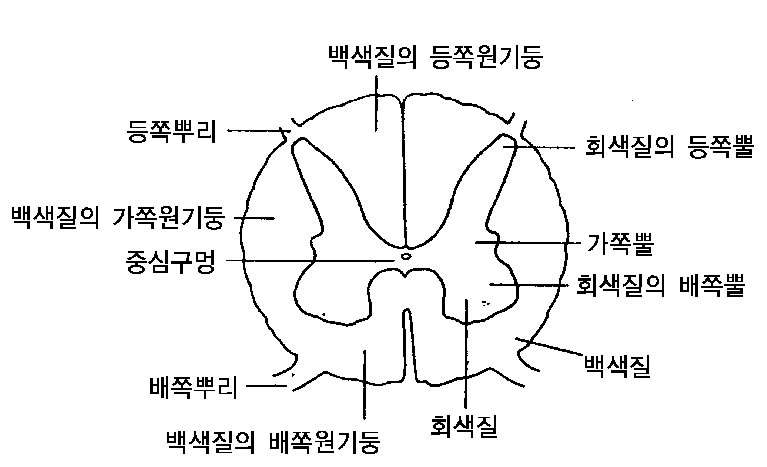 |
||
| 영문 | physical examination | 한글 | 진찰, 신체검사 |
|---|---|---|---|
| 설명 | 1. 질병의 진단수단으로서 환자의 몸을 보는 진단. 만지는 진단, 두드리는 진단, 듣는 진단 등을 통하여 검사하는 것. 신체검사. 2. 건강상태를 알기 위하여 신체의 각 부분을 검사하는 일 또는 법원의 신체에 대한 증거 조사. 일반적으로는 흔히 소지품의 검사라는 뜻으로도 쓰인다. ② 학교보건법상 : 학생들의 체격검사-체질검사-체능검사를 말한다(2조). 학교의 장은 해마다 학생과 교직원의 신체검사를 해야 한다. 다만 교직원에 대한 신체검사는 ‘공무원 및 사립학교교직원 의료보험법’에 의한 건강진단으로 이에 갈음할 수 있다. 신체검사실시의 시기-방법-절차 등은 교육부령으로 정한다(7조). 학교의 장은 신체검사의 결과 전염병에 감염되었거나, 감염되었다는 혐의가 있거나 감염될 우려가 있는 자의 등교를 중지시킬 수 있다(8조). ② 형사소송법상 : 법원이 증거자료를 얻기 위하여 신체를 검증하는 것을 뜻한다. 법원은 사실발견에 필요하면 신체검사를 할 수 있고(140조), 감정인 및 수사기관도 신체검사를 할 수 있다(173-219조). 신체검사는 검사를 당하는 자의 성별-연령-건강상태 기타 사정을 고려하여, 그 사람의 건강과 명예를 해하지 아니하도록 주의하여야 한다. 여자의 신체 검사를 할 때에는 의사나 성년의 여자를 참여시켜야 한다(141조). 법원은 신체 검사를 하기 위하여, 피고인이 아닌 자를 법원 기타의 지정한 장소에 소환할 수 있다(142조). |
||
| NYHA | New York Heart Association Heart Disease에 대한 Functional Classification &nbs... |
|---|---|
| ABCDES | abnormal alignment, bones-periarticular osteoporosis, cartilage-joint space loss, deformities, margi... |
| PE | Edinburgh Pharmacopoeia; pancreatic extract; paper electrophoresis; partial epilepsy; pelvic examina... |
| PT | pain threshold; parathormone; parathyroid; paroxysmal tachycardia; part time; patient; pericardial t... |
| AJKD | American Journal of Kidney Diseases |
| JAMA | Journal of the American Medical Association |
|---|---|
| NEJM | New England Journal of Medicine |
| ASPS | Alveolar soft part sarcoma |
| NSS | Neurological soft signs |
| PSE | Pale, soft, exudative |
| journal article | The predominant publication type for articles and other items indexed for nlm databases. (12 Dec 1998) |
|---|---|
| Central European tick-borne encephalitis virus | One of the virus's of the tick-borne encephalitis complex of group B arboviruses (genus Flavivirus); the causative agent of tick-borne encephalitis (Central European subtype). (05 Mar 2000) |
| Central European tick-borne fever | 1. (Central European subtype) tick-borne meningoencephalitis caused by a flavivirus closely related to the virus causing the Far Eastern type; it is transmitted by Ixodes ricinus, also by infected raw milk, especially that of goats. Synonym: biundulant meningoencephalitis, Central European tick-borne fever, diphasic milk fever, Russian spring-summer encephalitis (Western subtype). 2. (Eastern subtype) tick-borne encephalitis, a severe form of encephalitis caused by a flavivirus, a virus belonging to the Flaviviridae family, and transmitted by ticks (Ixodes pertulcatus and I. Ricinus). Synonym: Russian tick-borne encephalitis. (05 Mar 2000) |
| european molecular biology lab gene bank | <molecular biology> A large database of DNA sequence data in Heidelberg, Germany, compiled from international sources. It is the European equivalent to the Genbank DNA sequence databank in the United States of America. WWW: EMbase. (09 Oct 1997) |
| European snakeroot | An emetic and cathartic. Synonym: European snakeroot, hazelwort. (05 Mar 2000) |
| European tarantula | Lycosa tarentula, the large European wolf spider or true tarantula Its bite was once believed to cause madness, which inspired frenzied contortions and dancing to rid the body of the venom, though the bite is, in fact, harmless, as is that of most of the large, hairy "tarantula spiders" of the tropics. (05 Mar 2000) |
| european typhus | See Epidemic typhus. (12 Dec 1998) |
| european union | The collective designation of three organizations with common membership: the european economic community (common market), the european coal and steel community, and the european atomic energy community (euratom). It was known as the european community until 1994. It is primarily an economic union with the principal objectives of free movement of goods, capital, and labour. Professional services, social, medical and paramedical, are subsumed under labour. The constituent countries are austria, belgium, denmark, finland, france, germany, greece, ireland, italy, luxembourg, netherlands, portugal, spain, sweden, and the united kingdom. (12 Dec 1998) |
| typhus, european | See Typhus, epidemic. (12 Dec 1998) |
| matter | <chemistry> The material of the universe. (09 Jan 1998) |
| matter, gray | The cortex of the brain which contains nerve cell bodies. The gray matter is as opposed to the white matter, the part of the brain that contains myelinated nerve fibres. The gray matter is so named because it in fact appears gray. In the mysterious affair at styles (1920), agatha christie first quoted the fictional belgian detective hercule poirot in regard to his gray matter: 'this affair must be unravelled from within.' he tapped his forehead. 'these little grey cells. It is up to them as you say over here.' (12 Dec 1998) |
| matter, white | The part of the brain that contains myelinated nerve fibres. The white matter is white because it is the colour of myelin, the insulation covering the nerve fibres. The white matter is as opposed to the gray matter (the cortex of the brain which contains nerve cell bodies). (12 Dec 1998) |
| gray matter | The cortex of the brain which contains nerve cell bodies. The gray matter is in contrast to the white matter, the part of the brain that contains myelinated nerve fibres. The gray matter is so named because it in fact appears gray. The white matter is white because that is the colour of myelin, the insulation covering the nerve fibres. In the mysterious affair at styles (1920), agatha christie first quoted the fictional belgian detective hercule poirot in regard to his gray matter: 'this affair must be unravelled from within.' he tapped his forehead. 'these little grey cells. It is up to them as you say over here.' (12 Dec 1998) |
| grey matter | <anatomy> Gray matter, the thinking brain, appears gray because it is composed of numerous nerve cells and blood vessels. The outer layer of the cerebrum - the cerebral cortex and areas deep within the brain - the basal ganglia, are made up of grey matter. See: white matter. (16 Dec 1997) |
| white matter | <anatomy> Brain tissue composed of myelin-coated nerve cell fibres. White matter carries information between the nerve cells in the brain and spinal cord. The inner portion of the cerebrum is composed of white matter. See: grey matter. (13 Nov 1997) |
제품명 |
판매사 |
보험코드 | 성분/함량 | 구분/보험급여 |
|---|
제품명 |
판매사 |
보험코드 | 성분/함량 | 구분/보험급여 |
|---|