
| 영문 | ovulation cycle | 한글 | 배란주기 |
|---|---|---|---|
| 설명 | 사춘기가 되어 난소가 뇌하수체전엽으로부터의 생식샘자극호르몬의 작용을 받아 원시난포가 발육하고 성숙난포가 된다. 결국에는 난포벽이 파열되어 과립막세포로 둘러싸인 난자가 복강내로 배출된다(배란). 배란 후 24~96시간으로 과립막세포가 비대증식해서 황체를 형성한다. 수정되지 않은 경우 월경황체는 약 10일간 존속하고 퇴행변성해서 백체가 된다. 황체가 퇴행변성하면 다음의 난포가 성숙한다. 난소에서는 이 주기가 반복되고 있다. |
||
| 영문 | biliary tract | 한글 | 쓸개길, 담도, 담관 |
|---|---|---|---|
| 설명 | 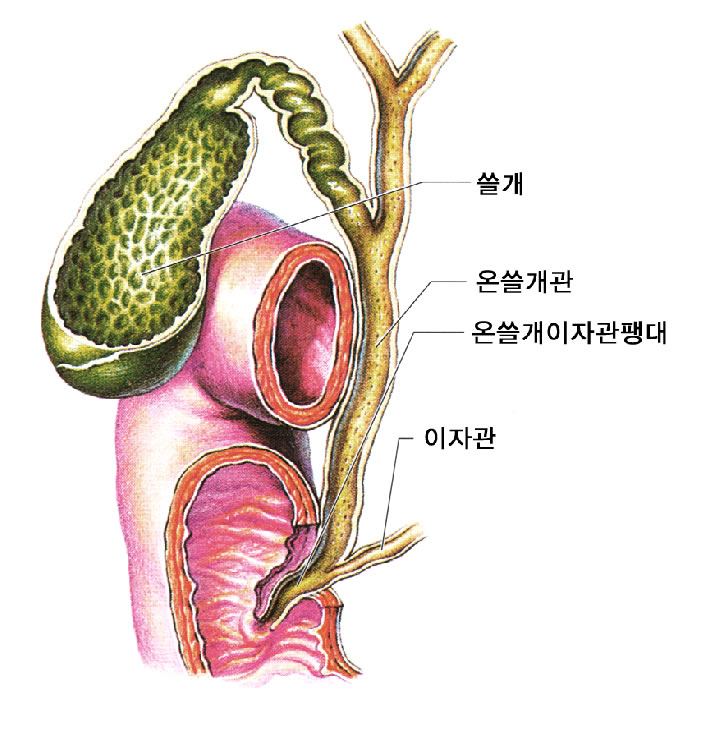 간에서 만들어진 쓸개즙을 수송하는 관조직의 일부. 간에서 만들어진 담즙은 간관, 쓸개관을 거쳐서 쓸개에 보관되었다가 온쓸개관을 통해서 샘창자로 보내진다. 이처럼 간에서 만들어진 담즙이 샘창자까지 배설되는 길로서 길이는 6~7cm 이며 간관, 쓸개관, 온쓸개관 따위로 이루어져 있다. |
||
| MC | mass casualties; mast cell; Master of Surgery [Lat. Magister Chirurgiae]; maximum concentration; Med... |
|---|---|
| PC | avoirdupois weight [Lat. pondus civile]; packed cells; paper chromatography; paracortex; parent cell... |
| PAS | 1) Periodic Acid-Schiff Stain 2) Para-Amino-Salicyclic Acid &nbs... |
| AT-PAS | aldehyde-thionine-periodic acid Schiff [test] |
| LTAS | lead tetra-acetate Schiff |
| AB-PAS | Alcian blue-periodic acid Schiff |
|---|---|
| PAS | Periodic Acid Schiff |
| PAS | Periodic Acid-Schiff reaction |
| PAS | Periodic acid-Schiff reagent |
| SB | Schiff base |
| periodic acid Schiff reaction | <technique> A histochemical technique based on periodic acid oxidation of a substance containing the 1,2-glycol grouping. It is used for staining carbohydrates as the resulting dialdehyde reacts with Schiff reagent to form a coloured product. The adjacent hydroxyl groups are oxidized to form aldehydes by periodic acid (HIO4) and these aldehyde groups react with Schiff's reagent (basic fuchsin decolourised by sulphurous acid) to give a purple colour. Acronym: PAS (18 Nov 1997) |
|---|---|
| periodic acid Schiff stain | <technique> A histochemical technique based on periodic acid oxidation of a substance containing the 1,2-glycol grouping. It is used for staining carbohydrates as the resulting dialdehyde reacts with Schiff reagent to form a coloured product. Substances that can be demonstrated include carbohydrates, mucins, cartilage matrix, collagen, reticulum, basement membranes, fibrin, thyroid colloid, amyloid, glomerular hyaline deposits, and a number of other secretions or tissue constituents. Also used in for staining gels on which glycoproteins have been run. See: periodic acid Schiff reaction Synonym: PAS stain. (22 Sep 2002) |
| Schiff base | The reaction of a primary amine with an aldehyde or ketone yields an imine sometimes called a Schiff base. When an arylamine is used the Schiff base may form an intermediate in a staining reaction, for example for polysaccharides. (18 Nov 1997) |
| schiff bases | Condensation products of aromatic amines and aldehydes forming azomethines substituted on the n atom, containing the general formula r-n:chr. (12 Dec 1998) |
| Schiff, Hugo | <person> German chemist in Florence, 1834-1915. See: Schiff base, Schiff's reagent, Kasten's fluorescent Schiff reagents, periodic acid-Schiff stain, ninhydrin-Schiff stain for proteins. (05 Mar 2000) |
| Schiff, Moritz | <person> German physiologist, 1823-1896. See: Schiff-Sherrington phenomenon. (05 Mar 2000) |
| Schiff-Sherrington phenomenon | When the spinal cord is transected in the midthoracic region or a little lower, the stretch and other postural reflexes of the upper extremity become exaggerated; if the transection is made in the sacral cord, a similar effect is observed in the lower limbs. The effect is regarded as a release phenomenon, i.e., release from an inhibitory influence normally exerted by the spinal segments below the transection. (05 Mar 2000) |
| Schiff's reagent | An aqueous solution of basic fuchsin or pararosaniline which is decolorised by sulfur dioxide, commonly prepared by addition of hydrochloric acid to a dye solution containing a metabisulphite or bisulphite salt; used for aldehydes and in histochemistry to detect polysaccharides, DNA, and proteins. See: Feulgen stain, periodic acid-Schiff stain, ninhydrin-Schiff stain for proteins. (05 Mar 2000) |
| ninhydrin-Schiff stain | <technique> For proteins, proteins are revealed by using ninhydrin or alloxan to produce aldehydes from primary aliphatic amines by oxidative deamination; the aldehydes are shown by reaction with Schiff's reagent. (05 Mar 2000) |
| Kasten's fluorescent Schiff reagents | Fluorescent analogues of Schiff's reagent which are fluorescent basic dyes lacking acidic side groups and containing one or more primary amine groups; used in cytochemical detection of DNA in Kasten's fluorescent Feulgen stain, polysaccharides in Kasten's fluorescent PAS stain, and proteins in the ninhydrin-Schiff stain; such analogues include acriflavine, auramine O, and flavophosphine N. (05 Mar 2000) |
| biliary | <anatomy> Pertaining to the bile, to the bile ducts or to the gallbladder. (13 Oct 1997) |
| biliary atresia | <embryology> A rare condition which is caused by the abnormal development of the bile ducts inside or outside the liver. The obstruction of bile flow from the liver can lead to cirrhosis of the liver if not treated. Symptoms include jaundice in the second to third week of life along with clay-coloured stools. See: newborn jaundice. (27 Sep 1997) |
| biliary calculus | <gastroenterology, surgery> A solid formation in the gallbladder composed of cholesterol and bile salts. (27 Sep 1997) |
| biliary canaliculus | One of the intercellular channels, about 1 um or less in diameter, that occurs between liver cells forming the first portion of the bile system. Synonym: bile capillary. (05 Mar 2000) |
| biliary cirrhosis | <gastroenterology> A rare form of liver disease which results in the irreversible destruction of the liver and bile ducts. The cause is unknown, but is thought to be an autoimmune mechanism. (27 Sep 1997) |
| Schiff's biliary cycle |
see under cycle.
출처: www.mercksource.com/pp/us/cns/cns_health_library.j...
|
|---|
제품명 |
판매사 |
보험코드 | 성분/함량 | 구분/보험급여 |
|---|
제품명 |
판매사 |
보험코드 | 성분/함량 | 구분/보험급여 |
|---|