
| 영문 | vocal cord | 한글 | 성대 |
|---|---|---|---|
| 설명 | 목소리를 내는 데 꼭 필요한 중요한 구조물이다. 성대주위에는 작은 근육들이 존재하여, 하는 소리가 나오도록 해 주는 데, 이 근육들은 주로 되돌이후두신경의 지배를 받고 있으며, 성대의 감각신경은 위후두신경이 맡고 있다. 이중 왼쪽 반회후두신경은 신경의 주행경로상 밑으로 내려갔다 다시 올라와 분포하게 되므로 폐암으로 인한 폐수술시에 손상받기 쉬워서, 수술합병증으로 목쉰소리가 남기도 한다. 또한 성대가 막히면, 공기의 통로가 막히게 되므로 호흡곤란을 유발한다. 성대나 그 주위에서 종양이 발생할 수 있으며, 흡연이 주요한 원인이다. 성대자체에서 종양이 발생하면 목쉰소리가 나타나 쉽게 알 수 있으나, 성대이하부위나, 이상부위에서 발생하면 증상이 늦게 나타나므로, 다른 곳으로의 전이소견이나, 혹은 호흡곤란으로 나타나기도 한다. |
||
| 영문 | spermatic cord | 한글 | 정삭 |
|---|---|---|---|
| 설명 | 고환의 위쪽끝에서부터 샅고랑의 안쪽 끝까지의 사이에 있는 끈 모양의 조직. 정관, 혈관, 신경, 민무늬근, 지방조직 따위로 이루어져 있다. |
||
| 영문 | spinal cord | 한글 | 척수 |
|---|---|---|---|
| 설명 | 척추내에 위치하는 중추신경계의 일부분. 위에서부터 목척수, 등척수, 허리척수, 엉치척수로 구분됨. 내부는 바깥쪽의 백색질과 안쪽의 회색질로 구분된다. 척수의 아래끝은 척수 원뿔이라 하며 첫번째 허리뼈 높이까지 내려온다. 뇌와 말초신경사이의 신경 통로 역할을 하며 척수반사(예: 무릎반사)에서는 뇌를 통하지 않고 반사의 중추 작용을 한다. 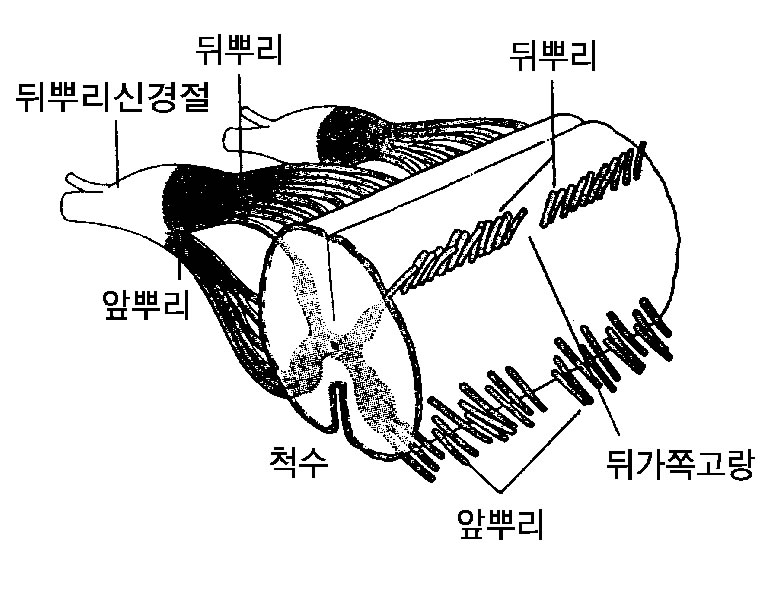 |
||
| 영문 | umbilical cord | 한글 | 탯줄, 제대 |
|---|---|---|---|
| 설명 | 태아의 배꼽을 태반과 연결시키는 유일한 구조로 2개의 탯줄동맥과 1개의 탯줄정맥이 지나간다. 신생아때에는 길이가 약 50cm이다. 태생기 발생 약 5주경에 요막경(allantoic diverticulum, body stalk)으로부터 형성되며 배꼽창자관(vitello- intestinal duct) 및 요막(allantoic membrane)을 포함하고 있다. 약 1%에서 제대동맥이 하나뿐인 경우가 있는데 이때에는 선천성기형의 동반률이 증가한다. |
||
| misc | miscarriage; miscellaneous |
|---|---|
| PET | Positron Emission Tomography |
| PET | peak ejection time; polyethylene terphthalate; poor exercise tolerance; positron emission tomography... |
| CC | 1) Chief Complaint; 주소(主訴), 주된 호소(불평) 2) Closing Capacity ... |
| ASCI | acute spinal cord injury; American Society for Clinical Investigation |
| KC | Kangaroo Care |
|---|---|
| FDG PET | 2-(18)fluoro-2-deoxy-D-glucose positron emission tomography |
| FDG PET | F-18-fluorodeoxyglucose positron emission tomography |
| PET | 3H)phosphatidylethanol |
| 3H]PEt | 3H]phosphatidylethanol |
| kangaroo | <zoology> Any one of numerous species of jumping marsupials of the family Macropodidae. They inhabit Australia, new Guinea, and adjacent islands, They have long and strong hind legs and a large tail, while the fore legs are comparatively short and feeble. The giant kangaroo (Macropus major) is the largest species, sometimes becoming twelve or fourteen feet in total length. The tree kangaroos, belonging to the genus Dendrolagus, live in trees; the rock kangaroos, of the genus Petrogale, inhabit rocky situations; and the brush kangaroos, of the genus Halmaturus, inhabit wooded districts. See Wallaby. Kangaroo apple, the potoroo. Origin: Said to be the native name. Source: Websters Dictionary (01 Mar 1998) |
|---|---|
| bonding, human-pet | The emotional attachment of individuals to pets. (12 Dec 1998) |
| PET | <radiology> A highly specialised research imaging technique using short lived radioactive substances - usually those made with a cyclotron. This technique is very sensitive in picking up active tumour tissue but does not measure the size of it. Tomographic images are formed by computer analysis of photons detected from annihilation of positrons emitted by radionuclides incorporated into biochemical substances; the images, often quantitated with a colour scale, show the uptake and distribution of the substances in the tissue, permitting analysis and localization of metabolic and physiological function. Because the half-lives of the radionuclides are so short (20 minutes to 2 hours), and the equipment expensive, PET is rarely used in a clinical setting. But since its development in the mid-1970s, it has proved the most important tool yet devised for experimental investigation of the living brain, whether healthy, traumatised, or diseased. With CT and MRI, it represents a new generation of computer imaging techniques that have revolutionised medicine and physiology. Acronym: PET (20 Jun 2000) |
| PET scan | Positron Emission Tomography. A scanning device which uses low-dose radioactive sugar to measure brain activity. This is a limited-use diagnostic tool. (16 Dec 1997) |
| acute spinal cord compression | <radiology> Signs and symptoms of cord compression show progression within 24 hours or less: pain, weakness, autonomic dysfunction, sensory loss, ataxia Diagnostic considerations: Primary or secondary malignancy of epidural space or vertebrae, Trauma, Inflammatory process, Osteoarthritis REF: MacNeil BJ, Abrams HL. Brigham and Women's Hospital Handbook of Diagnostic Imaging. Chapter 35. (12 Dec 1998) |
| anterior median fissure of spinal cord | A deep median fissure on the anterior surface of the spinal cord. Synonym: fissura mediana anterior medullae spinalis, anteromedian groove, sulcus ventralis. (05 Mar 2000) |
| anterolateral column of spinal cord | The lateral white column of the spinal cord between the lines of exit and entrance of the anterior and posterior nerve roots. Synonym: funiculus lateralis, anterolateral column of spinal cord, lateral funiculus of spinal cord. (05 Mar 2000) |
| arachnoid of spinal cord | That portion of the arachnoid which lies within the vertebral canal and surrounds the spinal cord and the vertebral portion of the subarachnoid space. It extends from the foramen magnum above to the S-2 vertebral level. Since the spinal cord ends at the L-2 vertebral level, a wide separation occurs between the arachnoid and pia mater, the lumbar cistern, filled with cerebrospinal fluid in which the cauda equina is suspended. Synonym: arachnoidea mater spinalis, spinal part of arachnoid. (05 Mar 2000) |
| gangliated cord | One of the two long ganglionated nerve strands alongside the vertebral column that extend from the base of the skull to the coccyx; they are connected to each spinal nerve by gray rami and receive fibres from the spinal cord through white rami connecting with the thoracic and upper lumbar spinal nerves. Synonym: truncus sympathicus, gangliated cord. (05 Mar 2000) |
| genital cord | One of a pair of mesenchymal ridges bulging into the caudal part of the celom of a young embryo and containing the mesonephric and paramesonephric duct. (05 Mar 2000) |
| glioma of the spinal cord | A glial tumour of the spinal cord, commonly an ependymoma; neoplasms of the spinal cord are relatively rare, but glioma's constitute approximately one-fourth of the total. (05 Mar 2000) |
| medial cord of brachial plexus | In the brachial plexus, the bundle of nerve fibres formed by the anterior division of the inferior trunk which lies medial to the axillary artery; it gives off the medial pectoral nerve, the medial brachial cutaneous, and medial antebrachial cutaneous, nerves and end by dividing into the medial root of the median nerves and the ulnar nerve. Synonym: fasciculus medialis plexus brachialis. (05 Mar 2000) |
| vitelline cord | A persistent yolk stalk in the form of a solid cord of tissue connecting ileum to umbilicus. Synonym: omphalomesenteric cord. (05 Mar 2000) |
| vocal cord nodules | Small, circumscribed, bilateral, beadlike enlargements on the vocal cords caused by overuse or abuse of the voice; often reversible by voice therapy. Synonym: singer's nodes, singer's nodules, teachers' nodes. (05 Mar 2000) |
| vocal cord paralysis | Paralysis of one or both of the vocal cords. (12 Dec 1998) |
제품명 |
판매사 |
보험코드 | 성분/함량 | 구분/보험급여 |
|---|
제품명 |
판매사 |
보험코드 | 성분/함량 | 구분/보험급여 |
|---|