
| 영문 | Gram stain | 한글 | 그람염색 |
|---|---|---|---|
| 설명 | 미생물을 염색하는 방법 중의 하나. 1884년 덴마크의 의사 H.C.J. 그람(1853~ 1938)이 고안한 특수 염색법이다. 이 염색법을 사용하면 미생물은 양성균과 음성균의 2무리로 크게 나뉜다. 염색법은 균을 유리면에 바르고 가열 고정한다. 젠시안바이오렛, 크리스탈 바이오렛, 메틸바이오렛 등 파라로즈 아닐린계 색소의 어느 하나를 사용하여 우선 염색하고 이어서 루골액을 작용시킨 뒤, 에탄올 또는 아세톤으로 탈색한다. 이때 탈색되지 않고 보라색을 타나내는 것을 그람양성균이라 부르며, 포도알균-폐렴알균-사슬알균 등이 대표적인 예이다. 탈색되면 그람음성균이라 부르며, 대장균-녹농균 등이 있다. 최후에 사프라닌, 푹신 등 적색계의 색소액으로 후염색을 한다. 미생물의 감별에 중요한 염색법이며 염색성의 차이는 영양요구성, 화학요법제(항생물질 등)에 대한 감수성의 차이와도 관련되는 점이 많으므로 사용약제의 선택시에도 중요한 역할을 한다. 그람양성균과 음성균의 차이는 세균벽의 구조에 있는데, 양성균은 세포막의 바깥쪽 펩티드글리칸이라는 당단백질층의 두께가 20~80nm나 되고, 그램음성균의 펩티드글리칸 층은 2~3nm로 얇고, 다시 바깥쪽에 외막이라 부르는 층이 있다. |
||
| 영문 | joint capsule | 한글 | 관절주머니, 관절낭 |
|---|---|---|---|
| 설명 | 관절의 종류 중에서 윤활관절은 두 뼈 사이가 약간의 간격을 두고 떨어져 있으며 관절면에는 얇은 유리 연골의 판이 덮여 있는 형태인데, 두 뼈 사이의 간격을 관절강이라고 하며 이 관절강 속은 연골이 덮여 있는 관절면을 제외하고는 윤활막에 의해 덮여 있고 이 윤활막은 다시 밖에서 질긴 섬유로 된 막으로 덮여 있다. 이 섬유막을 관절주머니라고 한다. |
||
| 영문 | Bowman capsule | 한글 | 보우만 주머니 |
|---|---|---|---|
| 설명 | 콩팥은 혈액속에 불순물을 제거하는 역할을 하는 부분이다. 콩팥의 역할은 콩팥단위(nephron)라는 것에 의해서 이루어진다. 이것은 콩팥기능의 단위로 콩팥에는 수많은 네프론이 존재한다. 네프론은 다음과 같은 구조로 이루어져 있다. 토리(glomerulus): 콩팥의 모세혈관의 실타래모양을 이루며 모여 있는 것을 말한다. 콩팥으로 들어온 혈액은 모세혈관을 통해서 사구체를 지나간다. 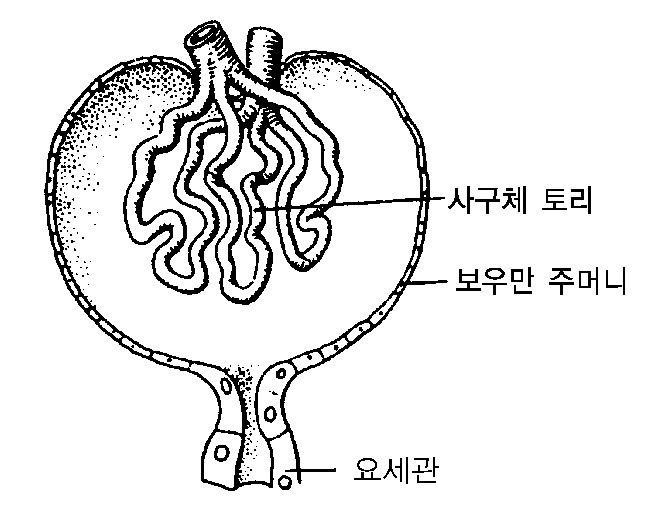 |
||
| AFB Stain | Acid Fast Bacilli Stain |
|---|---|
| HE stain | Hematoxylin-Eosin stain |
| WS | Waardenburg syndrome; ward secretary; Warkany syndrome; Warthin-Starry [stain]; water soluble; water... |
| IBT | ink blot test |
| INK | injury not known |
| A.I.I.M.S. | All India Institute of Medical Sciences |
|---|---|
| PWS | Port Wine Stain |
| PCO | Posterior capsule opacification |
| SRCA | Subrenal Capsule Assay |
| IC | internal capsule |
| India ink capsule stain | <technique> A negative stain for crystal bacteria in which cells appear purple (Gram's crystal violet) and the capsules appear clear against a dark background. (05 Mar 2000) |
|---|
| india | A country in Southern Asia; the two peninsulas of Hither and Farther India; in a restricted sense, Hither India, or Hindostan. India ink, a nearly black pigment brought chiefly from China, used for water colours. It is in rolls, or in square, and consists of lampblack or ivory black and animal glue. Called also China ink. The true India ink is sepia. See Sepia. India matting, floor matting made in China, India, etc, from grass and reeds; also called Canton, or China, matting. India paper, a variety of Chinese paper, of smooth but not glossy surface, used for printing from engravings, woodcuts, etc. India proof, a proof impression from an engraved plate, taken on India paper. India rubber. See Caoutchouc. <botany> India-rubber tree, any tree yielding caoutchouc, but especially the East Indian Ficus elastica, often cultivated for its large, shining, elliptical leaves. See: Indian. Source: Websters Dictionary (01 Mar 1998) |
|---|---|
| ink | 1. A fluid, or a viscous material or preparation of various kinds (commonly black or coloured), used in writing or printing. "Make there a prick with ink." (Chaucer) "Deformed monsters, foul and black as ink." (Spenser) 2. A pigment. See India ink, under India. Ordinarily, black ink is made from nutgalls and a solution of some salt of iron, and consists essentially of a tannate or gallate of iron; sometimes indigo sulphate, or other colouring matter,is added. Other black inks contain potassium chromate, and extract of logwood, salts of vanadium, etc. Blue ink is usually a solution of Prussian blue. Red ink was formerly made from carmine (cochineal), Brazil wood, etc, but potassium eosin is now used. Also red, blue, violet, and yellow inks are largely made from aniline dyes. Indelible ink is usually a weak solution of silver nitrate, but carbon in the form of lampblack or India ink, salts of molybdenum, vanadium, etc, are also used. Sympathetic inks may be made of milk, salts of cobalt, etc. See Sympathetic ink (below). Copying ink, a peculiar ink used for writings of which copies by impression are to be taken. <zoology> Ink bag, an ink sac. Ink berry. <botany> An organ, found in most cephalopods, containing an inky fluid which can be ejected from a duct opening at the base of the siphon. The fluid serves to cloud the water, and enable these animals to escape from their enemies. Sympathetic ink, a writing fluid of such a nature that what is written remains invisible till the action of a reagent on the characters makes it visible. Origin: OE. Enke, inke, OF. Enque, F. Encre, L. Encaustum the purple red ink with which the Roman emperors signed their edicts, Gr, fr. Burnt in, encaustic, fr. To burn in. See Encaustic, Caustic. Source: Websters Dictionary (01 Mar 1998) |
| ink blot tests | Projective tests utilizing ink blots to which a subject responds. They are used in personality diagnosis. (12 Dec 1998) |
| adipose capsule | The perirenal fat. Synonym: capsula adiposa renis, adipose capsule. (05 Mar 2000) |
| adrenal capsule | See adrenal gland. (12 Dec 1998) |
| anterior limb of internal capsule | The portion of the internal capsule between the head of the caudate nucleus and the putamen; it lies anterior to the genu of the internal capsule. Synonym: crus anterius capsulae internae. (05 Mar 2000) |
| articular capsule | A sac enclosing a joint, formed by an outer fibrous articular capsule and an inner synovial membrane. Synonym: capsula articularis, joint capsule. (05 Mar 2000) |
| atrabiliary capsule | See adrenal gland. (12 Dec 1998) |
| auditory capsule | The cartilage that, in the embryo, surrounds the developing auditory vesicle and develops into the bony labyrinth of the inner ear. (05 Mar 2000) |
| bacterial capsule | A layer of slime of variable composition which covers the surface of some bacteria; capsulated cells of pathogenic bacteria are usually more virulent than cells without capsules because the former are more resistant to phagocytic action. (05 Mar 2000) |
| Bonnet's capsule | The anterior part of the vagina bulbi. (05 Mar 2000) |
| Bowman's capsule | The expanded beginning of a nephron composed of an inner and outer layer: the visceral layer consists of podocytes which surround a tuft of capillaries (glomerulus); the parietal layer is simple squamous epithelium which becomes cuboidal at the tubular pole. Synonym: capsula glomeruli, Bowman's capsule, malpighian capsule, Muller's capsule. (05 Mar 2000) |
| capsule | <microbiology> Thick gel like material attached to the wall of gram-positive or gram-negative bacteria, giving colonies a smooth appearance. May contribute to pathogenicity by inhibiting phagocytosis. Mostly composed of very hydrophilic acidic polysaccharide, but considerable diversity exists. <pathology> Cellular response in invertebrate animals to a foreign body too large to be phagocytosed. A multicellular aggregate of haemocytes or coelomocytes isolates the foreign object. In some insects the capsule is apparently acellular and composed of melanin. (08 Oct 1997) |
| capsule cell | One of the cells located around the bodies of the cerebrospinal and sympathetic ganglionic neurons. Synonym: capsule cell. Origin: amphi-+ G. Kytos, cell (05 Mar 2000) |
| capsule forceps | Forceps used for removing the capsule of the lens in extracapsular extraction of a cataract. (05 Mar 2000) |
제품명 |
판매사 |
보험코드 | 성분/함량 | 구분/보험급여 |
|---|
제품명 |
판매사 |
보험코드 | 성분/함량 | 구분/보험급여 |
|---|