
| 영문 | pelvic inflammatory disease | 한글 | 골반염질환 |
|---|---|---|---|
| 설명 | 골반주위의 장기에 발생하는 염증을 말함. 주로 여성에서 발생하며 원인은 임균(gonococcus)과 비임균에 의한 감염(non-gonorrheal infection)에 의한다. 증상은 초기에는 질분비물, 하복부동통, 여성의 생식기부위에 발생하는 압통, 월경통, 월경량의 증가 등이다. 일찍 치료해야 하며, 계속적으로 병이 지속시 여성의 불임의 원인이 된다. 후진국에서는 가장 많은 여성불임의 원인이기도 함. 치료는 항생제의 투여이다. |
||
| 영문 | Dilatation and Curettage(D & C) | 한글 | 자궁긁어냄술, 자궁목확장 |
|---|---|---|---|
| 설명 | 자궁이란 태아가 수태되어서 분만전까지 발육하고 성장하는 공간이다. 자궁속에 병변이 있어 임신이 계속될 수 없거나 아니면 다른 이유로 임신되어 있는 태아를 제거하고자 할 경우에 사용되는 방법이다. 여기서 긁어내기 위하여는 우선 자궁의 입구에 해당하는 자궁목을 확장시켜야 한다. 여기에는 급속히 확장을 시도하는 법과 서서히 확장을 시도하는 2가지 방법이 있다. 자궁목을 급속히 확장할 때는 헤가르 목관확장기(Hegar's dilatator)를 사용한다. 이것은 작은 금속막대로 작은 크기부터 큰 크기까지 다양한 크기가 있어서 우선 작은 막대로 시작하여 점점 큰 크기의 막대를 자궁목에 넣어서 자궁목을 확장시킨다. 서서히 확장시킬 때는 Laminaria tent를 목관에 삽입하는 방법을 사용한다. Laminaria tent란 해초로 만든 작은 막대로 수분을 흡수하면 점점 늘어나는 성질이 있다. 이것을 자궁의 목에 넣으면 이것이 수분을 흡수하여 늘어나므로 천천히 자궁의 목이 늘어난다. 자궁목이 충분히 늘어나면 그 속으로 끝이 숟가락처럼 생긴 기구를 넣어서 자궁속의 병변이나 임신된 태아를 긁어내는데 여기에 사용되는 숟가락처럼 생긴 기구를 큐렛이라고 한다. 초기 임신중절 즉 유산과 같은 임신과 관련된 경우뿐만 아니라, 비임신 자궁의 자궁내막조직의 채취 및 제거를 위해서도 행해지는 수기이다. 이는 원칙적으로 마취하에 실시되는 것으로 자궁목관을 확장하고 기구로 자궁 내용물을 제거하고 큐렛으로 자궁내벽을 깨끗이 한다. 자궁천공이나 자궁목의 파열 등의 위험이 따르며, 수술후 감염 또는 출혈 등에 대한 주의가 필요하다. |
||
| 영문 | alimentary tract | 한글 | 소화관, 영양관 |
|---|---|---|---|
| 설명 | 입에서 시작하여 항문으로 끝나는 소화를 담당하는 이르는 말. 위창자관이라고도 불린다. |
||
| 영문 | biliary tract | 한글 | 쓸개길, 담도, 담관 |
|---|---|---|---|
| 설명 | 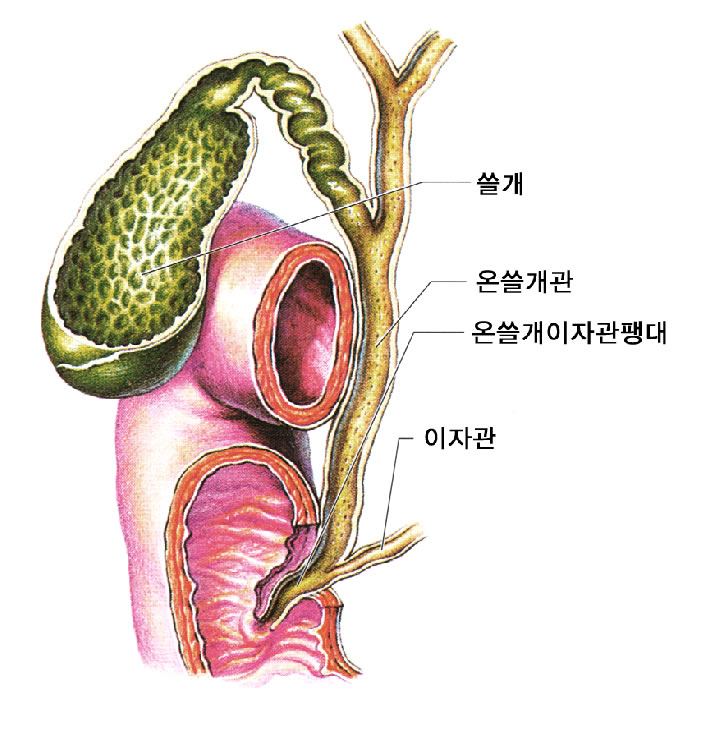 간에서 만들어진 쓸개즙을 수송하는 관조직의 일부. 간에서 만들어진 담즙은 간관, 쓸개관을 거쳐서 쓸개에 보관되었다가 온쓸개관을 통해서 샘창자로 보내진다. 이처럼 간에서 만들어진 담즙이 샘창자까지 배설되는 길로서 길이는 6~7cm 이며 간관, 쓸개관, 온쓸개관 따위로 이루어져 있다. |
||
| 영문 | urinary tract | 한글 | 요로 |
|---|---|---|---|
| 설명 | 오줌을 몸 밖으로 배출하기 위한 길. 콩팥, 요관, 방광, 요도로 이루어져 있다. |
||
| ECG | Electro-Cardio-Graphy(-Gram); 심전도 = EKG 1. Conducting System Structu... |
|---|---|
| LGTI | lower genital tract infection |
| LRI | lamina rara interna; lower respiratory [tract] illness; lower respiratory [tract] infection; lymphoc... |
| LRTI | lower respiratory tract illness; lower respiratory tract infection |
| ITFS | iliotibial tract friction syndrome; incomplete testicular feminization syndrome |
| UTI | 3-urinary tract infection |
|---|---|
| ALRI | Acute lower respiratory tract infection |
| LRI | Lower respiratory tract infection |
| LRTI | Lower respiratory tract infection |
| URTI | Upper Respiratory Tract Infection |
| benign mesothelioma of genital tract | A small, circumscribed, benign tumour of the genital tract, composed of small glandlike spaces lined by flattened or cuboidal mesothelium-like cells. (12 Dec 1998) |
|---|---|
| genital tract | The genital passages of the urogenital apparatus. Synonym: genital duct. (05 Mar 2000) |
| complicated | Made complex; denoting a disease upon which a morbid process or event has been superimposed, altering symptoms and modifying its course for the worse. Origin: L. Com-plico, pp. -atus, to fold together (05 Mar 2000) |
| complicated cataract | A cataract that accompanies or follows some other eye disease such as uveitis. Synonym: complicated cataract. A cataract occurring in the retained lens or capsule after a cataract extraction. Synonym: aftercataract. (05 Mar 2000) |
| complicated fracture | A fracture with significant soft tissue injury. (05 Mar 2000) |
| complicated migraine | A migraine attack during which an infarction of tissue takes place. (05 Mar 2000) |
| pregnancy danger from urinary tract infection | A pregnant woman who develops a uti should be treated promptly to avoid premature delivery of her baby and other risks such as high blood pressure. Some antibiotics are not safe to take during pregnancy. In selecting the best treatment, doctors consider various factors such as the drug's effectiveness, the stage of pregnancy, the mother's health, and potential effects on the foetus. (12 Dec 1998) |
| infection, urinary tract | An infection in the urinary system that begins when microorganisms cling to the opening of the urethra (the canal from the bladder) and begin to multiply. most utis are due to one type of bacteria, e. (escherichia) coli, a normal denisen of the colon. An infection in the urethra leads to inflammation called urethritis. From there bacteria may move up, causing a bladder infection (cystitis) and if the infection is not treated promptly, bacteria may go up the ureters to infect the kidneys (pyelonephritis). Factors leading to uti include any abnormality of the urinary tract (such as a urinary tract malformation or a kidney stone) that obstructs the flow of urine, an enlarged prostate gland that slows the flow of urine, catheters (tubes) in the bladder, diabetes (due to changes of the immune system), and any disorder that suppresses the immune system. Women have more uti than men, probably because a woman's urethra is shorter (allowing bacteria quick access to the bladder) and nearer sources of bacteria from the anus and vagina. For many women, sexual intercourse seems to trigger an infection, as may the use of a diaphragm. Not everyone with a uti has symptoms but symptoms commonly include a frequent urge to urinate and a painful, burning when urinating (dysuria). The urine may look milky or cloudy, even reddish if blood is present. Kidney infection can cause pain in the back or side below the ribs. In children, symptoms may be easily missed or misunderstood. A child with a uti may be irritable, not eat normally, have an unexplained fever, have incontinence or loose bowels, or just not thrive. (12 Dec 1998) |
| urinary tract infection | A bacterial infection of the urethra, bladder, ureters or kidneys (part of the urinary tract). Common symptoms of a urinary tract infection include pain with urination, urinary urgency and increased frequency of urination. Acronym: UTI (15 Nov 1997) |
| urologic and male genital diseases | A collective term for urinary tract diseases in male and female and diseases of the male genitalia. (12 Dec 1998) |
| tract of Munzer and Wiener | A fibre bundle arising in the superior colliculus, passing caudoventrally on the same side along the medial side of the lateral lemniscus, issuing fibres terminating in the lateral zone of the mesencephalic tegmentum, and ending in the lateral part of the gray matter of the ventral part of the pons. Synonym: tract of Munzer and Wiener, tractus tectopontinus. (05 Mar 2000) |
| abortion, incomplete | Abortion in which not all the products of conception have been expelled. (12 Dec 1998) |
| incomplete | 1. Not complete; not filled up; not finished; not having all its parts, or not having them all adjusted; imperfect; defective. "A most imperfect and incomplete divine." (Milton) 2. <botany> Wanting any of the usual floral organs; said of a flower. <mathematics> Incomplete equation, an equation some of whose terms are wanting; or one in which the coefficient of some one or more of the powers of the unknown quantity is equal to 0. Origin: L. Incompletus: cf. F. Incomplet. See In- not, and Complete. Source: Websters Dictionary (01 Mar 1998) |
| incomplete abortion | <obstetrics> A clinical situation where the foetus has died but has not been completely expelled from the uterus. (13 Nov 1997) |
| incomplete achromatopsia | Impaired, but not absent, colour vision with less severely reduced visual acuity than in complete achromatopsia; inherited as an autosomal recessive or as an X-linked disorder (blue cone monochromism; pi cone monochromatism ). (05 Mar 2000) |
제품명 |
판매사 |
보험코드 | 성분/함량 | 구분/보험급여 |
|---|
제품명 |
판매사 |
보험코드 | 성분/함량 | 구분/보험급여 |
|---|