
| 영문 | Dilatation and Curettage(D & C) | 한글 | 자궁긁어냄술, 자궁목확장 |
|---|---|---|---|
| 설명 | 자궁이란 태아가 수태되어서 분만전까지 발육하고 성장하는 공간이다. 자궁속에 병변이 있어 임신이 계속될 수 없거나 아니면 다른 이유로 임신되어 있는 태아를 제거하고자 할 경우에 사용되는 방법이다. 여기서 긁어내기 위하여는 우선 자궁의 입구에 해당하는 자궁목을 확장시켜야 한다. 여기에는 급속히 확장을 시도하는 법과 서서히 확장을 시도하는 2가지 방법이 있다. 자궁목을 급속히 확장할 때는 헤가르 목관확장기(Hegar's dilatator)를 사용한다. 이것은 작은 금속막대로 작은 크기부터 큰 크기까지 다양한 크기가 있어서 우선 작은 막대로 시작하여 점점 큰 크기의 막대를 자궁목에 넣어서 자궁목을 확장시킨다. 서서히 확장시킬 때는 Laminaria tent를 목관에 삽입하는 방법을 사용한다. Laminaria tent란 해초로 만든 작은 막대로 수분을 흡수하면 점점 늘어나는 성질이 있다. 이것을 자궁의 목에 넣으면 이것이 수분을 흡수하여 늘어나므로 천천히 자궁의 목이 늘어난다. 자궁목이 충분히 늘어나면 그 속으로 끝이 숟가락처럼 생긴 기구를 넣어서 자궁속의 병변이나 임신된 태아를 긁어내는데 여기에 사용되는 숟가락처럼 생긴 기구를 큐렛이라고 한다. 초기 임신중절 즉 유산과 같은 임신과 관련된 경우뿐만 아니라, 비임신 자궁의 자궁내막조직의 채취 및 제거를 위해서도 행해지는 수기이다. 이는 원칙적으로 마취하에 실시되는 것으로 자궁목관을 확장하고 기구로 자궁 내용물을 제거하고 큐렛으로 자궁내벽을 깨끗이 한다. 자궁천공이나 자궁목의 파열 등의 위험이 따르며, 수술후 감염 또는 출혈 등에 대한 주의가 필요하다. |
||
| 영문 | muscle cell(=muscle fiber) | 한글 | 근육세포 |
|---|---|---|---|
| 설명 | 근육은 수의근(의식에 의해서 조절이 가능한 근육: 예를 들어 다리, 팔, 얼굴근육 등)과 불수의근(의식과 무관하게 조절하지 않아도 움직이는 근육: 예를 들어 심장근, 소화기관에 분포하는 근육 등)으로 나누어지며, 근육세포의 모양은 다음과 같다(수의근, 불수의근 외에 심장에 있는 심장근은 불수의근에 해당하지만 그 모양은 수의근과 같아 따로 분류한다).  |
||
| 영문 | white blood cell(WBC), leukocyte | 한글 | 백혈구 |
|---|---|---|---|
| 설명 | 혈액내에 골수구계세포와 림프계세포, 단핵구계세포를 모두 통틀어 말한다. 백혈구의 증가가 있으면 대개 감염이 있거나, 혹은 탈수현상이 있음을 의미한다. 또한 지나친 백혈구수의 감소는 인체내 면역기능이 떨어져 있음을 의미하며, 다른 질병에 의해 나타나는 이차적인 현상이 아닌지 꼭 진단을 받아보아야 한다. |
||
| 영문 | mast cell | 한글 | 비만 세포 |
|---|---|---|---|
| 설명 | 동물의 결합 조직 가운데 널리 분포하는 세포. 결합조직과 점막조직 내에 있는 호염기성 색소로 이염색성(metachromasia)을 나타내는 과립을 가진 방추형의 세포에 작은 둥근 핵을 가진다. 비만세포의 표면에는 IgE에 대한 수용체가 존재하며, 수용체에 결합한 IgE 분자들끼리 다가의 항원에 의해 서로 연결되면 비만세포 과립탈출 반응이 일어나, 히스타민, 세로토닌, 헤파린 등의 화학전달 물질이 방출되어, 즉시형 알레르기 반응 등의 증상을 일으킨다. 피부, 장막, 혈관 주위, 점막 주변에 있다. |
||
| 영문 | cell | 한글 | 세포 |
|---|---|---|---|
| 설명 | 생명체를 이루는 구조적, 기능적 단위. 핵의 유무에 따라서 유핵세포와 무핵세포로 나눌 수가 있다. 무핵세포란 핵이 없는 세포를 말한다. 핵이란 유전정보를 가지고 있는 염색체를 보관하는 곳인데 무핵세포에서는 염색체가 세포속에 그냥 노출되어 있다. 대개 세포 하나하나가 독립된 생명체의 역할을 하는 단세포생물로서 외부환경으로부터 자신을 보호할 수 있는 견고한 세포벽을 가지고 있다. 유핵세포란 핵을 가지고 있어서 유전정보가 있는 염색체가 세포의 다른 부분과 구분되어 핵속에 들어있다. 세포속에서 핵외의 부분(이를 세포질이라 한다)에는 여러 가지 세포의 소기관이 있어서 세포의 다양한 기능을 분담한다. ◈유핵세포의 기본 구조 1.세포막-세포를 둘러싸서 주위환경과 분리하여 세포의 내환경을 유지한다. 2.형질내세망(endoplasmic reticulum)-단위막으로 둘러쌓여 있는 불규칙한 망상구조이다. 이 망상구조의 내부를 소강, 소조라고 부른다. 여기에는 표면이 매끈한 무과립형질내세망과 표면이 불규칙한 과립형질내세망의 두 가지가 있다. 과립형질내세망의 경우는 표면에 단백질을 합성하는 리보솜이라는 것이 부착되어 있다. 이곳은 주로 세포밖으로 분비할 단백질을 합성하는 장소이다. 무과립형질내세망은 표면에 리보솜이 부착되어 있지 않은 것을 말하며, 이곳에서는 주로 해독작용, 글리코겐의 합성, 스테로이드호르몬의 합성 등이 일어난다. 3.리보솜-단백질을 합성하는 역할을 하는 곳이다.이것은 세포질에 존재하는 자유리보솜과 과립형질내세망에 부착이 되어 존재하는 부착리보솜의 두 가지로 나눈다. 자유리보솜은 주로 세포내에서 필요한 단백질을 만드는 역할을 하고 부착리보솜은 세포밖으로 분비할 단백질을 만드는 역할을 한다. 4.골지장치(Golgi apparatus)-핵주위에 분포하는 납작해진 주머니모양의 것이 중첩되어 형성된 층판 모양의 구조물로 과립형질내세망에서 생성되어 외부로 분비될 단백질을 모아서 농축, 포장하여 과립을 만드는 역할을 한다. 5.사립체(mitochondria)-구형, 난형의 긴 막대기 모양으로 크기가 다양한 구조물. 생물체의 에너지 저장물질인 ATP를 생산하는 역할을 한다. 또 세포와 다른 자신만의 유전정보를 가진 DNA, RNA를 가지고 있다. 모양, 크기가 세균과 비슷하며 자체증식성 등 독립된 생명체로서 필요한 요건을 갖추고 있어서 세포와 공생관계를 가진 독립된 세포로 생각하고 있다. 6.용해소체(lysosome)-작은 구형의 소체로 여러 가지 분해효소를 가진다. 세포외계에서 들어온 물질과 결합하여 그 물질들을 용해하는 역할을 하고, 오래된 세포소기관들을 제거하는 역할도 한다. 7.세포핵(nucleus)-구형, 난형으로 세포의 중심에 위치한다. 핵내에는 유전정보가 있는 물질인 염색체가 존재한다. 8.중심소체(centrosome)-핵주위에 존재하면서 핵의 분열시에 양쪽의 염색체를 당기는 작은 섬유를 만드는 역할을 하는 곳. 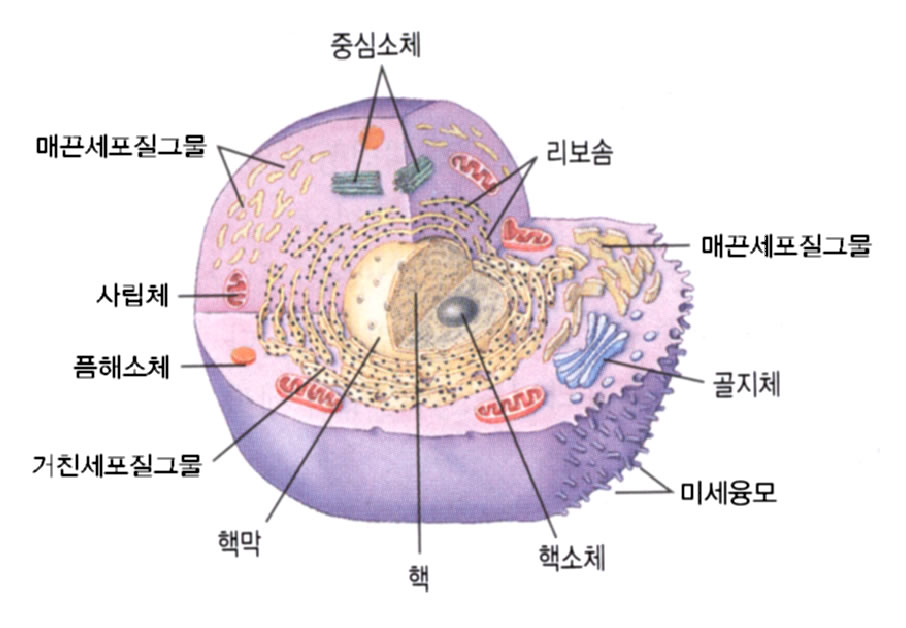 |
||
| HC | hair cell; hairy cell; handicapped; head circumference; head compression; health care; healthy contr... |
|---|---|
| MC | mass casualties; mast cell; Master of Surgery [Lat. Magister Chirurgiae]; maximum concentration; Med... |
| ACC | accommodation; acetyl coenzyme A carboxylase; acinic cell carcinoma; acute care center; adenoid cyst... |
| EMB | embryology; endomyocardial biopsy; engineering in medicine and biology; eosin-methylene blue; ethamb... |
| SEBM | Society of Experimental Biology and Medicine |
| IHC | Immuno-histochemistry |
|---|---|
| ISHH | In situ hybridisation histochemistry |
| ISH | In situ hybridization histochemistry |
| ACCESS | Access to Community Care and Effective Services and Support |
acute angle
| histochemistry | Study of the chemical composition of tissues by means of specific staining reactions. (18 Nov 1997) |
|---|---|
| cell biology | <study> The study of the internal workings of cells at the microscopic and molecular level - it is closely linked to molecular biology. (16 Dec 1997) |
| biology | <study> The scientific study of living organisms. (09 Oct 1997) |
| radiation biology | Field of science that studies the biological effects of ionizing radiation. (05 Mar 2000) |
| cellular biology | <study> The study of cells. Implies the use of light or electron microscopic methods for the study of morphology. (18 Nov 1997) |
| pharmaceutical biology | <pharmacology, study> A subfield of pharmacology which studies natural drugs, including the study of their biological and chemical components, botanical sources, and other characteristics (economic, biochemical, biological, etc.). (09 Oct 1997) |
| molecular biology | <study> The study of the biochemistry of cells, it is closely linked to cell biology, in particular the biochemistry of DNA and cogeners. (16 Dec 1997) |
| computational biology | A field of biology concerned with the development of techniques for the collection and manipulation of biological data, and the use of such data to make biological discoveries or predictions. This field encompasses all computational methods and theories applicable to molecular biology and areas of computer-based techniques for solving biological problems including manipulation of models and datasets. (12 Dec 1998) |
| structural biology | <study> The study of the three dimensional structures of biological molecules (such as proteins) and their mutual interactions as a means of understanding the functions of these molecules within the cell. (09 Oct 1997) |
| developmental biology | <study> The study of how a multicellular organism develops from its early immature forms (zygote, larva, embryo, etc.) into an adult. (09 Oct 1997) |
| oral biology | That aspect of biology devoted to the study of biological phenomena associated with the oral cavity in health and disease (e.g., dental caries, mastication, periodontal disease). (05 Mar 2000) |
| electro-biology | 1. <biology> That branch of biology which treats of the electrical phenomena of living organisms. 2. <physics> That phase of mesmerism or animal magnetism, the phenomena of which are supposed to be produced by a form of electricity. (03 Mar 1998) |
| european molecular biology lab gene bank | <molecular biology> A large database of DNA sequence data in Heidelberg, Germany, compiled from international sources. It is the European equivalent to the Genbank DNA sequence databank in the United States of America. WWW: EMbase. (09 Oct 1997) |
| b and t cell count | A test that measures the respective quantities of B lymphocytes and T lymphocytes. This test is often performed in the analysis of an immune deficiency disorder. Normal values include: 68 to 75% of total lymphocytes are T lymphocytes and 10 to 20% are B lymphocytes. Increased T-cell counts can indicate infectious mononucleosis, acute lymphocytic leukaemia or multiple myeloma. Increased B lymphocytes can indicate chronic lymphocytic leukaemia, multiple myeloma, Waldenstrom's macroglobulinaemia or Di George syndrome. Decreased T-cells may indicate congenital T-cell deficiency, Wiskott-Aldrich syndrome or AIDS. Decreased B-cells may indicate acute lymphocytic leukaemia or a congenital immunoglobulin deficiency disorder. (27 Sep 1997) |
| neoplasms, germ cell and embryonal | Neoplasms composed of primordial germ cells of embryonic gonads or of elements of the germ layers of the embryo. The concept does not refer to neoplasms located in the gonads or present in an embryo or foetus. (12 Dec 1998) |
제품명 |
판매사 |
보험코드 | 성분/함량 | 구분/보험급여 |
|---|
제품명 |
판매사 |
보험코드 | 성분/함량 | 구분/보험급여 |
|---|