
| 영문 | open heart surgery | 한글 | 개심술, 심장절개술 |
|---|---|---|---|
| 설명 | 심장의 한 개 또는 그 이상의 방실 절개하는 수술. 심방사이막결손증, 심실사이막결손증, 순수형 허파동맥판막협착증, 팔로(Fallot) 사징후 등이 적용이 된다. 이 수술을 위해서는 인공심폐장치가 필요하다. |
||
| 영문 | hypertensive heart disease | 한글 | 고혈압심장병 |
|---|---|---|---|
| 설명 | 고혈압에 의해서 생기는 심장병. 고혈압심장병이라는 진단을 붙이기 위해서는 최소한 다음과 같은 조건이 부합되어야 하는데, 첫째 심장혈관계에 심장병을 유발할 수 있을 만한 다른 병변이 없이 좌심실 비대가 있어야 하며, 둘째 고혈압을 앓았다는 병력이 있어야 한다. 주로 고혈압에 의한 심장병은 초기에는 좌심실이 비후라는 것으로 특징되어진다. 즉 혈압이 높으므로 혈액을 순환시키기 위해서는 그만큼 심장의 혈액을 보내는 힘이 좋아야 한다. 그 힘을 얻기위해서는 심근의 비후가 필요로 하여 좌심실 근육의 비후가 생긴다. 그리고 고혈압이 지속이 될 경우에는 결국 심장이 제 구실을 하지 못하고 펌프로서의 기능을 잃어버리게 되어 심장기능상실에 빠지게 된다. |
||
| 영문 | rheumatic heart disease | 한글 | 류마티스심장병 |
|---|---|---|---|
| 설명 | 사슬알균감염 후 생기는 심장판막병이다. 원인은 A군 -용혈사슬알에 의한 인두염후 일종의 면역반응으로 발병한다. 진단은 존의 기준에 의한다. (1) 주요기준은 관절염 심장염(심장비대, 심장잡음, 심장기능상실 등) 무도증: 무당이 춤을 추는 것 같은 행동의 발작증세. 연변홍반: 빨간 테두리를 가진 피부병변은 피하결절(subcutaneous nodule): 피부 밑에 생긴 결절, (2)참고 기준은 열, 관절통, EKG상 PR연장: 심전도 소견 급성기 반응물질(예: ESR, CRP)의 상승, 류마티스열 치료는 페니실린으로 치료하고 심장의 후유증 또한 페니실린으로 예방한다. |
||
| 영문 | congenital heart disease | 한글 | 선천심장병 |
|---|---|---|---|
| 설명 | 선천적으로 심장의 구조에 이상이 있는 병. |
||
| 영문 | heart | 한글 | 심장 |
|---|---|---|---|
| 설명 | 심장은 가슴의 중앙에 위치하며 오른쪽과 왼쪽반으로 나눌 수 있다. 각각은 정맥에서 피가 들어오는 방과 동맥으로 피를 내보내는 실이 있다. 심장은 정중앙선에서 왼쪽에 놓여 있다. 심장의 2개의 심방과 2개의 심실, 그리고 심방사이의 심방중격, 심실사이의 심실중격이 존재한다. 심실은 혈액을 주로 순환시키는 힘을 내는 곳으로 강한 근육층이 존재를 한다. 반면에 심방은 심실에 들어가기전에 일시적으로 피가 모이는 곳으로 근육층의 발달이 미약하다. 심방과 심실사이에 삼첨판과 승모판, 심실의 유출로에 대동맥판과 폐동맥판이 있다. 이것들은 혈액이 흐르는 방향에 거슬러 진행하는 것을 막는 기능을 한다. 그리고 심장에는 심장의 근육에 혈액을 공급하는 관상동맥이 있다. 이 심장동맥은 심장을 쌓듯이 존재한다. 심장박동의 신호는 특수한 장치에 의해서 발생이 되고 특수한 전도계를 통해서 전체의 심장으로 전도된다. 심장박동의 신호는 우선 우심방에 위치하는 동방결절(SA node)라는 곳에서 우선 생긴다. 여기에서 보내는 전기적 신호가 바로 심장을 뛰게하는 신호인 것이다. 이 신호로 말미암아 심방이 우선 수축을 한다. 그리고는 심방과 심실사이에 위치하는 방실결절(AV node)라는 곳에 일정하게 정해진 통로없이 전체의 심방을 통해서 전달이 되고 이 신호를 받은 방실결절(AV node)는 히스 다발(His bundle)과 심장전도근육섬유를 통해서 심실의 심장근육에게 이 신호를 보내주어 심실근육을 수축하게 한다. 히스다발과 심장전도근육섬유는 전체의 심실의 심근섬유에 동시에 전기적 신호를 보내어 줄 수 있게 하는 일종의 전기줄과 같은 역할을 한다. 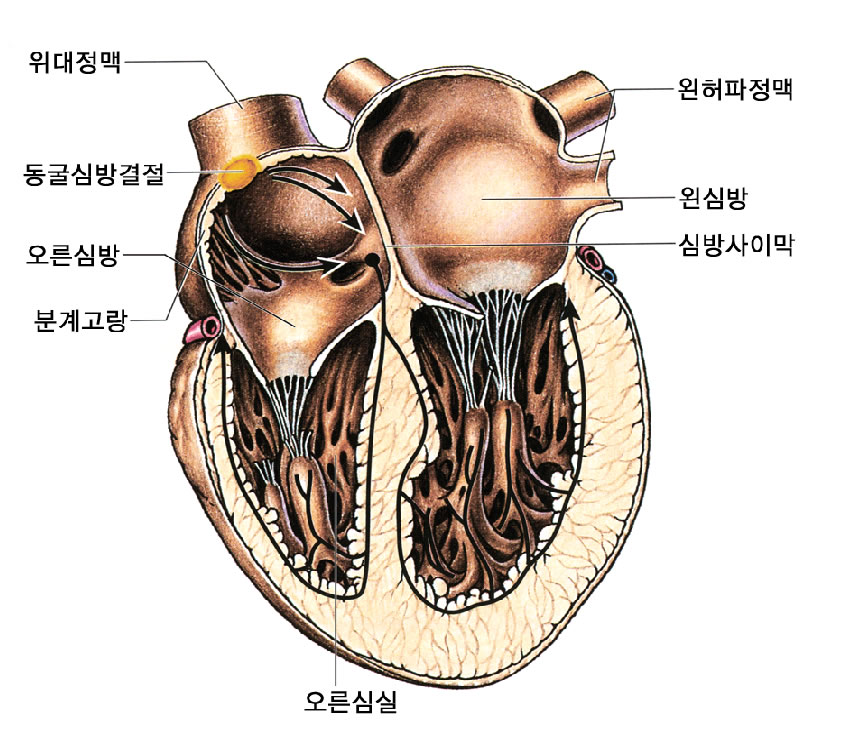 |
||
| ECG | Electro-Cardio-Graphy(-Gram); 심전도 = EKG 1. Conducting System Structu... |
|---|---|
| LH | late healing; lateral hypothalamic [syndrome]; left hand; left heart; left hemisphere; left hyperpho... |
| LHS | left hand side; left heart strain; left heelstrike; lymphatic/hematopoietic system |
| IHD | Ischemic Heart Disease = Coronary Heart(Artery) Disease = Atheroscler... |
| JVP | [POMD P 49 - 52] 1) Jugular Vein Pressure 2) Jugular Venous Pulse ... |
| HLHS | Hypoplastic left heart syndrome |
|---|---|
| LHB | Left heart bypass |
| ACC-AHA | American College of Cardiology - American Heart Association |
| AHA | American Heart Association |
| AH | Artificial heart |
| heart bypass, left | Diversion of the flow of blood from the pulmonary veins directly to the aorta, avoiding the left atrium and the left ventricle. This is a temporary procedure usually performed to assist other surgical procedures. (12 Dec 1998) |
|---|---|
| hypoplastic left heart syndrome | <syndrome> Underdevelopment of the left side of the heart characterised by: aortic valve atresia, hypoplastic ascending aorta, hypoplastic/atretic mitral valve, endocardial fibroelastosis most common cause of congestive heart failure in neonate, 25% of cardiac deaths in 1st week of life, prognosis: 100% fatal by 6 weeks haemodynamics: pulmonary venous return is diverted from LA to RA through atrial septal defect, RV supplies pulmonary artery, ductus arteriosus, descending aorta (antegrade flow), aortic arch, ascending aorta, coronary circulation (retrograde flow), leads to RV work overload and congestive heart failure Treatment: Norwood procedure (palliative), transplant (12 Dec 1998) |
| left heart | The left atrium and left ventricle. (05 Mar 2000) |
| left heart bypass | Any procedure that shunts blood returning from the pulmonary circulation to the systemic circulation without passing through the left heart. This is utilised during some cardiac surgery and experimentally during severe left heart failure or cardiogenic shock. (05 Mar 2000) |
| left-sided heart failure | Inability of the left heart to maintain its circulatory load with corresponding rise in pressure in the pulmonary circulation usually with pulmonary congestion and ultimately pulmonary oedema. (05 Mar 2000) |
| aortico-left ventricular tunnel | Congenital connection between the aorta above exit of coronary arteries and the left ventricle. (05 Mar 2000) |
| apicoposterior branch of left superior pulmonary vein | <anatomy, vein> Drains apicoposterior bronchopulmonary segment of superior lobe of left lung. Synonym: ramus apicoposterior venae pulmonalis sinistrae superioris. (05 Mar 2000) |
| atrial function, left | The haemodynamic and electrophysiological action of the left atrium. (12 Dec 1998) |
| auricle of left atrium | The small conical projection from the left atrium of the heart. Synonym: auricula sinistra, left auricular appendage. (05 Mar 2000) |
| bilateral left-sidedness | A syndrome in which normally unpaired organs develop more symmetrically in mirror image; two spleens, one on each side, are usually present, and cardiovascular anomalies are common. Synonym: polysplenia syndrome. (05 Mar 2000) |
| cardiac notch of left lung | The notch in the anterior border of the superior lobe of the left lung which accommodates the pericardium. Synonym: incisura cardiaca pulmonis sinistri. (05 Mar 2000) |
| ventricular dysfunction, left | A condition in which the left ventricle of the heart exhibits a decreased functionality. This decreased function could lead to congestive heart failure or myocardial infarction, among other cardiovascular diseases. Diagnostic measurements that indicate this condition include a diminished ejection fraction and a depressed level of motility of the left ventricular wall. (12 Dec 1998) |
| ventricular function, left | The haemodynamic and electrophysiological action of the left ventricle. Its measurement is an important aspect of the clinical evaluation of patients with heart disease to determine the effects of the disease on cardiac performance. (12 Dec 1998) |
| right or left lateral decubitus film | A radiograph exposed with the subject in the decubitus position; named for the side that is dependent. Synonym: right or left lateral decubitus film. (05 Mar 2000) |
| right-to-left shunt | The passage of blood from the right side of the heart into the left (as through a septal defect), or from the pulmonary artery into the aorta (as through a patent ductus arteriosus); such a shunt can occur only when the pressure on the right side exceeds that in the left, as in advanced pulmonic stenosis, or when the pulmonary artery pressure exceeds aortic pressure, as in one form of Eisenmenger's syndrome or in tricuspid atresia. (05 Mar 2000) |
제품명 |
판매사 |
보험코드 | 성분/함량 | 구분/보험급여 |
|---|
제품명 |
판매사 |
보험코드 | 성분/함량 | 구분/보험급여 |
|---|