
| 영문 | ovulation cycle | 한글 | 배란주기 |
|---|---|---|---|
| 설명 | 사춘기가 되어 난소가 뇌하수체전엽으로부터의 생식샘자극호르몬의 작용을 받아 원시난포가 발육하고 성숙난포가 된다. 결국에는 난포벽이 파열되어 과립막세포로 둘러싸인 난자가 복강내로 배출된다(배란). 배란 후 24~96시간으로 과립막세포가 비대증식해서 황체를 형성한다. 수정되지 않은 경우 월경황체는 약 10일간 존속하고 퇴행변성해서 백체가 된다. 황체가 퇴행변성하면 다음의 난포가 성숙한다. 난소에서는 이 주기가 반복되고 있다. |
||
| 영문 | muscle cell(=muscle fiber) | 한글 | 근육세포 |
|---|---|---|---|
| 설명 | 근육은 수의근(의식에 의해서 조절이 가능한 근육: 예를 들어 다리, 팔, 얼굴근육 등)과 불수의근(의식과 무관하게 조절하지 않아도 움직이는 근육: 예를 들어 심장근, 소화기관에 분포하는 근육 등)으로 나누어지며, 근육세포의 모양은 다음과 같다(수의근, 불수의근 외에 심장에 있는 심장근은 불수의근에 해당하지만 그 모양은 수의근과 같아 따로 분류한다).  |
||
| 영문 | white blood cell(WBC), leukocyte | 한글 | 백혈구 |
|---|---|---|---|
| 설명 | 혈액내에 골수구계세포와 림프계세포, 단핵구계세포를 모두 통틀어 말한다. 백혈구의 증가가 있으면 대개 감염이 있거나, 혹은 탈수현상이 있음을 의미한다. 또한 지나친 백혈구수의 감소는 인체내 면역기능이 떨어져 있음을 의미하며, 다른 질병에 의해 나타나는 이차적인 현상이 아닌지 꼭 진단을 받아보아야 한다. |
||
| 영문 | mast cell | 한글 | 비만 세포 |
|---|---|---|---|
| 설명 | 동물의 결합 조직 가운데 널리 분포하는 세포. 결합조직과 점막조직 내에 있는 호염기성 색소로 이염색성(metachromasia)을 나타내는 과립을 가진 방추형의 세포에 작은 둥근 핵을 가진다. 비만세포의 표면에는 IgE에 대한 수용체가 존재하며, 수용체에 결합한 IgE 분자들끼리 다가의 항원에 의해 서로 연결되면 비만세포 과립탈출 반응이 일어나, 히스타민, 세로토닌, 헤파린 등의 화학전달 물질이 방출되어, 즉시형 알레르기 반응 등의 증상을 일으킨다. 피부, 장막, 혈관 주위, 점막 주변에 있다. |
||
| 영문 | cell | 한글 | 세포 |
|---|---|---|---|
| 설명 | 생명체를 이루는 구조적, 기능적 단위. 핵의 유무에 따라서 유핵세포와 무핵세포로 나눌 수가 있다. 무핵세포란 핵이 없는 세포를 말한다. 핵이란 유전정보를 가지고 있는 염색체를 보관하는 곳인데 무핵세포에서는 염색체가 세포속에 그냥 노출되어 있다. 대개 세포 하나하나가 독립된 생명체의 역할을 하는 단세포생물로서 외부환경으로부터 자신을 보호할 수 있는 견고한 세포벽을 가지고 있다. 유핵세포란 핵을 가지고 있어서 유전정보가 있는 염색체가 세포의 다른 부분과 구분되어 핵속에 들어있다. 세포속에서 핵외의 부분(이를 세포질이라 한다)에는 여러 가지 세포의 소기관이 있어서 세포의 다양한 기능을 분담한다. ◈유핵세포의 기본 구조 1.세포막-세포를 둘러싸서 주위환경과 분리하여 세포의 내환경을 유지한다. 2.형질내세망(endoplasmic reticulum)-단위막으로 둘러쌓여 있는 불규칙한 망상구조이다. 이 망상구조의 내부를 소강, 소조라고 부른다. 여기에는 표면이 매끈한 무과립형질내세망과 표면이 불규칙한 과립형질내세망의 두 가지가 있다. 과립형질내세망의 경우는 표면에 단백질을 합성하는 리보솜이라는 것이 부착되어 있다. 이곳은 주로 세포밖으로 분비할 단백질을 합성하는 장소이다. 무과립형질내세망은 표면에 리보솜이 부착되어 있지 않은 것을 말하며, 이곳에서는 주로 해독작용, 글리코겐의 합성, 스테로이드호르몬의 합성 등이 일어난다. 3.리보솜-단백질을 합성하는 역할을 하는 곳이다.이것은 세포질에 존재하는 자유리보솜과 과립형질내세망에 부착이 되어 존재하는 부착리보솜의 두 가지로 나눈다. 자유리보솜은 주로 세포내에서 필요한 단백질을 만드는 역할을 하고 부착리보솜은 세포밖으로 분비할 단백질을 만드는 역할을 한다. 4.골지장치(Golgi apparatus)-핵주위에 분포하는 납작해진 주머니모양의 것이 중첩되어 형성된 층판 모양의 구조물로 과립형질내세망에서 생성되어 외부로 분비될 단백질을 모아서 농축, 포장하여 과립을 만드는 역할을 한다. 5.사립체(mitochondria)-구형, 난형의 긴 막대기 모양으로 크기가 다양한 구조물. 생물체의 에너지 저장물질인 ATP를 생산하는 역할을 한다. 또 세포와 다른 자신만의 유전정보를 가진 DNA, RNA를 가지고 있다. 모양, 크기가 세균과 비슷하며 자체증식성 등 독립된 생명체로서 필요한 요건을 갖추고 있어서 세포와 공생관계를 가진 독립된 세포로 생각하고 있다. 6.용해소체(lysosome)-작은 구형의 소체로 여러 가지 분해효소를 가진다. 세포외계에서 들어온 물질과 결합하여 그 물질들을 용해하는 역할을 하고, 오래된 세포소기관들을 제거하는 역할도 한다. 7.세포핵(nucleus)-구형, 난형으로 세포의 중심에 위치한다. 핵내에는 유전정보가 있는 물질인 염색체가 존재한다. 8.중심소체(centrosome)-핵주위에 존재하면서 핵의 분열시에 양쪽의 염색체를 당기는 작은 섬유를 만드는 역할을 하는 곳. 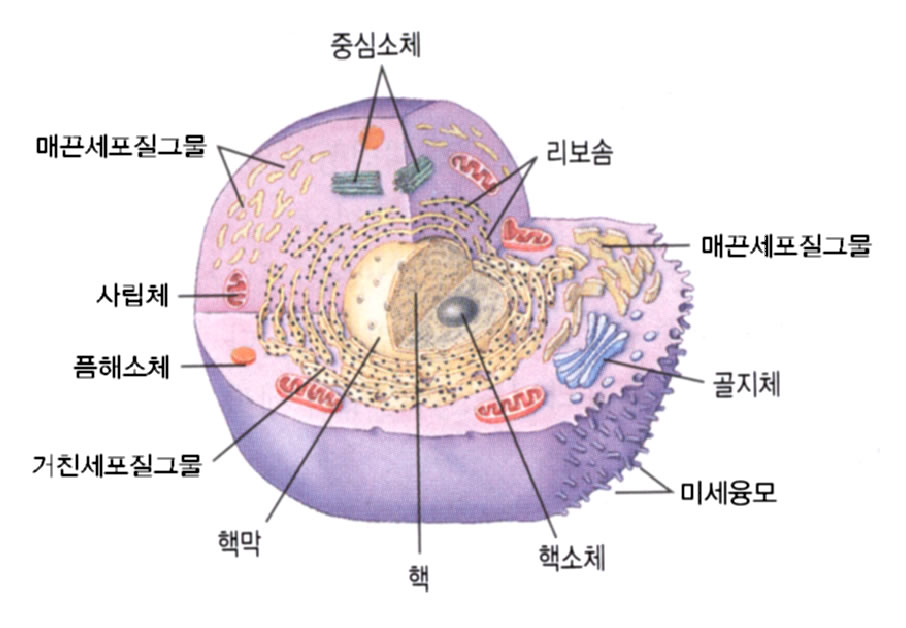 |
||
| MC | mass casualties; mast cell; Master of Surgery [Lat. Magister Chirurgiae]; maximum concentration; Med... |
|---|---|
| PC | avoirdupois weight [Lat. pondus civile]; packed cells; paper chromatography; paracortex; parent cell... |
| FLC | family life cycle; fatty liver cell; fetal liver cell; Friend leukemia cell |
| CDC | calculated date of confinement; cancer diagnosis center; capillary diffusion capacity; cell division... |
| LCC | lactose coliform count; left circumflex coronary (artery); left common carotid; left coronary cusp; ... |
| cdc | Cell division cycle |
|---|---|
| CDC2 | cell division cycle 2 |
| cpd | 1-cycle-per-degree |
| cpm | cycle per minute |
| BRAC | BASIC REST ACTIVITY CYCLE |
| cell cycle | <cell biology, molecular biology> The sequence of events between mitotic divisions. The cycle is conventionally divided into G0, G1, (G standing for gap), S (synthesis phase during which the DNA is replicated), G2 and M (mitosis). Cells that will not divide again are considered to be in G0 and the transition from G0 to G1 is thought to commit the cell to completing the cycle and dividing. (26 Mar 1998) |
|---|---|
| cell cycle proteins | Proteins that control the cell division cycle. This family of proteins includes a wide variety of classes, including cyclin-dependent kinases, mitogen-activated kinases, cyclins, and phosphoprotein phosphatases (phosphoprotein phosphatase) as well as their putative substrates such as chromatin-associated proteins, cytoskeletal proteins, and transcription factors. (12 Dec 1998) |
| cell cycle restriction point | <cell biology, molecular biology> A point, late in G1, after which the cell must, normally, proceed through to division at its standard rate. (26 Mar 1998) |
| cell division cycle gene | Genes which control the yeast cell cycle. There are around 50 different genes which do this. (09 Oct 1997) |
| cell division cycle mutant | A yeast cell which has cell division cycle genes that have mutated to become sensitive to temperature, at certain temperatures (usually high ones), various parts of the normal yeast cell cycle become abnormal, and in some strains the yeast cell does not survive at all. (09 Oct 1997) |
| anovulatory cycle | A sexual cycle in which no ovum is discharged. (05 Mar 2000) |
| Born-Haber cycle | <physics> This is a mathematical description of the relationship between the electron affinity, heats of atomisation, ionisation energy and lattice energy of ionic compounds. (09 Oct 1997) |
| bottoming cycle | A cogeneration system in which steam is used first for process heat and then for electric power production. (05 Dec 1998) |
| brain wave cycle | The complete upward and downward excursion of a single wave, complex, or impulse as seen on an electroencephalogram. (05 Mar 2000) |
| c3 cycle | <biochemistry> The part of the photosynthesis process where carbon dioxide is converted into three-carbon compounds, which can then be turned into six-carbon sugars. (07 Nov 1997) |
| c4 cycle | <plant biology> An alternative, very efficient pathway used by plants living in areas with low levels of carbon dioxide, to convert carbon dioxide into a form usable by the plants during photosynthesis. (09 Oct 1997) |
| Calvin Benson cycle | <biochemistry, plant biology> Metabolic pathway responsible for photosynthetic carbon dioxide fixation in plants and bacteria. The enzyme that fixes carbon dioxide is RuDP carboxylase. The cycle is the only photosynthetic pathway in C3 plants and the secondary pathway in C4 plants. The enzymes of the pathway are present in the stroma of the chloroplast. (18 Nov 1997) |
| calvin cycle | In plants, a cyclical series of carbon-fixing, sugar-producing reactions in the chloroplasts. Some of the sugars (triose phosphates) are recycled, others are stored as carbohydrates. Light is not needed for these reactions, they use the carbon dioxide and energy produced in the light reactions of photosynthesis. (09 Oct 1997) |
| carbon dioxide cycle | First, an organism which can photosynthesise (such as a plant or some bacteria) will absorb carbon dioxide (CO2) from the air and incorporate it into its body or turn it into organic matter. Then, other organisms which cannot photosynthesise will eat the organic matter, or the photosynthesising organism, and release carbon dioxide gas as a waste product back into the air. (09 Oct 1997) |
| cardiac cycle | The complete round of cardiac systole and diastole with the intervals between, or commencing with, any event in the heart's action to the moment when that same event is repeated. (05 Mar 2000) |
제품명 |
판매사 |
보험코드 | 성분/함량 | 구분/보험급여 |
|---|
제품명 |
판매사 |
보험코드 | 성분/함량 | 구분/보험급여 |
|---|